
PLB-120 · Lesson 10 of 12 · 25 min
Indirect waste, interceptors, sumps and ejectors
The lower parking level of Kingsway Tower was where the drainage system stopped being simple. Maya counted three kinds of equipment that never appear in a suite: a long concrete oil interceptor under the drive aisle, a duplex pump package in a pit by the elevator room, and a row of funnel-shaped receptors in the mechanical room catching water from relief valves, condensate lines and a water softener. Luis said these are the places where plumbers protect the drainage system from the building, and the building from the drainage system. A wrong connection here can poison a food service, flood a garage or send gasoline into the city sewer.
This lesson covers indirect waste and the air gaps and air breaks that make it work, interceptors for grease, oil and other substances, sumps and pumps for clear water, sewage ejectors for waste that cannot drain by gravity, and how pumped discharges connect to the gravity system.
Indirect waste
Most fixtures connect directly to the drainage system through a trap. Some equipment must not. If a drain from a food-handling fixture, an ice machine or a sterilizer were connected directly, a blockage or surcharge in the drain could back sewage up into the equipment and contaminate food, ice or medical instruments. Instead, these drains discharge indirectly: the pipe from the equipment ends above a separate, trapped receptor, with open air between the end of the pipe and the receptor, so that sewage can never flow back into the equipment.
Indirect waste is required or used for a range of equipment, depending on the code:
- Food storage, preparation and dishwashing equipment in commercial kitchens, such as refrigerated display cases, steam tables and some sinks.
- Ice machines and ice storage bins.
- Sterilizers and some medical and laboratory equipment.
- Clear-water wastes: relief valve discharges, boiler and water heater drains, air conditioning condensate, water softener and filter backwash, fire sprinkler test drains and cooling equipment.
- Drinking fountains and some beverage equipment, where the code calls for it.
Codes also set what may and may not discharge indirectly. The IPC and the Ohio Plumbing Code list the equipment that requires indirect waste and the receptors that may receive it, and they treat clothes washer standpipes and boxes as direct, trapped connections.
Air gaps and air breaks
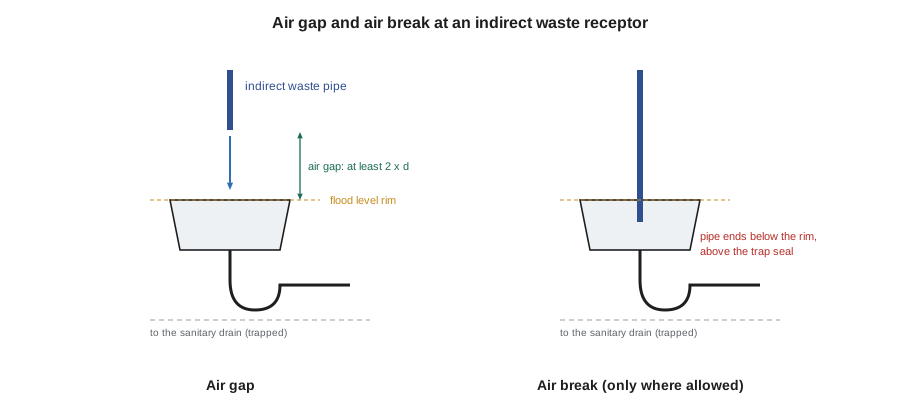
An air gap is the unobstructed vertical distance between the lowest opening of the indirect waste pipe and the flood level rim of the receptor below it. Because there is open air all the way around and nothing touches, sewage rising in the receptor overflows onto the floor before it can reach the pipe. Codes require an air gap of at least twice the diameter of the indirect waste pipe, with a minimum distance, for equipment where contamination would be most serious, such as food and medical equipment.
An air break is a less strict arrangement: the indirect waste pipe ends below the flood level rim of the receptor but above its trap seal, so the pipe is not connected to the drain but is inside the receptor. If the receptor backs up, the waste could reach the pipe, so air breaks are allowed only where the code permits them, typically for clear-water wastes where a backup would not create a health hazard.
Worked problem
Checking an air gap
A 1-inch indirect waste line from an ice machine discharges into a floor sink. How high above the floor sink's flood level rim must the end of the pipe be, if the code requires twice the diameter with a minimum of 1 inch?
Show solution
- Twice the diameter: \(2 \times 1 = 2\) in.
- Compare with the minimum of 1 in: 2 in is larger, so 2 in governs.
- The end of the pipe must be at least 2 inches above the flood level rim, with nothing in the gap.
Answer: At least 2 inches.
Indirect waste receptors
The receptor that receives indirect waste can be a floor sink, a hub drain, a standpipe or a laundry tray, depending on the flow and the code. Receptors are fixtures in their own right: they must be trapped, vented as the code requires, large enough for the flow they receive without splashing or overflowing, and in an accessible, ventilated location where they can be seen and cleaned. Codes generally prohibit indirect waste receptors in toilet rooms, closets and other places where they would be hidden or where splashing would be a nuisance.
In Kingsway's mechanical room, the receptors are floor sinks with half-grates. The boiler relief valves, the water softener backwash, the domestic water booster pump drain and the air handling unit condensate lines all discharge into them through air gaps. Maya noticed that each pipe was labeled at the receptor, so that a maintenance worker who sees water running can tell which piece of equipment it came from.
Why interceptors exist
Some substances must not enter the drainage system at all, or only in small amounts. Grease solidifies in pipes and sewers and causes blockages. Oil and gasoline are fire and explosion hazards and pollute the sewage treatment process. Sand and grit settle out and fill drains. Lint, hair, plaster and solids from manufacturing processes all cause blockages or damage. An interceptor is a device that separates these substances from the waste water and holds them until they are removed, letting the water continue to the drain.
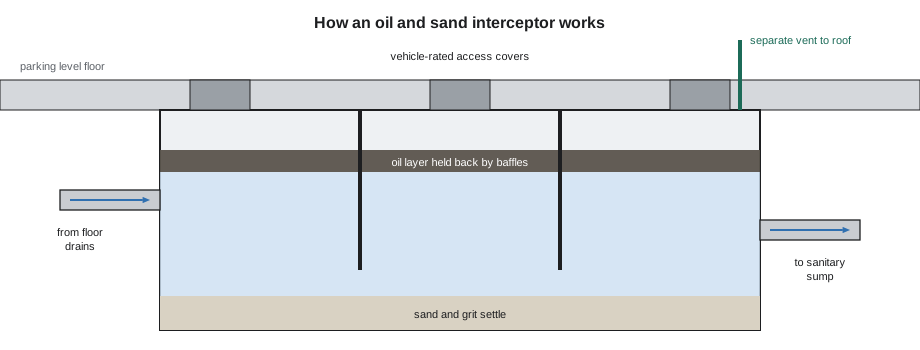
Interceptors work mainly by slowing the flow so that substances lighter than water float and those heavier sink. Baffles hold back the floating layer, and the clearer water leaves from the middle depth. Because they hold the separated material, interceptors must be cleaned regularly, and they must be accessible for that. An interceptor that is never pumped out stops intercepting.
Grease interceptors
Commercial kitchens produce fats, oils and grease from cooking and dishwashing. Codes require fixtures that discharge grease, such as pot sinks, pre-rinse sinks, floor drains in cooking areas and wok stations, to drain through a grease interceptor or grease removal device before connecting to the building drain. Small units sit under or near the sinks; large gravity interceptors are concrete or fiberglass tanks in the ground outside the building.
In the United States, grease interceptors are generally required to meet the applicable ASME or PDI standard for hydromechanical interceptors, or the gravity interceptor requirements of the code, and are sized by flow rate or volume. Local sewer-use ordinances, such as those in Columbus, often add their own requirements for grease interceptor sizing, maintenance and records.
The ground floor commercial space on Kingsway is roughed in for a future café. The engineer has shown a capped grease waste line from that space to a location where a grease interceptor can be added when a tenant moves in, so that kitchen waste never has to be connected to the residential stacks.
Worked problem
Sizing a small grease interceptor by flow
A three-compartment pot sink has compartments of 20 in by 20 in by 12 in deep. A common sizing method assumes the sink is filled to 75 percent and drains in one minute. What flow rate should the interceptor handle?
Show solution
- Volume of one compartment: \(20 \times 20 \times 12 = 4800\) in³; at 231 in³ per gallon, about 20.8 gal.
- Three compartments: \(3 \times 20.8 \approx 62.3\) gal.
- At 75 percent full: \(0.75 \times 62.3 \approx 46.8\) gal.
- Draining in one minute: about 47 gpm; choose the next standard interceptor size at or above this flow, such as 50 gpm.
Answer: About 47 gpm; the interceptor must be rated for at least that flow.
This is the kind of sizing an engineer or a supplier usually does, and local rules may require a different method or a larger unit. The point is that interceptors are sized for the flow that reaches them, and an undersized interceptor lets grease straight through.
Oil, sand and other interceptors
Parking garages, vehicle repair shops and car washes produce water contaminated with oil, gasoline and grit. Codes and sewer-use bylaws require floor drains in these areas to discharge through an oil interceptor, also called an oil and sand interceptor, that separates the oil and settles the sand before the water reaches the sewer. Because gasoline vapor can collect in an oil interceptor, these interceptors are vented to the outdoors separately and are often required to have specific covers and access.
On Kingsway, the floor drains in both parking levels drain to a long oil interceptor under the drive aisle of the lower level. Its covers are flush with the slab and rated for vehicle loads, and its vent runs up to the roof on its own. The interceptor outlet goes to the sanitary sump, because it is too low to drain to the building drain by gravity.
Other interceptors include lint interceptors for laundromats and commercial laundries, hair interceptors for salons, plaster traps for dental offices and art studios, and solids interceptors for some manufacturing processes. Each has its own standard and sizing method, and all need regular cleaning.
Sumps and sump pumps
Water that collects below the level of the gravity drainage system must be pumped up. A sump is a pit that collects clear water, such as groundwater from foundation drains or water from floor drains that carry no sewage, and a sump pump lifts it to a point where it can drain by gravity. Sump discharges usually go to the storm system or to grade, depending on the code and the city's rules; in Kingsway's case, the lower level's foundation drains go to a storm sump, while the oil interceptor outlet and other lower-level sanitary drains go to a separate sanitary sump.
Pumps are sized for the inflow they must handle, with a pit large enough that the pump does not start and stop too often. A pump that cycles every few seconds wears out quickly; one that runs too long between starts may let water rise too high. Duplex pump packages, with two pumps that alternate and a high-level alarm, give backup if one pump fails, which matters in a parking garage where a failed pump floods the lowest level.
Sewage ejectors
A sewage ejector is a pump and sealed pit that handles waste containing solids, from fixtures below the building drain, such as a basement washroom. Because the pit holds sewage, it must be gas-tight with a sealed cover, vented to the outdoors like any other part of the drainage system, and fitted with a pump that can pass solids of the size the code requires.
The discharge from a sump pump or sewage ejector needs a check valve to stop the water in the discharge pipe running back into the pit when the pump stops, and a full-port shut-off valve downstream of the check valve so the pump can be serviced. The discharge pipe must be sized to give enough velocity to carry solids without being so small that friction overloads the pump.
Pumped discharges must connect to the gravity system correctly. They generally connect to the top of a horizontal building drain or branch through a wye, not into the base of a stack or directly into a fitting where the pumped flow could disturb traps or back up the drain. Their flow is added to the building drain load as a continuous flow, as lesson 3 described.
# Sump sizing check: time to fill the pit between pump-off and pump-on levels, and run time
import math

pit_diameter_ft = 3.0
working_depth_ft = 1.0          # between pump-off and pump-on levels
inflow_gpm = 8                  # water entering the pit
pump_gpm = 30                   # pump capacity at the system head

volume_gal = math.pi / 4 * pit_diameter_ft ** 2 * working_depth_ft * 7.48
fill_min = volume_gal / inflow_gpm
run_min = volume_gal / (pump_gpm - inflow_gpm)
cycle_min = fill_min + run_min
print(f"working volume {volume_gal:5.1f} gal")
print(f"fills in {fill_min:4.1f} min, pump runs {run_min:4.1f} min, one cycle every {cycle_min:4.1f} min")
print(f"starts per hour: {60 / cycle_min:4.1f}")working volume 52.9 gal fills in 6.6 min, pump runs 2.4 min, one cycle every 9.0 min starts per hour: 6.7
Pump manufacturers give a maximum number of starts per hour for each motor. If the calculation shows too many starts, the fix is a larger working volume, either a bigger pit or a greater distance between the on and off levels, not a bigger pump.
Common mistakes
MistakeConnecting an ice machine or food equipment drain directly to the drainage system.
InsteadDischarge it indirectly through an air gap to a trapped receptor.
MistakeEnding an indirect waste pipe inside a floor sink where the code requires an air gap.
InsteadKeep the opening at least twice the pipe diameter above the flood level rim.
MistakeLetting a grease interceptor go uncleaned.
InsteadArrange regular cleaning and keep records; a full interceptor passes grease straight through.
MistakeVenting an oil interceptor into the building's sanitary vents where the code requires a separate vent.
InsteadVent it separately to the outdoors as the code requires.
MistakeConnecting a pumped discharge into the base of a stack.
InsteadConnect it to the top of a horizontal drain through a wye, with a check valve and shut-off on the discharge.
Summary and key terms
- Indirect waste protects food, ice and medical equipment by ending the drain above a trapped receptor.
- An air gap is at least twice the pipe diameter above the flood level rim; an air break is allowed only where the code permits.
- Receptors are trapped, vented, accessible fixtures sized for the flow they receive.
- Interceptors separate grease, oil, sand, lint and other substances; they must be sized for the flow and cleaned regularly.
- Sumps lift clear water and sewage ejectors lift waste with solids; ejector pits are sealed and vented.
- Pumped discharges need check and shut-off valves, adequate velocity and a proper connection to a horizontal drain.
- Indirect waste pipe
- A drain from equipment that discharges through an air gap or air break into a separate trapped receptor.
- Air gap
- The unobstructed vertical distance between the end of a pipe and the flood level rim of the receptor below it.
- Air break
- An arrangement where a waste pipe ends inside a receptor below its flood level rim but above its trap seal.
- Interceptor
- A device that separates and holds substances such as grease, oil or sand while letting waste water pass.
- Sump
- A pit that collects water below the level of the gravity drainage system so it can be pumped out.
- Sewage ejector
- A sealed, vented pit and pump that lifts waste containing solids to the gravity drainage system.
Practice problems
Work each problem on paper first, then reveal the answer to check.
Why must an ice machine drain discharge indirectly?
Show answer
So that a blockage or backup in the drain cannot contaminate the ice.
A 1-1/4 inch indirect waste pipe needs an air gap of twice its diameter. How large is the gap?
Show answer
At least 2-1/2 inches.
What is the difference between an air gap and an air break?
Show answer
In an air gap the pipe ends above the receptor's flood level rim; in an air break it ends inside the receptor, below the rim but above the trap seal.
Why do parking garage floor drains go through an oil interceptor?
Show answer
To separate oil, gasoline and grit before the water reaches the sewer.
Which two valves are needed on a sewage ejector discharge?
Show answer
A check valve and a full-port shut-off valve downstream of it.
A sump pump starts too often. What is the usual fix?
Show answer
Increase the working volume of the pit, not the pump size.
Lesson quiz · 5 questions
Score 60% or more to complete this lesson.
Create a free account to save your progress, take quizzes and earn a certificate.