
PLB-110 · Lesson 8 of 12 · 22 min
Threaded, grooved and mechanical joints
In the booster pump room on Kingsway Tower, Maya spent a day with Raj, a second-year apprentice, cutting and threading short lengths of steel pipe for the pump bypass and the drain connections. Raj showed her how to clamp the pipe in a tripod vise, feed the die head square, keep the cutting oil flowing and count the threads. By the end of the day she could cut a clean thread, but her first nipple leaked on the air test because she had wrapped the tape the wrong way. Luis said that was the cheapest lesson she would ever learn about threads: on a test bench, not behind a finished ceiling.
This lesson covers the joints that do not use heat or solvents: tapered pipe threads, grooved couplings, flanges, unions, and the compression, flare and transition fittings used throughout plumbing. Each has its own rules for preparation and tightening.
How tapered pipe threads seal
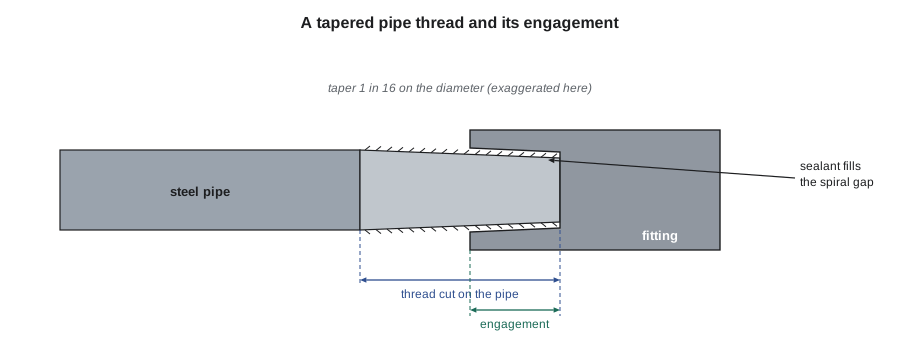
Plumbing and gas piping in North America use tapered pipe threads, usually called NPT (National Pipe Taper). The thread is cut on a slight cone, so the diameter grows along the length of the thread. When a male thread is screwed into a female thread, the two tapers wedge together, and the threads deform slightly to make a tight joint. A sealant fills the small spiral gap left at the crest and root of the threads.
The taper is 1 in 16 on the diameter: the diameter changes by \(\tfrac{1}{16}\) inch for every inch of length, which is \(\tfrac{3}{4}\) inch per foot. Each pipe size has a standard number of threads per inch: 27 for 1/8-inch pipe, 18 for 1/4 and 3/8, 14 for 1/2 and 3/4, and 11-1/2 for sizes from 1 inch to 2 inches. Because of the taper, only part of a cut thread actually screws into the fitting; that length is called the thread engagement or make-up.
Tapered threads are different from straight threads such as those on garden hose fittings, fixture tailpieces and many valve bodies, which do not seal on the threads at all but on a washer, gasket or O-ring. Mixing a tapered thread with a straight thread is a common cause of leaks. In countries using British standard pipe threads, the thread angle and pitch differ again, so imported fittings need checking.
Cutting threads on steel pipe
Threads are cut with a die: a set of hardened cutting chasers held in a die head. Small jobs use a manual ratchet threader; larger and repetitive work uses a powered threading machine or a power drive. The steps are:
- Cut the pipe square with a pipe cutter or saw, and clamp it securely in a pipe vise or the machine's chuck.
- Ream the inside of the pipe to remove the burr from cutting, which restricts flow.
- Start the die square on the pipe end, apply cutting oil generously, and turn the die steadily. Back off slightly now and then to clear chips if using a manual threader. Cutting oil cools the chasers, gives a clean thread and protects the dies; threading dry ruins both.
- Stop when the pipe end is flush with the end of the die chasers, or as the die manufacturer specifies; this cuts the right thread length for the size.
- Back the die off, wipe away oil and chips, and check the thread with a thread gauge or by hand-threading a fitting. A good thread is clean, full and even, with no torn or flattened crests.
Threading machines are powerful. Long hair, loose clothing, gloves near the rotating chuck and reaching across the machine are classic causes of serious injury. Use a foot switch so the machine stops when you step off, support long pipe on stands, and follow the machine's safety rules. Cutting oil and chips are slippery and sharp; clean them up.
Sealants and making up a threaded joint
Two kinds of thread sealant are common. Pipe joint compound (pipe dope) is a paste brushed onto the male threads. PTFE thread seal tape is wrapped around the male threads. Both must be suitable for the system: potable water sealants must be certified for drinking water, gas sealants must be rated for gas (yellow tape is commonly used for gas so it can be identified), and some sealants must not be used on plastics such as CPVC. Many plumbers use both tape and compound on critical joints, where the manufacturer allows.
Tape must be wrapped in the direction the threads turn as the fitting is screwed on, which is clockwise when looking at the end of the pipe. Wrapped the other way, the tape unwinds and bunches as the fitting goes on, and the joint leaks, as Maya found. Two to four wraps are typical, starting one thread back from the end so tape does not get into the pipe.
Making up a threaded joint means screwing the fitting on hand-tight and then tightening it with a pipe wrench a further number of turns, typically two to three turns for small sizes, until it is snug and aligned. Over-tightening can split a fitting, especially cast or plastic female fittings, and backing a fitting off to align it after tightening breaks the seal. If a fitting must be turned to align it, it should be turned further on, not back.
Pipe wrenches grip by biting into the pipe. Use the right size, keep the jaw pointing in the direction of the turn, and use a second wrench on the fitting or valve to hold it so the force goes into the joint being made, not into joints further back. Never use a pipe wrench on chrome or finished fittings; use a strap or smooth-jawed wrench instead.
| Pipe size (in) | Threads per inch | Typical thread engagement (in) |
|---|---|---|
| 1/2 | 14 | 1/2 |
| 3/4 | 14 | 9/16 |
| 1 | 11-1/2 | 11/16 |
| 1-1/4 | 11-1/2 | 11/16 |
| 1-1/2 | 11-1/2 | 11/16 |
| 2 | 11-1/2 | 3/4 |
Working out a threaded pipe length
To cut a piece of threaded pipe to fit between two fittings, you need the center-to-center distance, the fitting dimensions and the thread engagement. Each fitting has a center-to-end dimension: the distance from the center line of the fitting to the face of its opening. The pipe must span the center-to-center distance minus the two center-to-end dimensions, plus the two thread engagements that go inside the fittings.
Here C is the center-to-center distance, E is each fitting's center-to-end dimension and T is the thread engagement at each end. Fitting dimensions come from the manufacturer's catalog or the shop's fitting chart, and they vary by fitting type and maker.
Worked problem
A bypass nipple in the pump room
Two 1-inch malleable iron 90-degree elbows must be connected so their centers are 18 in apart. The fitting chart gives a center-to-end dimension of 1-1/2 in for this elbow, and thread engagement for 1-inch pipe is about 11/16 in. What length of pipe should be cut and threaded?
Show solution
- Subtract the fittings: \(18 - (1.5 + 1.5) = 15\) in between fitting faces.
- Add the engagement at both ends: \(15 + (0.6875 + 0.6875) = 16.375\) in.
- Cut the pipe to 16-3/8 in, then thread both ends.
Answer: Cut 16-3/8 in of 1-inch pipe and thread both ends.
# Cut length for threaded pipe between two fittings (all in inches)
from fractions import Fraction
def cut_length(c_to_c, end1, end2, eng1, eng2):
    return c_to_c - (end1 + end2) + (eng1 + eng2)

def sixteenths(x):
    f = Fraction(round(x * 16), 16)
    whole, rem = divmod(f, 1)
    return f"{whole} {rem}" if rem else f"{whole}"

jobs = [  # center-to-center, center-to-end of each fitting, engagement each end
    ("1 in bypass", 18, 1.5, 1.5, 0.6875, 0.6875),
    ("3/4 in drain", 12, 1.25, 1.125, 0.5625, 0.5625),
    ("2 in header tie", 24, 2.25, 2.25, 0.75, 0.75),
]
for name, c, e1, e2, t1, t2 in jobs:
print(f"{name:16s} cut {sixteenths(cut_length(c, e1, e2, t1, t2))} in")1 in bypass cut 16 3/8 in 3/4 in drain cut 10 3/4 in 2 in header tie cut 21 in
Grooved couplings
Grooved piping joins pipe with couplings that clamp onto grooves near the pipe ends. A groove is rolled into the pipe wall with a roll grooving tool (which displaces the metal without removing it, suitable for standard-weight pipe) or cut with a cutting tool (which removes metal, used on heavier pipe). A rubber gasket fits over both pipe ends, and a two-piece ductile iron housing bolts around the gasket, its keys engaging the grooves.
Grooved joints are fast to install, easy to take apart for maintenance and can allow a small amount of movement. Rigid couplings hold the pipe firmly like a welded joint; flexible couplings allow some angular movement, expansion and contraction, and vibration isolation, which designers use near pumps and in long runs. Fittings, valves and strainers are all available with grooved ends.
Good practice includes checking groove dimensions with the manufacturer's gauge, lubricating the gasket with the specified lubricant (petroleum products damage some gaskets), making sure the gasket is not pinched or rolled, and tightening the bolts evenly until the housing pads meet metal to metal, as most manufacturers require. A gap between the housing halves usually means the joint was assembled wrongly.
Flanges and unions
Flanges are flat rings, welded, threaded or cast onto pipe ends, valves and equipment, and bolted together with a gasket between them. They join large pipe and allow pumps, meters, valves and tanks to be removed. Flange bolts are tightened gradually in a crossing (star) pattern so the gasket compresses evenly; tightening bolts one after another around the circle tilts the flange and causes leaks. The gasket material must suit the fluid and temperature.
Unions are three-piece fittings, two halves and a nut, that join threaded or soldered pipe and can be undone without turning the pipe. They are installed beside equipment such as water heaters, pumps and softeners, so the equipment can be removed. Dielectric unions add an insulating gasket and sleeve between dissimilar metals.
Compression, flare and transition fittings
Smaller connections use several kinds of mechanical fittings:
- Compression fittings squeeze a brass or plastic ferrule onto the tube as a nut is tightened. They are used on fixture supply stops, supply tubes and some appliance connections. A compression joint is tightened just enough to seal, typically a set fraction of a turn beyond snug; over-tightening crushes the tube or splits the ferrule.
- Flare fittings clamp a flared tube end, formed with a flaring tool, between a cone-shaped fitting seat and a nut. They resist vibration and are used for some water services, soft copper connections and, where permitted, gas.
- Transition fittings join different materials: copper to PEX, copper to steel, cast iron to PVC, new pipe to old. Mechanical transition couplings for DWV (rubber sleeves with bands) and listed adapters for water piping make these joints reliably when they are chosen for the exact materials and outside diameters involved.
The most important rule with any mechanical fitting is to use it exactly as listed: the right fitting for the pipe's material and outside diameter, the right tool, the right torque or turns, and only in the locations the code allows. Some mechanical fittings are not permitted in concealed or inaccessible locations because they may need future service.
Choosing a joint
Most joint choices are made by the engineer's specifications, but plumbers make many small choices on site and must recognize what was specified. The questions are always the same: what material and size, what fluid and pressure, will the joint be accessible later, does it need to come apart, is heat allowed in this location, and what does the code permit here?
| Joint | Typical materials and sizes | Comes apart? | Notes |
|---|---|---|---|
| Threaded (NPT) | Steel, brass; up to about 2 in | With difficulty | Needs correct sealant; common for gas and small steel |
| Grooved | Steel, copper, stainless; 2 in and up | Yes | Fast; rigid or flexible couplings |
| Flanged | Steel, ductile iron; large sizes and equipment | Yes | Star-pattern tightening; gasket suited to the fluid |
| Union | Steel, copper; at equipment | Yes | Allows equipment removal; dielectric types available |
| Compression | Copper, plastic; small sizes | Yes | Fixture supplies; do not over-tighten |
| Flare | Soft copper; small sizes | Yes | Vibration resistant; check where permitted |
| Transition coupling | Between different materials | Varies | Must be listed for both materials and outside diameters |
Common mistakes
MistakeWrapping thread tape counterclockwise.
InsteadWrap clockwise when looking at the pipe end, so the fitting tightens the tape.
MistakeBacking a threaded fitting off to align it.
InsteadTurn it further on to align, or remake the joint.
MistakeThreading without cutting oil.
InsteadKeep oil flowing to cool the chasers and cut a clean thread.
MistakeTightening flange bolts one after another around the circle.
InsteadTighten gradually in a star pattern so the gasket compresses evenly.
MistakeUsing a mechanical fitting outside its listing.
InsteadMatch the fitting to the materials and diameters, and install it as the manufacturer and code require.
Summary and key terms
- Tapered pipe threads seal by wedging together, with sealant filling the spiral gap; the taper is 1 in 16 on the diameter.
- Cut threads square and with plenty of oil, ream the pipe, and check the thread; follow threading machine safety rules.
- Use sealants rated for the system, wrap tape clockwise, make up joints hand-tight plus a few turns, and never back off to align.
- Cut length equals center-to-center minus the fitting center-to-end dimensions plus the thread engagement at each end.
- Grooved couplings, flanges and unions make joints that can be taken apart; follow gasket, lubrication and tightening rules.
- Compression, flare and transition fittings must be used exactly as listed for the materials, sizes and locations.
- NPT
- National Pipe Taper, the standard tapered pipe thread used in North America.
- Thread engagement
- The length of a male thread that actually screws into the fitting.
- Center-to-end
- The distance from the center line of a fitting to the face of one of its openings.
- Grooved coupling
- A housing and gasket that clamp onto grooves near two pipe ends.
- Union
- A three-piece fitting that allows a joint to be undone without turning the pipe.
- Ferrule
- The ring in a compression fitting that is squeezed onto the tube to seal it.
Practice problems
Work each problem on paper first, then reveal the answer to check.
How many threads per inch are on 3/4-inch pipe?
Show answer
14.
Why must thread tape be wrapped clockwise?
Show answer
So that screwing on the fitting tightens the tape instead of unwinding it.
Two fittings are 24 in apart center to center, each with a center-to-end of 1-3/4 in, and thread engagement is 11/16 in. What is the cut length?
Show answer
24 minus 3-1/2 plus 1-3/8, which is 21-7/8 in.
What is the difference between rigid and flexible grooved couplings?
Show answer
Rigid couplings hold the pipe firmly; flexible couplings allow some movement, expansion and vibration isolation.
Why are unions installed next to water heaters and pumps?
Show answer
So the equipment can be removed without cutting or turning the pipe.
Why tighten flange bolts in a star pattern?
Show answer
To compress the gasket evenly and avoid tilting the flange.
Lesson quiz · 5 questions
Score 60% or more to complete this lesson.
Create a free account to save your progress, take quizzes and earn a certificate.