
PLB-110 · Lesson 7 of 12 · 22 min
Cast iron and steel pipe
The heaviest day of Maya's first month was the day the crew set the cast iron soil stack through the lower floors of Kingsway Tower. Each length of 4-inch pipe weighed more than she expected, and the crew used a chain hoist and riser clamps rather than muscle to move and hold it. Luis pointed out that the stack would carry the waste of twelve floors of apartments for fifty years or more, almost silently, without burning or sagging. Cast iron, he said, is old technology that keeps winning in tall buildings for good reasons.
This lesson covers cast iron soil pipe for drainage and venting, and steel pipe in its black, galvanized and stainless forms. Lesson 8 then looks closely at threaded, grooved and other mechanical joints, which are mostly used on steel.
Cast iron soil pipe
Cast iron soil pipe has been used for building drainage for more than a century. Modern pipe is centrifugally cast gray iron, coated inside and out, and made to standards that set its dimensions, weight and markings. It is used for soil, waste, vent and storm piping above and below ground, especially in multi-story residential, hotel, hospital and commercial buildings.
Its advantages are the ones Luis described. Cast iron is very quiet: its mass and the rubber in its joints absorb the sound of falling water far better than plastic, which matters when a stack runs past a bedroom wall. It is non-combustible, so it does not feed a fire or add smoke, and firestopping it is simpler. It is strong, resists crushing under fill, and has a very long service life. Its disadvantages are weight, cost and the labor of handling and supporting it.
Cast iron soil pipe comes in two main forms:
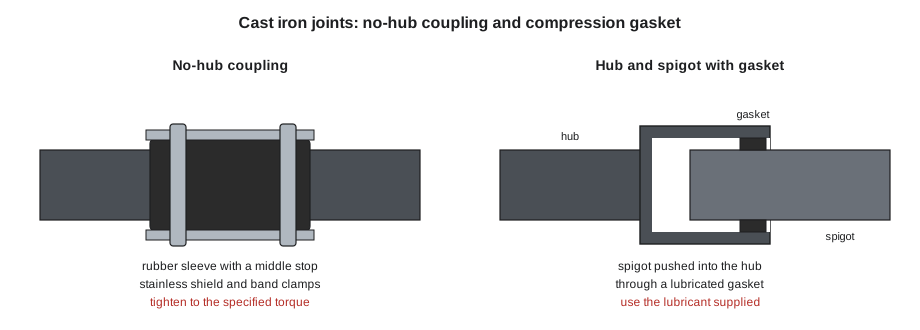
- Hubless (no-hub) pipe has plain ends. Lengths are joined with no-hub couplings: a neoprene rubber gasket sleeve with an internal center stop, surrounded by a corrugated stainless steel shield and tightened with stainless steel band clamps. This is the most common form inside buildings today.
- Hub-and-spigot pipe has a bell (hub) on one end. The plain spigot end of the next length is pushed into the hub through a compression gasket, a molded rubber ring lubricated and seated in the hub. Older systems used oakum packed into the hub and sealed with molten lead, a method still met in repairs but rarely installed new.
In the US, hubless cast iron pipe and fittings are made to ASTM A888 or CISPI 301, and hub-and-spigot pipe to ASTM A74. No-hub couplings are made to CISPI 310 for standard couplings and ASTM C1540 for heavy-duty couplings, which the specifications often require in larger sizes or below grade.
Cutting and joining cast iron
Cast iron is usually cut with a soil pipe cutter, a chain of cutting wheels wrapped around the pipe and tightened by a ratchet or hydraulic tool until the pipe snaps cleanly. A powered saw with an abrasive or carbide blade also works. Cuts must be square, and the end must be free of loose material. Cutting and grinding cast iron produces dust and sparks, so eye protection, hearing protection and the hot work rules apply to abrasive cutting.
To make a no-hub joint, slide the clamp band assembly onto one pipe, seat the rubber sleeve onto the other pipe end against its center stop, fold the sleeve back if needed, insert the first pipe into the other side of the sleeve until it meets the stop, slide the shield over the sleeve, and tighten the clamps to the torque the manufacturer specifies with a torque wrench or preset torque tool. Under-tightened clamps leak; over-tightened clamps can damage the band or crush the gasket. Clamps are tightened alternately on multi-band couplings so the shield draws down evenly.
To make a compression gasket joint, clean the hub and spigot, seat the gasket fully in the hub, lubricate the gasket and spigot with the lubricant the manufacturer supplies, and drive or pull the spigot fully home with a joint assembly tool. Lubricant matters: dry gaskets roll and leak.
Supporting cast iron
Cast iron is heavy, and its joints are flexible rubber couplings, not rigid welds. That combination means supports carry the whole load and keep the joints aligned. Typical practice, reflected in the codes, includes:
- Horizontal pipe supported at each joint or within a short distance of it, and at intervals that the code sets (commonly every 10 feet or 3 meters where 10-foot lengths are used, closer for shorter lengths), with a hanger near each change of direction.
- Vertical stacks supported at the base and at each floor, typically with riser clamps resting on the floor slab, so the weight of the stack is carried floor by floor instead of piling onto the fittings at the bottom.
- Restraint against movement at changes of direction in larger sizes, where water flowing under pressure during a test or a surge can push fittings apart. Manufacturers and engineers specify bracing or restraint for pipe 5 inches and larger in many conditions.
Lesson 11 covers hangers and supports in detail. For cast iron in particular, remember that a no-hub coupling is not designed to carry the weight of the pipe or to resist being pulled apart; supports and restraints do that.
Worked problem
How much does the stack weigh?
A 4-inch hubless cast iron stack runs 10 ft from one floor to the next on Kingsway Tower. If the pipe weighs about 7.4 lb per foot and a full stack length holds water during a test, roughly what load does each floor's riser clamp carry while the stack is full?
Show solution
- Pipe: \(10 \times 7.4 = 74\) lb.
- Water: inside diameter about 4 in, so area \(\tfrac{\pi}{4} \times 4^2 = 12.6\) sq in, volume \(12.6 \times 120 = 1508\) cu in, about 6.5 gal, about 54 lb.
- Total per floor: \(74 + 54 = 128\) lb, plus fittings and branches.
Answer: About 128 lb per floor plus fittings, which is why the clamp at each floor carries its own section rather than leaving the base to carry twelve floors.
Steel pipe
Steel pipe comes in several forms that plumbers meet in different places:
- Black steel pipe has a dark oxide or varnish finish. It is used for natural gas and propane piping, hydronic heating, fire protection and other non-potable systems. It rusts if exposed to oxygenated water, so it is not used for domestic water.
- Galvanized steel pipe is coated with zinc. It was the standard water pipe in houses built before about the 1960s and is still used for some non-potable purposes. Inside a water system, the zinc wears away over decades and the steel corrodes, building up scale that narrows the pipe and reduces flow; that is why old galvanized water lines give low pressure and rusty water. Galvanized fittings sometimes contained lead in the zinc, another reason to replace them.
- Stainless steel pipe and tube resist corrosion and are used for some potable, pharmaceutical, food and specialty systems, often joined by pressing or welding.
- Copper-nickel, brass and other alloys appear in special applications.
Steel pipe is sized by nominal pipe size (NPS), which, like copper, is not the actual outside diameter. For sizes up to 12 inches, the outside diameter for each nominal size is fixed, and the wall thickness is set by a schedule number. Schedule 40 is the standard weight for most plumbing and heating; schedule 80 is heavier for higher pressure or where threads cut deep into the wall. A 1/2-inch steel pipe is 0.840 inch outside; a 1-inch is 1.315 inch; a 2-inch is 2.375 inch.
| Nominal size (in) | Outside diameter (in) | Schedule 40 wall (in) | Schedule 40 inside (in) |
|---|---|---|---|
| 1/2 | 0.840 | 0.109 | 0.622 |
| 3/4 | 1.050 | 0.113 | 0.824 |
| 1 | 1.315 | 0.133 | 1.049 |
| 1-1/4 | 1.660 | 0.140 | 1.380 |
| 1-1/2 | 1.900 | 0.145 | 1.610 |
| 2 | 2.375 | 0.154 | 2.067 |
Note that a 1-inch steel pipe and a 1-inch copper tube have very different outside diameters (1.315 inch and 1.125 inch). Steel and copper never fit the same fittings; they connect through threaded adapters, unions, flanges or listed transition fittings, with dielectric protection where required.
Joining steel pipe
Steel pipe is joined in several ways, chosen by size, pressure, system and specification:
- Threading: tapered pipe threads cut on the pipe end screw into threaded fittings. This is the traditional method for sizes up to about 2 inches and is covered in lesson 8.
- Grooved couplings: a groove rolled or cut near each pipe end is clamped by a ductile iron housing with a rubber gasket. Grooved joints are fast and common in larger sizes, fire protection and mechanical rooms.
- Welding: butt welds and socket welds make permanent, high-strength joints, done by certified welders in larger sizes and higher pressures.
- Flanges: bolted flanges with gaskets join pipe to valves, pumps and equipment and allow them to be removed.
- Pressing: press systems for steel and stainless pipe use fittings with O-rings, like copper press systems, and avoid threading and welding.
On Kingsway Tower, the domestic water booster pump package connects to the copper mains through flanges and grooved couplings, and the gas piping to the rooftop units is black steel with threaded joints in small sizes and welded joints in larger sizes, installed by Northbridge's licensed gas fitters.
Corrosion, dielectric protection and old systems
Where steel meets copper or brass in a water system, galvanic corrosion attacks the steel, as lesson 3 explained. Dielectric unions, dielectric nipples or brass transition fittings separate the metals; codes and specifications say where they are required, commonly at water heaters and at connections between copper and steel piping. Dielectric unions themselves can fail by corrosion over time, which is why some designers prefer brass or bronze fittings at transitions.
Renovation work often meets old cast iron and galvanized steel. Old cast iron stacks may be sound for decades but can crack, rust through at the bottom of horizontal runs or have failing lead joints; inspection with a camera tells the story. Old galvanized water pipe is almost always replaced rather than repaired. When connecting new to old, use transition couplings made for the two materials and sizes, and support the old pipe so the new connection does not carry its weight.
Cutting into old cast iron also brings safety questions. Old joints may contain lead, and old pipe insulation may contain asbestos. Before cutting into an older system, check the building's designated substances survey or hazardous materials survey, as TRD-101 and HSE courses describe, and follow the controls it requires.
# Weight of pipe runs (approximate lb per foot, empty) and water when full
import math
pipe = {  # name: (lb per ft, inside diameter in inches)
    "4 in hubless cast iron": (7.4, 3.94),
    "3 in hubless cast iron": (5.2, 3.00),
    "2 in steel sched 40":    (3.65, 2.067),
    "4 in PVC DWV":           (2.0, 4.02),
}
run = 20
for name, (lbft, d) in pipe.items():
    gal = math.pi / 4 * d**2 * run * 12 / 231
    water = gal * 8.34
print(f"{name:24s} {run} ft: pipe {lbft*run:6.1f} lb, water {water:5.1f} lb, full {lbft*run+water:6.1f} lb")4 in hubless cast iron 20 ft: pipe 148.0 lb, water 105.6 lb, full 253.6 lb 3 in hubless cast iron 20 ft: pipe 104.0 lb, water 61.2 lb, full 165.2 lb 2 in steel sched 40 20 ft: pipe 73.0 lb, water 29.1 lb, full 102.1 lb 4 in PVC DWV 20 ft: pipe 40.0 lb, water 110.0 lb, full 150.0 lb
The numbers in the program are approximate and vary by manufacturer and wall thickness, but the pattern is clear: cast iron and steel weigh several times as much as plastic, and a full drain adds a large weight of water. That is why heavy pipe needs closely spaced, strong supports and why rigging and lifting, covered in TRD-105, matter for setting stacks.
Common mistakes
MistakeLetting no-hub couplings carry the weight of the pipe.
InsteadSupport cast iron at each joint and at each floor, and restrain larger sizes at changes of direction.
MistakeTightening no-hub clamps by feel.
InsteadUse a torque wrench or preset torque tool to the manufacturer's value.
MistakeInstalling compression gaskets dry.
InsteadClean, seat and lubricate the gasket with the lubricant supplied.
MistakeUsing black steel for domestic water.
InsteadUse black steel for gas, heating and other non-potable systems only.
MistakeCutting into old cast iron without checking for lead and asbestos.
InsteadCheck the hazardous materials survey and use the required controls.
Summary and key terms
- Cast iron soil pipe is quiet, non-combustible and durable, which is why it is used for stacks and drains in larger buildings.
- Hubless pipe joins with no-hub couplings; hub-and-spigot pipe joins with compression gaskets; old systems used oakum and lead.
- Cut cast iron square with a soil pipe cutter or saw, tighten couplings to specified torque and lubricate gaskets.
- Support cast iron at joints, at each floor and at changes of direction, and restrain larger sizes.
- Steel pipe is sized by nominal pipe size and schedule; black steel serves gas and heating, galvanized is largely obsolete for water, and stainless serves special systems.
- Steel joins by threading, grooving, welding, flanges or pressing; use dielectric or transition fittings where steel meets copper.
- Hubless pipe
- Cast iron soil pipe with plain ends joined by no-hub couplings.
- No-hub coupling
- A rubber sleeve with a stainless steel shield and clamps that joins hubless cast iron pipe.
- Compression gasket
- A rubber ring that seals a spigot end inside a hub.
- Riser clamp
- A clamp around a vertical pipe that rests on the floor structure to carry the pipe's weight.
- Schedule
- A number that sets the wall thickness of steel pipe for a given nominal size.
- Grooved coupling
- A housing and gasket that clamp onto grooves near the ends of two pipes.
Practice problems
Work each problem on paper first, then reveal the answer to check.
Give two reasons cast iron is used for soil stacks in apartment buildings.
Show answer
Any two of: quiet, non-combustible, durable, strong.
What tool is commonly used to cut cast iron soil pipe?
Show answer
A soil pipe cutter, which snaps the pipe with a chain of cutting wheels.
Why are riser clamps installed at every floor on a stack?
Show answer
So each floor carries its own section of the stack instead of the base carrying all of it.
What is the outside diameter of 1-inch schedule 40 steel pipe, and how does it compare with 1-inch copper?
Show answer
1.315 in, larger than 1-inch copper at 1.125 in.
Why is old galvanized water pipe usually replaced?
Show answer
Internal corrosion and scale narrow it, reducing flow and causing rusty water.
Using the program, what does a full 20 ft run of 4-inch cast iron weigh?
Show answer
About 148 lb of pipe plus about 105.6 lb of water, about 253.6 lb.
Lesson quiz · 5 questions
Score 60% or more to complete this lesson.
Create a free account to save your progress, take quizzes and earn a certificate.