
PLB-110 · Lesson 1 of 12 · 23 min
The plumber's job and the plumbing code
Maya Chen's first morning in the plumbing trailer on Kingsway Tower started with a roll of drawings, a cup of bad coffee and a question from her mentor, Luis Ferreira. He pointed at the twelve-story building rising across the site and asked her what she thought plumbers actually do. Maya said they install pipes. Luis said that was true the way it is true that doctors write prescriptions. Plumbers protect the health of everyone who will ever live in that building. They bring safe water in, carry waste out without letting sewer gas back in, keep the two systems from ever mixing, and do it all in a way an inspector can check against a written code.
This course is the first plumbing course in the apprenticeship program. It follows Maya, a first-year apprentice with Northbridge Mechanical, through the materials and methods every plumber uses: the systems in a building, the pipe materials and how they are joined, valves and fittings, pipe sizing basics, supports, layout and testing. The trades core courses (TRD-101 to TRD-107) covered site safety, trade math, drawings, tools, rigging, crew communication and the apprenticeship system. Here the work becomes specifically plumbing. Kingsway Tower is a 12-story residential building with two levels of underground parking in Columbus, Ohio, and Northbridge holds the plumbing contract.
Why plumbing is regulated
Plumbing is one of the most regulated trades because mistakes make people sick. Historians of public health often point out that clean water and proper sewers did more to lengthen human life than almost any medical advance. Cholera, typhoid and dysentery spread through water contaminated by sewage, and in modern buildings the same risks return whenever a drain is connected wrongly, a trap dries out, a vent is missing or a hose is left submerged in a laboratory sink. A single cross-connection between a drinking water line and a contaminated source can make hundreds of people ill.
Plumbing also carries water under pressure and waste by gravity through every floor of a building. A leaking joint can cause mold, rot and electrical hazards long before anyone sees a drip. A badly supported stack can pull apart. A water heater without a working relief valve can explode. Scalding water from an improperly set mixing valve injures children and older adults every year. Codes exist to prevent each of these failures, and almost every rule you will learn has a story behind it.
That is why plumbing is a licensed or certified trade almost everywhere in North America, why plumbing work needs a permit and inspection, and why apprentices learn the code alongside the tools. Luis told Maya that the code is not an obstacle to good work: it is the written record of what went wrong for other people, so that it does not go wrong on Kingsway Tower.
What a plumber does
The plumbing trade covers several kinds of work, and most plumbers do several of them over a career:
- New construction: installing the complete plumbing system in new buildings, from the building sewer and water service to every fixture. Maya's work on Kingsway Tower is new construction.
- Renovation: replacing and extending systems in existing buildings, often working around occupants and old materials such as galvanized steel, lead and cast iron.
- Service and repair: finding and fixing leaks, blockages, failed water heaters, low pressure and other problems in occupied buildings. Northbridge's service plumber, Grace Lin, spends her days on this work.
- Specialized systems: gas piping, hydronic heating, backflow testing, medical gas, fire protection connections and commercial kitchens. Later courses in the program cover these.
Across all of these, the core skills are the same: reading drawings and specifications, laying out piping, choosing and joining the right materials, supporting and protecting the pipe, testing it, and leaving a system that the code, the inspector and the owner will accept. This course builds those skills.
Model codes and adopted codes
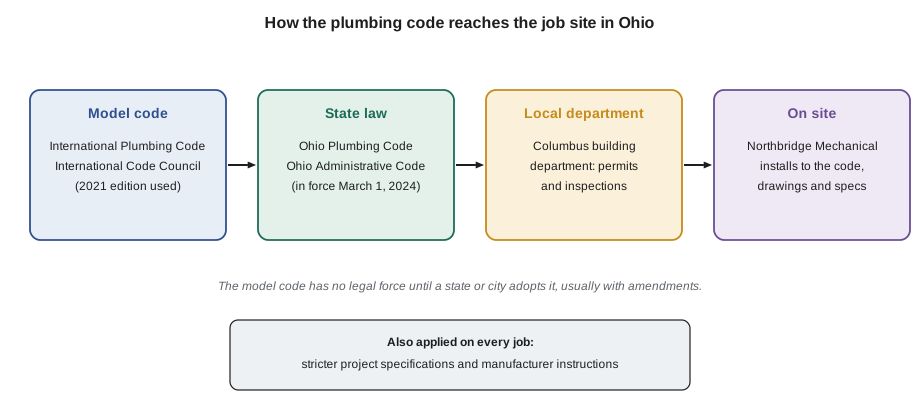
In the United States, plumbing codes are also model codes written by private organizations and then adopted by states and cities. The two main model codes are the International Plumbing Code (IPC), published by the International Code Council, and the Uniform Plumbing Code (UPC), published by the International Association of Plumbing and Mechanical Officials. Most of the eastern and central states use the IPC; many western states use the UPC. A few states write their own code. A model code has no legal force until a state or city adopts it, usually with amendments.
Ohio adopts the IPC as the Ohio Plumbing Code, part of the Ohio Administrative Code, for buildings other than one-, two- and three-family dwellings, which fall under the Residential Code of Ohio. The current Ohio Plumbing Code is based on the 2021 IPC with Ohio amendments and took effect on March 1, 2024. On Kingsway Tower, the legally binding rules are the Ohio Plumbing Code, the conditions of the Columbus building permit and the project specifications.
This difference matters in practice. When an instructor, a textbook or a website quotes a rule, ask which code and which edition it comes from. A rule from another province or state, or from an older edition, may not apply on your job. Experienced plumbers keep the adopted code for the jurisdiction they work in, know roughly where things are in it, and look rules up rather than trusting memory when it matters.
| Model code | Ohio law | Who enforces it | |
|---|---|---|---|
| Plumbing rules | International Plumbing Code (Ohio uses the 2021 edition) | Ohio Plumbing Code, based on the 2021 IPC with amendments | Local certified building department plumbing inspectors |
| Building rules | International Building Code | Ohio Building Code | Building inspectors |
| Gas piping | International Fuel Gas Code or NFPA 54 | Ohio Mechanical Code fuel gas provisions | Local building department |
How a plumbing code is organized
Plumbing codes look intimidating at first, but they follow a predictable pattern. Once you know the pattern, finding a rule takes minutes instead of an hour.
The Ohio Plumbing Code follows the IPC's chapter structure. Chapter 1 covers scope and administration and Chapter 2 holds definitions. The technical chapters follow: general regulations (Chapter 3), fixtures (4), water heaters (5), water supply and distribution (6), sanitary drainage (7), indirect waste (8), vents (9), traps and interceptors (10), storm drainage (11) and special piping (12), with referenced standards in Chapter 15. Section numbers start with the chapter: Section 308 is in Chapter 3, and 308.5 is a subsection about hanger spacing.
Every code depends on its definitions. Words such as fixture, trap, vent, stack, branch, building drain, building sewer, potable water and cross-connection have precise meanings, and a rule often turns on a definition. When a rule is unclear, read the definitions first. Many apprentices tab the definitions section and the most-used tables in their code book in their first month.
Codes also refer to standards. When a code says a pipe must conform to a particular standard, it is pointing to a separate document, written by a standards organization, that sets the material, dimensions, testing and marking for that product. The pipe or fitting will carry markings showing the standard it meets and the certification body that tested it. Part of every plumber's job is checking those markings before the material goes into the building.
Permits, inspections and who may do the work
Plumbing work in Columbus needs a permit from the city's building department before it starts, except for some minor repairs. The permit drawings show the plumbing design, and the inspector visits at defined stages: typically underground drainage before it is backfilled, rough-in before walls are closed, and final when fixtures are installed and the system is working. Each inspection includes a test, covered in lesson 12. Columbus licenses plumbers, so the work must be done by or under the supervision of a licensed journeyperson plumber, and the contractor must hold the right contractor license. Maya's registration as an apprentice and her supervision by Luis are what make her work legal.
Inspections are not a formality. An inspector can reject work, order it uncovered, or stop a job. Good plumbers prepare for inspections: the system is complete for the stage, the test is on and holding before the inspector arrives, the pipe markings are visible, and the permit card and approved drawings are on site. Luis's rule is simple: never let an inspector be the first person to find a problem.
Drawings, specifications and the code together
On a large project like Kingsway Tower, the code is only one of three documents a plumber works from. The mechanical drawings, prepared by a professional engineer, show where the piping goes, its sizes and the fixtures it serves. The specifications describe the materials, methods and quality required, often more strictly than the code. The code sets the legal minimum.
When the documents disagree, the stricter requirement generally governs, and any real conflict goes back to the foreman as a question for the engineer (an RFI, as TRD-103 described). Never quietly change a pipe size or material because you think the drawings are wrong. Engineers sometimes size pipe larger than the code minimum for future capacity or noise, and specifications sometimes require a heavier pipe than the code allows. A change that saves an hour today can fail an inspection or a warranty next year.
| Document | Prepared by | What it tells the plumber |
|---|---|---|
| Mechanical drawings | Professional engineer | Routes, sizes, fixture locations, risers, details and schedules |
| Specifications | Engineer and architect | Approved materials, joining methods, testing, insulation, labeling and quality |
| Ohio Plumbing Code | Government, from the model code | The legal minimum for materials, sizing, venting, protection and testing |
| Manufacturer's instructions | Product manufacturer | How to install a specific product so it performs and keeps its warranty and certification |
| Shop drawings and submittals | Contractor and suppliers | The exact products chosen, reviewed by the engineer before purchase |
Reading a code rule: a worked example
Worked problem
Finding the minimum slope for a horizontal drain
Maya needs to know the minimum slope for a 3-inch horizontal drain under the parking level slab. How should she find it, and what does it mean on site for a 40 ft run?
Show solution
- Go to Chapter 7 of the Ohio Plumbing Code, the section on slope of horizontal drainage piping.
- The table there sets a minimum slope by pipe size; for a 3-inch drain it is 1/8 inch per foot, and 1/4 inch per foot for drains 2-1/2 inches and smaller.
- Fall over the run: \(40 \times \tfrac{1}{8} = 5\) in, so the downstream end must be at least 5 inches lower.
- Check the drawings: the engineer may show a steeper slope or invert elevations that govern; many contractors run 1/4 inch per foot where space allows.
Answer: At least 5 inches of fall over 40 ft (1/8 inch per foot), unless the drawings require more.
The point of the example is the habit, not the number. Find the right part of the right code, read the rule and its definitions, apply it with simple math, and then check the drawings and specifications for anything stricter. PLB-120 and PLB-210 go much deeper into drainage rules and code navigation.
# Fall needed over a run at a given slope in inches per foot
def fall_in(run_ft, inch_per_ft):
    return run_ft * inch_per_ft

for run in (10, 22, 40, 61):
print(f"run {run:3d} ft at 1/4 in/ft: fall {fall_in(run, 0.25):5.2f} in at 1/8 in/ft: fall {fall_in(run, 0.125):5.2f} in")run 10 ft at 1/4 in/ft: fall 2.50 in at 1/8 in/ft: fall 1.25 in run 22 ft at 1/4 in/ft: fall 5.50 in at 1/8 in/ft: fall 2.75 in run 40 ft at 1/4 in/ft: fall 10.00 in at 1/8 in/ft: fall 5.00 in run 61 ft at 1/4 in/ft: fall 15.25 in at 1/8 in/ft: fall 7.62 in
The plumber's responsibilities on site
Beyond the code itself, a plumber carries responsibilities that are easy to overlook in the first year:
- Protecting potable water. Keep open pipe ends capped, keep pipe and fittings off the ground and out of mud, and never use a potable water line for anything that could contaminate it. New systems are flushed and often disinfected before use.
- Protecting the building. Plumbers cut holes in floors, walls and structure. Openings in structural members need approval, and openings in fire separations must be sealed with a listed firestop system, covered in lesson 11.
- Working safely with heat, chemicals and confined spaces. Soldering and brazing are hot work; solvent cements are flammable and give off vapors; trenches and pits can be confined spaces. TRD-101 covered the basics, and lessons 5 and 6 apply them to plumbing.
- Keeping records. Test results, inspection reports, as-built changes and material certifications all end up in the turnover package for the owner.
- Respecting other trades. Plumbing must fit around ductwork, electrical, structure and finishes. Coordination meetings and coordinated drawings exist so that the plumber's pipe does not end up where the duct needs to go.
Luis summed it up for Maya on her first day: install it so it works, so it lasts, so it passes inspection, and so the next plumber can understand what you did.
Common mistakes
MistakeQuoting a rule without knowing which code or edition it comes from.
InsteadUse the Ohio Plumbing Code currently in force for the job, and confirm the edition.
MistakeTreating the code as the target instead of the minimum.
InsteadFollow the drawings and specifications where they are stricter, and ask when they conflict.
MistakeChanging a pipe size or material on site because it seems easier.
InsteadRaise the question with the foreman so the engineer can answer it in writing.
MistakeCovering work before it has been tested and inspected.
InsteadKeep the stage open until the test passes and the inspector signs off.
MistakeLeaving open pipe ends uncapped on site.
InsteadCap or plug every open end to keep dirt, debris and pests out of the system.
Summary and key terms
- Plumbing is regulated because mistakes in water supply and drainage make people sick and damage buildings.
- The IPC and UPC are model codes; in Ohio the legal rules are in the Ohio Plumbing Code, based on the 2021 IPC and in force since March 1, 2024.
- Codes are organized around definitions, materials, piping practice, drainage, venting and water supply, and they refer to product standards.
- Plumbing work needs a permit and staged inspections with tests, and it must be done by qualified people.
- Drawings, specifications, the code and manufacturer's instructions all apply; the stricter requirement generally governs and conflicts go back to the engineer.
- A plumber protects potable water, the building, the crew and the record of what was installed.
- Model code
- A code written by a private organization that becomes law only when a state or city adopts it.
- International Plumbing Code
- The model plumbing code published by the International Code Council and used by most eastern and central states.
- Ohio Plumbing Code
- The legal plumbing code in Ohio, based on the 2021 IPC with Ohio amendments.
- Potable water
- Water that is safe to drink and use for cooking and washing.
- Cross-connection
- Any physical connection through which a contaminant could enter a potable water system.
- Permit
- Written approval from the local building department to carry out plumbing work, with required inspections.
Practice problems
Work each problem on paper first, then reveal the answer to check.
What is the difference between the International Plumbing Code and the Ohio Plumbing Code?
Show answer
The IPC is a model code with no legal force on its own; the Ohio Plumbing Code adopts the 2021 IPC with amendments and is the law in Ohio.
Name three stages at which a plumbing inspector typically inspects new work.
Show answer
Underground drainage before backfill, rough-in before walls are closed, and final.
Why should a plumber check pipe markings before installation?
Show answer
To confirm the product meets the standard the code requires and has been certified.
A 3-inch drain runs 32 ft at 1/8 inch per foot. What is the minimum fall?
Show answer
32 times 1/8 is 4 inches.
The drawings show a larger pipe than the code requires. What should you install?
Show answer
The size on the drawings; the code is a minimum, and the engineer may have reasons for the larger pipe.
Why does Columbus license plumbers?
Show answer
Because faulty plumbing work endangers public health, so only qualified, licensed people or supervised apprentices may do it.
Lesson quiz · 5 questions
Score 60% or more to complete this lesson.
Create a free account to save your progress, take quizzes and earn a certificate.