
PLB-110 · Lesson 4 of 12 · 21 min
Copper tube and fittings
Luis handed Maya a short offcut of copper tube and a pair of calipers and asked her to measure it. The tube was printed "3/4 L", but the calipers read 7/8 of an inch outside and a little over 3/4 of an inch inside. Maya assumed the calipers were wrong. Luis laughed and said every apprentice makes the same discovery: copper water tube is named by a nominal size that is not its real outside diameter. Knowing why, and knowing the types of tube and the fittings that go with them, is the start of working with copper.
Copper is still the material most plumbers think of first for water supply, and on Kingsway Tower it carries every riser and main. This lesson covers the kinds of copper tube, how they are sized, how they are cut, reamed and bent, and the fittings and joining methods used with them. Lesson 5 covers soldering and brazing in detail.
Types of copper tube
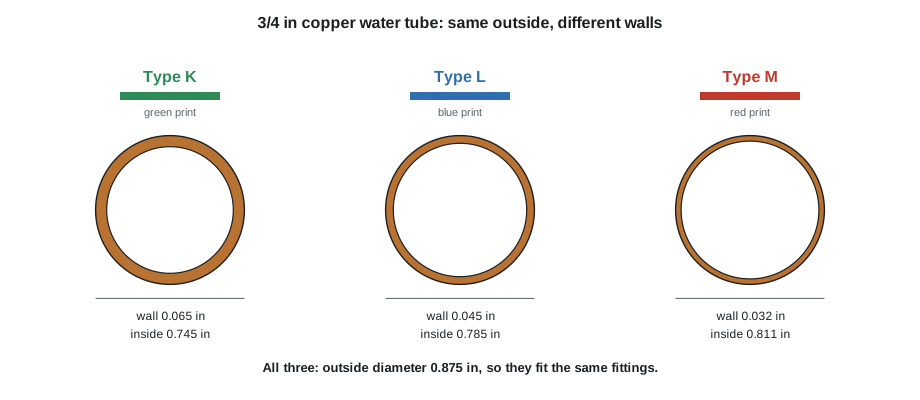
Copper water tube in North America is made to standards that define three wall thicknesses for the same outside diameter. All three have the same outside diameter for a given nominal size, so they all fit the same fittings; only the wall thickness, and therefore the inside diameter, pressure rating and weight, changes.
- Type K has the thickest wall. It is used for underground water services and other places where strength and resistance to damage matter most. It comes hard (straight lengths) or soft (coils).
- Type L has a medium wall. It is the most common type for water distribution inside buildings and is often the minimum required by specifications for commercial work. It also comes hard or soft.
- Type M has the thinnest wall. It is permitted for water distribution in many situations and is common in residential work where the code and specifications allow it. It is usually sold hard.
Copper DWV tube has an even thinner wall and is made only for drainage, waste and venting, not for pressure. ACR tube, used for refrigeration and air conditioning, is named by its actual outside diameter rather than a nominal size, is cleaned and capped for refrigerant use, and is a different product from plumbing tube even when the outside diameter is the same.
Hard (drawn) tube comes in straight lengths, typically 12 or 20 feet, and holds its shape for neat, well-supported runs. Soft (annealed) tube comes in coils and bends easily, which suits water services, long runs with gentle bends and connections to appliances. Heating copper with a torch softens it, so soldering a hard tube anneals the area near the joint.
Nominal size and actual size
For copper water tube, the actual outside diameter is the nominal size plus 1/8 inch. A 1/2-inch tube is 5/8 inch (0.625 in) outside, a 3/4-inch tube is 7/8 inch (0.875 in), and a 1-inch tube is 1-1/8 inch (1.125 in). The inside diameter depends on the type. This system dates back to the time when copper replaced steel pipe and was sized to carry roughly the same flow as steel of the same nominal size.
US plumbing sizes copper tube by nominal inch sizes. Drawings show sizes as 3/4" or 3/4 in, sometimes with the type, such as 3/4" L. When ordering and fitting, always work in the nominal size.
| Nominal size (in) | Outside diameter (in) | Type K wall / inside (in) | Type L wall / inside (in) | Type M wall / inside (in) |
|---|---|---|---|---|
| 1/2 | 0.625 | 0.049 / 0.527 | 0.040 / 0.545 | 0.028 / 0.569 |
| 3/4 | 0.875 | 0.065 / 0.745 | 0.045 / 0.785 | 0.032 / 0.811 |
| 1 | 1.125 | 0.065 / 0.995 | 0.050 / 1.025 | 0.035 / 1.055 |
| 1-1/4 | 1.375 | 0.065 / 1.245 | 0.055 / 1.265 | 0.042 / 1.291 |
| 1-1/2 | 1.625 | 0.072 / 1.481 | 0.060 / 1.505 | 0.049 / 1.527 |
| 2 | 2.125 | 0.083 / 1.959 | 0.070 / 1.985 | 0.058 / 2.009 |
Inside diameter matters because it decides how much water a pipe holds and how much it can carry. The program below uses the table to work out how much water is in 100 feet of each size of type L tube, which plumbers need when flushing and disinfecting new piping and when estimating how long hot water takes to reach a fixture.
import math
# water held in type L copper tube (inside diameters in inches)
inside_in = {"1/2": 0.545, "3/4": 0.785, "1": 1.025, "1-1/4": 1.265, "1-1/2": 1.505, "2": 1.985}
for size, d in inside_in.items():
    cubic_in_per_ft = math.pi / 4 * d**2 * 12
    gal_per_ft = cubic_in_per_ft / 231          # 231 cubic inches in a US gallon
print(f"{size:>6s} in type L: {gal_per_ft:6.4f} gal per foot, {gal_per_ft*100:5.2f} gal per 100 ft") 1/2 in type L: 0.0121 gal per foot, 1.21 gal per 100 ft
3/4 in type L: 0.0251 gal per foot, 2.51 gal per 100 ft
1 in type L: 0.0429 gal per foot, 4.29 gal per 100 ft
1-1/4 in type L: 0.0653 gal per foot, 6.53 gal per 100 ft
1-1/2 in type L: 0.0924 gal per foot, 9.24 gal per 100 ft
2 in type L: 0.1608 gal per foot, 16.08 gal per 100 ftWorked problem
Waiting for hot water
A shower in a suite on Kingsway Tower is supplied through 30 ft of 1/2-inch PEX from a recirculated hot water line, but for this example imagine it were 30 ft of 1/2-inch type L copper with no recirculation. If the shower runs at 2.0 gallons per minute, about how long until hot water arrives?
Show solution
- Volume per foot of 1/2-inch type L, from the program: about 0.0121 gal.
- Volume in the run: \(30 \times 0.0121 = 0.36\) gal.
- Time to push it out: \(0.36 \div 2.0 = 0.18\) minutes, about 11 seconds.
- Real waits are longer because the pipe itself must warm up and cools the first water that reaches it.
Answer: About 11 seconds just to move the cold water out of the pipe, and longer in practice. That waste of water and time is why recirculation and short hot water runs matter in a large building.
Cutting, reaming and cleaning copper
Most copper is cut with a tube cutter: a hardened wheel that is tightened a little at a time as the cutter is rotated around the tube. A cutter gives a square, clean cut without filings. Tightening too hard at once crushes the tube out of round. Large sizes may be cut with a fine-tooth hacksaw or a portable band saw, but then the end must be squared and every chip removed.
A tube cutter leaves a burr, a ridge of metal turned inward, on the inside of the tube. The burr must be removed with a reamer or deburring tool. A burr restricts flow and creates turbulence that can cause erosion corrosion over time, which shows up as thinning and pinholes just downstream of the joint. Reaming every cut is one of the habits inspectors and journeyworkers notice.
For soldered and brazed joints, the outside of the tube end and the inside of the fitting socket must be cleaned to bright metal with abrasive cloth, a pad or a fitting brush. Oxides, oils and fingerprints prevent the filler metal from flowing into the joint. Press fittings need clean, round, burr-free tube too, and the insertion depth must be marked so the tube is fully seated.
Copper tube must also be protected on site. Keep the ends capped, store it off the ground and away from mud and concrete splatter, and do not drag it across a slab. A dented or scratched tube end can make a joint leak, and dirt inside the tube ends up in valves, aerators and fixture cartridges.
Bending soft and hard copper
Soft copper bends by hand for gentle curves, but tight bends need a tube bender or bending spring to avoid kinking or flattening the tube. Every bender has a minimum bend radius for each size; bending tighter than that thins the outside wall and flattens the cross-section, which reduces flow and weakens the tube. Hard copper can be bent with a lever-type bender in smaller sizes, but most hard copper runs use fittings for changes of direction.
A well-made bend saves two joints and reduces resistance to flow compared with a sharp elbow, which is why water services and long runs of soft tube are bent rather than fitted where possible. Lesson 12 shows how bends and fittings affect layout measurements.
Copper fittings
Copper fittings come in two main families. Wrought copper fittings are formed from copper tube and are light and smooth inside. Cast fittings are made of bronze or brass and are used for more complex shapes, threaded adapters and valves. Fittings for water tube are named by the nominal size of the tube they fit.
The common fitting shapes are the same as for other materials, and lesson 9 covers them in more detail: couplings to join two lengths in a straight line; elbows (90 and 45 degree) to change direction; tees to branch; reducers to change size; caps to close an end; unions to allow a joint to be taken apart; and adapters, male or female, to change from a soldered or pressed end to a threaded one.
Fitting ends are described by how they join. A solder or sweat end is a socket that the tube slips into. A fitting with a socket on one end and a tube-size outside diameter on the other is called a street or fitting-by-copper (FTG) end, and it fits directly into another fitting's socket, saving a short piece of tube. Pressed fittings have an O-ring in each socket. Compression and flare fittings have threaded nuts.
Joining methods for copper
Copper can be joined several ways, and the specifications usually say which are allowed for each system:
- Soldering uses a filler metal that melts below about 450 °C (840 °F), drawn into the joint by capillary action. It is the traditional method for water piping. Lesson 5 covers it.
- Brazing uses a filler metal that melts above that temperature. It makes stronger joints for larger sizes, higher temperatures, medical gas and refrigeration, and it needs more heat and more care.
- Pressing uses a fitting with an O-ring and a battery-powered tool with jaws that crimp the fitting onto the tube. It needs no flame, so it avoids hot work permits and fire watch, and it is fast. Fittings and jaws must match, and an unpressed fitting must be detectable during testing; quality press fittings are designed to leak if they are not pressed.
- Compression fittings use a brass ring (ferrule) squeezed onto the tube by a nut. They are common for fixture supplies and stop valves and can be taken apart.
- Flare fittings use a flared tube end clamped between a fitting and a nut. They are used for some water services and for gas in some jurisdictions.
- Push-to-connect fittings grip the tube with a stainless steel ring and seal with an O-ring. They are quick for repairs and where codes and specifications permit them.
On Kingsway Tower, the specifications allow soldered or pressed joints on copper up to 2 inches, require brazed or pressed joints on larger sizes, and prohibit push-to-connect fittings in concealed locations. Northbridge presses most joints in occupied areas to avoid hot work, and solders in the open shafts during early construction.
Copper's weak points
Copper is reliable, but plumbers should know how it fails. Erosion corrosion happens when water moves too fast, especially at fittings near pumps and in hot water recirculation lines; reaming burrs and limiting velocity prevent it. Pitting corrosion happens with some water chemistries and causes pinhole leaks. Freezing splits copper. Contact with some building materials, such as certain wet concrete additives or ammonia-based products, can attack it. And copper's scrap value makes it a target for theft from unsecured sites, which is why Northbridge locks copper in a container every night.
Common mistakes
MistakeMeasuring copper tube and assuming the outside diameter equals the nominal size.
InsteadRemember the outside diameter of copper water tube is the nominal size plus 1/8 inch.
MistakeSkipping the reamer after cutting.
InsteadReam every cut to remove the burr, which restricts flow and causes erosion.
MistakeTightening a tube cutter hard on the first turn.
InsteadTighten a little each revolution to keep the tube round.
MistakeBending tighter than the bender's minimum radius.
InsteadUse the correct bender and radius, or use fittings.
MistakeMixing press fittings and jaws from different systems.
InsteadUse only the jaws and fittings approved together by the manufacturer.
Summary and key terms
- Copper water tube comes in types K, L and M, which share an outside diameter for each size but have different walls.
- The outside diameter of copper water tube is the nominal size plus 1/8 inch; the inside diameter depends on the type.
- Copper DWV tube is for drainage only, and ACR tube is a separate refrigeration product sized by outside diameter.
- Cut copper square with a tube cutter, ream every cut, and clean joint surfaces to bright metal.
- Soft copper bends; hard copper uses fittings; never bend tighter than the minimum radius.
- Copper is joined by soldering, brazing, pressing, compression, flare and push-to-connect fittings, as the code and specifications allow.
- Type L
- Medium-wall copper water tube, the most common type for distribution inside buildings.
- Nominal size
- The trade name for a pipe size, which is not necessarily any actual dimension.
- Annealed
- Softened by heating; soft copper tube is annealed so it can be bent.
- Burr
- A ridge of metal left inside a tube by cutting, removed by reaming.
- Street fitting
- A fitting with one end sized like tube so it fits directly into another fitting.
- Press fitting
- A fitting with an O-ring that is crimped onto the tube with a powered tool.
Practice problems
Work each problem on paper first, then reveal the answer to check.
What is the outside diameter of 1-inch copper water tube?
Show answer
1-1/8 inch, or 1.125 in.
Which type of copper tube has the thickest wall, and where is it typically used?
Show answer
Type K, for underground water services and where strength matters most.
Why must every cut be reamed?
Show answer
The burr restricts flow and causes turbulence that leads to erosion corrosion.
Using the program, how much water does 60 ft of 3/4-inch type L hold?
Show answer
About 0.0251 gal per foot, so about 1.5 gal.
Give one advantage of press fittings over soldered joints.
Show answer
No flame, so no hot work permit or fire watch, and faster installation.
What is ACR tube, and why should it not be mixed up with plumbing tube?
Show answer
Refrigeration tube sized by actual outside diameter and cleaned for refrigerant; it is a different product.
Lesson quiz · 5 questions
Score 60% or more to complete this lesson.
Create a free account to save your progress, take quizzes and earn a certificate.