
PLB-110 · Lesson 10 of 12 · 22 min
Pipe sizing basics: flow, pressure and fixture units
Maya asked Luis why the copper riser serving the top floors of Kingsway Tower was 2 inches when each suite's fixtures were fed by 1/2-inch PEX. Surely, she said, twelve floors of half-inch lines added up to a much bigger pipe. Luis said that was exactly the right question, and that the answer has two parts: not every fixture in the building runs at once, and a pipe's job is to deliver enough water at a reasonable speed without losing too much pressure. Sizing is about flow, velocity and pressure, and about the statistics of how people actually use water.
This lesson introduces the ideas behind pipe sizing. It is not a sizing course: the engineer sizes the piping on a project like Kingsway Tower, and PLB-120 and PLB-130 teach the code methods for drainage and water supply. But an apprentice who understands why pipes are the size they are makes better decisions on site and recognizes when something looks wrong.
Flow, area and velocity
Flow rate is the volume of water passing a point each unit of time. In the US it is measured in gallons per minute (gpm). Federal rules cap new showerheads at 2.5 gpm, and many are 2.0 gpm or less; lavatory faucets are often 1.5 gpm or less.
Velocity is how fast the water moves along the pipe. Flow, velocity and the inside area of the pipe are linked by a simple relationship: flow equals area times velocity. For a given flow, a smaller pipe means faster water, and a larger pipe means slower water.
Velocity matters for three reasons. Fast water causes noise, which tenants notice. It causes water hammer when a valve closes quickly, because a fast-moving column of water stopped suddenly creates a pressure spike. And it erodes copper, especially at elbows and tees, causing pinhole leaks over time, as lesson 4 explained. Fast water also loses more pressure to friction. Designers therefore limit velocity, and widely used copper industry guidance keeps cold water velocity below about 2.4 m/s (8 ft/s) and hot water below about 1.5 m/s (5 ft/s), lower still in recirculation lines where water flows continuously.
import math
# Velocity in type L copper for a given flow (inside diameters in inches)
inside_in = {"1/2": 0.545, "3/4": 0.785, "1": 1.025, "1-1/4": 1.265, "1-1/2": 1.505, "2": 1.985}
flow_gpm = 8.0
for size, d in inside_in.items():
    v = 0.4085 * flow_gpm / d**2                   # ft/s, from Q = A v with unit conversions
    flag = "too fast for cold" if v > 8 else ("too fast for hot" if v > 5 else "ok")
print(f"{size:>6s} in: {v:5.2f} ft/s {flag}") 1/2 in: 11.00 ft/s too fast for cold
3/4 in: 5.30 ft/s too fast for hot
1 in: 3.11 ft/s ok
1-1/4 in: 2.04 ft/s ok
1-1/2 in: 1.44 ft/s ok
2 in: 0.83 ft/s okThe program shows why a pipe carrying 8 gpm should be at least 3/4 inch for cold water and 1 inch for hot water by velocity alone. A 1/2-inch line carrying that flow would be noisy and would erode.
Pressure
Pressure is force per unit area, measured in pounds per square inch (psi). Typical municipal pressure at a building might be 50 to 80 psi. The IPC sets a maximum static pressure of 80 psi at fixtures, above which a pressure-reducing valve is needed, and fixtures need a minimum flowing pressure to work properly, with flushometer valves needing more than tank-type fixtures.
Static pressure is the pressure when no water is flowing. Flowing or residual pressure is what remains when water is moving, and it is always lower, because pressure is used up by friction in pipes, fittings, meters and valves, and by lifting water uphill. The difference between the pressure available at the street and the minimum a fixture needs is the pressure budget for the piping.
Height has a big effect. Every foot of height costs about 0.433 psi. Lifting water to the twelfth floor of Kingsway Tower costs far more pressure than the street provides, which is why the building has a booster pump. On the lowest floors, the boosted pressure would be too high, so pressure-reducing valves bring it back down.
Worked problem
Pressure at the top floor
Street pressure at Kingsway Tower is 60 psi static at the water meter in the lower parking level. The highest fixture is about 135 ft above the meter. Without a booster pump, what static pressure would that fixture see? If the fixture needs about 20 psi flowing and friction losses at peak flow are about 10 psi, is a booster needed?
Show solution
- Pressure used by height: \(135 \times 0.433 = 58.5\) psi.
- Static pressure at the top: \(60 - 58.5 = 1.5\) psi.
- Needed at the fixture plus friction: \(20 + 10 = 30\) psi, far more than 1.5 psi.
Answer: Yes. Without a booster, water would barely reach the top floor and would not flow properly there.
Friction loss
As water flows, it rubs against the pipe wall and churns through fittings, losing pressure along the way. Friction loss rises with velocity (roughly with its square), with pipe length and with the roughness of the pipe, and falls with pipe size. That is why a long run needs a bigger pipe than a short run carrying the same flow, and why fittings count: as lesson 9 showed, each elbow and tee adds the friction of a length of straight pipe.
Designers use friction loss charts and formulas, such as the Hazen-Williams formula, to find the loss per unit length for each pipe size and flow, then check that the total loss through the longest or highest run stays within the pressure budget. PLB-130 teaches the method. On site, the practical lesson is that replacing a specified pipe with a smaller one, adding many extra fittings or running a much longer route than drawn can starve fixtures at the end of the line.
Fixture units and diversity
If you added up the full flow of every fixture in Kingsway Tower and assumed they all ran at once, you would size enormous pipes that would never be full. In reality, at any moment only a fraction of fixtures are in use, and the larger the building, the smaller that fraction. This is called diversity.
Plumbing codes handle diversity with fixture units. Each type of fixture is given a number of fixture units that reflects how much water it uses, how long it runs and how often. A water closet with a flushometer valve gets more units than one with a tank, and a bathtub more than a lavatory. To size a pipe, you add up the fixture units it serves and use a table or curve to convert the total into a design flow. The conversion is not linear: doubling the fixture units increases the design flow by much less than double, because more fixtures means less chance they all run together.
The method goes back to work by Roy Hunter at the US National Bureau of Standards in the 1940s, who used probability to estimate peak demand. Many engineers now consider the old curves too high for today's low-flow fixtures, and the IPC added an alternative method for dwelling units based on newer research. The plumbing code sets the method that applies; in Ohio that is the Ohio Plumbing Code, and the engineer may use an accepted alternative.
Drainage uses fixture units too, called drainage fixture units or hydraulic loads. Each fixture's load reflects how much and how suddenly it discharges. A drain's capacity depends on its size, slope and whether it is horizontal or vertical, because a drain runs only partly full with air above the water, and a vertical stack carries water as a film around the wall with an air core in the center.
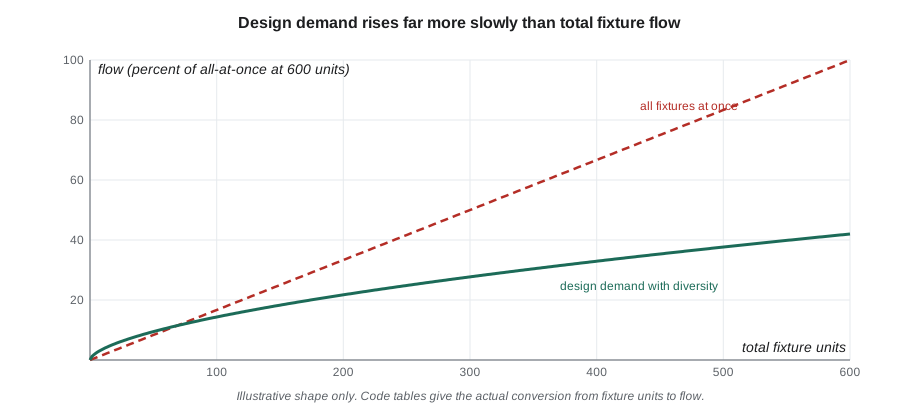
The program below uses a made-up, simplified demand curve to show the effect. The numbers are illustrative only and are not from any code table.
import math
# Illustrative only: a made-up diversity curve, not a code table
def design_flow_gpm(fixture_units):
    return 1.9 * fixture_units ** 0.6                  # flattens as units grow

for fu in (10, 40, 160, 640):
    all_at_once = fu * 1.9                             # if every unit's flow added up
print(f"{fu:4d} units: design {design_flow_gpm(fu):6.1f} gpm vs all at once {all_at_once:7.1f} gpm")10 units: design 7.6 gpm vs all at once 19.0 gpm 40 units: design 17.4 gpm vs all at once 76.0 gpm 160 units: design 39.9 gpm vs all at once 304.0 gpm 640 units: design 91.7 gpm vs all at once 1216.0 gpm
Water hammer
Water hammer is the bang or knock heard when a valve closes quickly on a moving column of water. Water is almost incompressible, so when it is stopped suddenly its momentum turns into a sharp pressure spike that travels back and forth along the pipe at roughly the speed of sound in water, well over a thousand meters per second. The spike can be many times the normal working pressure. It shakes pipe on its supports, loosens joints, damages valves, gauges and appliance solenoid valves, and annoys everyone within earshot.
Quick-closing valves cause most water hammer: solenoid valves in washing machines and dishwashers, single-lever faucets, flushometer valves and some automatic controls. The size of the spike depends mainly on how fast the water was moving and how quickly it stopped, which is one more reason to keep velocity low.
Plumbers control water hammer in several ways. Keeping velocity within limits reduces the energy in the moving water. Supporting and anchoring pipe well stops it from moving and banging. Water hammer arrestors, sealed devices with a cushion of gas or a spring behind a piston, absorb the spike near quick-closing valves; codes require them at certain fixtures and appliances, and manufacturers size them by fixture units. Old-style air chambers, capped vertical pipe stubs, lose their air over time and stop working, so modern work uses engineered arrestors. Spring-loaded check valves on pump discharges prevent the slam that happens when a pump stops and the water column reverses.
On service calls, a sudden new hammer problem often points to a failed pressure-reducing valve letting pressure rise, a waterlogged arrestor or a loose pipe support rather than a design fault.
Measuring pressure and flow on site
Plumbers check pressure with a gauge threaded onto a hose bibb, drain valve or test port. A reading with no water running gives static pressure; a reading while fixtures run gives residual pressure. Comparing the two shows how much the system loses under flow. On Kingsway Tower, gauges on each PRV station let the crew confirm the outlet pressure is set to the value on the drawings, typically well under the 80 psi maximum.
Flow at a fixture can be checked simply by timing how long it takes to fill a container of known volume: a 5-gallon pail that fills in 2-1/2 minutes means 2 gpm. Flow meters on larger piping and the building's water meter give more precise readings.
How sizing shows up on site
Most apprentices will never size a riser on a project like Kingsway Tower, but sizing ideas come up on site every day:
- Sizes on drawings are not suggestions. A pipe one size smaller than drawn can carry noticeably less flow, lose more pressure and run faster and louder.
- Fixture supplies have minimum sizes in the code, often 1/2 inch for most fixtures and smaller for some, and fixture manufacturers state supply requirements.
- Drains never get smaller in the direction of flow. A drain receiving more fixtures may need to get bigger; it must not reduce downstream, except in specific cases such as a closet flange arrangement the code allows.
- Velocity and noise problems often trace back to undersized piping, PRVs set too high or missing air chambers and water hammer arrestors.
- In service work, low pressure at one fixture may mean a clogged aerator or cartridge; low pressure everywhere may mean a failing PRV, a partly closed main valve or corroded old pipe.
Common mistakes
MistakeThinking every fixture in a building runs at the same time.
InsteadUse the code's fixture unit method, which accounts for diversity.
MistakeDownsizing a pipe on site because the smaller size is in the truck.
InsteadInstall the size on the drawings; smaller pipe means less flow, more loss and more noise.
MistakeIgnoring the pressure lost to height in a tall building.
InsteadAllow about 0.433 psi per foot of rise.
MistakeReducing a drain in the direction of flow.
InsteadDrains must stay the same size or get larger downstream.
MistakeBlaming the fixture for low pressure without checking the system.
InsteadCheck aerators, cartridges, PRVs, valves and pipe condition.
Summary and key terms
- Flow equals area times velocity; for the same flow, a smaller pipe means faster water.
- Velocity is limited to control noise, water hammer, friction and erosion; common guidance is about 2.4 m/s (8 ft/s) cold and 1.5 m/s (5 ft/s) hot.
- Pressure is measured in psi; the IPC caps static pressure at fixtures at 80 psi, and fixtures need a minimum flowing pressure.
- Height costs about 0.433 psi per foot, so tall buildings need boosters and PRVs.
- Friction loss rises with velocity, length, roughness and fittings and falls with pipe size.
- Fixture units capture diversity: design flow rises much more slowly than the total of all fixture flows.
- Flow rate
- The volume of water passing a point per unit of time.
- Velocity
- The speed at which water moves along a pipe.
- Static pressure
- Pressure in a system when no water is flowing.
- Residual pressure
- Pressure remaining in a system while water is flowing.
- Friction loss
- Pressure lost as water flows through pipe, fittings and valves.
- Fixture unit
- A number assigned to a fixture that reflects its water use or drainage load, used with tables to size pipes.
Practice problems
Work each problem on paper first, then reveal the answer to check.
A 1-inch type L pipe (inside 1.025 in) carries 8 gpm. What is the velocity?
Show answer
0.4085 times 8 divided by 1.025 squared, about 3.1 ft/s.
How much static pressure is lost lifting water 60 ft?
Show answer
60 times 0.433, about 26 psi.
Why are velocity limits lower for hot water?
Show answer
Hot water erodes copper more readily, so lower velocity is used.
Why does design flow not double when fixture units double?
Show answer
Because of diversity: more fixtures means a smaller chance they all run at once.
Give two site problems caused by undersized piping.
Show answer
Any two of low flow, low pressure at the end of the line, noise, water hammer and erosion.
What should you do if the drawings show a larger pipe than you have on the truck?
Show answer
Get the specified size; do not install the smaller pipe.
Lesson quiz · 5 questions
Score 60% or more to complete this lesson.
Create a free account to save your progress, take quizzes and earn a certificate.