
PHYS-131 · Lesson 2 of 5 · 37 min
Electric fields and potential
Coulomb's law says that charges push and pull on each other across empty space. A more powerful way to think about this is that every charge fills the space around it with an electric field, and any other charge placed in that field feels a force from it. The field idea turns out to be essential: it explains how energy travels as light and radio waves, and it makes it easy to describe what happens inside capacitors, cables and electronic devices.
This chapter defines the electric field, shows how to compute it for point charges and simple arrangements, and introduces electric potential, the "voltage" you meet on every battery and power outlet. It ends with the link between field and potential, and with practical limits such as the breakdown of air.
The electric field
The electric field at a point is the force per unit charge that a small positive test charge would feel there:
Once you know the field, the force on any charge \(q\) placed there is simply \(\mathbf{F} = q\mathbf{E}\). A positive charge is pushed along the field; a negative charge (such as an electron) is pushed against it.
For a single point charge \(Q\), dividing Coulomb's law by the test charge gives
directed away from a positive charge and toward a negative one. The field of several charges is the vector sum of their individual fields, by the same superposition principle as in Lesson 1.
Worked problem
Field of a point charge
Find the electric field 2.0 m from an 8.0 nC point charge, and the force it would exert on an electron placed there.
Show solution
- \(E = (8.99 \times 10^9)(8.0 \times 10^{-9})/(2.0)^2 = 18.0\) N/C, pointing away from the charge.
- Force on an electron: \(F = eE = (1.602 \times 10^{-19})(18.0) = 2.9 \times 10^{-18}\) N, toward the charge (opposite to E).
Answer: E = 18 N/C outward; F ≈ 2.9 × 10⁻¹⁸ N on the electron, directed toward the charge
Field lines
Field lines are a way to picture a field. They are drawn so that the field at any point is tangent to the line through it, and the lines are closer together where the field is stronger. Their rules:
- Lines start on positive charges and end on negative charges (or go off to infinity).
- The number of lines leaving a charge is proportional to its size.
- Lines never cross, because the field has only one direction at each point.
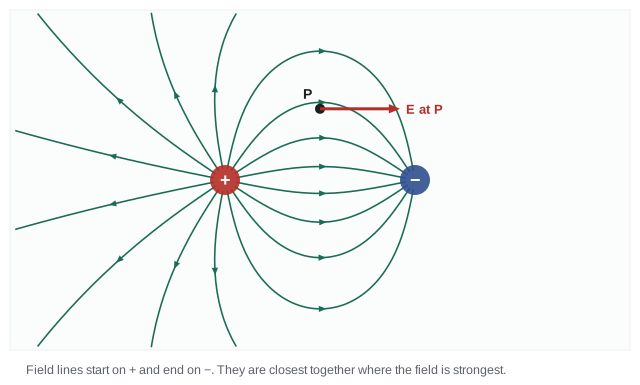
A pair of equal and opposite charges is called an electric dipole. Dipoles are everywhere: water molecules are dipoles, which is why water dissolves salts so well and why microwave ovens heat it so effectively.
Worked problem
Field of a dipole
Charges of \(+5.0\) nC and \(-5.0\) nC are 4.0 cm apart. Find the field at point P, 3.0 cm from the midpoint along the perpendicular bisector.
Show solution
- Distance from each charge to P: \(\sqrt{0.020^2 + 0.030^2} = 0.0361\) m.
- Size of each field: \(E_1 = (8.99 \times 10^9)(5.0 \times 10^{-9})/0.0361^2 = 34\,600\) N/C.
- The field from \(+Q\) points away from it and the field from \(-Q\) points toward it. Their vertical components cancel; their horizontal components (toward the negative charge) add.
- Each horizontal component is \(E_1\cos\theta\), with \(\cos\theta = 0.020/0.0361 = 0.555\).
- \(E = 2(34\,600)(0.555) = 38\,300\) N/C.
Answer: About 3.8 × 10⁴ N/C, parallel to the line from the positive to the negative charge
Uniform fields and moving charges
Between two large, parallel, oppositely charged plates the field is nearly uniform: the same size and direction everywhere, except near the edges. Uniform fields are used to accelerate and steer charged particles in X-ray tubes, mass spectrometers, inkjet printers and electrostatic precipitators that clean smokestack gases.
A charge in a uniform field feels a constant force, so it has constant acceleration \(a = qE/m\), and all the kinematics from Mechanics applies. An electron moving sideways through the plates follows a parabola, exactly like a projectile.
Worked problem
An electron between plates
Two parallel plates 1.0 cm apart have a potential difference of 1000 V. Find the field and the acceleration of an electron between them.
Show solution
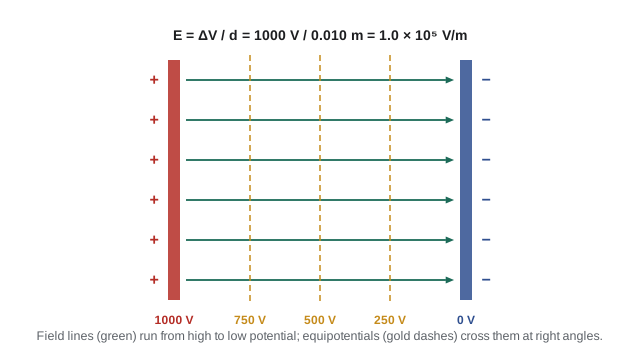
- For a uniform field, \(E = \Delta V/d = 1000/0.010 = 1.0 \times 10^5\) V/m (this relation is derived below).
- \(a = eE/m_e = (1.602 \times 10^{-19})(1.0 \times 10^5)/(9.109 \times 10^{-31})\).
Answer: a ≈ 1.8 × 10¹⁶ m/s², about 10¹⁵ times g. Gravity is negligible for electrons in fields like this
Gauss's law in brief
For charge distributions with high symmetry, there is a shortcut to the field. Gauss's law says that the total field passing out through any closed surface (the electric flux) equals the enclosed charge divided by \(\varepsilon_0\). Applying it to symmetric shapes gives some results worth remembering:
- Outside a uniformly charged sphere, the field is the same as if all the charge were at the center.
- Inside a conductor in equilibrium, the field is zero. This is why a metal enclosure (a Faraday cage) shields what is inside from external fields, and why you are safe inside a car struck by lightning.
- Near a large flat sheet with charge density \(\sigma\), the field is \(\sigma/2\varepsilon_0\), independent of distance. Between two oppositely charged plates the fields add to \(\sigma/\varepsilon_0\); outside they cancel.
You will use Gauss's law in full, with surface integrals, in electromagnetics courses later in the program.
Electric potential energy and potential
The electric force is conservative, like gravity, so it has a potential energy. Moving a positive charge against the field takes work, which is stored as electric potential energy; letting it go, the field gives that energy back as kinetic energy.
Just as the field is force per unit charge, the electric potential \(V\) is potential energy per unit charge:
Only differences in potential matter. The potential difference between two points, \(\Delta V\), is what a voltmeter measures and what we commonly call "voltage". When a charge \(q\) moves through a potential difference \(\Delta V\), its potential energy changes by
Positive charges naturally move toward lower potential, and negative charges toward higher potential, both losing potential energy and gaining kinetic energy.
The electron volt
Atomic and particle physics use a convenient energy unit, the electron volt: the energy an electron gains when accelerated through 1 V. \(1 \text{ eV} = 1.602 \times 10^{-19}\) J. Chemical bonds are a few eV; X-ray photons are tens of keV; the Large Hadron Collider reaches several TeV.
Worked problem
Accelerating an electron
An electron starts from rest and is accelerated through 100 V. Find its kinetic energy and speed.
Show solution
- Energy gained: \(K = e\Delta V = 100\) eV \(= (1.602 \times 10^{-19})(100) = 1.60 \times 10^{-17}\) J.
- \(v = \sqrt{2K/m_e} = \sqrt{2(1.60 \times 10^{-17})/9.109 \times 10^{-31}} = 5.93 \times 10^6\) m/s.
Answer: 100 eV (1.6 × 10⁻¹⁷ J); about 5.9 × 10⁶ m/s, roughly 2% of the speed of light
Potential of point charges
The potential at distance \(r\) from a point charge \(Q\), taking \(V = 0\) far away, is
Unlike the field, potential is a scalar, and it carries the sign of the charge. The potential of several charges is simply the algebraic sum of their potentials, with no components to worry about. This is the great practical advantage of working with potential.
Worked problem
Potential from two charges
A \(+4.0\) nC charge is at the origin and a \(-2.0\) nC charge at \((0.30, 0)\) m. Find the potential at \((0.15, 0.20)\) m. How much work is needed to bring a \(+1.0\) nC charge there from far away?
Show solution
- Both charges are \(\sqrt{0.15^2 + 0.20^2} = 0.25\) m from the point.
- \(V = (8.99 \times 10^9)\left(\dfrac{4.0 \times 10^{-9}}{0.25} + \dfrac{-2.0 \times 10^{-9}}{0.25}\right) = (8.99 \times 10^9)(8.0 \times 10^{-9}) = 71.9\) V.
- Work = change in potential energy = \(q\Delta V = (1.0 \times 10^{-9})(71.9 - 0) = 7.2 \times 10^{-8}\) J.
Answer: V ≈ 72 V; about 7.2 × 10⁻⁸ J of work
Equipotentials
An equipotential is a surface on which the potential is constant. Moving a charge along one takes no work. Equipotentials are always perpendicular to field lines, and the field points from high to low potential. Around a point charge they are spheres; between parallel plates they are flat planes parallel to the plates. The surface of any conductor in equilibrium is an equipotential.
Field from potential
Potential and field are two descriptions of the same thing. Moving a distance \(dx\) along the field changes the potential by \(dV = -E\,dx\). So the field is the rate at which potential falls with distance:
This is why the units V/m and N/C are the same. A steep change in potential over a short distance means a strong field.
Worked problem
Field across a membrane
An insulating layer 4.0 mm thick has 120 V across it. What is the average field inside?
Show solution
- \(E = \Delta V/d = 120/0.0040 = 3.0 \times 10^4\) V/m.
Answer: 3.0 × 10⁴ V/m
Dielectric breakdown
Insulators stop conducting only up to a point. If the field is strong enough, it rips electrons from atoms and the material breaks down: a spark jumps through air, or an insulator punctures. Dry air breaks down at about 3 MV/m (3 kV per millimeter). This sets real design limits.
Worked problem
How high a voltage can a sphere hold?
For a charged metal sphere, the field at the surface is \(E = V/R\). What is the highest potential a sphere of radius 0.10 m can reach in air?
Show solution
- Breakdown when \(E = 3 \times 10^6\) V/m.
- \(V_{\max} = E R = (3 \times 10^6)(0.10) = 3 \times 10^5\) V.
Answer: About 300 kV. A smaller radius means a lower limit, which is why sharp points spark and high-voltage hardware is large and rounded
Common mistakes
MistakeThinking an electron moves along the field direction.
InsteadF = qE. For a negative charge the force, and the acceleration, point opposite to E.
MistakeAdding the fields of several charges as plain numbers.
InsteadFields are vectors: add components. Potentials are scalars: add with signs.
MistakeUsing V = kQ/r² or E = kQ/r.
InsteadField falls as 1/r², potential as 1/r.
MistakeAssuming zero field means zero potential (or the reverse).
InsteadField is the slope of potential. Inside a charged conductor E = 0 but V is constant and may be large.
MistakeConfusing potential (V, in volts) with potential energy (U, in joules).
InsteadU = qV. Potential belongs to a point in space; potential energy belongs to a charge placed there.
Summary and key terms
- The electric field is force per unit charge: E = F/q, so F = qE.
- A point charge produces E = k|Q|/r², away from + and toward −. Fields of several charges add as vectors.
- Field lines start on + and end on −, never cross, and crowd together where E is strong.
- Between parallel plates the field is uniform; charges there accelerate at a = qE/m.
- Potential is potential energy per unit charge, V = U/q, measured in volts. ΔU = qΔV.
- A point charge has V = kQ/r; potentials add as scalars.
- Equipotentials are perpendicular to field lines. E = −dV/dx, and E = ΔV/d in a uniform field.
- Air breaks down near 3 MV/m, which limits voltages and shapes high-voltage design.
- Electric field
- Force per unit charge at a point, in N/C or V/m.
- Field line
- A curve tangent to the field everywhere; density shows strength.
- Dipole
- Equal and opposite charges a small distance apart.
- Gauss's law
- Electric flux through a closed surface equals enclosed charge over ε₀.
- Electric potential
- Potential energy per unit charge, in volts.
- Electron volt
- The energy gained by an electron through 1 V: 1.602 × 10⁻¹⁹ J.
- Equipotential
- A surface of constant potential, perpendicular to field lines.
- Dielectric breakdown
- Failure of an insulator in a strong field, producing a spark or puncture.
Practice problems
Work each problem on paper first, then reveal the answer to check.
A −2.0 μC charge feels a force of 0.050 N pointing east. What is the electric field?
Show answer
E = F/q = 0.050/(2.0 × 10⁻⁶) = 2.5 × 10⁴ N/C, pointing west (opposite to the force on a negative charge).
At what distance from a 1.0 μC charge is the field 1000 N/C?
Show answer
r = √(kQ/E) = √(8.99 × 10⁹ × 10⁻⁶/1000) = 3.0 m.
Charges of +3.0 nC at x = 0 and +3.0 nC at x = 0.20 m. Find the field at x = 0.10 m and at x = 0.30 m.
Show answer
At 0.10 m the fields cancel: zero. At 0.30 m: k(3 × 10⁻⁹)(1/0.09 + 1/0.01) = 3000 N/C toward +x.
A proton is released from rest in a uniform 2000 N/C field. Find its speed after it has moved 5.0 cm.
Show answer
K = qEd = (1.602 × 10⁻¹⁹)(2000)(0.050) = 1.60 × 10⁻¹⁷ J. v = √(2K/m) = √(2 × 1.60 × 10⁻¹⁷/1.673 × 10⁻²⁷) = 1.38 × 10⁵ m/s.
How much energy, in joules and in eV, does a +2e ion gain when accelerated through 5000 V?
Show answer
10 000 eV = 10 keV = 1.60 × 10⁻¹⁵ J.
Find the potential 0.50 m from a −6.0 nC charge.
Show answer
V = kQ/r = (8.99 × 10⁹)(−6.0 × 10⁻⁹)/0.50 = −108 V.
Two charges of +2.0 nC and −2.0 nC are 0.40 m apart. Find the potential and the field at the midpoint.
Show answer
Potentials cancel: V = 0. Fields add: each is k(2 × 10⁻⁹)/0.04 = 449 N/C toward the negative charge, total 899 N/C. Zero potential does not mean zero field.
The potential along a line is \(V(x) = 50x^2\) V (x in m). Find the field at x = 2.0 m.
Show answer
E = −dV/dx = −100x = −200 V/m, i.e. 200 V/m pointing toward −x.
Two plates 2.5 mm apart are connected to a 9.0 V battery. What is the field between them?
Show answer
E = 9.0/0.0025 = 3600 V/m.
What is the maximum voltage across a 0.5 mm air gap before it sparks?
Show answer
(3 × 10⁶ V/m)(0.0005 m) = 1500 V.
Lesson quiz · 5 questions
Score 60% or more to complete this lesson.
Create a free account to save your progress, take quizzes and earn a certificate.