
PHYS-131 · Lesson 1 of 5 · 40 min
Electric charge and Coulomb's law
Every electrical device, from a phone charger to a 500 kV transmission line, works because of one property of matter: electric charge. Charges push and pull on each other, and those forces hold atoms together, make chemistry possible, and let us move energy and information over wires.
This chapter starts at the beginning. It describes what charge is and how objects become charged, explains why some materials conduct and others insulate, and develops Coulomb's law for the force between charges. You will learn to add electric forces as vectors, work through equilibrium problems, and see why static electricity matters in industry, where a spark in the wrong place can ignite fuel vapor or destroy a microchip.
Electric charge
Charge comes in two kinds, which Benjamin Franklin labeled positive and negative. Like charges repel; unlike charges attract. In ordinary matter, the positive charge is carried by protons in atomic nuclei and the negative charge by electrons around them.
Three facts about charge underlie everything else:
- Charge is conserved. It cannot be created or destroyed, only moved. When you rub a balloon on your hair, electrons move from your hair to the balloon; the total charge stays zero.
- Charge is quantized. Every charge is a whole-number multiple of the elementary charge \(e = 1.602 \times 10^{-19}\) C. An electron carries \(-e\) and a proton \(+e\).
- Most matter is neutral. An object becomes charged when it gains or loses a tiny fraction of its electrons.
The SI unit of charge is the coulomb (C). One coulomb is an enormous amount of static charge: it is the charge of \(1/e = 6.24 \times 10^{18}\) electrons. Static charges in everyday life are measured in nanocoulombs (nC, \(10^{-9}\) C) and microcoulombs (μC, \(10^{-6}\) C).
Worked problem
How many electrons?
A rubbed balloon carries a charge of \(-50\) nC. How many extra electrons does it hold?
Show solution
- Number of electrons \(= |q|/e = 50 \times 10^{-9}/1.602 \times 10^{-19}\).
- \(= 3.12 \times 10^{11}\) electrons.
- For scale, the balloon contains roughly \(10^{24}\) electrons in total, so the imbalance is about one part in ten trillion.
Answer: About 3.1 × 10¹¹ extra electrons. A tiny imbalance produces a noticeable force
Conductors, insulators and charging
In a conductor, such as copper or aluminum, some electrons are free to move through the material. In an insulator, such as glass, rubber or most plastics, electrons are bound to their atoms and charge stays where it is put. Semiconductors like silicon fall in between, and their conductivity can be controlled precisely, which is the basis of all electronics.
Because charges in a conductor move freely, any excess charge on a conductor spreads out until it reaches equilibrium. On an isolated conductor in equilibrium, the excess charge sits on the outer surface and concentrates where the surface is most sharply curved. This is why lightning rods are pointed and why high-voltage equipment has smooth, rounded fittings.
Objects can be charged in three ways:
- By friction (the triboelectric effect): rubbing two different materials transfers electrons from one to the other.
- By conduction: touching a charged object to a neutral conductor shares the charge between them.
- By induction: bringing a charged object near a conductor (without touching) pushes the conductor's free electrons to one side. If the far side is briefly connected to ground, charge flows away and the conductor is left with the opposite charge.
A charged object can also attract a neutral one. Its field slightly shifts the charges within the neutral object (polarization), so the nearer side carries the opposite charge and is attracted more strongly than the far side is repelled. That is why a charged comb picks up bits of paper.
Coulomb's law
In 1785 Charles-Augustin de Coulomb measured the force between small charged spheres with a torsion balance. He found that the force is proportional to the product of the charges and inversely proportional to the square of the distance between them:
The constant \(\varepsilon_0 = 8.854 \times 10^{-12}\) C²/(N·m²) is the permittivity of free space; it appears throughout electromagnetism. The force acts along the line joining the charges: repulsive for like charges, attractive for unlike charges. By Newton's third law, each charge feels a force of the same size.
Strictly, Coulomb's law applies to point charges, or to spherically symmetric charge distributions treated as if all the charge were at the center. It has the same inverse-square form as Newton's law of gravitation.
Worked problem
Two charges
Charges of \(+3.0\) μC and \(-3.0\) μC are 0.10 m apart. Find the force between them.
Show solution
- \[F = \frac{(8.99 \times 10^9)(3.0 \times 10^{-6})(3.0 \times 10^{-6})}{(0.10)^2} = \frac{0.0809}{0.010} = 8.1 \text{ N}\]
- The charges have opposite signs, so the force is attractive.
Answer: 8.1 N, attractive. That is roughly the weight of an 0.8 kg mass, from charges you could carry on two small spheres
Worked problem
Electric versus gravitational force
Compare the electric and gravitational attraction between the electron and the proton in a hydrogen atom.
Show solution
- Both forces follow an inverse square law, so the distance cancels in the ratio.
- \[\frac{F_e}{F_g} = \frac{ke^2}{Gm_e m_p} = \frac{(8.99 \times 10^9)(1.602 \times 10^{-19})^2}{(6.674 \times 10^{-11})(9.109 \times 10^{-31})(1.673 \times 10^{-27})}\]
- This evaluates to about \(2.3 \times 10^{39}\).
Answer: The electric force is about 10³⁹ times stronger. Gravity dominates on large scales only because matter is almost perfectly neutral
Superposition: several charges
When several charges act on one charge, the total force is the vector sum of the forces each one exerts on its own. This principle of superposition is what makes electrostatics tractable: you never need a formula for "three charges together", only Coulomb's law applied pair by pair and the vector addition from Linear Algebra.
The method:
- Draw the charges and pick the one you want the force on.
- For each other charge, find the size of the force with Coulomb's law (using magnitudes) and its direction from the signs (toward for attraction, away for repulsion).
- Resolve each force into components and add.
Worked problem
Charges on a line
A \(+4.0\) μC charge sits at \(x = 0\) and a \(-2.0\) μC charge at \(x = 0.30\) m. Find the force on a \(+1.0\) μC charge at \(x = 0.50\) m.
Show solution
- From the \(+4.0\) μC charge, 0.50 m away, repulsive (toward \(+x\)): \(F_1 = (8.99 \times 10^9)(4.0 \times 10^{-6})(1.0 \times 10^{-6})/0.25 = 0.144\) N.
- From the \(-2.0\) μC charge, 0.20 m away, attractive (toward it, so \(-x\)): \(F_2 = (8.99 \times 10^9)(2.0 \times 10^{-6})(1.0 \times 10^{-6})/0.04 = 0.449\) N.
- Net: \(0.144 - 0.449 = -0.306\) N.
Answer: 0.306 N toward −x. The nearer charge wins even though it is smaller
Worked problem
A two-dimensional arrangement
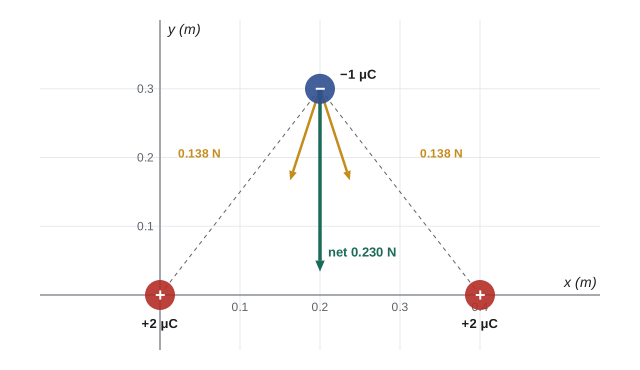
Charges of \(+2.0\) μC sit at \((0, 0)\) and \((0.40, 0)\) m. Find the net force on a \(-1.0\) μC charge at \((0.20, 0.30)\) m.
Show solution
- Distance to each positive charge: \(\sqrt{0.20^2 + 0.30^2} = 0.361\) m.
- Size of each force: \((8.99 \times 10^9)(2.0 \times 10^{-6})(1.0 \times 10^{-6})/0.130 = 0.138\) N, attractive, directed toward each positive charge.
- Horizontal components are equal and opposite and cancel.
- Vertical components both point down: each is \(0.138 \times 0.30/0.361 = 0.115\) N.
Answer: 0.230 N, straight down toward the line joining the positive charges
Worked problem
Where is the net force zero?
Charges of \(+4.0\) μC and \(+1.0\) μC are 0.90 m apart. Where on the line between them would a third charge feel no net force?
Show solution
- Between two like charges, the forces on a third charge point in opposite directions, so they can cancel there. Let the point be a distance \(x\) from the \(+4.0\) μC charge.
- Equal magnitudes: \(\dfrac{4.0}{x^2} = \dfrac{1.0}{(0.90 - x)^2}\). Taking square roots: \(\dfrac{2}{x} = \dfrac{1}{0.90 - x}\).
- \(1.80 - 2x = x\), so \(x = 0.60\) m.
Answer: 0.60 m from the larger charge, 0.30 m from the smaller one. The size and sign of the third charge do not matter
Equilibrium problems
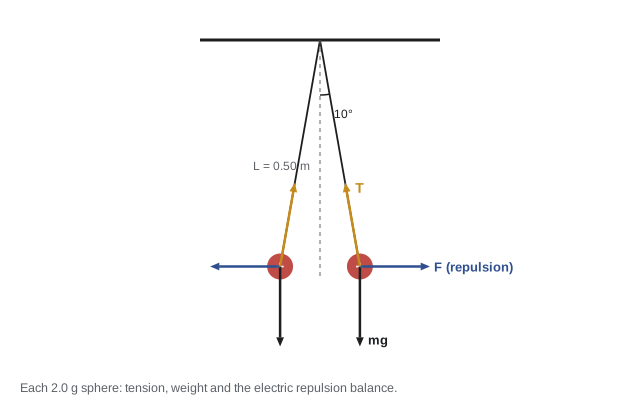
Electric forces enter Newton's laws exactly like any other force. Draw a free-body diagram, include the Coulomb force with the weight, tension and normal forces, and apply \(\sum\mathbf{F} = 0\) for equilibrium.
Worked problem
Charged pith balls
Two identical 2.0 g spheres hang from 0.50 m threads attached at the same point. After being given equal charges, each thread hangs at 10° from vertical. Find the charge on each sphere.
Show solution
- Separation: \(r = 2(0.50)\sin 10^\circ = 0.174\) m.
- Vertical: \(T\cos 10^\circ = mg\). Horizontal: \(T\sin 10^\circ = F\). Divide: \(F = mg\tan 10^\circ\).
- \(F = (0.0020)(9.81)(0.176) = 3.46 \times 10^{-3}\) N.
- Coulomb's law with equal charges: \(F = kq^2/r^2\), so \(q = r\sqrt{F/k} = 0.174\sqrt{3.46 \times 10^{-3}/8.99 \times 10^9}\).
Answer: q ≈ 1.1 × 10⁻⁷ C, about 108 nC on each sphere (the sign cannot be determined, only that both are the same)
This experiment is a classic way to measure charge with nothing more than a ruler and a protractor. Its sensitivity comes from the small mass: gravity on a 2 g sphere is only 0.02 N.
Charge distributions
Real charge is often spread over a rod, a plate or a volume rather than concentrated at points. We describe it with a charge density: per unit length \(\lambda\) (C/m), per unit area \(\sigma\) (C/m²) or per unit volume \(\rho\) (C/m³). To find the force from a distribution, split it into small pieces \(dq\), treat each as a point charge, and integrate, exactly the method you used for centroids and moments of inertia in Calculus II. In Lesson 2 you will see that for symmetric distributions there is a shortcut, Gauss's law.
Electrostatics at work
Static electricity is not just a nuisance. Several industrial processes depend on it:
- Electrostatic precipitators clean the exhaust of power plants, cement kilns and pulp mills. A high voltage charges dust particles in the gas stream, and the charged particles are pulled onto collecting plates, removing over 99% of the dust.
- Powder coating and electrostatic spray painting charge the paint droplets so they are attracted to the grounded part, wrapping around edges and wasting far less paint.
- Laser printers and photocopiers use light to discharge selected areas of a charged drum; toner sticks only to the areas that are still charged.
- Electrostatic separators sort crushed ores and recycled plastics by how readily different materials pick up charge.
In each case the design question is the one this chapter answers: how large a force do given charges produce, and in which direction?
Worked problem
Lifting a dust particle
A precipitator gives a 1.0 × 10⁻¹² kg dust particle a charge of 1.0 × 10⁻¹⁵ C. Another charge of 1.0 × 10⁻¹² C is 1.0 cm away. Compare the electric force on the particle with its weight.
Show solution
- Electric force: \(F = (8.99 \times 10^9)(1.0 \times 10^{-15})(1.0 \times 10^{-12})/(0.010)^2 = 9.0 \times 10^{-14}\) N.
- Weight: \(mg = (1.0 \times 10^{-12})(9.81) = 9.8 \times 10^{-12}\) N.
- Ratio: about 0.009.
Answer: Here the electric force is under 1% of the weight. Real precipitators use the strong, uniform fields of Lesson 2 (hundreds of kV/m) rather than a nearby point charge, which raises the force by a factor of several thousand, to many times the weight
Common mistakes
MistakeForgetting to square the distance, or using the distance in centimeters.
InsteadF = kq₁q₂/r², with r in meters and charges in coulombs (convert μC and nC).
MistakePutting the signs of the charges into Coulomb's law and then adding the results as numbers.
InsteadUse magnitudes for the size of each force; find each direction from the signs, then add as vectors.
MistakeAdding the magnitudes of forces that point in different directions.
InsteadResolve into components first. Superposition is a vector sum.
MistakeThinking a neutral object cannot be attracted by a charged one.
InsteadPolarization makes the near side oppositely charged, so neutral objects are attracted.
MistakeTreating the coulomb as a small unit.
InsteadOne coulomb of static charge is huge. Everyday static charges are in nC to μC.
Summary and key terms
- Charge comes in two signs; like charges repel and unlike charges attract.
- Charge is conserved and quantized in units of e = 1.602 × 10⁻¹⁹ C.
- Conductors let charge move freely; insulators do not. Objects charge by friction, conduction or induction.
- Coulomb's law: F = k|q₁q₂|/r² with k = 8.99 × 10⁹ N·m²/C², along the line joining the charges.
- Forces from several charges add as vectors (superposition).
- Electric forces join weight, tension and normal forces in free-body diagrams and equilibrium problems.
- Elementary charge
- e = 1.602 × 10⁻¹⁹ C, the charge of a proton.
- Coulomb (C)
- The SI unit of charge.
- Conductor
- A material in which charge moves freely.
- Insulator
- A material in which charge stays in place.
- Induction
- Charging a conductor by bringing a charge near it, without contact.
- Polarization
- A slight separation of charge within a neutral object.
- Coulomb's law
- F = kq₁q₂/r², the force between point charges.
- Superposition
- The net force is the vector sum of the individual forces.
Practice problems
Work each problem on paper first, then reveal the answer to check.
A plastic rod gains \(5.0 \times 10^{12}\) electrons. What is its charge?
Show answer
q = −(5.0 × 10¹²)(1.602 × 10⁻¹⁹) = −8.0 × 10⁻⁷ C = −0.80 μC.
Find the force between charges of 5.0 nC and 8.0 nC that are 4.0 cm apart.
Show answer
F = (8.99 × 10⁹)(40 × 10⁻¹⁸)/0.0016 = 2.2 × 10⁻⁴ N, repulsive.
By what factor does the force between two charges change if the distance is tripled?
Show answer
It becomes 1/9 as large.
Two equal charges 0.20 m apart repel with 0.90 N. What is each charge?
Show answer
q = r√(F/k) = 0.20 × √(0.90/8.99 × 10⁹) = 2.0 × 10⁻⁶ C = 2.0 μC.
Two small metal spheres carry +6.0 μC and −2.0 μC. They touch and are separated. What charge does each carry now?
Show answer
The total, +4.0 μC, is shared equally: +2.0 μC each.
Charges of +1.0 μC at x = 0 and +1.0 μC at x = 0.20 m. Find the force on a +1.0 μC charge at x = 0.10 m and at x = 0.30 m.
Show answer
At 0.10 m the forces cancel: zero. At 0.30 m: k(10⁻¹²)(1/0.09 + 1/0.01) = 0.999 N ≈ 1.0 N toward +x.
A +3 μC charge is at the origin and a −3 μC charge at (0.10, 0) m. Find the force on a +1 μC charge at (0, 0.10) m.
Show answer
From +3: 2.70 N straight up. From −3 (distance 0.141 m): 1.35 N toward (0.10, 0), components (0.954, −0.954). Net (0.954, 1.74) N, magnitude 1.99 N.
Charges +9 μC and +1 μC are 0.40 m apart. Where between them is the net force on a third charge zero?
Show answer
3/x = 1/(0.40 − x), so x = 0.30 m from the 9 μC charge.
Why is an electrically neutral sheet of paper attracted to a charged comb?
Show answer
The comb polarizes the paper: opposite charge collects on the near side and like charge on the far side. The attraction to the nearer charge is stronger than the repulsion from the farther charge.
Why are fuel trucks connected to the tank by a grounding cable before unloading?
Show answer
Flowing fuel builds up static charge. The cable keeps the truck, hose and tank at the same potential so no spark can jump between them and ignite the vapor.
Lesson quiz · 5 questions
Score 60% or more to complete this lesson.
Create a free account to save your progress, take quizzes and earn a certificate.