
PHOT-302 · Lesson 9 of 12 · 25 min
Fashion movement, attitude and showing the garment
PHOT-220 covered posing and directing people in portraits: putting subjects at ease, guiding posture and expression, and giving feedback. Fashion direction builds on those skills but has a different purpose. In a portrait, the person is the subject; in fashion, the person and the clothes together carry a story, and the image must show the garment, its line, movement and details, while expressing an attitude that fits the brand or the editorial. This lesson covers how fashion poses differ from portrait poses, working with professional models, movement and flow, showing garments and accessories, attitude and character, the camera's role in fashion poses, directing groups and non-professionals, and the ethics of direction.
How fashion posing differs
Portrait poses aim to flatter and reveal the person; fashion poses aim to make the garment look its best and to express a mood. Fashion poses are often more angular, exaggerated or unusual than portrait poses: elbows out to show the shape of a sleeve, a twisted torso to show a dress's back, a wide stance to show the cut of trousers, or a deliberately awkward posture that reads as editorial attitude. What looks strange in the room may look powerful in the frame. Fashion also values continuous movement over held poses: experienced models change position slightly between every frame, giving the photographer a range of options to choose from. Commercial work, particularly e-commerce and catalog, uses more natural, approachable poses that show the product clearly; high-fashion editorials allow the most experimentation.
| Aspect | Portrait | Fashion editorial | E-commerce |
|---|---|---|---|
| Main purpose | Reveal the person | Story, attitude and garment | Show the product |
| Pose style | Natural, flattering | Angular, expressive, experimental | Simple, consistent |
| Movement | Often still | Continuous variation | Set sequence of poses |
| Expression | Authentic | In character | Approachable, neutral |
| Garment | Secondary | Co-star | The subject |
Working with professional models
Professional fashion models are skilled performers. They know their angles, how to find light, how to move through poses in rhythm with the shutter, and how to adapt to different clothes and moods. With experienced models, photographers direct less and set a mood more: describing the character and situation, showing a reference image, choosing music, and letting the model explore, then refining with small adjustments. Over-directing an experienced model can make images stiff. New models need more help: demonstrations, mirroring (the photographer showing a pose), clear and specific instructions, encouragement and frequent breaks. Always look at the first images on the monitor together, so the model sees what is working.
Movement and flow
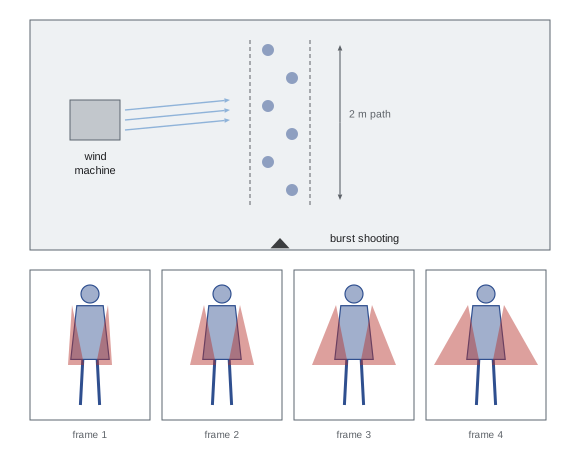
Movement brings garments to life: fabric swinging, coats flaring, hair lifting. Techniques include walking toward or across the camera (models can walk a short marked path repeatedly while the photographer shoots in bursts); turning or spinning to make skirts flare; jumping, which works best with clear counting and a safe surface; using a fan or wind machine; having an assistant toss fabric into the frame just out of view; and interacting with the set, such as leaning, climbing or sitting. Plan movement with the stylist, since some garments are fragile or restrictive, and with the photographer's technical choices: a fast shutter speed or short flash duration freezes movement, while a slower shutter speed with flash (drag the shutter) creates blur trails with a sharp moment, a classic fashion effect.
Worked problem
Counting frames for a walking sequence
A model walks a 3-meter marked path toward the camera at about 1 meter per second, and the photographer shoots bursts at 8 frames per second with strobes that recycle fast enough. How many frames does each walk produce, and how many walks are needed to get roughly 200 frames for the look?
Show solution
- Time per walk: 3 m ÷ 1 m/s = 3 s.
- Frames per walk: 3 s × 8 frames per second = 24 frames.
- Walks needed for 200 frames: 200 ÷ 24 ≈ 8.3, so about 9 walks.
- Check strobe recycle times: at 8 frames per second, lights must recycle in less than 1/8 s, which requires lower power or lights designed for burst shooting.
- Allow time for the model to reset between walks and for the stylist to fix the garment.
Answer: About 24 frames per walk, so about nine walks for roughly 200 frames.
Showing garments and accessories
The clothes must read in every fashion image. Directors and stylists watch for the garment's key features: the silhouette, the drape and movement, the neckline, sleeves, waist, length, closures, pockets and details such as embroidery, prints or hardware. Poses should reveal rather than hide them: arms away from the body to show a waist, a turn to show the back of a dress, a hand in a pocket only if the pocket matters, a hand lifting a bag to show its handle. Accessories, such as bags, shoes, jewelry, sunglasses, belts and watches, need their own considerations: hands that hold bags naturally and show the logo or clasp, feet positioned to show the shoe's shape, jewelry catching the light. For campaigns, the art director will specify which products must be visible and how. Detail shots, such as close-ups of fabric, hands or shoes, give designers and editors useful variety.
- Watch the silhouette: avoid poses that flatten or distort the cut unless that is the intention.
- Show the back when it matters: many gowns and jackets are designed from behind.
- Keep logos and key details visible, unless the concept calls for subtlety.
- Hide pins and clips with angles, or plan for retouching.
- Repeat key looks in at least two framings: full-length and three-quarter or detail.
Attitude and character
Fashion images express attitude: confidence, aloofness, joy, mystery, defiance, tenderness or humor. The mood board and concept define the character the model plays. Directors communicate attitude through stories and references ("you have just walked out of a party and do not care who sees you"), music, adjectives, film or painting references, and their own energy. Expression in fashion is often subtler or more stylized than in portraiture: a neutral, intense look that holds the viewer's attention; a glance away; a mouth slightly open; laughter caught between frames. Eyes matter most: direct eye contact creates connection and confrontation, while looking away suggests a story beyond the frame. Variety within a story, such as some images with eye contact, some without, some still, some moving, keeps the sequence alive (Lesson 11).
The camera's role
The photographer's position shapes the pose as much as the model does. A low camera angle lengthens legs and adds stature, which is why many full-length fashion images are taken from waist height or lower; a high angle can feel intimate or vulnerable; shooting straight on is graphic and confrontational. Focal length affects proportion: wide lenses close to the model exaggerate the nearest parts of the body (often feet or hands) for dramatic effect, while longer lenses (85 to 200 mm in full-frame terms) flatten perspective and give natural proportions for full-length work. Tilting the camera, cropping through the body at unexpected points, and shooting through objects are fashion techniques that add energy, but cropping at joints such as knees or wrists often looks awkward. The photographer also moves: walking around the model, changing height and distance, and shooting continuously to find unexpected moments.
Directing groups and non-professionals
Group fashion images, such as campaigns with several models or editorials about friends, families or communities, need composition and relationships: varied heights and poses, interaction and connection, and every garment visible. Direct groups by giving each person a role and a relationship to the others, and shoot many frames because one person will always be blinking or looking away. Non-professional talent, such as street-cast people, athletes or musicians, may be self-conscious; they respond best to activities and conversation rather than poses, to familiar actions (walking, dancing, playing), to honest encouragement and to seeing the images. Authenticity often comes from letting people be themselves rather than imitating model poses.
Ethics of direction
Directing people involves power. Photographers should give direction with words, demonstrations and reference images rather than physical contact; ask before adjusting hair or garments, and preferably let the stylist or hair artist do so. Avoid comments on bodies and appearance that are personal rather than about the image. Respect a model's limits on poses and clothing, and agree on any sensitive content in advance (Lesson 5). Be aware of how poses and styling might sexualize, infantilize or stereotype the people in the image, especially minors and people from marginalized groups. A respectful set is also a more creative one: models who feel safe experiment more.
Building a pose vocabulary
Models and photographers both benefit from a vocabulary of poses and movements that can be combined and varied. Standing poses can shift weight from one leg to the other, open or close the stance, turn the hips and shoulders in different directions, and place the hands at the waist, in pockets, on the face, in the hair or away from the body. Seated poses can perch on an edge, fold the legs, lean forward with elbows on knees or sprawl across a chair. Movements include walking, turning, stepping, leaning, crouching and reaching. Photographers who study fashion images, dance and film build a mental library of shapes to suggest when a session stalls. Over time, this vocabulary becomes part of a personal style.
Music, pace and energy on set
The energy of a set shows in the images. Music chosen to match the story's mood helps models find a rhythm and helps the whole team stay focused; agree on the music with the model, since some people find certain music distracting. Pace matters too: shooting continuously for a few minutes, then pausing to review and adjust, keeps energy high without exhausting the model. The photographer's own manner is contagious: calm, positive and decisive direction produces confident images, while hesitation or frustration shows on the model's face. Short breaks between looks allow everyone to reset.
Directing through the monitor
Tethered capture (Lesson 10) changes direction. Showing the model and team early frames on the monitor helps everyone understand the light, the framing and the attitude, and models can adjust their own poses after seeing them. Avoid constant pauses to review, which break momentum; instead, check the monitor at natural breaks. Stylists and hair artists watch the monitor for garment and hair issues and step in when needed. Clients may want to comment frequently, so agree that comments go through the art director or photographer rather than directly to the model, which keeps direction clear and consistent.
Shooting for the edit
Directing a look is also shooting for the edit. For each look, make sure you have a range of options: full-length and closer framings, horizontal and vertical orientations, still and moving frames, eye contact and looking away, and a few detail shots. This gives the photographer and editor choices when building the story (Lesson 11) and allows designers to fit images to layouts. A simple checklist for each look, kept by the photographer or digital tech, ensures nothing important is missed before the model changes into the next outfit. Experienced photographers learn to recognize the moment when they have the image and move on, saving time for the rest of the day.
Directing accessories and beauty close-ups
Close framings change direction. In beauty and accessory images, small movements make large differences: a slight turn of the head, a change in eye direction, the position of a finger on a ring or the angle of a bag strap. Give precise, small instructions, move slowly, and watch the monitor closely, since a millimeter can move a highlight off a lip or a reflection onto a watch face. Hand models and specialist parts models are sometimes booked for this work because they can hold precise positions steadily.
Common mistakes
MistakeOver-directing experienced models.
InsteadSet a mood and refine with small adjustments.
MistakePoses that hide the key features of a garment.
InsteadReveal silhouette, back and details deliberately.
MistakeCropping at knees, elbows or wrists.
InsteadCrop between joints or show the full limb.
MistakeBurst shooting faster than strobes recycle.
InsteadLower power or use burst-capable lights.
MistakeTouching models to adjust poses.
InsteadDemonstrate or describe; let the stylist adjust clothes.
Summary and key terms
- Fashion poses serve the story, attitude and garment.
- Experienced models need a mood; new models need clear help.
- Movement brings garments to life; plan it with the stylist.
- Poses should reveal silhouette, details and accessories.
- Attitude is communicated through story, references and energy.
- Camera height, focal length and cropping shape proportion and mood.
- Direct groups and non-professionals with roles and activities, respectfully.
- Silhouette
- Overall shape of a garment on the body.
- Drape
- How fabric hangs and moves.
- Mirroring
- Demonstrating a pose for the model to copy.
- Burst
- Rapid series of frames.
- Dragging the shutter
- Slow shutter with flash for blur and sharpness.
- Wind machine
- Fan used to move hair and fabric.
- Attitude
- Mood or character expressed in a pose.
- Detail shot
- Close-up of a garment feature or accessory.
- Recycle time
- Time for a flash to recharge.
- Low angle
- Camera below eye level; lengthens the figure.
Practice problems
Work each problem on paper first, then reveal the answer to check.
How do fashion poses differ from portrait poses?
Show answer
More angular and expressive; they show the garment and attitude.
How should you direct an experienced model?
Show answer
Set the mood and refine lightly.
Name three ways to create movement.
Show answer
Walking, spinning, jumping, wind, tossing fabric.
Frames from a 2-second walk at 10 fps?
Show answer
20.
Why show the back of a gown?
Show answer
Many garments are designed from behind.
How can you communicate attitude?
Show answer
Stories, references, music, adjectives, energy.
What does a low camera angle do?
Show answer
Lengthens legs and adds stature.
Where should you avoid cropping?
Show answer
At joints such as knees and wrists.
How do you direct non-professionals?
Show answer
Activities, conversation, familiar actions, encouragement.
Why avoid touching models?
Show answer
Respect, consent and a safe set.
Lesson quiz · 5 questions
Score 60% or more to complete this lesson.
Create a free account to save your progress, take quizzes and earn a certificate.