
PHOT-302 · Lesson 11 of 12 · 25 min
Editing and sequencing a fashion story
A fashion shoot may produce thousands of frames, but a magazine editorial might publish eight to twelve images and a campaign three to six. Editing (selecting images) and sequencing (arranging them in an order) turn raw material into a story. These are among the most important creative decisions a fashion photographer makes, often made together with the fashion editor, photo editor or art director. This lesson covers the editing process, criteria for selecting fashion images, building a story with variety and rhythm, sequencing for print and digital formats, working with layouts and designers, retouching standards and briefs for fashion, ethical retouching in fashion, delivering files, and submitting editorials to publications. Detailed retouching techniques were covered in PHOT-202; here the focus is on fashion-specific decisions.
The editing process
Editing works in rounds, from many images to few. A first pass eliminates technical failures: missed focus, closed eyes, blur, exposure problems, garments badly arranged, visible clips or awkward crops. A second pass rates the strongest frames from each look or setup, comparing similar frames side by side to choose the best expression, pose and garment line. A third pass considers the story as a whole: which images work together, which repeat each other and which are missing. It helps to step away and return with fresh eyes, to view images both large and as small thumbnails (which reveal graphic strength), and to involve trusted collaborators. Rating systems, such as stars and color labels, keep the rounds organized.
Worked problem
Narrowing a shoot to a story
An editorial shoot produced 2,400 frames across 10 looks. The magazine will publish 10 images and wants a further 6 alternates. The photographer keeps about 8 % after the first technical pass, then about 25 % of those as strong selects. How many images remain after each round, and how many strong selects per look on average?
Show solution
- First pass: 8 % × 2,400 = 192 frames.
- Second pass: 25 % × 192 = 48 strong selects.
- Average per look: 48 ÷ 10 = 4.8, about 5 strong selects per look.
- Final edit: 10 images to publish plus 6 alternates = 16 images.
- So about one-third of the strong selects (16 of 48) reach the final edit, roughly one or two per look.
Answer: 192 after the first pass, 48 strong selects (about 5 per look), and 16 images in the final edit.
Criteria for selecting fashion images
A strong fashion image works on several levels at once:
- The garment reads well: silhouette, details and fabric are clear and attractive.
- The expression and pose carry the attitude of the story.
- The light and color match the concept and mood board.
- The composition is strong as a whole and at small sizes.
- Technical quality is high: focus on the eyes or key detail, clean exposure.
- The image has something unexpected: a gesture, a moment, an imperfection that makes it memorable.
- It meets the brief: required products, layouts and formats for commercial work.
When two frames are close, the one with the better expression usually wins over the one with marginally better garment arrangement, unless the client's requirements say otherwise; small garment issues can often be fixed in retouching, but expression cannot.
Building a story: variety and rhythm
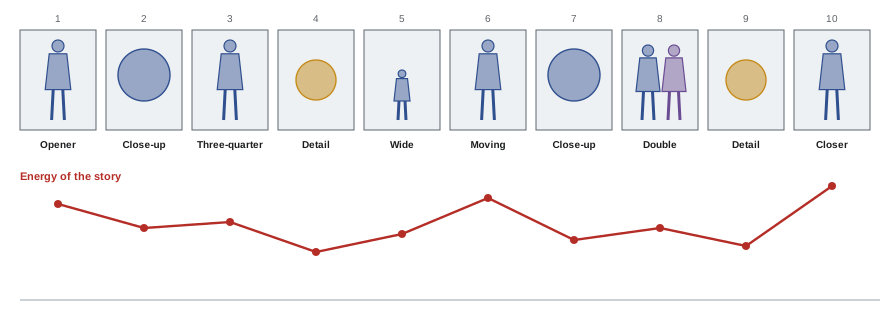
A fashion story is more than a set of good pictures; it should flow and develop like a short film. Variety keeps viewers engaged: mix framings (full-length, three-quarter, close-up, detail); orientations (vertical and horizontal); camera angles; poses (still and moving, eye contact and looking away); settings within the location; and scales (wide environmental images and intimate close-ups). Rhythm comes from how these alternate: a powerful opening image, a building of mood, quieter moments and a strong ending. Each look should usually appear once in a short editorial, unless the story calls for repetition. Too much similarity makes a story flat; too much variety breaks its unity, so the light, color grade and attitude should remain consistent across the edit.
Sequencing for print and digital
In print, images are seen in pairs across spreads, so sequencing considers how left and right pages work together: two images may face each other for contrast or harmony; a horizontal image may span a spread; and a single image may sit opposite text. The opening spread often pairs the strongest image with the title and introduction. On websites, images may be scrolled vertically, one at a time or in grids, and the first image must work as a thumbnail or social preview. On social media, carousels of up to about ten or twenty images (depending on the platform) are seen one at a time, and vertical formats dominate. Photographers should plan edits for each format, perhaps with different selections or crops for each.
| Format | How images are seen | Sequencing considerations |
|---|---|---|
| Print magazine | Spreads of two facing pages | Pairs, gutter, opening spread with title |
| Magazine website | Scrolling, single images or grids | Strong first image; consistent widths |
| Social carousel | One image at a time, mostly vertical | Hook first, vertical crops, short sequence |
| Campaign | Separate placements | Each hero image stands alone; consistent set |
| Portfolio | Online or printed book | Best work first; tell your range |
Working with layouts and designers
Magazine designers and art directors lay out editorials with type, credits and sometimes text. Photographers usually submit a proposed edit and sequence, but publications often make their own choices, cropping or reordering to fit page counts, advertising placement or the issue's design. Discuss expectations in advance: some photographers negotiate approval of the final layout or crops, especially for covers. Provide images with space for type when planned (Lesson 7), and supply both vertical and horizontal options where possible. Credits must be supplied accurately for each image (Lesson 4).
Retouching standards and briefs for fashion
Fashion retouching ranges from light clean-up to extensive image manipulation. Common tasks include color correction to match garments; removing dust, stray hairs, lint and creases; hiding clips, pins and tags; skin retouching that keeps texture (PHOT-202 covered methods); background cleaning and extension; compositing elements; and color grading to the story's look. Many photographers work with specialist retouchers, briefing them with marked-up images (notes drawn on the frame), reference images for the look, the live style from the shoot, color chart frames and the garment samples or swatches for color. The client or editor should agree the level of retouching in advance, since it affects cost and time: a light retouch might take 20 to 30 minutes per image, while a complex campaign composite may take many hours.
Ethical retouching in fashion
Fashion images have been widely criticized for retouching that changes bodies and faces beyond reality, contributing to unrealistic beauty standards and harm to body image. Practices that raise concern include slimming bodies, lengthening legs, removing natural features such as stretch marks or pores, lightening skin, and altering the shape of faces. Some brands and publications now commit to limited retouching or label retouched images; some countries require labels on commercial images whose bodies have been altered, such as France since 2017 and Norway since 2022, and some brands publish images of unretouched bodies. Generative AI has added new questions: images or models created or altered by AI, and digital replicas of real models (protected by consent requirements under New York's Fashion Workers Act, Lesson 5). Ethical fashion photographers discuss retouching openly with clients and models, avoid altering body shape or skin color, respect the model's identity and disclose significant manipulation where appropriate.
Delivering files
Delivery specifications vary by client: publications often want high-resolution TIFF or JPEG files in a stated color space (Adobe RGB or sRGB for digital, or files prepared for the printer's profile), at a stated size and resolution; e-commerce clients specify exact dimensions, backgrounds and naming; campaign clients may need many crops and versions. Embed copyright and contact metadata, follow the client's naming conventions, and use secure file transfer. Keep the master files and retouching layers archived; clients may request new versions or usage later (Lesson 12).
Submitting editorials to publications
Independent editorials, made without a commission, are often submitted to magazines. Each publication has submission guidelines on exclusivity (images must not have been published or posted elsewhere), the number of images, formats, credits, styling requirements such as minimum percentages of designer garments, and themes. Submission platforms collect editorials for many publications. Submit to one publication at a time when exclusivity is required, follow the guidelines exactly, include complete credits, and hold back social media posts until publication. Rejection is common; resubmitting a strong story elsewhere is part of the process. Consider the publication's reputation and readership, since some charge fees or have little audience.
Contact sheets and client selection
After the shoot, clients and editors usually choose final images from contact sheets or online galleries. Prepare these carefully: remove technical failures and near-duplicates so the client is not overwhelmed, apply the agreed look so images are seen as intended, number frames clearly, and group them by look or setup. Explain any planned retouching so the client does not reject a strong frame because of a removable clip or crease. Set a deadline for selections and agree how many images will be retouched within the quote; additional selections are charged extra. Recording the client's final selections in writing prevents confusion later.
Color grading a story
A consistent color grade unifies a story. The grade, the overall treatment of contrast, color balance, saturation and tone, is usually established in the live style on set and refined in post-production. Images shot at different times or locations may need individual adjustments to match, especially skin tones and the colors of key garments, which must remain accurate even within a stylized grade. Black and white treatments, film emulations and strong color casts can all suit fashion stories, but they should support the concept rather than disguise weak images. Compare all images of the story side by side at the end to check consistency.
Editing your own work objectively
Photographers are often attached to images for reasons the viewer cannot see: a difficult setup, a long wait for light, a favorite garment. Objective editing requires distance. Strategies include waiting a day before the final edit, viewing images in a different order or size, asking a trusted editor or peer for an opinion, and asking whether each image adds something new to the story. A smaller edit of excellent images is always stronger than a larger edit that includes weak frames. Many photographers find that learning to edit ruthlessly improves their shooting, because they begin to recognize strong images in the moment.
Archiving the story
Once a story is delivered and published, archive it properly. Keep the raw files, the session with its adjustments, the retouched masters with layers, delivered files, contracts, releases, credit sheets and correspondence together and backed up. Record where and when the images were published and what usage was granted, so that future requests for additional use can be handled correctly (Lesson 12). A well-organized archive allows images to be relicensed, included in exhibitions or books, and found quickly years later.
Writing captions and story text
Some editorials include a short introduction, captions or text written by the photographer, stylist or a writer. Even when the publication writes the text, photographers can help by providing a clear description of the concept, the location and any people or places featured, with names spelled correctly and permissions confirmed. Captions for social media posts should include credits for the team and agencies, the publication, and tags agreed with the client. Accurate, thoughtful text adds context to the images and shows respect for everyone who contributed to the story, including the communities and places that appear in it.
Reviewing the published story
When the story is published, review it carefully. Check that the images, crops and credits are correct, note how the designer used the images, and save copies for your records and portfolio. Share the publication with the team, tag them correctly and thank the editor. Reflect on what worked in the edit and what you would change, and use those lessons on the next story.
Common mistakes
MistakeChoosing better garment arrangement over better expression.
InsteadExpression usually wins; fix garments in retouching.
MistakeA story of similar framings and poses.
InsteadVary framing, orientation, angle and scale.
MistakeIgnoring the gutter and spreads in print.
InsteadSequence in pairs and plan for the fold.
MistakeVague retouching instructions.
InsteadBrief with mark-ups, references, charts and swatches.
MistakeSlimming bodies or lightening skin.
InsteadRespect identity and avoid altering body shape and color.
Summary and key terms
- Editing works in rounds from technical failures to story choices.
- Strong images combine garment, attitude, light, composition and surprise.
- Stories need variety, rhythm and consistent mood.
- Sequence differently for print spreads, websites, social and campaigns.
- Collaborate with designers on layouts, crops and credits.
- Brief retouchers clearly and agree the level of retouching.
- Retouch ethically and follow submission and delivery specifications.
- Edit
- Selection of images from a shoot.
- Sequence
- Order in which images are presented.
- Spread
- Two facing pages.
- Opener
- First image of a story, often with the title.
- Alternates
- Extra images offered beyond the main edit.
- Mark-up
- Notes drawn on an image for the retoucher.
- Swatch
- Fabric sample for color reference.
- Exclusivity
- Requirement that images are unpublished elsewhere.
- Retouching label
- Disclosure that a body image has been altered.
- Color space
- Defined range of colors for a file.
Practice problems
Work each problem on paper first, then reveal the answer to check.
What does the first editing pass remove?
Show answer
Technical failures.
Why view thumbnails?
Show answer
They reveal graphic strength.
Keep 10 % of 1,500, then 30 %: how many?
Show answer
150, then 45.
Which usually wins: expression or garment arrangement?
Show answer
Expression.
Name four ways to vary a story.
Show answer
Framing, orientation, angle, pose, setting, scale.
How are images seen in a print magazine?
Show answer
In spreads of facing pages.
What goes in a retouching brief?
Show answer
Mark-ups, references, live style, charts, swatches.
Name two countries requiring retouching labels.
Show answer
France and Norway.
What metadata should delivered files include?
Show answer
Copyright and contact information.
What does exclusivity require?
Show answer
Images unpublished and unposted elsewhere.
Lesson quiz · 5 questions
Score 60% or more to complete this lesson.
Create a free account to save your progress, take quizzes and earn a certificate.