
PHOT-240 · Lesson 1 of 12 · 25 min
Why analog photography today
For most of its history, photography meant light-sensitive materials, chemistry and darkness. A photographer exposed a piece of film, carried it to a darkroom, developed it into a negative, and then printed that negative onto paper under an enlarger. Digital capture replaced these processes for nearly all commercial work in the first decade of the twenty-first century, yet film never disappeared. In the 2010s and 2020s, analog photography experienced a remarkable revival among students, artists, enthusiasts and professionals, and film manufacturers have invested in new products and production capacity. This course teaches the complete black-and-white analog workflow, from choosing a camera and film to exposing, developing, printing and finishing a silver gelatin print, and introduces color film processing and hybrid workflows. This first lesson looks at why photographers still choose film, a brief history of photographic materials, the state of the film industry today, how analog and digital differ in practice, and what an analog workflow involves.
A brief history of photographic materials
The first permanent photographs were made in the 1820s and 1830s. Nicéphore Niépce's heliographs used bitumen that hardened in light; Louis Daguerre's daguerreotype, announced in 1839, produced a unique, highly detailed image on a silvered copper plate; and William Henry Fox Talbot's calotype, patented in 1841, introduced the negative-positive process, in which one paper negative could produce many prints. The wet collodion process of the 1850s made sharper glass negatives but had to be coated, exposed and developed before the plate dried, so photographers carried portable darkrooms. Gelatin dry plates, introduced in the 1870s, could be manufactured in factories and stored, freeing photographers from mixing chemistry on location and making shorter exposures possible.
In 1888, George Eastman's Kodak camera came loaded with a roll of flexible film; after exposure, the whole camera was sent back to the company for processing, under the slogan "You press the button, we do the rest." Roll film, 35 mm cameras such as the Leica of the 1920s, and color films such as Kodachrome (1935) made photography a mass medium. Through the twentieth century, black-and-white printing in the darkroom became an art form in its own right, practiced by photographers such as Ansel Adams, Edward Weston and many others who treated printing as inseparable from making the photograph. When digital cameras became affordable and capable in the early 2000s, film sales fell sharply, many film stocks and manufacturers disappeared, and photo labs closed. Kodak filed for bankruptcy protection in 2012, and its photographic film business continued under restructured companies.
| Period | Development | Significance |
|---|---|---|
| 1826–1827 | Niépce's heliograph | Earliest surviving camera photograph |
| 1839 | Daguerreotype | First commercially successful process |
| 1841 | Talbot's calotype | Negative-positive process |
| 1851 | Wet collodion | Sharp glass negatives, portable darkrooms |
| 1870s | Gelatin dry plates | Factory-made, storable plates |
| 1888 | Kodak roll film camera | Photography for everyone |
| 1925 | Leica 35 mm camera | Small-format, candid photography |
| 1935–1942 | Kodachrome and Kodacolor | Practical color films |
| 2000s | Digital transition | Film becomes a specialty medium |
Film today
The film industry is far smaller than at its peak in the late 1990s, but it has stabilized and, in some areas, grown. As of the mid-2020s, black-and-white films are manufactured by several companies, including Harman Technology in the United Kingdom, which makes Ilford and Kentmere films and papers; Foma Bohemia in the Czech Republic; ADOX in Germany; and Eastman Kodak in the United States. Color negative and color reversal films are made by very few manufacturers, principally Kodak and Fujifilm, with Harman introducing its own color negative film, Harman Phoenix, in 2023. Many smaller brands sell films made under contract by these manufacturers, or adapt motion picture film stocks for still cameras. Instant film is made by Fujifilm (Instax) and Polaroid. Film prices have risen considerably in recent years, and availability of particular stocks changes, so photographers should check current offerings and prices before planning a project rather than relying on older lists.
Darkroom papers and chemistry remain available from Harman (Ilford), Foma, ADOX and others, and several companies make new film cameras, enlargers and accessories, including recent half-frame and compact cameras. Many community darkrooms, colleges and artist-run centers in Canada and the United States offer darkroom access, and mail-order and local labs still develop and scan film.
Why photographers choose film
People choose analog photography for many reasons:
- The look: film grain, tonal rendering, highlight roll-off and color palettes differ from digital capture, and many photographers prefer them for particular work.
- Deliberation: a roll of 36 exposures, or 10 or 12 on medium format, or a single sheet of large format film, encourages careful seeing and slower, more considered photography.
- The physical object: a negative is a tangible original, and a silver gelatin print made by hand is a unique object with qualities of surface, depth and tone that inkjet prints imitate but do not replicate.
- Craft and learning: understanding exposure, development and printing in chemical terms deepens understanding of photography as a whole, including digital work, since many digital tools are modeled on darkroom practices.
- Archival permanence: properly processed black-and-white negatives and fiber-based prints can last for well over a century, and negatives remain readable without software or file formats.
- Specific techniques: large-format camera movements, alternative processes such as cyanotype and platinum printing, pinhole photography and instant film offer creative possibilities with their own character.
- Enjoyment: many people simply enjoy the process, the anticipation of seeing results, and the break from screens.
Film also has disadvantages: cost per image is high, results are delayed, mistakes are discovered late, materials can be hard to find, and chemistry requires space, safety precautions and responsible disposal. A good analog practice acknowledges these trade-offs and uses film where its qualities matter.
Worked problem
Comparing the cost per image
A student shoots 36-exposure rolls of black-and-white 35 mm film costing $14 per roll and develops it at home with chemistry costing about $2 per roll. A medium format roll of the same film costs $12 and gives 12 frames on a 6 × 6 camera, with about $2 of chemistry. What is the approximate cost per frame for each, before printing?
Show solution
- 35 mm: ($14 + $2) / 36 ≈ $0.44 per frame.
- Medium format: ($12 + $2) / 12 ≈ $1.17 per frame.
- Prints add paper and chemistry costs, perhaps $0.50 to $2 per 8 × 10 inch sheet depending on paper type.
Answer: About $0.44 per 35 mm frame and about $1.17 per 6 × 6 frame before printing; costs encourage deliberate shooting.
Analog and digital compared
Film and digital capture differ in ways that affect how photographers work. Digital sensors respond linearly to light and clip highlights abruptly, so digital photographers expose to protect highlights. Black-and-white and color negative films respond in a compressed, roughly logarithmic way, with a long shoulder in the highlights, so they tolerate overexposure well, while underexposure produces thin negatives with lost shadow detail; film photographers therefore expose for the shadows (Lesson 4). Digital ISO can be changed frame by frame; film ISO is fixed for the whole roll, although development can be adjusted for a whole roll. Digital images can be reviewed instantly; film requires processing before anything can be seen. Digital color balance is adjustable after capture; color films are balanced for particular light, and corrections must be made with filters or in printing. On the other hand, film offers a physical original, a distinctive look and, in large formats, enormous resolution and camera movements at modest cost compared with high-end digital systems.
| Aspect | Black-and-white negative film | Digital sensor |
|---|---|---|
| Highlight response | Gradual shoulder, tolerant of overexposure | Abrupt clipping |
| Exposure strategy | Expose for the shadows | Protect the highlights |
| Sensitivity | Fixed per roll; development can push or pull | Changeable per frame |
| Review | After processing | Immediate |
| Original | Physical negative | Digital file |
| Cost per image | High (film, chemistry, paper) | Low after equipment purchase |
The analog black-and-white workflow
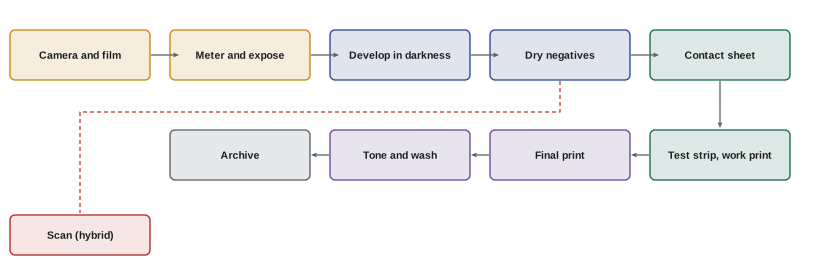
The complete black-and-white workflow taught in this course has several stages, each of which affects the final print:
- Choose a camera, format and film suited to the subject (Lessons 2 and 3).
- Meter and expose the film, placing important shadows where they will hold detail (Lessons 4 and 5).
- Develop the film in complete darkness, then stop, fix, wash and dry it to produce negatives (Lessons 6 and 7).
- Make contact sheets to see and select frames (Lesson 8).
- Print selected negatives with an enlarger, using test strips to set exposure and contrast filters to set contrast (Lesson 9).
- Refine prints by dodging, burning, split-grade printing and toning, and process them for permanence (Lesson 10).
- Store negatives and prints in archival materials.
Color films follow a similar path with different chemistry, and many photographers combine film capture with scanning and digital editing in a hybrid workflow (Lesson 11). Safety and responsible chemical handling apply throughout (Lesson 12).
Getting started
A first analog kit need not be expensive. A working manual 35 mm camera with a standard 50 mm lens, a few rolls of a forgiving black-and-white film such as a 400-speed film, a handheld meter or a reliable phone metering app, and access to a darkroom or a home developing kit are enough to begin. Home film developing requires only a light-tight developing tank with reels, a changing bag, a thermometer, measuring cylinders, chemistry and a place to hang film to dry; printing requires an enlarger and a darkroom, which many people access through community darkrooms or school facilities. This course assumes access to a shared or school darkroom for printing and teaches home development of film.
Throughout the course, keep a notebook recording each roll: the film, camera, exposure decisions, development details and printing notes. Analog photography rewards systematic records, because results appear days or weeks after decisions are made, and only careful notes let you connect cause and effect.
Analog photography in Canada and the United States
Both countries have rich traditions of film photography and active analog communities today. In Canada, William Notman's Montreal studio in the nineteenth century produced hundreds of thousands of glass plate negatives now held at the McCord Stewart Museum, and the National Film Board of Canada's Still Photography Division documented the country from the 1940s to the 1980s. In the United States, the Farm Security Administration photographers of the 1930s and the f/64 group of Ansel Adams, Edward Weston and Imogen Cunningham shaped both documentary and fine art photography. Today, community darkrooms, artist-run centers, college programs and film labs in many cities offer access to darkrooms, workshops and processing, and online communities share development data, scanning techniques and camera repair knowledge. Visiting a local community darkroom is often the fastest way to learn, borrow equipment and see what experienced printers achieve.
Film and the environment
Film photography consumes materials and chemistry, and responsible practitioners consider its environmental footprint alongside its creative value. Manufacturing film uses silver, gelatin, plastics and energy; processing uses water and chemicals; and printing adds paper and further chemistry. Digital photography has its own footprint in electronics, energy and the frequent replacement of devices. Careful analog practice, shooting deliberately, processing efficiently, recovering silver and disposing of waste properly (Lesson 12), keeps the impact modest, and the longevity of negatives and prints means that a well-made analog image can last generations without migration to new storage.
What this course does and does not cover
This course concentrates on black-and-white film and silver gelatin printing, with an introduction to color film, processing and scanning. Alternative processes such as cyanotype, platinum and palladium, salt prints, wet plate collodion and lith printing are rewarding extensions that build on the same principles, and many community darkrooms offer workshops in them. Large format photography and the zone system are introduced here and can be pursued further in advanced study.
Learning by doing
Analog skills are learned through practice and repetition. Shoot regularly, develop film soon after shooting while the conditions are fresh in your memory, print often, and compare results with your notes. Share contact sheets and prints with classmates and instructors, since others often see problems and strengths that you miss.
Common mistakes
MistakeTreating film like digital and protecting highlights.
InsteadExpose negative film for the shadows.
MistakeRelying on outdated lists of available films.
InsteadCheck current manufacturer offerings and prices.
MistakeShooting film without notes.
InsteadRecord exposure, development and printing details.
MistakeExpecting instant results.
InsteadPlan for processing time and review negatives carefully.
MistakeIgnoring chemical safety and disposal.
InsteadLearn safe handling and local disposal rules from the start.
Summary and key terms
- Photographic materials evolved from heliographs and daguerreotypes to roll film and color.
- Film declined with digital but has stabilized and revived since the 2010s.
- Several manufacturers still make black-and-white film and paper; few make color film.
- Photographers choose film for its look, deliberation, physical originals and craft.
- Negative film tolerates overexposure; expose for the shadows.
- The workflow runs from exposure through development, printing and finishing.
- Careful notes connect decisions with results.
- Analog photography
- Photography using light-sensitive chemical materials.
- Daguerreotype
- Early unique image on a silvered copper plate.
- Calotype
- Early paper negative-positive process.
- Wet collodion
- Glass plate process developed while wet.
- Dry plate
- Factory-made gelatin plate that could be stored.
- Negative
- Developed film with tones reversed.
- Silver gelatin print
- Black-and-white print on gelatin silver paper.
- Hybrid workflow
- Film capture combined with scanning and digital editing.
- Roll film
- Flexible film wound on a spool.
- Enlarger
- Projector used to print negatives onto paper.
Practice problems
Work each problem on paper first, then reveal the answer to check.
Who introduced the negative-positive process?
Show answer
William Henry Fox Talbot.
What did gelatin dry plates allow?
Show answer
Factory production and storage of plates.
What was Kodak's 1888 slogan?
Show answer
"You press the button, we do the rest."
Name two current black-and-white film makers.
Show answer
Harman (Ilford, Kentmere), Foma, ADOX, Kodak.
Name three reasons people choose film.
Show answer
Look, deliberation, physical original, craft, permanence.
How should negative film be exposed?
Show answer
For the shadows.
Cost per frame of a $15 roll of 36 plus $3 chemistry?
Show answer
About $0.50.
What does a hybrid workflow combine?
Show answer
Film capture with scanning and digital editing.
What equipment is needed to develop film at home?
Show answer
Tank, reels, changing bag, thermometer, cylinders, chemistry.
Why keep a notebook?
Show answer
To connect decisions with delayed results.
Lesson quiz · 5 questions
Score 60% or more to complete this lesson.
Create a free account to save your progress, take quizzes and earn a certificate.