
PHOT-101 · Lesson 5 of 12 · 26 min
ISO, noise and the exposure value
Aperture and shutter speed control how much light reaches the sensor. The third exposure setting, ISO, does something different: it controls how strongly the sensor's signal is amplified before it becomes an image. Raising the ISO lets you use a faster shutter speed or a smaller aperture in dim light, at the cost of more visible noise, the grainy speckle that degrades detail and color. This lesson explains what ISO really does, where noise comes from and why the amount of light, not the ISO number itself, mostly decides how noisy a picture looks, how ISO affects dynamic range, how to use auto ISO well, how noise reduction works, and how the exposure value (EV) system ties aperture, shutter and ISO into one number that describes the light in a scene.
What ISO does
In film photography, ISO (formerly ASA) measured the sensitivity of the film itself: ISO 400 film needed a quarter of the light that ISO 100 film did. A digital sensor's basic sensitivity is fixed by its design. The ISO setting tells the camera how bright to make the image for a given amount of light, mostly by amplifying the sensor's analog signal before it is converted to numbers, and partly by digital scaling. Doubling the ISO doubles the brightness of the final image, one stop, just as doubling the shutter time or opening the aperture one stop would.
The crucial difference is that ISO does not change how much light the sensor actually captures. Aperture and shutter speed do. Brightening a dim exposure with ISO is like turning up the volume on a quiet recording: the music gets louder, and so does the hiss.
Every camera has a base ISO, usually 100 (sometimes 64 or 200), at which it delivers its best dynamic range and lowest noise. Cameras also offer "extended" ISOs below base (such as 50) that are produced by deliberately overexposing and pulling back, at some cost in highlight range, and above the normal maximum, which are mostly digital multiplication of a very noisy image.
Where noise comes from
Noise has several sources, of which two dominate:
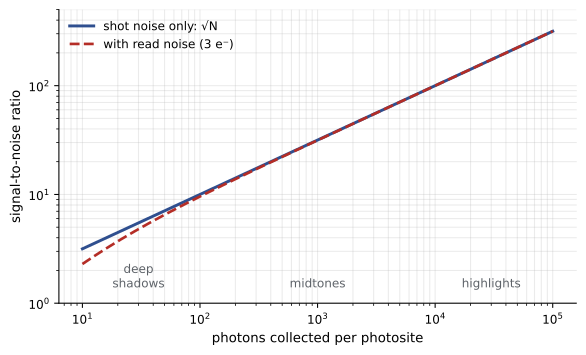
- Photon shot noise. Light arrives as discrete photons, randomly, like raindrops. If a photosite expects to collect N photons on average, the actual count fluctuates by about √N. The signal-to-noise ratio (SNR) is therefore about N/√N = √N. A bright area that collects 10,000 photons has an SNR of about 100, and looks smooth; a shadow area collecting 100 photons has an SNR of about 10, and looks grainy. Shot noise is a property of light itself and cannot be engineered away; the only cure is more light.
- Read noise. The electronics that measure and amplify each photosite add a small, fairly constant amount of noise. It matters mainly in the deepest shadows and in very dim scenes, where the signal is tiny.
Other sources include thermal noise in long exposures and hot sensors (seen as colored speckles and "hot pixels"), and fixed patterns from the sensor's structure. Cameras subtract some of these with long-exposure noise reduction, which takes a second, dark frame of the same length.
Worked problem
Light, not ISO, sets the noise
A shadow area collects 1,600 photons per photosite at a well-lit exposure. In a darker scene, at the same settings except ISO, it collects only 100. Compare the SNR, and explain why raising the ISO does not restore the clean result.
Show solution
- Well lit: SNR ≈ √1600 = 40.
- Dark scene: SNR ≈ √100 = 10, four times worse. The light is 16 times (4 stops) less.
- Raising ISO by 4 stops amplifies the signal and the noise together; the ratio stays about 10.
Answer: The darker image is noisier because it collected less light, not because of the higher ISO. Higher ISO is the symptom, not the cause. That is why a fast lens or a slower shutter speed, which gather more light, give cleaner images than the same exposure brightened with ISO.
This explains why larger sensors are less noisy (Lesson 1): at the same f-number and shutter speed, a full-frame sensor collects about 2.3 times more total light than APS-C and 4 times more than Micro Four Thirds, so its whole-image SNR is about 1.5 and 2 times higher, roughly one and two stops of noise advantage at the same output size.
ISO and dynamic range
Dynamic range is the range of brightness, from the deepest shadow that still shows detail to the brightest highlight before it clips to pure white, that a camera can record in one exposure, measured in stops. Good modern sensors capture about 12 to 14 stops at base ISO. Each doubling of ISO amplifies the signal so that highlights clip one stop sooner, while the shadow noise floor improves less, so dynamic range falls by nearly a stop per stop of ISO at higher settings. Bright, contrasty scenes are therefore best shot at base ISO, with exposure set to protect the highlights (Lesson 6).
Many current sensors are largely "ISO-invariant" above a certain point, often with a second, higher-gain mode switching in around ISO 400 to 800 (dual gain). For such cameras, an image shot at ISO 800 and brightened two stops in raw processing looks almost the same as one shot at ISO 3200, which lets photographers protect highlights in high-contrast night scenes. The general principle remains: get as much light as the picture allows, then use ISO to set the brightness.
Choosing ISO in practice
In practice, choose the aperture the picture needs for depth of field and the shutter speed it needs for motion, then raise the ISO only as far as necessary to reach a correct exposure. A sharp, noisy picture is almost always better than a clean, blurred one: noise can be reduced in editing, motion blur cannot be removed.
Auto ISO automates this. The photographer sets the aperture and shutter speed (in manual) or the aperture and a minimum shutter speed (in aperture priority), and a maximum acceptable ISO; the camera adjusts ISO to keep exposure correct as the light changes. It is ideal for events, weddings, sport and street photography where light changes quickly. Exposure compensation (Lesson 6) still works with auto ISO in manual mode on most cameras.
| Situation | Typical ISO |
|---|---|
| Sunny day outdoors | 100 |
| Overcast or open shade | 200–400 |
| Bright indoor rooms, near windows | 400–1,600 |
| Typical indoor events, evening streets | 1,600–6,400 |
| Concerts, dim interiors, night sky | 3,200–12,800 |
Noise reduction
Noise appears in two forms: luminance noise, variation in brightness that looks like film grain, and chroma noise, colored blotches, which is usually more objectionable. Cameras apply noise reduction to JPEG images, and raw processing software (Lesson 10) offers adjustable noise reduction, which trades noise for loss of fine detail: too much makes skin and foliage look plastic. Recent software uses machine-learning models trained on pairs of noisy and clean images and achieves remarkable results, often recovering one or two stops of usable ISO. Other techniques include averaging several frames of a still scene, which reduces random noise by √n for n frames, and exposing generously ("exposing to the right") so shadows collect more light (Lesson 6).
Moderate luminance noise is not always a problem. At normal viewing sizes, it is less visible than on a magnified screen, and a fine, even grain can look pleasing, particularly in black-and-white. Judge noise at the size the picture will be seen.
The exposure value
Aperture and shutter speed can be combined into one number, the exposure value (EV), which identifies all settings that give the same exposure. At ISO 100:
where N is the f-number and t the shutter time in seconds. f/8 at 1/125 s gives EV log₂(64 × 125) ≈ 13, and so do f/5.6 at 1/250 s and f/11 at 1/60 s. Each higher EV is one stop less light admitted. Light meters often report the brightness of a scene as the EV needed at ISO 100: a bright, sunny scene is about EV 15, and a dim interior about EV 6 or 7. At a higher ISO, the required EV rises by one for each doubling of ISO.
| Scene (ISO 100) | Approximate EV | Example settings |
|---|---|---|
| Snow or beach in bright sun | 16 | f/16, 1/250 s |
| Bright sun, distinct shadows | 15 | f/16, 1/125 s |
| Overcast day | 12–13 | f/8, 1/60–1/125 s |
| Open shade, heavy overcast | 11–12 | f/5.6, 1/60–1/125 s |
| Bright indoor room | 8–9 | f/2.8, 1/30–1/60 s |
| Typical home interior at night | 5–7 | f/2.8, 1/4–1/15 s |
| Floodlit buildings, city at night | 3–6 | f/4, 1/4–2 s |
| Full-moon landscape | −3 to −2 | f/2.8, about 30–60 s |
The sunny 16 rule
Before built-in meters, photographers relied on the sunny 16 rule: in bright sun, set the aperture to f/16 and the shutter speed to the reciprocal of the ISO, so 1/100 s (or 1/125) at ISO 100. From there, open up for dimmer conditions: f/11 for slight overcast, f/8 for overcast, f/5.6 for heavy overcast, f/4 for open shade at sunset. It still works, and it is a quick check that a meter reading is sensible, especially with bright or dark subjects that fool meters (Lesson 6).
Worked problem
Indoor event settings
An indoor event meters at about EV 7 at ISO 100. You need 1/250 s to freeze people moving and want f/2.8. What ISO do you need?
Show solution
- f/2.8 at 1/250 s corresponds to EV log₂(7.84 × 250) ≈ 11.
- The scene provides EV 7 at ISO 100; you need 4 more stops of brightness.
- ISO 100 × 2⁴ = ISO 1,600.
Answer: ISO 1,600. If that is noisier than you would like, consider whether 1/125 s would freeze the action well enough (ISO 800), or use a faster lens at f/1.8 (about ISO 640), or add light with flash (PHOT-102). Each choice has a visual cost; choose the one that harms the picture least.
Common mistakes
MistakeBelieving high ISO itself creates most of the noise.
InsteadLow light creates the noise; ISO brightens it along with the signal.
MistakeKeeping ISO low at the cost of a blurred picture.
InsteadA sharp, noisy image is better than a clean, blurred one.
MistakeShooting high-contrast scenes at high ISO when light allows base ISO.
InsteadUse base ISO to preserve dynamic range.
MistakeApplying heavy noise reduction to every image.
InsteadJudge at the final viewing size; excess reduction smears detail.
MistakeForgetting that EV tables assume ISO 100.
InsteadAdd one EV per doubling of ISO.
Summary and key terms
- ISO sets how much the sensor signal is amplified; it does not change the light captured.
- Photon shot noise gives SNR ≈ √N, so more light means cleaner images.
- Larger sensors collect more total light and show less noise at the same settings.
- Dynamic range is greatest at base ISO and falls as ISO rises.
- Choose aperture and shutter for the picture, then raise ISO only as needed; auto ISO automates this.
- Noise reduction trades noise for detail; modern AI tools recover one to two stops.
- EV = log₂(N²/t) at ISO 100 describes scene brightness; the sunny 16 rule is a quick check.
- ISO
- The setting that controls the brightness of the image for a given exposure, by amplification.
- Base ISO
- The ISO giving a camera's best dynamic range and lowest noise.
- Noise
- Random variation in brightness or color that obscures detail.
- Photon shot noise
- Noise from the random arrival of photons, proportional to √N.
- Read noise
- Noise added by the sensor's readout electronics.
- Signal-to-noise ratio
- The ratio of signal to noise; higher is cleaner.
- Dynamic range
- The range of brightness a sensor can record, in stops.
- Auto ISO
- A mode in which the camera adjusts ISO within set limits.
- Exposure value
- A number identifying combinations of aperture and shutter speed with equal exposure.
- Sunny 16 rule
- In bright sun, f/16 at a shutter speed of 1/ISO gives correct exposure.
Practice problems
Work each problem on paper first, then reveal the answer to check.
How many stops brighter is ISO 3,200 than ISO 200?
Show answer
Four stops.
A photosite collects 2,500 photons. What is its shot-noise SNR?
Show answer
√2500 = 50.
If the light falls by 2 stops, by what factor does shot-noise SNR fall?
Show answer
By 2 (the photon count falls by 4).
Why is a fast lens better than raising ISO for a dim scene?
Show answer
It gathers more light, improving the signal-to-noise ratio.
Find the EV of f/4 at 1/60 s (ISO 100).
Show answer
log₂(16 × 60) ≈ 9.9, about EV 10.
Give two other aperture-shutter pairs with the same EV as f/8 at 1/125 s.
Show answer
For example f/5.6 at 1/250 s and f/11 at 1/60 s.
Using sunny 16, what are the settings at ISO 400 in bright sun?
Show answer
f/16 at 1/400 s (or 1/500 s).
A scene is EV 9 at ISO 100. What shutter speed is needed at f/2.8 and ISO 800?
Show answer
At ISO 800 the scene is EV 12; f/2.8 needs t = 7.84/2¹² ≈ 1/500 s.
Why shoot bright, contrasty landscapes at base ISO?
Show answer
To get the most dynamic range.
How does averaging 4 frames of a still scene affect random noise?
Show answer
It reduces it by √4 = 2 (one stop).
Lesson quiz · 5 questions
Score 60% or more to complete this lesson.
Create a free account to save your progress, take quizzes and earn a certificate.