
PET-440 · Lesson 10 of 12 · 19 min
Gas sweetening and NGL recovery
The Kessler 3H analysis showed no hydrogen sulfide and 1.4 percent carbon dioxide, which is below the usual 2 percent pipeline limit. The Ten Mile Ridge gas is sweet, and the Ten Mile Ridge processing plant will not need an amine unit to sell gas into the interstate system. But Lena wants the team to understand acid gas treating anyway. Part of the gas may one day be sold under a contract that requires LNG feed quality, and Prairie Crest's other assets include sour gas. More important for this plant, the gas carries about 7 percent propane and heavier and 8.5 percent ethane, liquids worth far more than the gas they ride in. Gwen lays out the processing options: amine treating, sulfur recovery for sour gas, and the deep-cut NGL train. “Liquids are where this plant earns its keep,” she says.
Acid gases and why they come out
Hydrogen sulfide is toxic, corrosive and odorous. At low concentrations it smells of rotten eggs, but at higher concentrations it paralyzes the sense of smell, and exposure to a few hundred parts per million can be fatal within minutes. Sour gas facilities therefore have gas detection, breathing apparatus, emergency shutdown systems, emergency planning zones around wells and pipelines, and materials resistant to sulfide stress cracking, specified to NACE MR0175/ISO 15156. Carbon dioxide is not toxic at pipeline concentrations but forms carbonic acid with water, which corrodes carbon steel, and it dilutes the heating value. Pipelines limit hydrogen sulfide to a few parts per million and carbon dioxide to about 2 percent. LNG plants need carbon dioxide below about 50 ppm, because it would freeze at liquefaction temperatures.
Amine treating
Most acid gas is removed by chemical absorption in aqueous alkanolamine solutions. The amine reacts reversibly with hydrogen sulfide and carbon dioxide: the reaction runs forward at the high pressure and moderate temperature of the absorber and backward at the low pressure and high temperature of the regenerator. Sour gas flows up through the absorber against lean amine; sweet gas leaves the top. The rich amine is flashed to release dissolved hydrocarbons, heated in a lean-rich exchanger and stripped with steam from a reboiler in the regenerator, which releases the acid gas at the top. The lean amine is cooled and pumped back.
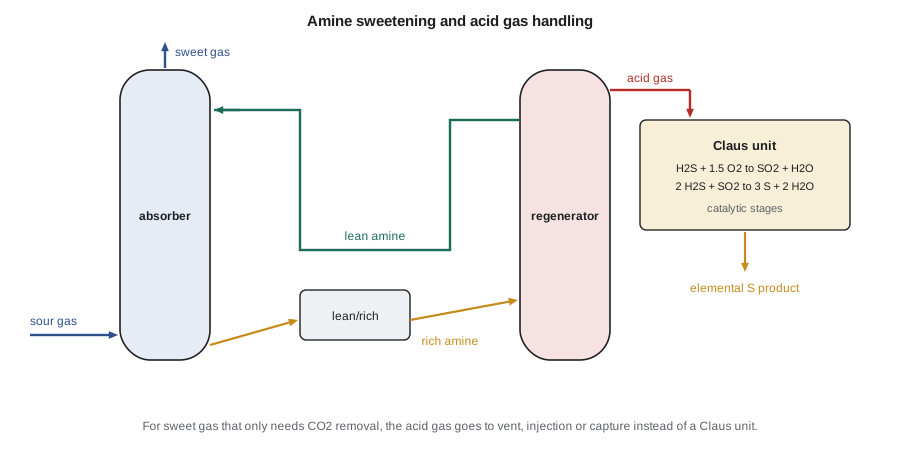
The choice of amine sets much of the design. Monoethanolamine (MEA) is the most reactive and removes both acid gases, but it is corrosive and limited to low concentrations and loadings. Diethanolamine (DEA) is less reactive and less corrosive. Methyldiethanolamine (MDEA), a tertiary amine, reacts quickly with hydrogen sulfide but only slowly with carbon dioxide, so a short-contact absorber can remove hydrogen sulfide selectively and let much of the carbon dioxide slip into the sales gas. That selectivity reduces circulation and energy and concentrates hydrogen sulfide in the acid gas, which helps the sulfur plant. Activated MDEA, with a piperazine promoter, is used when deep carbon dioxide removal is needed, as for LNG feed. Physical solvents and membranes suit very high acid gas partial pressures.
A first estimate of the circulation rate follows from stoichiometry. The moles of acid gas to remove per day, divided by the net loading of the amine, in moles of acid gas picked up per mole of amine, give the moles of amine to circulate; the solution strength and density convert that to a volume. Net loadings of 0.3 to 0.45 mol/mol are typical for MDEA. Reboiler duty, the main operating cost, scales roughly with the circulation rate.
# Amine sweetening, sulfur recovery and NGL recovery for a 150 MMscf/d (about 4.2 x 10^6 m3/d) plant.
SI = False     # True: metric units, False: oilfield units

Q = 150e6                                     # plant inlet gas, scf/d
h2s = 0.0020 if SI else 0.0                   # sour Montney gas (Canada) / sweet Marcellus gas (US)
co2 = 0.0140 - h2s
lbmol = Q / 379.5                             # lb-mol of gas per day
# MDEA unit removing all H2S and enough CO2 to meet 2 mol% (pipeline) or 50 ppm (LNG feed)
for label, co2_out in (("pipeline spec, 2 mol% CO2", 0.02), ("LNG feed spec, 50 ppm CO2", 50e-6)):
    ag = lbmol * (h2s + max(co2 - co2_out, 0.0))   # lb-mol acid gas picked up per day
    if ag == 0:
        print(f"{label}: no CO2 removal needed" + ("; H2S must still come out" if h2s else ""))
        if not h2s: continue
        ag = lbmol * h2s
    amine = ag / 0.35                         # lb-mol MDEA at a net loading of 0.35 mol acid gas per mol amine
    sol = amine * 119.16 / 0.50               # lb/d of 50 wt% solution
    gpm = sol / 8.67 / 1440                   # US gal/min at 8.67 lb/gal
    print(f"{label}: acid gas {ag * 0.4536:,.0f} kmol/d, MDEA solution {gpm * 0.2271:,.0f} m3/h" if SI else
          f"{label}: acid gas {ag:,.0f} lb-mol/d, MDEA solution {gpm:,.0f} gal/min")
if h2s:
    S = lbmol * h2s * 32.06 * 0.985 * 0.4536 / 1000    # metric tons/d of sulfur at 98.5 percent recovery
    print(f"Claus sulfur recovery: {S:.1f} metric tons/d of sulfur; {lbmol * h2s * 0.015 * 0.4536:.2f} kmol/d of H2S equivalent to the incinerator")

# NGL recovery in a turboexpander plant: (component, mole fraction, molar mass, liquid density lb/gal, recovery)
ngl = [('C2', 0.0850, 30.070, 2.970, 0.85), ('C3', 0.0350, 44.097, 4.223, 0.98), ('iC4', 0.0060, 58.123, 4.686, 0.995),
       ('nC4', 0.0100, 58.123, 4.865, 0.998), ('C5+', 0.0250, 96.0, 5.60, 1.0)]
tot_gal = 0.0; tot_mol = 0.0
for name, y, mw, rho, rec in ngl:
    gal = lbmol * y * rec * mw / rho          # US gallons per day of liquid product
    tot_gal += gal; tot_mol += lbmol * y * rec
    print(f"  {name:4s} {gal * 0.0037854:8,.0f} m3/d" if SI else f"  {name:4s} {gal / 42:8,.0f} bbl/d")
print(f"Total NGL {tot_gal * 0.0037854:,.0f} m3/d" if SI else f"Total NGL {tot_gal / 42:,.0f} bbl/d")
print(f"Shrinkage of the gas stream by liquids removal: {tot_mol / lbmol:.1%}")pipeline spec, 2 mol% CO2: no CO2 removal needed LNG feed spec, 50 ppm CO2: acid gas 5,514 lb-mol/d, MDEA solution 301 gal/min C2 6,884 bbl/d C3 3,371 bbl/d iC4 697 bbl/d nC4 1,122 bbl/d C5+ 4,033 bbl/d Total NGL 16,107 bbl/d Shrinkage of the gas stream by liquids removal: 14.8%
For the 150 MMscf/d plant, the pipeline specification needs no carbon dioxide removal at all. Treating the same gas to LNG feed quality, below 50 ppm of carbon dioxide, would need an activated MDEA unit circulating about 300 gallons per minute of 50 weight percent solution, with a reboiler duty to match. That treating is done at the liquefaction plant, which is why LNG feed contracts usually accept pipeline-quality gas.
Sulfur recovery and acid gas disposal
The acid gas from the regenerator of a sour plant is mostly hydrogen sulfide and carbon dioxide with some water and hydrocarbons. It cannot be vented. The Claus process converts hydrogen sulfide to elemental sulfur in two steps. In the thermal stage, a furnace burns one-third of the hydrogen sulfide to sulfur dioxide; in two or three catalytic stages, the remaining hydrogen sulfide reacts with the sulfur dioxide over alumina or titania catalyst to form sulfur, which is condensed between stages:
A modified Claus unit with three catalytic stages recovers about 96 to 98 percent of the sulfur. Tail gas treating units, which convert the remaining sulfur compounds back to hydrogen sulfide and recycle them, raise overall recovery to 99.8 percent or more. Regulators set minimum recovery levels that rise with plant size, and the tail gas is incinerated before release, so sulfur dioxide emissions are monitored. The liquid sulfur is degassed, formed into prills or blocks and sold, mostly for fertilizer manufacture.
For smaller sour plants, especially where sulfur markets are poor, acid gas injection is an alternative: the acid gas is compressed, dehydrated and injected into a deep saline aquifer or depleted reservoir. Western Canada has many acid gas injection schemes, operating since the late 1980s, and the experience gained has informed carbon capture and storage projects. For the Ten Mile Ridge processing plant, which is sweet, the question does not arise; the small carbon dioxide stream from any future treating would be vented or, if a capture project is built, compressed for storage.
NGL recovery
Natural gas liquids are recovered by cooling the gas until the heavier components condense. The deeper the cooling, the more ethane and propane are recovered. Three main processes are used. Refrigeration plants chill the gas with propane refrigerant to about −20 °F, enough to meet the hydrocarbon dew point and recover much of the butanes and heavier but only part of the propane. Lean oil absorption, once common, has been largely replaced. Cryogenic turboexpander plants, the modern standard for rich gas, cool the dry, treated gas against cold residue gas in a brazed aluminum exchanger, then expand it through a turboexpander. The expander does work on a compressor wheel as the gas expands, which cools the gas much more than a simple valve would, to about −130 to −150 °F. The cold gas and liquids feed a demethanizer column, which sends methane overhead as residue gas and recovers 80 to 95 percent of the ethane and nearly all the propane and heavier in its bottoms.
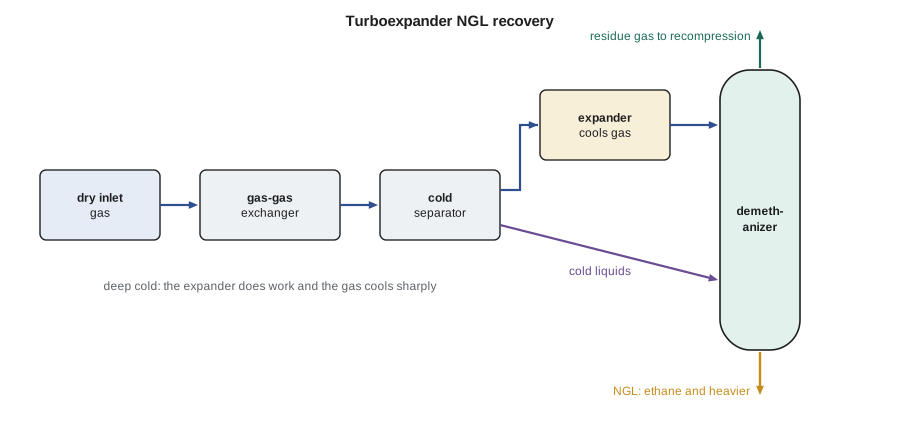
The NGL stream, often called Y-grade, is either sold as a mixture or fractionated into ethane, propane, butanes and natural gasoline in a series of columns: a deethanizer, a depropanizer and a debutanizer. Ethane recovery is a commercial choice made month by month in many plants. When ethane is worth more as a petrochemical feedstock than as fuel in the gas stream, the plant recovers it; when it is not, the plant runs in ethane rejection and leaves most of the ethane in the residue gas, which raises the gas's heating value. In the Appalachian Basin, ethane is moved by pipeline to export terminals and to a cracker in western Pennsylvania, and plants frequently switch between recovery and rejection.
Removing liquids shrinks the gas. The code shows that recovering 85 percent of the ethane and all the heavier components from the Ten Mile Ridge gas removes about 15 percent of the molecules, which the residue gas sales volume must reflect. Fuel for compressors and heaters takes another few percent. The plant also lowers the heating value of the residue gas, from about 1,250 to 1,050 Btu/scf, bringing it within the pipeline's heating value range.
Worked problem
NGL production from a GPM analysis
A plant processes 100 MMscf/d of gas with a propane content of 3.0 mole percent and recovers 95 percent of it. Propane has a molar mass of 44.1 and a liquid density of 4.22 lb/gal . Find the propane product rate.
Show solution
- Gas moles per day: 100 × 10⁶ / 379.5 = 263,500 lb-mol/d .
- Propane recovered: 263,500 × 0.030 × 0.95 = 7,510 lb-mol/d, or 7,510 × 44.1 = 331,200 lb/d.
- Liquid volume: 331,200 / 4.22 = 78,500 gal/d = 1,870 bbl/d .
Answer: The plant makes about 1,870 bbl/d of propane. The propane GPM of the gas, 3.0 percent × 27.5 = 0.82 gallons per thousand cubic feet, gives the same answer with less arithmetic.
Product specifications and markets
Each NGL product has its own specification. Propane sold as fuel (HD-5 grade) limits ethane, butanes, sulfur and water. Ethane for crackers limits methane and carbon dioxide. Condensate and natural gasoline are specified by vapor pressure, so they are stabilized to a Reid vapor pressure that allows safe storage. The plant design balances recoveries against the market for each product and the cost of transporting it, by pipeline, rail or truck. Prairie Crest's marketing group will sign the NGL and condensate contracts before the plant is sanctioned, because the liquids revenue is as large as the gas revenue in the early years.
Common mistakes
MistakeChoosing a non-selective amine when only hydrogen sulfide must be removed.
InsteadUse MDEA for selective hydrogen sulfide removal and let carbon dioxide slip, reducing circulation and energy.
MistakeTreating NGL recovery as a fixed design decision.
InsteadEthane recovery or rejection is a commercial choice that can change with prices; design for flexibility.
MistakeForgetting gas shrinkage when forecasting sales gas from raw gas.
InsteadSubtract the liquids removed and the fuel used to get the residue gas sales volume.
MistakeFeeding gas to a cryogenic plant without deep dehydration and carbon dioxide control.
InsteadWater and carbon dioxide freeze at cryogenic temperatures; use molecular sieves and meet the plant's carbon dioxide limit.
Summary and key terms
- Hydrogen sulfide is lethal and corrosive; carbon dioxide is corrosive with water and dilutes heating value; both are limited by pipeline and LNG specifications.
- Amine units absorb acid gas at high pressure and release it on heating; MDEA allows selective hydrogen sulfide removal.
- The Claus process converts hydrogen sulfide to elemental sulfur; tail gas treating raises recovery above 99.8 percent.
- Acid gas injection is an alternative to sulfur recovery, widely used in western Canada.
- Turboexpander plants cool gas by work expansion to recover most ethane and nearly all heavier liquids.
- Liquids removal shrinks the gas and lowers its heating value; ethane recovery depends on prices.
- Sour gas
- Natural gas containing hydrogen sulfide above a specified limit.
- Amine
- An alkanolamine solution, such as MEA, DEA or MDEA, that absorbs acid gases.
- Net loading
- Moles of acid gas picked up per mole of amine circulated.
- Claus process
- Conversion of hydrogen sulfide to elemental sulfur by partial combustion and catalytic reaction.
- Turboexpander
- A machine that expands gas while extracting work, cooling the gas sharply.
- Demethanizer
- The column that separates methane from ethane and heavier liquids.
- Ethane rejection
- Operating an NGL plant so that most ethane stays in the residue gas.
Practice problems
Work each problem on paper first, then reveal the answer to check.
Why does MDEA allow selective hydrogen sulfide removal?
Show answer
It reacts quickly with hydrogen sulfide but slowly with carbon dioxide.
What fraction of hydrogen sulfide is burned in the Claus furnace?
Show answer
About one-third, to make the sulfur dioxide that reacts with the rest.
Why does a turboexpander cool gas more than a valve?
Show answer
It extracts work from the gas, so the expansion is close to isentropic rather than isenthalpic.
A gas contains 2.0 percent propane. What is its propane GPM?
Show answer
0.020 × 27.5 = about 0.55 gal/Mscf.
Lesson quiz · 5 questions
Score 60% or more to complete this lesson.
Create a free account to save your progress, take quizzes and earn a certificate.