
PET-440 · Lesson 1 of 12 · 24 min
Natural gas composition and phase behavior
Three years after the Tamarack Lake waterflood became a pool-wide project, Prairie Crest Energy Inc. has made the largest acquisition in its history: a block of Marcellus rights in Pennsylvania, about 70 miles from Waynesburg. The company now calls the block the Ten Mile Ridge project. Four horizontal wells drilled by the previous owner have produced for two years into a third-party plant, and the plan is to build a company-owned gas plant, drill a long program of wells and sell the gas into the interstate pipeline network that supplies both East Coast markets and the Gulf Coast LNG terminals. Lena Haugen, now the vice-president of development, has put Ethan Cardinal on the new gas asset team. His lead is Farid Mansour, a senior gas engineer who spent fifteen years on deep gas and condensate fields before joining Prairie Crest. “Oil engineers think of gas as the stuff that comes out of solution,” Farid tells him on the first day. “Here gas is the product. Every decision starts with what the gas is made of and how it behaves when pressure and temperature change.”
This course follows the Ten Mile Ridge team from the first gas analysis to a field development plan. Along the way it covers gas properties, gas in place and material balance, water influx, deliverability, well testing, condensate reservoirs, tight and shale gas, gas processing, pipelines and compression. This first lesson sets out what natural gas is and how its phase behavior decides almost everything that follows.
What natural gas is
Natural gas is a mixture of light hydrocarbons, mostly methane, with smaller amounts of ethane, propane, butanes and heavier compounds, plus non-hydrocarbon gases. The common non-hydrocarbons are nitrogen, carbon dioxide, hydrogen sulfide, water vapor and, in some fields, helium. Each component matters for a different reason. Methane carries most of the heating value. Ethane, propane, butanes and pentanes plus are worth more as liquids than as fuel and are recovered as natural gas liquids, or NGLs. Nitrogen and carbon dioxide dilute the heating value and must be kept below pipeline limits. Hydrogen sulfide is lethal at low concentrations, corrosive and the reason sour gas plants exist. Water causes corrosion and hydrates and must be removed before the gas is sold.
Gas engineers describe composition in mole fractions, because the gas laws work with moles. A gas analysis from the laboratory lists each component's mole fraction, usually lumping everything heavier than hexane into a single heptanes-plus fraction, C7+, with a measured molar mass and specific gravity. Mei Lin, who has moved from the EOR laboratory to support the gas team, runs the analysis of a recombined sample from the Kessler 3H well: the separator gas and separator liquid were sampled at the same time and recombined in the laboratory at the measured producing ratio, so the analysis describes the fluid that actually leaves the reservoir.
| Component | Mole percent | Notes |
|---|---|---|
| Nitrogen | 0.80 | inert; lowers heating value |
| Carbon dioxide | 1.40 | acid gas; corrosive with water |
| Hydrogen sulfide | none detected | sweet gas |
| Methane | 81.70 | main fuel component |
| Ethane | 8.50 | recoverable as NGL |
| Propane | 3.50 | NGL |
| i-Butane and n-butane | 1.60 | NGL |
| i-Pentane and n-pentane | 0.80 | condensate and NGL |
| Hexanes | 0.40 | condensate |
| Heptanes plus | 1.30 | condensate; molar mass about 115 |
Ethan notices that the analysis is richer than he expected for a gas well. More than 7 percent of the molecules are propane and heavier. That makes the Ten Mile Ridge gas a liquids-rich gas, and the liquids are a large part of its value. It also means the reservoir fluid might behave very differently from the dry methane that textbooks use as the example of an ideal gas.
Molar mass, gas gravity and pseudo-critical properties
Three numbers summarize a gas composition for most engineering work. The apparent molar mass is the mole-fraction-weighted average of the component molar masses. The gas specific gravity is that molar mass divided by the molar mass of air, 28.97 g/mol:
A methane-rich dry gas has a gravity near 0.56 to 0.6; a rich wet gas or gas condensate can reach 0.75 to 0.9 or more. The pseudo-critical temperature and pressure are the mole-fraction-weighted averages of the component critical properties, a mixing rule introduced by Kay in 1936. They are not the true critical point of the mixture, which must be measured or computed with an equation of state; they are simply the scaling factors that let one chart of z-factors serve all natural gases, as Lesson 2 explains.
When a gas contains carbon dioxide or hydrogen sulfide, Kay's rule gives z-factors that are too low, because acid gas molecules interact more strongly than hydrocarbons of similar size. Wichert and Aziz published a correction in 1972 that lowers both pseudo-critical properties by an amount that depends on the acid gas content. For the Ten Mile Ridge gas the correction is small, but for a gas with 10 or 20 percent acid gas, common in some deep carbonate reservoirs, it changes the z-factor by several percent.
# Molar mass, gas gravity, pseudo-critical properties and heating value of the Caribou Ridge separator gas.
SI = False     # True: metric units, False: oilfield units

h2s = 0.0020 if SI else 0.0      # the Canadian Montney gas is slightly sour; the Marcellus gas is sweet
# name: (mole fraction, molar mass g/mol, Tc K, pc kPa, gross heating value Btu/scf, liquid density lb/gal)
comp = {
    'N2':   (0.0080, 28.013, 126.2, 3394, 0.0, None),
    'CO2':  (0.0140 - h2s, 44.010, 304.1, 7374, 0.0, None),
    'H2S':  (h2s, 34.082, 373.5, 8963, 637.1, None),
    'C1':   (0.8170, 16.043, 190.6, 4599, 1010.0, None),
    'C2':   (0.0850, 30.070, 305.3, 4872, 1769.7, None),
    'C3':   (0.0350, 44.097, 369.8, 4248, 2516.1, 4.223),
    'iC4':  (0.0060, 58.123, 408.1, 3648, 3251.9, 4.686),
    'nC4':  (0.0100, 58.123, 425.1, 3796, 3262.3, 4.865),
    'iC5':  (0.0040, 72.150, 460.4, 3381, 4000.9, 5.199),
    'nC5':  (0.0040, 72.150, 469.7, 3370, 4008.9, 5.251),
    'C6':   (0.0040, 86.177, 507.6, 3025, 4755.9, 5.526),
    'C7+':  (0.0130, 115.0, 575.0, 2650, 6180.0, 5.92),
}
total = sum(v[0] for v in comp.values())
assert abs(total - 1) < 1e-9, total
M = sum(y * mw for y, mw, *_ in comp.values())
gg = M / 28.966
Tpc = sum(y * tc for y, _, tc, *_ in comp.values())
ppc = sum(y * pc for y, _, _, pc, *_ in comp.values())
# Wichert-Aziz correction for CO2 and H2S (temperatures in degrees Rankine, pressures in psia)
A = comp['CO2'][0] + comp['H2S'][0]; B = comp['H2S'][0]
eps = 120 * (A ** 0.9 - A ** 1.6) + 15 * (B ** 0.5 - B ** 4)        # deg R
TpcR, ppcpsi = Tpc * 1.8, ppc * 0.145038
TpcR2 = TpcR - eps
ppc2 = ppcpsi * TpcR2 / (TpcR + B * (1 - B) * eps)
hv = sum(y * h for y, _, _, _, h, _ in comp.values())         # Btu/scf, ideal gross
# liquid content of propane and heavier: US gallons per thousand standard cubic feet
gpm = sum(y * 1000 / 379.5 * mw / rho for k, (y, mw, _, _, _, rho) in comp.items() if rho)
print(f"Apparent molar mass {M:.2f} g/mol, gas gravity {gg:.3f}")
if SI:
    print(f"Kay pseudo-criticals: Tpc {Tpc:.1f} K, ppc {ppc:,.0f} kPa")
    print(f"Wichert-Aziz corrected: Tpc {TpcR2 / 1.8:.1f} K, ppc {ppc2 / 0.145038:,.0f} kPa (epsilon {eps / 1.8:.1f} K)")
    print(f"Gross heating value {hv * 0.037259:.1f} MJ/m3")
    print(f"C3+ liquid content {gpm * 0.0037854 / 28.317 * 1e6:.0f} m3 per 10^6 m3 (from {gpm:.2f} US gal/Mscf)")
else:
    print(f"Kay pseudo-criticals: Tpc {TpcR:.1f} deg R, ppc {ppcpsi:,.0f} psia")
    print(f"Wichert-Aziz corrected: Tpc {TpcR2:.1f} deg R, ppc {ppc2:,.0f} psia (epsilon {eps:.1f} deg R)")
    print(f"Gross heating value {hv:,.0f} Btu/scf")
print(f"C3+ liquid content {gpm:.2f} gal/Mscf")Apparent molar mass 21.39 g/mol, gas gravity 0.739 Kay pseudo-criticals: Tpc 395.7 deg R, ppc 665 psia Wichert-Aziz corrected: Tpc 393.2 deg R, ppc 661 psia (epsilon 2.4 deg R) Gross heating value 1,247 Btu/scf C3+ liquid content 2.59 gal/Mscf
The well stream has a molar mass of about 21.4 g/mol and a gravity of 0.74. Its gross heating value is about 1,250 Btu/scf, far above the roughly 1,000 to 1,050 Btu/scf of pipeline gas, because the heavier components carry more energy per molecule. That high heating value is a sign of liquids the gas plant will recover. The last line of the output is the propane-plus liquid content, which gas processors call the GPM: gallons of liquid per thousand standard cubic feet. At about 2.6 US gallons per thousand cubic feet, or roughly 350 m³ of liquid per million cubic meters of gas, the Ten Mile Ridge gas is rich enough for a deep-cut NGL plant to pay for itself.
Standard conditions
Gas volumes are always quoted at standard conditions, because a cubic meter of gas at reservoir pressure contains hundreds of standard cubic meters. In Canada the usual standard is 15 °C and 101.325 kPa; in the United States it is 60 °F and 14.696 psia for most purposes, with 14.73 psia in many gas contracts. The two are close but not identical, so a careful engineer always checks which base a volume uses. Gas is also sold by energy, in gigajoules in Canada and in million British thermal units in the United States, so the heating value links the volume a well produces to the money it earns.
Phase behavior of a pure substance and a mixture
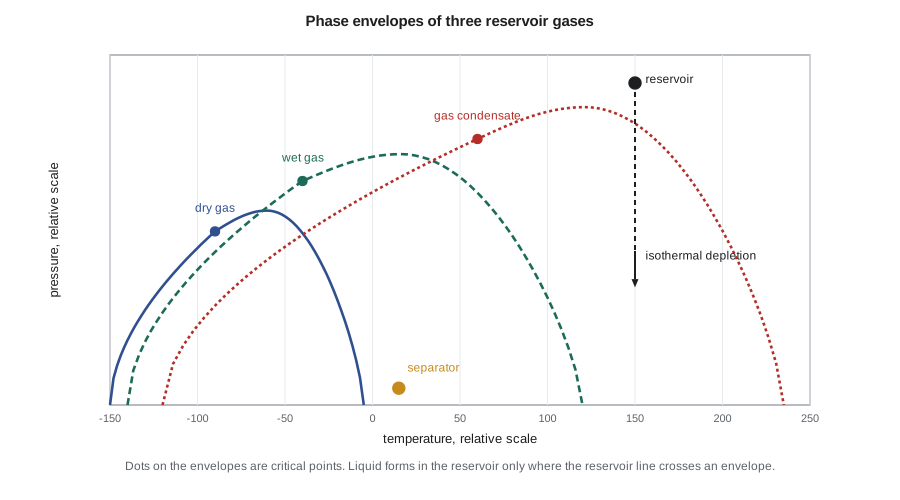
A pure substance such as methane has a single vapor pressure curve that ends at the critical point. Below the curve it is a gas; above it, a liquid; on the curve, both phases coexist. Above the critical temperature no amount of compression produces a separate liquid. A mixture behaves differently. Instead of a single curve, it has a phase envelope: a region in pressure-temperature space inside which two phases coexist. The upper-left boundary is the bubble point curve, where the first bubble of gas appears in a liquid. The right-hand boundary is the dew point curve, where the first drop of liquid appears in a gas. The two meet at the critical point. The highest pressure on the envelope is the cricondenbar and the highest temperature is the cricondentherm.
The shape of the envelope depends on composition. A gas made almost entirely of methane has a small envelope at low temperatures. Adding heavier components stretches the envelope to the right and upward, because heavier molecules condense at higher temperatures. A rich gas condensate can have a cricondentherm well above reservoir temperature, so its dew point curve passes through the reservoir's temperature at a high pressure.
The five reservoir fluid types
McCain's classification, used throughout the industry, sorts reservoir fluids into five types by where the reservoir and the separator sit relative to the phase envelope. Black oils and volatile oils have critical temperatures above reservoir temperature, so they are liquids in the reservoir; they were the subject of the oil courses. The three gas types have critical temperatures below reservoir temperature.
A dry gas lies entirely to the right of its envelope at both reservoir and separator conditions. No liquid forms anywhere in the production system, and the gas produces only some water. Dry gas is mostly methane, with a gravity around 0.55 to 0.6. A wet gas lies to the right of its envelope at reservoir conditions, so no liquid forms in the reservoir, but the separator sits inside the envelope and some liquid condenses at the surface. Wet gases produce a light liquid, often colorless, at condensate-gas ratios of a few to perhaps 20 barrels per million standard cubic feet. A gas condensate, or retrograde gas, has a critical temperature below reservoir temperature but a cricondentherm above it. As reservoir pressure falls below the dew point, liquid condenses in the reservoir itself. That liquid is mostly lost, because it rarely reaches a saturation high enough to flow. Gas condensates have initial condensate-gas ratios from about 20 to more than 200 barrels per million standard cubic feet.
| Fluid type | Liquid in reservoir? | Liquid at surface? | Typical initial yield | Typical liquid color |
|---|---|---|---|---|
| Dry gas | No | No (water only) | none | none |
| Wet gas | No | Yes | up to about 20 bbl/MMscf | water-white |
| Gas condensate | Yes, below the dew point | Yes | about 20 to 200 bbl/MMscf | water-white to light amber |
| Volatile oil | Liquid | Yes, with much gas | GOR 300 to 570 m³/m³ (1,750 to 3,200 scf/STB) | brown to green |
| Black oil | Liquid | Yes | GOR below about 300 m³/m³ | dark |
The table's boundaries are rules of thumb, not physical limits. A fluid near a boundary must be tested in the laboratory to decide whether it has a dew point or a bubble point at reservoir conditions. Farid's first question about the Kessler 3H analysis is exactly that. With an initial condensate yield near 45 barrels per million standard cubic feet, the fluid is probably a gas condensate. If so, the reservoir will begin to drop liquid as soon as its pressure falls below the dew point, and the development plan must account for that lost liquid. Lesson 7 returns to this with the laboratory's constant-volume depletion test.
Worked problem
Gas gravity from a simple composition
A separator gas from the Birch Coulee gas pool, which Prairie Crest has produced for several years, has the composition: methane 92 percent, ethane 4 percent, propane 1.5 percent, nitrogen 1.5 percent, carbon dioxide 1 percent (mole percent). Find its apparent molar mass and gas gravity, and its pseudo-critical properties by Kay's rule.
Show solution
- Molar mass: 0.92 × 16.04 + 0.04 × 30.07 + 0.015 × 44.10 + 0.015 × 28.01 + 0.01 × 44.01 = 14.76 + 1.20 + 0.66 + 0.42 + 0.44 = 17.48 g/mol.
- Gas gravity: 17.48 / 28.97 = 0.603.
- Pseudo-critical temperature: 0.92 × 190.6 + 0.04 × 305.3 + 0.015 × 369.8 + 0.015 × 126.2 + 0.01 × 304.1 = 175.4 + 12.2 + 5.5 + 1.9 + 3.0 = 198.0 K (356 °R).
- Pseudo-critical pressure: 0.92 × 4,599 + 0.04 × 4,872 + 0.015 × 4,248 + 0.015 × 3,394 + 0.01 × 7,374 = 4,231 + 195 + 64 + 51 + 74 = 4,615 kPa (669 psia).
Answer: The Birch Coulee gas pool gas has a molar mass of 17.5 g/mol, a gravity of 0.60 and pseudo-critical properties of about 198 K and 4,615 kPa (356 °R and 669 psia), typical of a lean, nearly dry gas.
Why phase behavior drives the whole project
The fluid type decides the engineering choices downstream. For a dry gas, the reservoir engineer can work with a single-phase gas from reservoir to sales line, and the plant needs only to remove water and perhaps acid gas. For a wet gas, the reservoir is still single-phase, but the surface facilities must separate, stabilize and sell a liquid, and gas-in-place calculations must use the well-stream gravity, not the separator gas gravity. For a gas condensate, the reservoir itself becomes two-phase below the dew point. Liquid builds up around the wellbore, lowering gas productivity, and the most valuable components are left behind unless pressure is kept above the dew point by cycling dry gas back into the reservoir.
Composition also decides the processing. Hydrogen sulfide means an amine unit, a sulfur recovery unit, special metallurgy, emergency planning zones and stricter regulation under federal and state rules for sour gas, although the Marcellus gas is sweet. High propane-plus content means an NGL recovery plant and a market for the liquids. Water content decides dehydration and hydrate prevention. Carbon dioxide may need removal to meet the pipeline's limit, typically 2 mole percent, and nitrogen above a few percent may need rejection to meet heating value limits. Farid sums it up for Ethan: “The analysis is the cheapest piece of data we will ever get, and it decides half the capital cost.”
Sampling therefore deserves care. A gas sample must represent the reservoir fluid, which means sampling early, before the reservoir pressure falls below the dew point; flowing the well at a low, stable rate so that liquid does not drop out near the wellbore; and recording the separator pressure, temperature and the gas and liquid rates so that the laboratory can recombine the samples at the right ratio. A gas condensate sampled after the near-well pressure has fallen below the dew point is leaner than the true reservoir fluid, because some of the heavy ends have stayed behind in the rock. Ethan learns that the Kessler 3H samples were taken in the first month of production at a choked-back rate, and that two other wells were sampled for comparison; the three analyses agree within the expected scatter.
Common mistakes
MistakeUsing the separator gas gravity to compute the z-factor of a wet gas or gas condensate in the reservoir.
InsteadUse the recombined well-stream gravity, which includes the liquids; Lesson 7 shows the recombination calculation.
MistakeTreating the pseudo-critical properties as the true critical point of the mixture.
InsteadThey are mixing-rule scaling factors for the z-factor chart; the true critical point needs measurement or an equation of state.
MistakeComparing gas volumes measured at different standard conditions.
InsteadCheck the base pressure and temperature; Canadian and US standards differ slightly, and contracts may use their own.
MistakeIgnoring acid gases in the pseudo-critical calculation.
InsteadApply the Wichert-Aziz correction whenever carbon dioxide or hydrogen sulfide is present in significant amounts.
MistakeCalling every gas that produces liquid at the surface a gas condensate.
InsteadA wet gas produces liquid only at the surface; a gas condensate also drops liquid in the reservoir below its dew point.
Summary and key terms
- Natural gas is mostly methane with heavier hydrocarbons, nitrogen, carbon dioxide, hydrogen sulfide and water; each component matters for value, safety or processing.
- Apparent molar mass, gas gravity and pseudo-critical properties summarize a composition; the Wichert-Aziz correction adjusts for acid gases.
- Mixtures have a phase envelope bounded by bubble point and dew point curves meeting at the critical point.
- Dry gases never form liquid; wet gases form liquid only at the surface; gas condensates also drop liquid in the reservoir below the dew point.
- Heating value and liquid content (GPM) link composition to sales value and processing design.
- Representative sampling early in a field's life is essential, especially for gas condensates.
- Gas gravity
- The ratio of a gas molar mass to that of air, 28.97 g/mol.
- Pseudo-critical properties
- Mole-fraction-weighted critical temperature and pressure used to scale z-factor correlations.
- Phase envelope
- The region of pressure and temperature within which a mixture forms two phases.
- Dew point
- The pressure at which the first drop of liquid forms in a gas at a given temperature.
- Cricondentherm
- The highest temperature at which two phases can coexist for a mixture.
- Gas condensate
- A reservoir gas whose dew point lies above the abandonment pressure at reservoir temperature, so liquid forms in the reservoir as pressure falls.
- GPM
- Gallons of recoverable liquid per thousand standard cubic feet of gas, a measure of gas richness.
Practice problems
Work each problem on paper first, then reveal the answer to check.
A gas has a molar mass of 19.1 g/mol. What is its gravity?
Show answer
19.1 / 28.97 = 0.66.
Why does adding heavier components move the phase envelope to the right?
Show answer
Heavier molecules condense at higher temperatures, so the dew point curve and cricondentherm move to higher temperatures.
A well produces liquid at the separator but laboratory tests show no dew point at reservoir temperature. What fluid type is it?
Show answer
A wet gas.
Why should gas condensate samples be taken early and at low rates?
Show answer
So the near-well pressure stays above the dew point and the sample keeps all its heavy components.
Lesson quiz · 5 questions
Score 60% or more to complete this lesson.
Create a free account to save your progress, take quizzes and earn a certificate.