
PET-430 · Lesson 9 of 12 · 19 min
Polymer flooding
Polymer flooding is the simplest chemical EOR method and the most widely applied. It adds a few hundred to a few thousand parts per million of a water-soluble polymer to the injection water, raising its viscosity and lowering its mobility. It does not change the residual oil saturation much; its purpose is sweep. For the Mission Canyon pool, with its favorable waterflood mobility ratio, polymer would mainly help vertical conformance in the layered sand. For heavy oil reservoirs, where waterflood mobility ratios run into the hundreds, polymer can transform a poor waterflood into a good one. Mei Lin has spent part of her career testing polymers for heavy oil floods in northern Alberta, and she walks Ethan through the design.
How polymer improves recovery
Polymer works on the mobility ratio from both sides of the fraction. It raises the viscosity of the water, and it lowers the water's effective permeability, because polymer molecules adsorb on the rock and are mechanically retained in small pores. Two laboratory quantities describe these effects. The resistance factor R_F is the ratio of the mobility of brine to the mobility of polymer solution in the same core, and combines both effects. The residual resistance factor R_RF is the ratio of brine mobility before and after polymer, and measures the permeability reduction that remains when brine follows the polymer. The mobility ratio with polymer is then:
For light oils, a polymer that brings M down from 0.5 to 0.05 improves areal sweep only slightly, but in a layered reservoir it improves vertical sweep by reducing the flow into the high-permeability layers, especially where layers communicate. For heavy oils the effect is dramatic. A 1,500 cp oil displaced by water has a mobility ratio of several hundred, and the water fingers through almost at once. Polymer at 20 cp does not make the displacement favorable, but it cuts the mobility ratio by a factor of 20 to 30, delays breakthrough, and roughly doubles or triples the oil recovered for each barrel of fluid injected.
Polymers and their behavior
Two families of polymer are used. Partially hydrolyzed polyacrylamide (HPAM), a synthetic polymer with a molecular weight of 10 to 30 million daltons, accounts for almost all field projects because it is relatively cheap and effective. Its chains carry negative charges, typically on 25 to 35 percent of the monomer units, which repel each other and stretch the molecule, so its viscosity is high in fresh water. In saline water, and especially in water containing calcium and magnesium, the charges are screened, the molecule coils and viscosity falls sharply. Xanthan gum, a biopolymer produced by fermentation, is more tolerant of salinity and shear but more expensive and vulnerable to bacterial attack. Newer synthetic polymers that include sulfonated monomers such as ATBS tolerate higher temperatures and salinities.
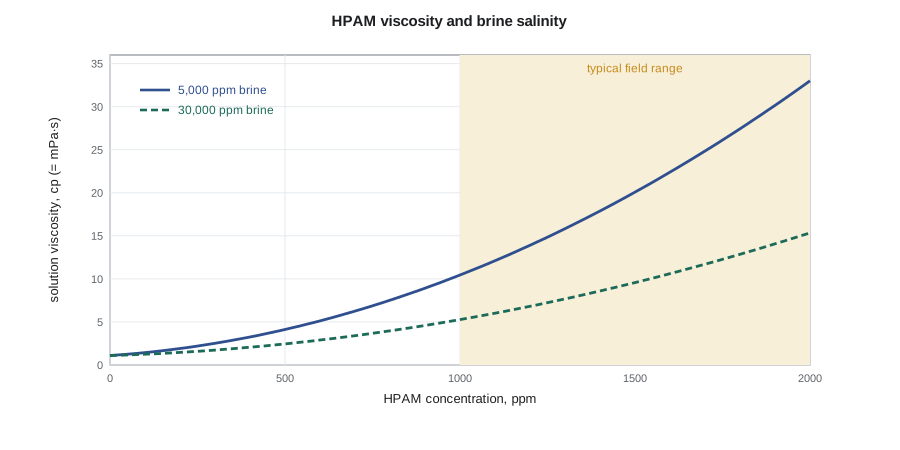
Polymer solutions are shear-thinning: their viscosity falls as the shear rate rises. Near an injection well, where the velocity is high, the viscosity is lower, which helps injectivity. HPAM solutions are also viscoelastic, and at high flow rates in porous rock their apparent viscosity can rise again, a shear-thickening effect that can hurt injectivity but that some studies suggest also helps displace residual oil slightly. Polymer can be degraded in several ways: mechanically, by high shear in chokes, pumps and perforations; chemically, by oxygen and iron, which is why injection water for polymer is kept oxygen-free; thermally, because HPAM hydrolyzes further above about 70 °C and can precipitate with calcium; and biologically, especially xanthan. The screening limit of about 93 °C (200 °F) in Lesson 1 reflects these effects.
# Polymer flood design: viscosity, mobility ratio, adsorption delay and polymer mass.
SI = False     # True: metric units, False: oilfield units
BBL = 6.2898

def visc(c_ppm, mu_w, sal_ppm):
    """HPAM solution viscosity at low shear; salinity screens the polymer charge."""
    f = (sal_ppm / 5000.0) ** -0.45
    return mu_w * (1 + f * (2.5e-3 * c_ppm + 6e-6 * c_ppm ** 2))

mu_w = 1.1                       # brine viscosity at 17 C, mPa.s
print("HPAM viscosity, " + ("mPa·s" if SI else "cp") + ", in two brines")
for c in (500, 1000, 1500, 2000):
    print(f"  {c:5d} ppm: {visc(c, mu_w, 5000):6.1f} in 5,000 ppm brine, {visc(c, mu_w, 30000):6.1f} in 30,000 ppm brine")

# Mobility ratio in a heavy oil sand (Pelican Lake-like) with water and polymer
mu_o, kro, krw, rrf = 1500.0, 0.85, 0.20, 1.5
for name, mu in (('water', mu_w), ('1,500 ppm polymer', visc(1500, mu_w, 5000))):
    lam = krw / (mu * (rrf if 'poly' in name else 1.0))
    print(f"  {name:18s} M = {lam / (kro / mu_o):6.1f}")

# Adsorption delay and inaccessible pore volume
rho_r, phi, gamma, c, ipv = 2650.0, 0.30, 30e-6, 1.5, 0.15   # kg/m3, -, kg/kg, kg/m3, PV
delay = rho_r * (1 - phi) * gamma / (phi * c)
print(f"Adsorption delay {delay:.3f} PV, inaccessible pore volume {ipv:.2f} PV, net front lag {delay - ipv:+.3f} PV")

# Polymer for a 0.6 PV slug in one pattern
area, h = 16.2e4, 5.0                         # m2, m
pv = area * h * phi
mass = 0.6 * pv * c / 1000                    # metric tons
inc = 0.10 * pv * 0.70                        # incremental oil, 10 % of OOIP at So = 0.70
cost = mass * 1000 * 3.0                      # 3 dollars per kg
if SI:
    print(f"Pattern pore volume {pv / 1e3:,.0f} thousand m³; polymer {mass:,.0f} t; incremental oil {inc / 1e3:,.0f} thousand m³")
    print(f"Polymer cost {cost / 1e6:.2f} million dollars, {cost / inc:.1f} dollars per m³ of incremental oil")
else:
    print(f"Pattern pore volume {pv * BBL / 1e6:.2f} million bbl; polymer {mass * 2204.6 / 1e3:,.0f} thousand lb; incremental oil {inc * BBL / 1e3:,.0f} thousand bbl")
print(f"Polymer cost {cost / 1e6:.2f} million dollars, {cost / (inc * BBL):.2f} dollars per incremental barrel")HPAM viscosity, cp, in two brines
500 ppm: 4.1 in 5,000 ppm brine, 2.5 in 30,000 ppm brine
1000 ppm: 10.5 in 5,000 ppm brine, 5.3 in 30,000 ppm brine
1500 ppm: 20.1 in 5,000 ppm brine, 9.6 in 30,000 ppm brine
2000 ppm: 33.0 in 5,000 ppm brine, 15.3 in 30,000 ppm brine
water M = 320.9
1,500 ppm polymer M = 11.7
Adsorption delay 0.124 PV, inaccessible pore volume 0.15 PV, net front lag -0.026 PV
Pattern pore volume 1.53 million bbl; polymer 482 thousand lb; incremental oil 107 thousand bbl
Polymer cost 0.66 million dollars, 6.13 dollars per incremental barrelRetention and inaccessible pore volume
Polymer is retained in the rock by adsorption on mineral surfaces and by mechanical trapping in narrow pore throats, typically 10 to 100 micrograms per gram of rock in sandstones. Retention strips polymer from the leading edge of the slug, so the polymer front lags the water front. The delay, in pore volumes, is:
where ρ_r is the rock grain density, Γ the retention per unit mass of rock and C the polymer concentration. Working against this, large polymer molecules cannot enter the smallest pores, which form an inaccessible pore volume, often 10 to 30 percent of the total. Polymer moves only through the accessible pores, so it travels faster than the water it was injected with. In the example in the code the two effects nearly cancel; in tight or clay-rich rock retention dominates and much more polymer must be injected before the slug becomes effective. Retention also sets a lower limit on permeability: in rock below about 10 mD, high molecular weight HPAM is retained so strongly that it plugs the formation.
Designing a polymer flood
A polymer flood design chooses the polymer, its concentration, the slug size and the timing. Concentration is chosen to give a target viscosity, often enough to make the mobility ratio about one for light oils or as high as injectivity allows for heavy oils. Slug sizes in successful projects have grown over time. Early projects in the 1970s and 1980s injected small slugs of 10 to 20 percent of the pore volume at low concentrations and saw little benefit. Modern projects inject 0.5 to 1 pore volume or more, at concentrations of 1,000 to 2,500 ppm, and some inject polymer continuously. Polymer injected early in the life of a waterflood, while oil saturation is high, gives a larger and faster response than polymer injected in a mature, watered-out flood.
Worked problem
Adsorption delay of a polymer slug
A sandstone has a porosity of 0.30 and a grain density of 2,650 kg/m³. The polymer retention measured in a coreflood is 30 μg/g and the injection concentration is 1,500 ppm, or 1.5 kg/m³. The inaccessible pore volume is 0.15. Find the delay of the polymer front due to retention and the net lag behind the water front.
Show solution
- Retention per unit bulk volume is ρ_r (1 − φ) Γ = 2,650 × 0.70 × 30 × 10⁻⁶ = 0.0557 kg/m³.
- Polymer carried per unit bulk volume at the injected concentration is φ C = 0.30 × 1.5 = 0.45 kg/m³.
- The delay is D = 0.0557 / 0.45 = 0.124 pore volumes.
- The inaccessible pore volume speeds the polymer by 0.15 PV, so the net lag is 0.124 − 0.15 = −0.026 PV.
Answer: Retention alone would delay the polymer by about 0.12 pore volumes, but the inaccessible pore volume more than offsets it, so the polymer front arrives slightly ahead of the water injected with it.
Pelican Lake: polymer in heavy oil
The best-known example of polymer flooding in heavy oil is the Pelican Lake field in northern Alberta, Canada. The oil lies in the Wabiskaw sand, a thin, laterally extensive, high-permeability unit a few hundred meters deep, and its viscosity is in the range of hundreds to thousands of cp, too viscous for an efficient waterflood but too thin and deep for thermal methods. The field was developed from the late 1980s with long horizontal wells on primary production, which recovered only a few percent of the oil. Polymer flooding was tested from the mid-2000s with alternating horizontal injectors and producers, the response was strong, and Canadian Natural Resources and other operators expanded it across much of the field. In the United States, a polymer flood pilot in viscous oil at the Milne Point field on the Alaska North Slope, begun in 2018, has drawn on the same ideas.
Pelican Lake changed the industry's view of where polymer can work. The old screening limit of about 150 cp assumed vertical wells and small slugs. With horizontal wells, which give large injectivity and short interwell distances, and with continuous injection of large volumes, polymer flooding has proved economic in oils many times more viscous. Other large polymer floods include the Daqing field in China, the largest in the world, and the Marmul field in Oman.
Facilities and operations
Polymer is delivered as a powder or as a concentrated emulsion. Powder must be dispersed and hydrated carefully, in skids that wet the particles without forming lumps and that give the long molecules time to uncoil, typically an hour or more, before the solution is diluted and pumped to the injectors. Oxygen must be excluded throughout. Low-shear chokes and pumps are used to avoid mechanical degradation. The produced water from a polymer flood contains back-produced polymer, which raises its viscosity and makes oil-water separation harder, so the water treating plant must be designed for it. The cost of the polymer itself, at a few dollars per kilogram, is often only a few US dollars per incremental barrel, but the facilities and water handling add substantially to it.
For the Mission Canyon pool, Ethan concludes that polymer is a credible conformance tool for the thief layer but a modest EOR process on its own, because the oil is light and the waterflood mobility ratio is already favorable. Its natural role is as part of a combined chemical process, the subject of Lesson 10.
Common mistakes
MistakeChoosing polymer concentration from a viscosity measured in fresh water.
InsteadMeasure viscosity in the actual injection brine at reservoir temperature and representative shear rates.
MistakeInjecting small polymer slugs late in the flood.
InsteadModern practice favors large slugs, 0.5 PV or more, started as early as possible.
MistakeIgnoring oxygen in the injection water.
InsteadOxygen and iron degrade HPAM chemically; keep the system oxygen-free.
MistakeApplying high molecular weight HPAM to tight rock.
InsteadBelow about 10 mD the polymer is retained and plugs the formation; use lower molecular weight or a different process.
Summary and key terms
- Polymer flooding raises water viscosity and reduces water permeability to lower the mobility ratio and improve sweep.
- The resistance factor combines both effects; the residual resistance factor measures the permeability reduction that remains.
- HPAM dominates field use; its viscosity falls in saline and hard water, and it degrades with shear, oxygen, iron and heat.
- Retention delays the polymer front while inaccessible pore volume speeds it up.
- Modern designs use large slugs, 1,000 to 2,500 ppm, started early.
- Pelican Lake showed that polymer with horizontal wells works in oil of hundreds to thousands of mPa·s.
- HPAM
- Partially hydrolyzed polyacrylamide, the most widely used EOR polymer.
- Resistance factor
- The ratio of brine mobility to polymer solution mobility in the same rock.
- Residual resistance factor
- The ratio of brine mobility before and after polymer flow, measuring retained permeability reduction.
- Shear-thinning
- Viscosity falling as shear rate increases.
- Polymer retention
- Polymer held in the rock by adsorption and mechanical trapping.
- Inaccessible pore volume
- The fraction of pore space too small for polymer molecules to enter.
- Xanthan gum
- A biopolymer used for EOR, tolerant of salinity but vulnerable to bacteria.
Practice problems
Work each problem on paper first, then reveal the answer to check.
A polymer has R_F = 15 in a core. If brine mobility is 0.6 per cp, what is the polymer solution mobility?
Show answer
0.6 / 15 = 0.04 per cp.
Why does HPAM viscosity fall in hard water?
Show answer
Calcium and magnesium screen the negative charges on the chains, which coil up.
Retention is 50 μg/g, φ = 0.25, ρ_r = 2,650 kg/m³ and C = 1 kg/m³. What is the delay?
Show answer
2,650 × 0.75 × 50 × 10⁻⁶ / (0.25 × 1) = 0.40 PV.
Why were horizontal wells important at Pelican Lake?
Show answer
They provide high injectivity and short interwell distances, making viscous polymer injection practical.
Lesson quiz · 5 questions
Score 60% or more to complete this lesson.
Create a free account to save your progress, take quizzes and earn a certificate.