
PET-430 · Lesson 1 of 12 · 22 min
Recovery stages and EOR screening
Two years after the reservoir simulation study that launched it, the Mission Canyon waterflood pilot at the Tamarack Lake field has become a pool-wide waterflood. The first injector, 7-15, was joined by eleven more, the producers have responded, and the pool's decline has flattened. Ethan Cardinal is back in the reservoir engineering group in Denver, and Lena Haugen has a new question for him. “The waterflood will eventually recover perhaps a third of the oil in place, and then the water cut will climb past ninety-five percent and the wells will be shut in. That leaves roughly two thirds of the oil in the rock. Your job for the next year is to tell us whether any of it can be recovered economically, and how.”
That question is the subject of this course. Enhanced oil recovery (EOR) is the set of processes that inject something other than the reservoir's own fluids, or inject water in a modified form, to change how oil and rock interact: gases that dissolve in the oil or become miscible with it, chemicals that thicken the water or lower the interfacial tension, and heat that thins viscous oil. Waterflooding is not usually counted as EOR, but every EOR project is built on waterflood knowledge, so this course covers waterflood design and surveillance in depth before moving to the tertiary methods.
Primary, secondary and tertiary recovery
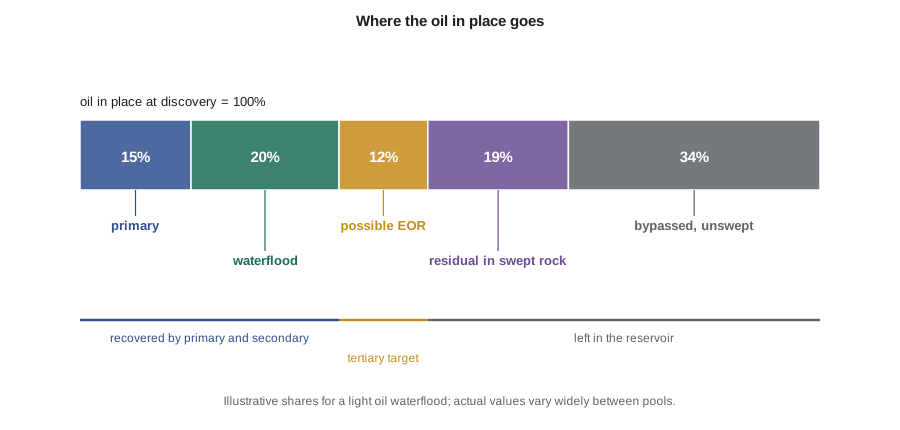
Petroleum engineers describe a field's life in three stages. Primary recovery uses only the natural energy of the reservoir: fluid and rock expansion, solution gas drive, a gas cap, an aquifer or gravity drainage. In PET-320 you saw that primary recovery from a solution-gas drive pool like the Mission Canyon pool is typically 10 to 25 percent of the oil in place. Secondary recovery adds energy by injecting water or gas to maintain pressure and to push oil toward producers; a good waterflood in a light oil sandstone or carbonate may take recovery to 30 to 50 percent. Tertiary recovery, the traditional meaning of EOR, then targets the oil the waterflood leaves behind.
The stages are labels of convenience, not a fixed order. Many heavy oil fields go directly to thermal methods because neither primary depletion nor waterflooding recovers much; Canada's oil sands are produced by steam from the first day. Some light oil fields begin gas injection or polymer flooding early, because injecting the improved fluid before the waterflood matures captures oil sooner and gives better economics. The industry term improved oil recovery (IOR) is broader still and includes infill drilling, horizontal wells and better completions as well as EOR proper.
Where the remaining oil is
To decide which process might work, you first ask where the remaining oil is and why the waterflood left it. There are two answers, and they lead to different processes. The first is residual oil: oil in rock that water has swept, trapped as isolated droplets and ganglia by capillary forces. In a water-wet sandstone the waterflood residual oil saturation is commonly 0.20 to 0.35. No amount of additional water will move it, because the forces holding it are capillary forces, not a lack of pressure. Recovering residual oil requires lowering the interfacial tension, by miscible gas or by surfactant.
The second answer is bypassed oil: oil in rock that the injected water never reached, or reached only weakly. Water bypasses oil when its mobility is too high compared with the oil's, so it fingers through, and when the reservoir is layered so that water rushes through the most permeable layers. In the Mission Canyon waterflood pilot model, one thief layer carried 74 percent of the flow capacity, and the simulation showed the tighter layers still near their initial saturation when the producers reached high water cut. Recovering bypassed oil requires better sweep: thicker injected fluids, conformance treatments, or new well patterns.
The two ideas combine in a single product that will appear in every lesson of this course. The overall recovery efficiency of a displacement is the microscopic displacement efficiency times the volumetric sweep efficiency, and the volumetric sweep is itself the product of the areal and vertical sweep efficiencies:
Here E_D is the fraction of the oil in the contacted rock that the injected fluid displaces, E_A is the fraction of the pattern area the injected fluid contacts, and E_I is the fraction of the vertical cross-section it contacts. Each factor lies between zero and one. Lesson 2 is about E_D and the capillary forces that limit it. Lesson 3 is about E_A and E_I and the mobility ratio and heterogeneity that limit them. Most EOR processes attack one factor more than the other: surfactants raise E_D, polymers raise E_V, and miscible gas raises E_D sharply while often lowering E_V because gas is so mobile.
Worked problem
Recovery efficiency of a waterflood
In the Mission Canyon pool, laboratory corefloods give an initial water saturation of 0.30 and a waterflood residual oil saturation of 0.28. Simulation of the pool-wide flood predicts an areal sweep of 0.75 and a vertical sweep of 0.62 at the economic limit. Estimate the displacement efficiency, the overall waterflood recovery efficiency, and the fraction of the oil in place left as bypassed oil.
Show solution
- Displacement efficiency is the fraction of the initial oil saturation displaced in swept rock: E_D = (S_oi − S_or) / S_oi = (0.70 − 0.28) / 0.70 = 0.60.
- Volumetric sweep is E_V = E_A × E_I = 0.75 × 0.62 = 0.465.
- Recovery efficiency is E_R = 0.60 × 0.465 = 0.28 of the oil in place at the start of the flood.
- The unswept fraction of the oil is 1 − 0.465 = 0.535 of the oil in place. The oil left as residual oil in swept rock is 0.465 × 0.40 = 0.186.
Answer: The waterflood recovers about 28 percent of the oil present at the start of injection. About 54 percent remains as bypassed oil in unswept rock and about 19 percent as residual oil in swept rock, which tells Ethan that sweep improvement is at least as important as lowering the residual saturation.
How much oil comes from EOR
EOR is a mature industry but a small share of world supply. Published estimates by the International Energy Agency and others have put global EOR production at roughly two million barrels per day for most of the last two decades, a few percent of world oil supply. Thermal methods in heavy oil, including Canadian oil sands steam projects, California steamfloods and fields in Oman, Venezuela and elsewhere, have provided the largest share. Gas injection is next, and in the United States carbon dioxide flooding is the leading method, concentrated in the Permian Basin of west Texas and southeast New Mexico, with further projects in the Rocky Mountain and Gulf Coast regions. Chemical EOR is smaller, led by large polymer floods in China, Canada and Oman.
In the United States the CO2 floods of the Permian Basin dominate, and they will appear repeatedly in this course. North Dakota adds two stories. The Weyburn and Midale fields across the border in Saskatchewan have been supplied since 2000 with CO2 piped from a coal gasification plant at Beulah, North Dakota, and are among the most studied CO2 storage sites in the world. The Bakken itself has been the site of a series of gas injection pilots, run by operators with the Energy and Environmental Research Center at the University of North Dakota, testing whether produced gas can raise recovery from tight horizontal wells. Canada's Pelican Lake field adds a classic example of polymer flooding in heavy oil.
EOR screening
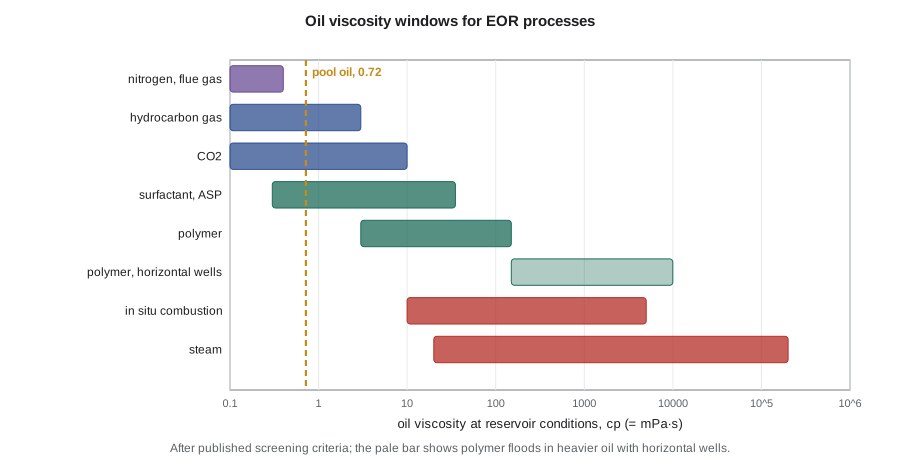
With dozens of processes available, the first step of any EOR study is screening: comparing the reservoir and oil properties with the ranges in which each process has worked in the field. The best-known screening tables were published by Taber, Martin and Seright in 1997, updating earlier work from the 1980s, and many later authors have refined them with larger project databases. The criteria are not physical limits. They summarize where projects have succeeded, so a pool outside a range is not impossible, only unusual, and a pool inside a range is a candidate, not a guaranteed success.
| Process | Oil gravity | Oil viscosity | Other main criteria |
|---|---|---|---|
| Nitrogen or flue gas | above 35 °API | below 0.4 cp | deep, below about 6,000 ft |
| Hydrocarbon miscible | above 23 °API | below 3 cp | below about 4,000 ft |
| CO2 miscible | above 22 °API | below 10 cp | below about 2,500 ft, so that pressure can exceed the MMP |
| Polymer flooding | above 15 °API | 10 to 150 cp | permeability above 10 mD; temperature below about 93 °C (200 °F) |
| Surfactant, ASP | above 20 °API | below 35 cp | permeability above 10 mD; low clay and divalent ions preferred |
| In situ combustion | above 10 °API | below 5,000 cp | permeability above 50 mD; thick, continuous sand |
| Steamflooding | 8 to 25 °API | below 200,000 cp | shallow, above about 4,500 ft; permeability above 200 mD |
The table has a pattern worth remembering. Gas methods favor light, thin oils and deep reservoirs, because miscibility needs high pressure and the gas must not finger too badly through viscous oil. Chemical methods favor intermediate oils and moderate temperatures, because polymers and surfactants degrade when hot and lose effectiveness when the oil is too viscous to sweep. Thermal methods favor heavy oil in shallow, thick, permeable sands, because heat losses to the surroundings grow with depth and with thin pay. The Mission Canyon pool is a light oil at moderate depth, so the gas and chemical columns are where Ethan should look first.
The code below applies the screening criteria to the Mission Canyon pool. It is deliberately simple: a list of ranges and a check of each property. Real screening tools add more criteria, such as lithology, the presence of a gas cap, fracture intensity and salinity, and score candidates rather than simply passing or failing them.
# Screen the pool against approximate EOR criteria (after Taber, Martin and Seright, 1997).
SI = False     # True: metric units, False: oilfield units

pool = {'api': 38.0, 'visc_cp': 0.72, 'depth_m': 1650.0, 'temp_c': 60.0,
        'perm_md': 15.0, 'net_m': 6.5, 'so_now': 0.42, 'lith': 'sandstone'}

# name: (min API, max viscosity cp, min depth m, max depth m, min perm mD, max temp C)
rules = {
    'nitrogen or flue gas':  (35, 0.4, 1830, 9e9, 0, 999),
    'hydrocarbon miscible':  (23, 3.0, 1220, 9e9, 0, 999),
    'CO2 miscible':          (22, 10.0, 760, 9e9, 0, 999),
    'polymer flooding':      (15, 150.0, 0, 2740, 10, 93),
    'surfactant or ASP':     (20, 35.0, 0, 2740, 10, 93),
    'in situ combustion':    (10, 5000.0, 150, 3500, 50, 999),
    'steamflooding':         (8, 200000.0, 0, 1370, 200, 999),
}

def check(p, r):
    api, mu, dmin, dmax, kmin, tmax = r
    fails = []
    if p['api'] < api: fails.append('oil too heavy')
    if p['visc_cp'] > mu: fails.append('oil too viscous')
    if p['depth_m'] < dmin: fails.append('too shallow')
    if p['depth_m'] > dmax: fails.append('too deep')
    if p['perm_md'] < kmin: fails.append('permeability too low')
    if p['temp_c'] > tmax: fails.append('too hot')
    return fails

if SI:
    print(f"Pool: {pool['api']:.0f} API, {pool['visc_cp']} mPa·s, {pool['depth_m']:.0f} m, "
          f"{pool['temp_c']:.0f} °C, {pool['perm_md']:.0f} mD")
else:
    print(f"Pool: {pool['api']:.0f} API, {pool['visc_cp']} cp, {pool['depth_m'] / 0.3048:,.0f} ft, "
          f"{pool['temp_c'] * 1.8 + 32:.0f} °F, {pool['perm_md']:.0f} mD")
for name, r in rules.items():
    f = check(pool, r)
    if name == 'steamflooding' and pool['api'] > 25: f.append('oil too light for steam to pay')
    print(f"  {name:22s} {'passes' if not f else 'fails: ' + ', '.join(f)}")
print(f"Remaining oil saturation {pool['so_now']:.2f}: enough target for a tertiary process" if pool['so_now'] > 0.25
else "Remaining oil saturation is low: tertiary target is thin")Pool: 38 API, 0.72 cp, 5,413 ft, 140 °F, 15 mD nitrogen or flue gas fails: oil too viscous, too shallow hydrocarbon miscible passes CO2 miscible passes polymer flooding passes surfactant or ASP passes in situ combustion fails: permeability too low steamflooding fails: too deep, permeability too low, oil too light for steam to pay Remaining oil saturation 0.42: enough target for a tertiary process
The screen passes four processes: hydrocarbon miscible gas, CO2, polymer and surfactant flooding. It rejects nitrogen because the oil is not light enough and the pool not deep enough to reach miscibility with nitrogen, and it rejects the thermal methods because the oil is already thin and the rock too tight for heat to pay. That is a typical result for a light oil waterflood, and it frames the rest of Ethan's study: gas methods in Lessons 6 to 8, chemical methods in Lessons 9 and 10, and a short look at thermal and emerging methods in Lesson 11.
From screening to a project
Screening is only the first gate of a staged process that usually takes several years. After screening, the engineer looks for analogs: fields with similar rock and oil where a process has been tried. The second gate is laboratory work: phase behavior tests and slim-tube displacements for gas, polymer rheology and adsorption tests, surfactant phase behavior scans and corefloods. The third is simulation, building on the history-matched waterflood model to compare processes, patterns and injection strategies. The fourth is a field pilot, usually one or a few patterns with intensive surveillance. Only after the pilot is understood does a company commit to a full-field project, which may cost hundreds of millions of US dollars.
Each gate is a decision point, and most candidates fail somewhere along the way, often for reasons that have nothing to do with reservoir physics: no affordable source of CO2 within pipeline distance, no water source compatible with polymer, an oil price that collapses during the pilot. Lena reminds Ethan that the screening table is cheap and the pilot is expensive, so the time to be skeptical is early. The capstone in Lesson 12 returns to this staged process and puts numbers on it.
Common mistakes
MistakeTreating screening criteria as physical limits.
InsteadThey summarize where projects have worked; a pool just outside a range is a candidate for closer study, not an automatic rejection.
MistakeAssuming the remaining oil after a waterflood is all residual oil.
InsteadMuch of it is often bypassed oil in unswept rock; the split decides whether sweep or displacement efficiency is the target.
MistakeCounting infill drilling as EOR.
InsteadInfill drilling is improved oil recovery (IOR); EOR changes the fluids or the rock-fluid interaction.
MistakeJudging a process on reservoir fit alone.
InsteadInjectant supply, facilities, water handling and price usually decide whether an EOR project goes ahead.
Summary and key terms
- Primary recovery uses natural reservoir energy, secondary recovery adds water or gas for pressure and displacement, and tertiary recovery or EOR targets the oil the waterflood leaves.
- Remaining oil is either residual oil trapped by capillary forces in swept rock or bypassed oil in rock the flood did not contact.
- Recovery efficiency is the product of displacement efficiency and the areal and vertical sweep efficiencies.
- Global EOR production has been about two million barrels per day, led by thermal methods, then gas injection, with chemical methods smaller.
- Screening criteria such as those of Taber, Martin and Seright compare oil and reservoir properties with the ranges where each process has succeeded.
- A screened candidate passes through analogs, laboratory work, simulation and a field pilot before a full project.
- Enhanced oil recovery (EOR)
- Recovery by injecting fluids or energy that change the interaction between oil, water and rock, beyond simple pressure maintenance.
- Improved oil recovery (IOR)
- Any technique that raises recovery, including infill drilling and better wells as well as EOR.
- Residual oil saturation
- The oil saturation left in rock swept by a displacing fluid, held by capillary trapping.
- Bypassed oil
- Oil in rock that the displacing fluid has not contacted.
- Displacement efficiency
- The fraction of the oil in contacted rock that the displacing fluid removes.
- Volumetric sweep efficiency
- The fraction of the reservoir volume contacted by the displacing fluid, the product of areal and vertical sweep.
- Screening criteria
- Ranges of oil and reservoir properties in which an EOR process has worked in the field.
Practice problems
Work each problem on paper first, then reveal the answer to check.
A flood has E_D = 0.55, E_A = 0.80 and E_I = 0.50. What is the recovery efficiency?
Show answer
0.55 × 0.80 × 0.50 = 0.22, or 22 percent of the oil in place at the start of the flood.
Why does nitrogen flooding need deep, light oil reservoirs?
Show answer
Nitrogen reaches miscibility only at very high pressure and with light oil rich in intermediate components.
Why are thermal methods rarely used below about 4,500 ft?
Show answer
Heat losses in the wellbore and to the surrounding rock grow with depth, and steam needs high pressure at depth.
Name two non-reservoir reasons an EOR candidate might fail.
Show answer
No affordable injectant supply, such as CO2, and low oil prices; others include water source, facilities and regulation.
Lesson quiz · 5 questions
Score 60% or more to complete this lesson.
Create a free account to save your progress, take quizzes and earn a certificate.