
PET-430 · Lesson 2 of 12 · 19 min
Displacement efficiency and capillary number
Ethan's first task is to understand the oil the waterflood leaves in rock it has already swept. He asks Mei Lin, the laboratory chemist who supported the stimulation work on the field, to pull the special core analysis reports for the Mission Canyon pool. The waterflood corefloods all end the same way: after a few pore volumes of brine the oil production stops completely, even though about 28 percent of the pore space still holds oil. Raising the injection rate tenfold changes almost nothing. “That oil is not waiting for more pressure,” Mei says. “It is stuck, and the reason is surface chemistry.”
How oil is trapped
In a water-wet rock, water coats the grain surfaces and occupies the smallest pores, while oil sits in the centers of the larger pores. When water advances, it moves along the grain surfaces as thin films and swells in the pore throats. Two trapping mechanisms then leave oil behind. In snap-off, water swelling in a narrow throat pinches off the oil thread that connects one pore body to the next, leaving an isolated blob in the pore body. In bypassing, water advances faster through a small, well-connected pore path than through a parallel large pore, surrounds the large pore and isolates its oil. Both mechanisms leave oil as discontinuous ganglia, each held in place by the curvature of its interfaces with water.
To move a trapped ganglion, the pressure difference across it must exceed the capillary pressure difference between its leading and trailing interfaces. The leading interface must squeeze through a narrow throat, which requires a pressure of roughly 2σ/r_throat, while the trailing interface sits in a wide pore body. For typical pore throats of a few micrometers and an oil-water interfacial tension of 30 mN/m, the required pressure gradient is hundreds of times larger than any gradient a waterflood can apply over the length of one ganglion. That is why more water and more pressure do not help.
The capillary number
The balance between the viscous forces that push a ganglion and the capillary forces that hold it is measured by a dimensionless group, the capillary number. The simplest and most common definition uses the Darcy velocity v of the displacing fluid, its viscosity μ and the interfacial tension σ between oil and the displacing fluid:
Other definitions include the porosity, the contact angle or the pressure gradient, so values from different papers cannot always be compared directly. With this definition, a typical waterflood has a capillary number around 10⁻⁷. Experiments on sandstone cores show that residual oil saturation stays at its waterflood value until the capillary number reaches a critical value, commonly between 10⁻⁵ and 10⁻⁴, and then falls steadily, approaching zero near 10⁻² or higher. The plot of residual oil saturation against capillary number is the capillary desaturation curve, and it is the single most important picture in chemical EOR.
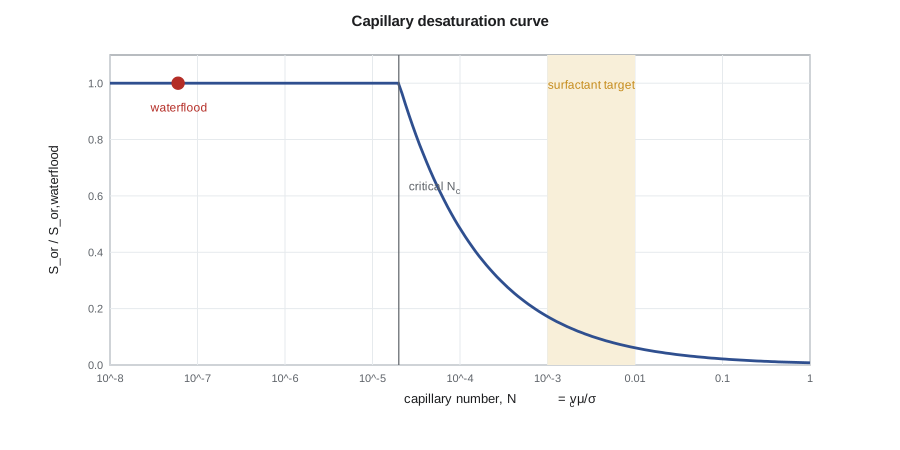
The capillary desaturation curve tells you at once which knobs are worth turning. Velocity cannot be raised much: injection rates are limited by fracture pressure and well count, and in any case the velocity far from the wells is low. Viscosity can be raised perhaps tenfold with polymer before injectivity suffers. Interfacial tension, in contrast, can be reduced from about 30 mN/m to 0.001 mN/m by a well-designed surfactant formulation, a factor of 30,000. That is why surfactant flooding is the chemical route to residual oil, and why polymer alone, though it improves sweep, does not usually lower the residual oil saturation much. Miscible gas floods go further still: when the injected gas and the oil become a single phase, the interfacial tension is zero, the capillary number is effectively infinite and, in the swept rock, almost all the oil can be displaced.
# Capillary number and a capillary desaturation curve for the pool.
SI = False     # True: metric units, False: oilfield units

def nc(v, mu, sigma):
    """Capillary number from Darcy velocity (m/s), viscosity (Pa.s) and IFT (N/m)."""
    return v * mu / sigma

def sor_ratio(n, ncrit=2e-5, slope=0.45):
    """Residual oil relative to the waterflood value; constant below the critical number."""
    return 1.0 if n <= ncrit else (n / ncrit) ** (-slope)

sorw = 0.28                    # waterflood residual oil saturation
v_md = 0.30                    # frontal Darcy velocity, m/d (about 1 ft/d)
v = v_md / 86400.0
cases = [('waterflood', 0.50e-3, 30e-3),
         ('dilute surfactant', 0.50e-3, 0.1e-3),
         ('ultralow IFT surfactant', 0.50e-3, 0.002e-3),
         ('surfactant-polymer slug', 20e-3, 0.002e-3)]
print(f"Velocity {v_md:.2f} m/d" if SI else f"Velocity {v_md / 0.3048:.2f} ft/d")
for name, mu, s in cases:
    n = nc(v, mu, s)
    sor = sorw * sor_ratio(n)
    ed = (0.70 - sor) / 0.70
    unit = f"{s * 1e3:g} mN/m" if SI else f"{s * 1e3:g} dyn/cm"
    print(f"{name:25s} IFT {unit:12s} Nc {n:8.1e}  Sor {sor:.3f}  E_D {ed:.2f}")
need = 1e-3                  # target capillary number
sig = v * 0.50e-3 / need
print(f"IFT needed for Nc = {need:.0e} with water viscosity: {sig * 1e3:.4f} " + ("mN/m" if SI else "dyn/cm")
+ f", a {30e-3 / sig:,.0f}-fold reduction")Velocity 0.98 ft/d waterflood IFT 30 dyn/cm Nc 5.8e-08 Sor 0.280 E_D 0.60 dilute surfactant IFT 0.1 dyn/cm Nc 1.7e-05 Sor 0.280 E_D 0.60 ultralow IFT surfactant IFT 0.002 dyn/cm Nc 8.7e-04 Sor 0.051 E_D 0.93 surfactant-polymer slug IFT 0.002 dyn/cm Nc 3.5e-02 Sor 0.010 E_D 0.99 IFT needed for Nc = 1e-03 with water viscosity: 0.0017 dyn/cm, a 17,280-fold reduction
The code uses a power-law fit to a typical sandstone curve, with a critical capillary number of 2 × 10⁻⁵. A dilute surfactant that lowers the tension to 0.1 mN/m is still below the critical value and recovers no additional oil, which is a common disappointment in early surfactant projects. An ultralow tension near 0.002 mN/m lifts the displacement efficiency from 0.60 to above 0.90. Adding polymer to raise the slug viscosity pushes the capillary number higher still. Real curves must be measured on the reservoir's own rock, because they shift with pore structure, wettability and the definition used.
Worked problem
Interfacial tension needed to mobilize residual oil
In the Mission Canyon pool, the frontal Darcy velocity midway between injector and producer is about 1.0 ft/d. The brine viscosity at reservoir temperature is 0.50 cp and the oil-brine interfacial tension is 30 dyn/cm. Find the waterflood capillary number and the interfacial tension needed to raise it to 10⁻³ with the same velocity and viscosity.
Show solution
- Convert the velocity: 1.0 ft/d = 0.3048 / 86,400 = 3.53 × 10⁻⁶ m/s.
- The waterflood capillary number is N_c = vμ/σ = 3.5 × 10⁻⁶ × 0.50 × 10⁻³ / 0.030 = 5.8 × 10⁻⁸.
- For N_c = 10⁻³, σ = vμ / N_c = 3.5 × 10⁻⁶ × 0.50 × 10⁻³ / 10⁻³ = 1.7 × 10⁻⁶ N/m, or about 0.0017 dyn/cm.
- The required reduction is 0.030 / 1.7 × 10⁻⁶, or roughly 17,000 times.
Answer: The waterflood capillary number is about 6 × 10⁻⁸. Reaching 10⁻³ requires an interfacial tension of about 0.002 dyn/cm, an ultralow value that only carefully designed surfactant systems achieve.
Wettability and residual oil
The trapping picture above assumes water-wet rock. Many reservoirs, especially carbonates and sandstones with oils rich in polar compounds, are mixed-wet or oil-wet: oil has contacted and altered the grain surfaces in the larger pores. In an oil-wet rock the roles are reversed. Oil coats the grains and occupies the small pores, water advances through the centers of the large pores, and breakthrough comes early, followed by a long period of high water cut during which oil drains slowly through surface films. The residual oil saturation after an extended flood can be quite low in mixed-wet rock, because continuous oil films keep draining, but only after many pore volumes of water have been injected.
Wettability is measured with the Amott and USBM tests, which compare the amounts of spontaneous and forced imbibition of water and oil, and it is inferred from the shape of the relative permeability curves. A useful rule of thumb from Craig's waterflood monograph is that water-wet rock has a crossover saturation, where the water and oil relative permeabilities are equal, above about 50 percent water saturation, and an endpoint water relative permeability below about 0.3. Oil-wet rock shows the opposite. Several EOR processes work in part by changing wettability: low-salinity water in sandstones, surfactants and modified brines in carbonates, and some alkaline floods.
Relative permeability endpoints
Displacement efficiency appears in the relative permeability curves as the two endpoint saturations. The connate water saturation S_wc sets where the oil curve starts, and the residual oil saturation S_or sets where it ends. The movable oil saturation is 1 − S_wc − S_or, and the maximum displacement efficiency for a waterflood is:
Between the endpoints, the Corey model introduced in PET-320 is the usual description: the oil relative permeability is its endpoint value times the normalized oil saturation raised to an exponent n_o, and the water curve likewise with an exponent n_w. The exponents shape the curves and, through the fractional flow, decide how quickly the displacement approaches its maximum. In a simulation of a surfactant flood, the residual saturations are made functions of the capillary number, so the curves straighten and the endpoints move toward zero as the tension falls. In a miscible gas simulation, the relative permeabilities are interpolated toward straight lines as the gas and oil approach a single phase.
Displacement efficiency in time
Ultimate displacement efficiency is the limit at infinite throughput. What matters to a project is how much oil is displaced after the volume of fluid that can be injected economically, usually one to three pore volumes for a waterflood and much less for an expensive chemical slug. The Buckley-Leverett theory from PET-320 gives that time dependence: the average saturation behind the front, found by Welge's tangent construction, rises toward 1 − S_or as more water passes. A displacement with favorable viscosities and curve shapes reaches near its maximum at breakthrough; an unfavorable one reaches breakthrough early and then needs many pore volumes to approach the maximum. Lesson 4 returns to this in detail, because it controls the waterflood forecast.
For Ethan's study the conclusion is clear. In the swept parts of the Mission Canyon pool, about 40 percent of the original oil saturation remains as residual oil after the waterflood. Only processes that drive the capillary number up by three or four orders of magnitude, miscible gas or ultralow-tension surfactant, can reach it. Whether that is the bigger prize, compared with the bypassed oil, depends on the sweep, which is the subject of Lesson 3.
Measuring a capillary desaturation curve
A capillary desaturation curve is measured on a sequence of core plugs or on a single plug flooded in stages. The plug is first restored to reservoir wettability by aging it in crude oil at reservoir temperature, then waterflooded to residual oil saturation at a low rate. The capillary number is then raised step by step, by increasing the flow rate, by raising the viscosity of the injected brine with glycerol or polymer, or by lowering the interfacial tension with a series of surfactant solutions, and the residual saturation is measured after each step by material balance, weighing or imaging. Because rate alone can raise the capillary number only about a hundredfold before the plug fractures or fines move, tension reduction is needed to cover the full curve. Curves measured this way differ between rock types: well-sorted, homogeneous sandstones begin to desaturate at lower capillary numbers than poorly sorted or vuggy rocks, and the curve for the non-wetting phase sits to the left of the curve for the wetting phase.
For Ethan's study, Mei Lin measures two curves on Cardium-equivalent plugs, one with brine of increasing viscosity and one with a surfactant series. Both show the same critical capillary number within a factor of three, which gives confidence that the simulation can use a single curve for the pool.
Common mistakes
MistakeTrying to recover residual oil by raising the injection rate.
InsteadRate raises the capillary number only slightly; residual oil needs a reduction of interfacial tension by orders of magnitude.
MistakeComparing capillary numbers from papers that use different definitions.
InsteadCheck whether porosity, contact angle or pressure gradient is included before comparing values.
MistakeExpecting polymer alone to lower residual oil much.
InsteadPolymer raises viscosity tenfold at most; it mainly improves sweep, although viscoelastic effects can reduce residual oil slightly.
MistakeAssuming all reservoirs are water-wet.
InsteadMany carbonates and some sandstones are mixed-wet or oil-wet, which changes breakthrough, residual oil and the best EOR process.
Summary and key terms
- Residual oil in water-wet rock is trapped as ganglia by snap-off and bypassing at the pore scale.
- The capillary number N_c = vμ/σ compares viscous and capillary forces; waterfloods operate near 10⁻⁷.
- The capillary desaturation curve shows residual oil unchanged until a critical capillary number near 10⁻⁵ to 10⁻⁴, then falling toward zero near 10⁻².
- Lowering interfacial tension is the only practical way to raise N_c by orders of magnitude; miscible gas removes it entirely.
- Wettability changes how and where oil is trapped and how quickly it drains.
- Maximum displacement efficiency is (1 − S_wc − S_or) / (1 − S_wc), approached over time as described by Buckley-Leverett theory.
- Capillary number
- A dimensionless ratio of viscous to capillary forces, commonly vμ/σ.
- Capillary desaturation curve
- A plot of residual saturation against capillary number.
- Snap-off
- Trapping of oil when a swelling water collar in a pore throat pinches off the oil thread.
- Interfacial tension
- The energy per unit area of the interface between two immiscible fluids, in mN/m or dyn/cm.
- Wettability
- The tendency of one fluid to spread on or adhere to the rock surface in the presence of another fluid.
- Mixed-wet
- A wettability state in which the larger pores are oil-wet and the smaller pores water-wet.
- Movable oil saturation
- The oil saturation between residual and initial values, 1 − S_wc − S_or.
Practice problems
Work each problem on paper first, then reveal the answer to check.
A flood has v = 3 × 10⁻⁶ m/s, μ = 1 mPa·s and σ = 0.01 mN/m. What is N_c?
Show answer
3 × 10⁻⁶ × 10⁻³ / 10⁻⁵ = 3 × 10⁻⁴.
Why does a dilute surfactant at 0.1 mN/m often recover little extra oil?
Show answer
The capillary number is still below the critical value, so the residual saturation is unchanged.
For S_wc = 0.25 and S_or = 0.30, what is the maximum displacement efficiency?
Show answer
(1 − 0.25 − 0.30) / 0.75 = 0.60.
What does a crossover saturation below 50 percent water suggest?
Show answer
Oil-wet or mixed-wet behavior, by Craig's rules of thumb.
Lesson quiz · 5 questions
Score 60% or more to complete this lesson.
Create a free account to save your progress, take quizzes and earn a certificate.