
PET-430 · Lesson 11 of 12 · 19 min
Thermal methods and emerging processes
Thermal recovery is the largest EOR family in the world by production. PET-370 covered it in detail: steam generation, cyclic steam stimulation, steamflooding, steam-assisted gravity drainage and in situ combustion, with Prairie Crest Energy Inc.'s Tamarisk Hill steamflood in California as the example. This lesson summarizes those methods in the EOR framework of this course, so that Ethan can place them alongside gas and chemical processes, and then looks at newer processes that are still being tested. Ethan calls Paul Desrosiers, who ran the thermal reservoir work at Tamarisk Hill, for a refresher.
Why heat works
The viscosity of heavy oil and bitumen falls by orders of magnitude when it is heated. An oil of 5,000 cp at reservoir temperature may fall to about 100 cp at 100 °C (212 °F) and near 10 cp at 200 °C (392 °F). In the terms of Lesson 3, heating improves the mobility ratio of a displacement by a factor of hundreds and makes gravity drainage fast enough to be practical. Heat also expands the oil, distils light components from it, and in steam processes delivers a large amount of energy per unit of injected water through the latent heat of condensation. Heat does not usually change the residual oil saturation as dramatically as miscible gas, although residual oil to steam is lower than to water, often 10 to 20 percent of the pore volume.
# Why heat works for heavy oil, and why depth limits steam: viscosity-temperature and wellbore heat loss.
import math
SI = False     # True: metric units, False: oilfield units

# Walther-type relation fitted to a heavy oil: log10(log10(mu + 0.7)) = A - B log10(T in K)
mu1, T1, mu2, T2 = 5000.0, 288.15, 12.0, 473.15
y = lambda mu: math.log10(math.log10(mu + 0.7))
B = (y(mu1) - y(mu2)) / (math.log10(T2) - math.log10(T1)); A = y(mu1) + B * math.log10(T1)
def mu(Tk): return 10 ** (10 ** (A - B * math.log10(Tk))) - 0.7
print("Heavy oil viscosity, " + ("mPa·s" if SI else "cp"))
for tc in (15, 50, 100, 150, 200, 250):
    t = f"{tc:3d} °C" if SI else f"{tc * 1.8 + 32:3.0f} °F"
    print(f"  {t}: {mu(tc + 273.15):10,.1f}")

# Wellbore heat loss: steam at 100 t/d with 2.6 MJ/kg useful enthalpy, loss 400 W per meter of well
heat = 100e3 * 2.6e6 / 86400          # W
for depth in (300, 600, 1000, 1500, 2000):
    f = depth * 400.0 / heat
    d = f"{depth:5d} m" if SI else f"{depth / 0.3048:6,.0f} ft"
print(f" depth {d}: {f:5.1%} of the injected heat lost before reaching the formation")Heavy oil viscosity, cp 59 °F: 5,000.0 122 °F: 625.9 212 °F: 92.5 302 °F: 27.4 392 °F: 12.0 482 °F: 6.6 depth 984 ft: 4.0% of the injected heat lost before reaching the formation depth 1,969 ft: 8.0% of the injected heat lost before reaching the formation depth 3,281 ft: 13.3% of the injected heat lost before reaching the formation depth 4,921 ft: 19.9% of the injected heat lost before reaching the formation depth 6,562 ft: 26.6% of the injected heat lost before reaching the formation
The first part of the output shows the viscosity collapse that makes thermal recovery possible. The second shows one of the limits that keeps it shallow. Heat is lost from the wellbore to the surrounding rock all the way down, so the deeper the reservoir, the larger the fraction of the steam's energy wasted before it arrives. At greater depth the steam must also be injected at higher pressure, its saturation temperature is higher and its latent heat is lower, so each metric ton carries less useful energy. Insulated tubing helps, but by about 4,500 ft most steam projects become uneconomic, which is the depth limit in the screening table of Lesson 1.
The thermal methods in brief
| Method | How it works | Typical application |
|---|---|---|
| Cyclic steam stimulation | Inject steam into a well, soak, then produce from the same well; repeat | Heavy oil and bitumen with some natural mobility; first stage of many steamfloods |
| Steamflooding | Inject steam continuously in patterns; a steam zone pushes heated oil to producers | Heavy oil of tens to thousands of cp at shallow depth, as in California |
| SAGD | Steam from an upper horizontal well forms a chamber; heated oil drains by gravity to a lower horizontal producer | Bitumen in thick, clean oil sands, as in Athabasca |
| In situ combustion | Inject air; burn a small fraction of the oil in the reservoir to heat and displace the rest | Heavy and some light oils where steam is impractical; complex to control |
| Hot water flooding | Inject hot water instead of steam | Moderate viscosity reduction; less efficient than steam |
The key performance measure of a steam process is the steam-oil ratio, the volume of steam, as cold water equivalent, injected per volume of oil produced. Good SAGD projects run at cumulative steam-oil ratios of 2 to 3.5, and the ratio sets both the cost and the greenhouse gas intensity of the oil, because the steam is raised by burning natural gas. Reducing that intensity is the main driver of research in thermal recovery, and it links thermal methods to the solvent processes below.
Emerging processes
Many EOR ideas are in laboratory or pilot stages. They are worth knowing because some will become tomorrow's commercial methods, but their field performance is less certain than that of the established processes, and claims for them should be read critically.
Solvent-assisted thermal recovery adds a light hydrocarbon solvent, such as propane, butane or a diluent blend, to the steam in SAGD or cyclic steam stimulation. The solvent condenses at the edge of the steam chamber, dissolves in the bitumen and lowers its viscosity further, so less steam is needed. Several Canadian operators have piloted solvent-steam processes and reported lower steam-oil ratios; the economics depend on how much of the solvent is recovered. Pure solvent processes without steam, and electrical or radio-frequency heating of the reservoir, have also been tested at pilot scale.
Foam for gas mobility control injects surfactant with CO2 or hydrocarbon gas so that the gas flows as a foam, with much lower mobility than free gas. Foam has long been used in gas diversion and well treatments, and several CO2 foam pilots in the United States and elsewhere have reported improved conformance. The challenges are keeping foam stable over long distances, at reservoir temperature and in contact with oil, which destabilizes many foams. Nanoparticle-stabilized foams and emulsions are an active research area.
Microbial EOR uses bacteria, either injected or stimulated in place with nutrients, to produce gases, acids, surfactants or polymers in the reservoir, or to plug high-permeability zones with biomass. It has been studied for decades, with many small field trials and some reported successes, but results have been hard to reproduce and predict, and it remains a niche method. Nanoparticles, chemically tailored to alter wettability or to stabilize emulsions, have produced interesting laboratory results, and a few field trials have been reported; their transport and retention in reservoir rock over interwell distances is still an open question.
Finally, the combination of CO2 EOR with dedicated storage has attracted interest because each metric ton of purchased CO2 left in the reservoir offsets part of the emissions from the oil produced. Some studies suggest that a CO2 flood designed to maximize storage, for example by injecting more CO2 and continuing injection after oil production ends, could store more CO2 than is emitted when the produced oil is burned; whether that is achieved depends on the CO2 source, the project design and the accounting rules used. That topic belongs to PET-460, but it already shapes how new CO2 floods are planned.
Worked problem
Viscosity reduction and mobility ratio
A heavy oil has a viscosity of 5,000 cp at 15 °C (59 °F) and about 93 cp at 100 °C (212 °F). Water at 100 °C has a viscosity of about 0.28 cp. With endpoint relative permeabilities of 0.3 for water and 0.85 for oil, compare the waterflood mobility ratio at 15 °C, where the water viscosity is 1.1 cp, with that at 100 °C.
Show solution
- At 15 °C, M = (0.3 / 1.1) / (0.85 / 5,000) = 0.273 / 0.00017 = 1,600.
- At 100 °C, M = (0.3 / 0.28) / (0.85 / 93) = 1.07 / 0.00914 = 117.
- The ratio of the two is 1,600 / 117, about 14.
Answer: Heating to 100 °C lowers the mobility ratio by a factor of about 14, from about 1,600 to about 120. That is still unfavorable, which is why steam processes rely on the steam zone and gravity drainage rather than a hot waterflood alone.
Placing the methods
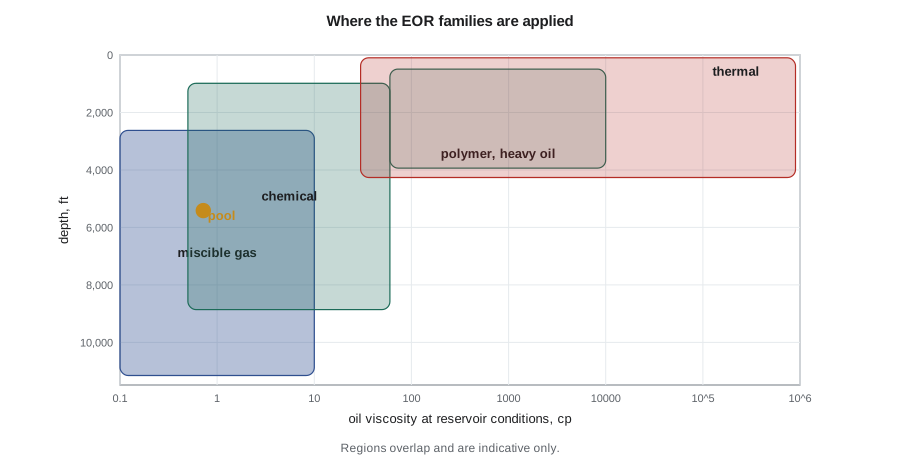
For the Mission Canyon pool, the map confirms what the screening suggested. Thermal methods are out: the oil is already thin, the reservoir is too deep for efficient steam, and the rock is too tight. The emerging methods are worth watching, especially foam for CO2 mobility control in the thief layer, but none is ready to carry a project on its own. Paul's advice to Ethan is practical: “Pick the established process that fits, design it well and pilot it carefully. Keep the new ideas as options to add once you understand the reservoir's response.”
Thermal methods and emissions
Steam processes burn natural gas to raise steam, so every barrel of thermal oil carries the combustion emissions of that gas as well as the emissions of processing and transporting the oil. The steam-oil ratio is therefore the main control on the emissions intensity of thermal production. Operators have reduced it by better well placement, by optimizing steam injection pressure and by adding solvents, and many facilities use cogeneration, producing electricity alongside steam, so that some of the fuel energy is used twice. Carbon capture on steam generators has been studied, and several oil sands operators have announced or proposed capture projects connected to a shared CO2 pipeline and storage hub, but at the time of writing those plans were still at an early stage.
In situ combustion avoids burning purchased fuel because it burns part of the oil in place, but it brings its own difficulties: controlling the combustion front, handling the produced flue gas and dealing with corrosion and sand production. Field results have been mixed. A few long-running projects, for example in Romania and India, have been successful, while many others were stopped early. High-pressure air injection into deep light oil reservoirs, where the oil oxidizes at low temperature and the flue gas displaces the oil, has worked in a small number of fields in the United States, such as in the Williston Basin of the Dakotas, and remains a niche method.
Hot water flooding has a place too. It is used where the oil is only moderately viscous, where steam generation is impractical, or as a follow-up to a steamflood to scavenge heat from the steam zone. Because hot water carries far less energy per unit mass than steam, its effect on viscosity is limited, but its facilities are simpler and its losses smaller.
Ethan's conclusion from the thermal review is brief. The Mission Canyon pool is the wrong reservoir for heat, but the thermal industry's experience still matters to his study in two ways. Its surveillance practice, with observation wells, temperature logging and repeated seismic, is a model for monitoring any injection process. Its long experience with emissions accounting shows how a CO2 flood's storage will be scrutinized, and how important it is to measure and report it carefully from the first day of injection.
Common mistakes
MistakeConsidering steam for a deep light oil reservoir.
InsteadHeat losses grow with depth and light oil gains little from heat; thermal methods suit shallow heavy oil.
MistakeJudging a steam project by oil rate alone.
InsteadThe steam-oil ratio drives fuel cost and emissions intensity and is the key performance measure.
MistakeTreating emerging methods as proven.
InsteadPilot results are often limited or site-specific; plan staged tests and keep the base case on an established process.
MistakeAssuming every CO2 flood is carbon-negative.
InsteadThe net balance depends on the CO2 source, design and accounting; it must be calculated for each project.
Summary and key terms
- Thermal methods are the largest EOR family worldwide and dominate Canadian oil sands production.
- Heat reduces heavy oil viscosity by orders of magnitude, improving mobility ratio and enabling gravity drainage.
- Wellbore heat losses and lower latent heat at high pressure limit steam processes to shallow reservoirs.
- The steam-oil ratio measures the efficiency, cost and emissions intensity of a steam process.
- Emerging methods include solvent-assisted thermal processes, foam for gas mobility control, microbial EOR and nanoparticles; their field performance is less certain.
- CO2 EOR combined with storage can offset part of the emissions of the produced oil, depending on design and accounting.
- Cyclic steam stimulation
- A single-well cycle of steam injection, soaking and production.
- SAGD
- Steam-assisted gravity drainage, using a pair of horizontal wells and a steam chamber.
- In situ combustion
- Injection of air to burn part of the oil in the reservoir, generating heat and gases.
- Steam-oil ratio
- Cold water equivalent volume of steam injected per volume of oil produced.
- Solvent-assisted SAGD
- SAGD with a light hydrocarbon added to the steam to cut viscosity further and reduce steam use.
- Foam EOR
- Injection of gas with surfactant so that the gas flows as a low-mobility foam.
- Microbial EOR
- Use of bacteria to generate gases, surfactants, polymers or biomass in the reservoir.
Practice problems
Work each problem on paper first, then reveal the answer to check.
Why is residual oil to steam lower than to water?
Show answer
Heat lowers oil viscosity, expands the oil and distils light components, so less oil remains trapped.
A steam project injects 1,890 bbl/d cold water equivalent of steam and produces 630 bbl/d of oil. What is the steam-oil ratio?
Show answer
300 / 100 = 3.0.
Why does solvent reduce the steam-oil ratio in SAGD?
Show answer
The solvent dissolves in the bitumen at the chamber edge and lowers its viscosity, so less heat is needed per unit of oil.
What destabilizes many foams in the reservoir?
Show answer
Contact with oil, high temperature and long transport distances.
Lesson quiz · 5 questions
Score 60% or more to complete this lesson.
Create a free account to save your progress, take quizzes and earn a certificate.