
PET-250 · Lesson 6 of 12 · 18 min
Wettability and interfacial tension
The special core analysis program for the Tamarack Lake field includes a test Ethan has never heard of: wettability. He asks Lena why it matters. She takes two glass slides from her desk drawer, one clean and one smeared with a thin film of crude oil, and puts a drop of water on each. On the clean slide the water spreads out flat. On the oily slide it beads up like rain on a waxed car. 'Imagine the grains in the reservoir are those slides,' she says. 'The Bakken middle member sits between two organic-rich shales that generated its oil, and its grains have been soaking in that oil for millions of years. If the rock has turned oil-wet, fracturing fluid will not soak in the way it would in a water-wet rock.'
Interfacial tension
Where two fluids that do not mix meet, the molecules at the boundary are pulled inward more strongly than outward, because they have similar molecules on only one side. The boundary behaves like a stretched elastic skin. The energy needed to create a unit area of this boundary, or equivalently the force per unit length along it, is called interfacial tension when both fluids are liquids, and surface tension when one is a gas. It is measured in millinewtons per meter (mN/m), which is the same as the older unit dynes per centimeter.
| Fluid pair | Typical tension at laboratory conditions |
|---|---|
| Pure water and air | 72 mN/m |
| Crude oil and air | 25 to 30 mN/m |
| Crude oil and brine | 20 to 35 mN/m |
| Gas and oil at reservoir pressure | a few mN/m, falling toward zero near the critical point |
| Oil and brine with surfactant | below 0.01 mN/m (ultralow) |
Interfacial tension falls with rising temperature, and the gas-oil tension falls strongly with rising pressure as more gas dissolves in the oil and the two phases become more alike. At the critical point of a mixture the two phases become identical and the tension vanishes. That is the principle behind miscible gas injection, in which injected gas develops miscibility with the oil so that no interface traps oil in the pores. Surfactant flooding works the other way, adding chemicals that lower the oil-water tension by a factor of a thousand or more so that trapped oil droplets can be pushed through pore throats.
Contact angle and wettability
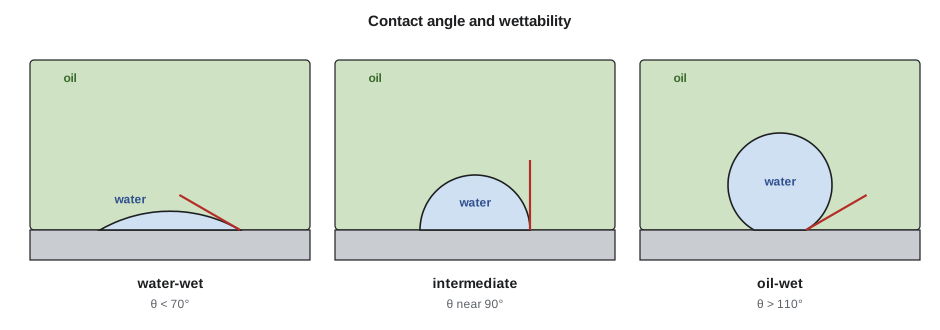
When a drop of water sits on a solid surface surrounded by oil, three interfaces meet at the edge of the drop: solid-water, solid-oil and oil-water. Each pulls with its own tension. The drop spreads or beads until the forces balance along the surface, and the angle the water-oil interface makes with the solid, measured through the water, is the contact angle θ. Young's equation, from 1805, expresses the balance.
If the solid has a lower interfacial energy with water than with oil, the water spreads and θ is small: the surface is water-wet. If the reverse is true, the water beads, θ exceeds 90 degrees, and the surface is oil-wet. Conventionally, contact angles from 0 to about 75 degrees indicate water-wet, 75 to 105 degrees intermediate or neutral wettability, and 105 to 180 degrees oil-wet, though different authors draw the lines differently.
# Wettability: Young's equation, Amott-Harvey index and capillary rise in a tube
import math
# 1. Young's equation: cos(theta) = (sigma_os - sigma_ws) / sigma_ow
sigma_ow = 30.0                                # mN/m, oil-water interfacial tension
for d_sigma in (25.0, 5.0, -10.0, -25.0):      # sigma_os - sigma_ws, mN/m
    theta = math.degrees(math.acos(d_sigma / sigma_ow))
    kind = "water-wet" if theta < 75 else ("intermediate" if theta <= 105 else "oil-wet")
    print(f"surface energy difference {d_sigma:6.1f} mN/m -> contact angle {theta:5.1f} deg ({kind})")

# 2. Amott-Harvey index from four displacement volumes (cm3) on one plug
v_w_spont, v_w_forced = 6.1, 3.4     # oil displaced by spontaneous and forced water imbibition
v_o_spont, v_o_forced = 0.4, 7.9     # water displaced by spontaneous and forced oil imbibition
I_w = v_w_spont / (v_w_spont + v_w_forced)
I_o = v_o_spont / (v_o_spont + v_o_forced)
print(f"water index {I_w:.2f}, oil index {I_o:.2f}, Amott-Harvey index {I_w - I_o:+.2f}")

# 3. Capillary rise of water against oil in tubes of different radius
rho_w, rho_o, g = 1050.0, 820.0, 9.81
theta = math.radians(30)
for r_um in (100, 10, 1):
    r = r_um * 1e-6
    pc = 2 * sigma_ow * 1e-3 * math.cos(theta) / r      # Pa
    h = pc / ((rho_w - rho_o) * g)
print(f"radius {r_um:4d} um: Pc {pc / 1000:7.2f} kPa, rise {h:8.2f} m")surface energy difference 25.0 mN/m -> contact angle 33.6 deg (water-wet) surface energy difference 5.0 mN/m -> contact angle 80.4 deg (intermediate) surface energy difference -10.0 mN/m -> contact angle 109.5 deg (oil-wet) surface energy difference -25.0 mN/m -> contact angle 146.4 deg (oil-wet) water index 0.64, oil index 0.05, Amott-Harvey index +0.59 radius 100 um: Pc 0.52 kPa, rise 0.23 m radius 10 um: Pc 5.20 kPa, rise 2.30 m radius 1 um: Pc 51.96 kPa, rise 23.03 m
Why reservoirs are not all water-wet
Clean quartz, calcite and dolomite are naturally water-wet, and reservoir rocks were water-filled before oil arrived. For many years engineers assumed all reservoirs were water-wet. Measurements since the 1950s have shown that many are not. When oil migrates into a trap, polar compounds in the crude oil, particularly asphaltenes and resins that contain nitrogen, oxygen and sulfur, can adsorb onto grain surfaces where the water film has thinned or ruptured. Over geological time, the parts of the pore surfaces in contact with oil become oil-wet, while surfaces still covered by water, in the small pores and crevices, stay water-wet.
The result is often mixed wettability, a term introduced by Salathiel in 1973: the large pores, which oil filled first, are oil-wet, while the small pores, which kept their water, are water-wet. Mixed-wet rocks can give low residual oil saturations, because the oil-wet films in the large pores provide continuous paths through which oil can keep draining slowly to very low saturations. Carbonate reservoirs are often oil-wet or mixed-wet, because carbonate surfaces carry a positive charge at reservoir pH that attracts the negatively charged acidic components of crude oil. Sandstones vary from strongly water-wet to mixed-wet depending on the crude oil, brine chemistry, temperature and mineralogy.
Measuring wettability
Contact angles can be measured directly on polished mineral crystals with a drop of brine in oil, but a flat crystal is not a rock, and the method misses the effects of roughness and mixed mineralogy. Laboratories therefore use tests on core plugs that measure how the rock behaves.
The Amott test, developed in 1959, compares spontaneous and forced displacement. A plug at irreducible water saturation is submerged in brine and the volume of oil that it expels by itself, by spontaneous imbibition of water, is measured. Then the plug is flooded or spun in a centrifuge to force out more oil. The ratio of spontaneous to total oil displaced is the water index, Iw. The process is repeated in reverse, starting at residual oil saturation in oil, to give the oil index, Io. The Amott-Harvey index is Iw − Io, which ranges from +1 for strongly water-wet to −1 for strongly oil-wet.
The USBM test, developed by the US Bureau of Mines in the late 1960s, uses a centrifuge to measure the capillary pressure curves for water displacing oil and oil displacing water. The logarithm of the ratio of the areas under the two curves is the USBM index, W, which is positive for water-wet rock and negative for oil-wet rock. The USBM test is better at distinguishing degrees of wettability near neutral, while the Amott test is better at detecting mixed wettability. Many laboratories run a combined test that gives both indices on the same plug.
| Wettability | Amott-Harvey index | USBM index | Contact angle |
|---|---|---|---|
| Strongly water-wet | +0.3 to +1.0 | well above 0 | 0 to 75° |
| Intermediate or neutral | −0.3 to +0.3 | near 0 | 75 to 105° |
| Oil-wet | −1.0 to −0.3 | well below 0 | 105 to 180° |
Worked problem
Reading an Amott test
A plug at irreducible water saturation expels 6.1 cm³ of oil spontaneously when placed in brine and a further 3.4 cm³ when flooded. Starting from residual oil, it expels 0.4 cm³ of water spontaneously in oil and 7.9 cm³ when flooded with oil. Calculate the indices and classify the plug.
Show solution
- Iw = 6.1/(6.1 + 3.4) = 6.1/9.5 = 0.64.
- Io = 0.4/(0.4 + 7.9) = 0.4/8.3 = 0.05.
- Amott-Harvey index = 0.64 − 0.05 = +0.59.
Answer: The plug imbibes water readily but hardly imbibes oil, so it is water-wet, with an index of +0.59. A waterflood in this rock will be helped by capillary forces pulling water into the smaller pores, and imbibition will be an important recovery mechanism in any fractured or layered parts of the reservoir.
Effects of wettability
Wettability affects nearly every multiphase property. In a water-wet rock, water coats the grains and occupies the small pores and crevices, while oil sits in the centers of the larger pores. During a waterflood, water advances along the grain surfaces and through small pores, and can pinch off oil in the larger pores, leaving isolated trapped droplets. Breakthrough of water at the producer is relatively late, and after breakthrough little more oil is produced. In an oil-wet rock the roles reverse: water moves through the centers of the large pores as a non-wetting phase, breaks through early, and then oil continues to drain slowly through films for a long time, so much more water must be injected to recover the same oil.
Capillary pressure curves, covered in lesson 7, change sign as wettability changes. Relative permeability curves, covered in lesson 8, shift: in water-wet rock the water relative permeability stays low, while in oil-wet rock it rises quickly. Electrical properties change too, because the saturation exponent n in Archie's law rises well above 2 in oil-wet rock where water no longer forms continuous films. Using water-wet laboratory data for an oil-wet reservoir can lead to large errors in predicted recovery and water production.
Preserving wettability in the laboratory
Wettability is easily altered between the reservoir and the laboratory. Drilling mud surfactants, particularly in oil-based muds, can make cores more oil-wet. Exposure to air oxidizes crude oil components. Cleaning with hot solvents strips adsorbed oil components and usually makes rocks more water-wet than they were underground. To measure representative multiphase properties, laboratories use one of three strategies. Native-state core is preserved at the well site, sealed and kept away from air, and tested without cleaning. Restored-state core is cleaned, resaturated with formation brine, flooded with the reservoir's crude oil to irreducible water saturation, and aged at reservoir temperature for several weeks to let wettability re-establish. Fresh-state core is tested quickly without special preservation and is the least reliable. The choice is a compromise between cost, time and confidence.
For the Tamarack Lake field, Lena specifies restored-state tests: plugs will be aged in Bakken crude at reservoir temperature before imbibition is measured. Early spontaneous imbibition tests show that brine hardly enters middle-member plugs, while oil enters readily, consistent with mixed- to oil-wet behavior. That will influence the choice of fracturing fluid additives and the case for any future enhanced recovery by gas injection.
Wettability and recovery in practice
Laboratory studies and field experience suggest that waterflood recovery is often highest at weakly water-wet to neutral conditions, where oil films remain connected and drain slowly while water does not trap oil as isolated droplets. Strongly water-wet rock traps oil by snap-off at pore throats, and strongly oil-wet rock lets water channel through the larger pores. Low-salinity waterflooding, which alters wettability toward more water-wet conditions in some clay-bearing sandstones, is one practical application of this understanding.
Common mistakes
MistakeAssuming every reservoir is water-wet.
InsteadMany sandstones are mixed-wet and many carbonates are oil-wet; measure wettability on preserved or restored core.
MistakeCleaning plugs with hot solvents and then measuring relative permeability.
InsteadCleaning usually makes rock more water-wet; restore wettability by aging in crude oil first.
MistakeMeasuring contact angle through the oil.
InsteadBy convention the angle is measured through the denser phase, usually water.
MistakeIgnoring wettability when choosing the Archie saturation exponent.
InsteadOil-wet rocks can have n well above 2.
Summary and key terms
- Interfacial tension is the energy per unit area of the boundary between immiscible fluids; lowering it frees trapped oil.
- Contact angle and Young's equation describe which fluid preferentially wets a surface.
- Polar crude oil components make many rocks mixed-wet or oil-wet over geological time.
- Amott and USBM tests measure wettability on core plugs.
- Wettability controls fluid distribution, capillary pressure, relative permeability, residual oil and electrical properties.
- Interfacial tension
- The energy per unit area, or force per unit length, at the boundary between two immiscible fluids.
- Contact angle
- The angle between a fluid interface and a solid surface, measured through the denser fluid.
- Water-wet
- Describes a rock whose grain surfaces are preferentially coated by water.
- Mixed wettability
- A state in which large pores are oil-wet and small pores remain water-wet.
- Spontaneous imbibition
- Uptake of a wetting fluid by a rock without applied pressure.
- Amott-Harvey index
- A wettability measure from +1 (water-wet) to −1 (oil-wet) based on spontaneous and forced displacement.
- Restored-state core
- Core that is cleaned, resaturated and aged in crude oil to re-establish reservoir wettability.
Practice problems
Work each problem on paper first, then reveal the answer to check.
If σ_os − σ_ws = 15 mN/m and σ_ow = 30 mN/m, what is the contact angle?
Show answer
cos θ = 0.5, so θ = 60°: water-wet.
Amott results: Iw = 0.10 and Io = 0.55. Classify the rock.
Show answer
Index = −0.45: oil-wet.
Why can surfactant flooding recover trapped oil?
Show answer
It lowers interfacial tension so much that the capillary forces trapping oil droplets can be overcome by the injection pressure gradient.
Name two ways core wettability can change between the reservoir and the laboratory.
Show answer
Mud surfactants adsorbing on grains, oxidation on exposure to air, or cleaning with hot solvents.
Lesson quiz · 5 questions
Score 60% or more to complete this lesson.
Create a free account to save your progress, take quizzes and earn a certificate.