
PET-250 · Lesson 5 of 12 · 18 min
Fluid saturation and Archie's law
With porosity and permeability in hand, Ethan turns to the question every development decision depends on: how much of the pore space actually holds oil? The core from the Haugen 14-6H well gives Dean-Stark water saturations, but Lena warns him they are only a check. 'We have core in one well and logs in hundreds,' she says. 'The logs measure electrical resistivity, not oil. Archie's law turns one into the other, and the constants in it come from the plugs sitting in that lab. In the Bakken the shales and the fine pores make it harder, but the principle is the same.'
What saturation means
Saturation is the fraction of the pore volume occupied by a particular fluid. In a reservoir with water, oil and gas, the three saturations add to one: Sw + So + Sg = 1. Saturation is always a fraction of pore volume, not of bulk volume; the fraction of the bulk rock that holds oil is φSo. In petroleum reservoirs water is almost always present, because the rock was water-filled before oil migrated in, and oil could not displace all of it.
Several saturations have special names. Connate water saturation, Swc, is the water present when the reservoir was discovered. Irreducible water saturation, Swirr, is the lowest water saturation that can be reached by displacing water with oil, because some water is held in small pores and as films on grain surfaces. In the oil column well above the oil-water contact, connate and irreducible water saturations are often similar. Residual oil saturation, Sor, is the oil left behind after a waterflood, trapped as isolated droplets. Critical gas saturation is the gas saturation at which gas bubbles first link up and begin to flow, typically a few percent.
| Saturation | Symbol | Typical range | Why it matters |
|---|---|---|---|
| Connate water | Swc | 0.10 to 0.40 | sets oil in place |
| Irreducible water | Swirr | 0.10 to 0.35 | lowest water saturation oil can reach |
| Residual oil to water | Sor | 0.15 to 0.40 | oil left after waterflooding |
| Critical gas | Sgc | 0.02 to 0.10 | gas starts to flow above it |
Measuring saturation on core
Lesson 1 described Dean-Stark extraction, which measures water directly and oil by difference. Saturations on core are affected by fluid loss as pressure is released, by gas expansion and by invasion of drilling mud filtrate. A plug cut with water-based mud will have its water saturation raised by filtrate; one cut with oil-based mud will have its oil saturation altered but its water saturation preserved fairly well, because the oil filtrate does not displace the water held in small pores near irreducible saturation. Special sponge-coring and pressure-coring methods trap expelled fluids or keep the core at reservoir pressure, but they are expensive and used only when saturation is critical, such as before an enhanced recovery project.
Electrical resistivity of rocks
Most minerals that make up reservoir rock, quartz, calcite and dolomite, do not conduct electricity. Oil and gas do not conduct either. Formation water does, because it contains dissolved salts that carry current as ions. The electrical resistivity of a reservoir rock therefore depends almost entirely on how much water it holds, how salty that water is, and how the water-filled pores are connected. That is the basis of resistivity logging, the oldest and still most important method for finding oil in a well.
Water resistivity, Rw, depends on salinity and temperature. Seawater has about 35,000 ppm of dissolved solids and a resistivity of roughly 0.2 ohm-meters at room temperature; many deep formation waters are saltier and more conductive. Resistivity falls as temperature rises, because ions move more freely, so Rw must be corrected to formation temperature. It can be measured on a produced water sample or estimated from logs in a water-bearing zone.
Archie's first law: the formation factor
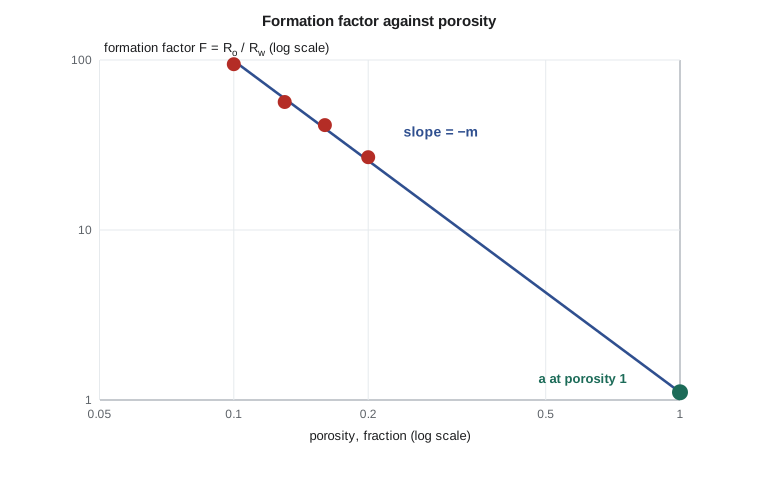
In 1942 Gus Archie, an engineer at Shell, measured the resistivity of brine-saturated core plugs. He defined the formation factor, F, as the resistivity of the rock fully saturated with brine, R₀, divided by the resistivity of the brine, Rw. F is always greater than one, because the grains block part of the current path and force it to wander. Archie found that F depends on porosity through a power law.
The exponent m, called the cementation exponent, describes how tortuous the current path is. For clean, well-connected sandstones m is close to 2. It is lower, around 1.3 to 1.8, for unconsolidated sands and fractured rocks where paths are straight, and higher, 2.2 to 3 or more, for carbonates with isolated vugs or moldic pores that hold water but do not connect it. The constant a, the tortuosity factor, is often set to 1, though fitted values for individual formations range from about 0.6 to 1.5.
Archie's second law: the resistivity index
When oil or gas replaces some of the water, the rock becomes more resistive. Archie defined the resistivity index, I, as the true resistivity of the partly saturated rock, Rt, divided by R₀. He found that it depends on water saturation through another power law, with exponent n, the saturation exponent, which is close to 2 for water-wet sandstones.
Combining the two laws gives the equation used to calculate water saturation from logs. Porosity comes from the density, neutron or sonic log; Rt from a deep-reading resistivity log beyond the zone invaded by drilling fluid; Rw from water samples or a water zone; and a, m and n from special core analysis.
# Archie's law: formation factor from core, then water saturation from logs
import math
# 1. Core: formation factor F = R0/Rw measured on brine-saturated plugs
plugs = [(0.10, 98.0), (0.14, 51.0), (0.18, 31.5), (0.22, 21.0)]   # (porosity, F)
xs = [math.log10(p) for p, _ in plugs]; ys = [math.log10(F) for _, F in plugs]
n = len(xs); mx, my = sum(xs) / n, sum(ys) / n
slope = sum((x - mx) * (y - my) for x, y in zip(xs, ys)) / sum((x - mx) ** 2 for x in xs)
m = -slope                                  # cementation exponent from the log-log slope
a = 10 ** (my + m * mx)
print(f"fitted a = {a:.2f}, m = {m:.2f}")

# 2. Resistivity index I = Rt/R0 against Sw gives the saturation exponent n
ri = [(1.0, 1.0), (0.7, 2.05), (0.5, 4.1), (0.3, 11.6)]
nn = sum(-math.log10(I) * math.log10(s) for s, I in ri[1:]) / sum(math.log10(s) ** 2 for s, _ in ri[1:])
print(f"saturation exponent n = {nn:.2f}")

# 3. Logs: water saturation in three zones
Rw = 0.06                                    # ohm-m at formation temperature
for phi, Rt in [(0.16, 18.0), (0.12, 8.0), (0.18, 1.1)]:
    sw = (a * Rw / (phi ** m * Rt)) ** (1 / nn)
    sw = min(sw, 1.0)
    print(f"phi {phi:.2f}, Rt {Rt:5.1f} ohm-m -> Sw {sw:.2f}, hydrocarbon fraction of bulk {phi * (1 - sw):.3f}")
# sensitivity: same zone with m = 1.7 and a = 1 assumed instead of measured
phi, Rt = 0.12, 8.0
print(f"zone 2 with a = 1, m = 1.7, n = 2.0 assumed: Sw {(Rw / (phi ** 1.7 * Rt)) ** 0.5:.2f}")fitted a = 1.11, m = 1.95 saturation exponent n = 2.03 phi 0.16, Rt 18.0 ohm-m -> Sw 0.37, hydrocarbon fraction of bulk 0.101 phi 0.12, Rt 8.0 ohm-m -> Sw 0.72, hydrocarbon fraction of bulk 0.033 phi 0.18, Rt 1.1 ohm-m -> Sw 1.00, hydrocarbon fraction of bulk 0.000 zone 2 with a = 1, m = 1.7, n = 2.0 assumed: Sw 0.53
The program illustrates the workflow. Core measurements of F on four plugs give m ≈ 1.95 and a ≈ 1.1; resistivity index measurements give n ≈ 2.0. Applied to three log readings, the equation gives Sw of 0.37, 0.72 and 1.00. The last zone is water-bearing. The final line shows the sensitivity: assuming a = 1 and m = 1.7 instead of the measured values changes Sw in the second zone from 0.72 to 0.53, enough to turn a marginal zone into apparent pay. Errors in m matter most at low porosity.
Worked problem
Water saturation in a pay zone
A zone has a density-log porosity of 0.15 and a deep resistivity of 25 ohm-m. Rw at formation temperature is 0.05 ohm-m. Core gives a = 1, m = 2 and n = 2. Calculate Sw and the fraction of the bulk rock that holds hydrocarbon.
Show solution
- F = 1/0.15² = 1/0.0225 = 44.4.
- R₀ = F × Rw = 44.4 × 0.05 = 2.22 ohm-m.
- I = Rt/R₀ = 25/2.22 = 11.3.
- Sw = I^(−1/2) = 1/√11.3 = 0.30.
- Hydrocarbon fraction of bulk = φ(1 − Sw) = 0.15 × 0.70 = 0.105.
Answer: Water fills 30 percent of the pores and hydrocarbon 70 percent, so 10.5 percent of the rock volume is oil or gas. The zone would normally be counted as pay if its permeability and thickness meet the field's cutoffs.
When Archie's law breaks down
Archie developed his equations for clean, water-wet sandstones, and they work well there. They fail when the rock contains conductive minerals or when the water is not the only conductive path. Clay minerals carry an excess of exchangeable cations on their surfaces that conduct electricity even in fresh water. In shaly sands the measured Rt is lower than it would be for a clean rock with the same saturation, so Archie's equation overestimates Sw and can make good oil zones look wet. Shaly-sand models such as Waxman-Smits, the dual-water model, and the simpler Simandoux and Indonesia equations add a clay conductivity term, using the clay content estimated from gamma-ray or neutron-density logs and laboratory measurements of cation exchange capacity.
Pyrite and other conductive minerals have a similar effect. Oil-wet rocks can have saturation exponents well above 2, because water is held in isolated pockets rather than as continuous films, and a value of n = 2 would then underestimate Sw. Carbonates with complex pore systems need m measured carefully on representative samples, and the value may vary with pore type. Low-resistivity pay, oil zones that look wet on resistivity logs because of clay, fine grains or thin layers, is a classic trap for the unwary analyst, and it has been bypassed in many old fields.
For the Bakken middle member, the fine pores, clay content and pyrite all push resistivity down. Archie's law with standard constants gives water saturations that are too high, so the log analysts calibrate a shaly-sand model against Dean-Stark saturations from preserved core cut with oil-based mud, and against crushed-rock measurements described in lesson 10.
Saturation height functions
Water saturation is not constant through an oil column. It is highest near the oil-water contact and falls with height above it, because capillary forces hold water in the pores against the buoyancy of the oil. Lesson 7 explains why. Engineers build saturation height functions that give Sw as a function of height above the free water level and rock quality, fitted to core capillary pressure data and log-derived saturations. These functions fill the reservoir model with saturations between wells, and they are an important check on log analysis: a log saturation that disagrees with the height function in a well usually points to an error in one or the other.
Common mistakes
MistakeCalculating hydrocarbon volume with saturation as a fraction of bulk volume.
InsteadSaturation is a fraction of pore volume; multiply by porosity to get the fraction of bulk volume.
MistakeUsing Rw at surface temperature.
InsteadCorrect water resistivity to formation temperature before using it in Archie's equation.
MistakeUsing a = 1, m = 2 and n = 2 everywhere.
InsteadMeasure the constants on core; errors in m are especially large at low porosity.
MistakeApplying Archie's law to shaly sands without correction.
InsteadClay conductivity lowers Rt; use a shaly-sand model or Sw will be overestimated.
Summary and key terms
- Saturation is the fraction of pore volume filled by a fluid; water, oil and gas saturations add to one.
- Core saturations are affected by fluid loss and mud invasion and are used mainly as checks.
- Archie's first law relates formation factor to porosity through a and m; the second relates resistivity index to saturation through n.
- Water saturation from logs depends on porosity, true resistivity, water resistivity and the core-measured constants.
- Clay, pyrite, oil-wet rock and complex carbonates violate Archie's assumptions and need special models.
- Water saturation
- The fraction of the pore volume occupied by water.
- Irreducible water saturation
- The lowest water saturation achievable by displacing water with oil.
- Residual oil saturation
- The oil left trapped in pores after displacement by water.
- Formation factor
- The ratio of the resistivity of a brine-saturated rock to the resistivity of the brine.
- Cementation exponent
- The exponent m in Archie's law relating formation factor to porosity.
- Saturation exponent
- The exponent n in Archie's law relating resistivity index to water saturation.
- Shaly-sand model
- A saturation equation that accounts for the electrical conductivity of clay minerals.
Practice problems
Work each problem on paper first, then reveal the answer to check.
A brine-saturated plug with φ = 0.20 has R₀ = 1.25 ohm-m in brine of Rw = 0.05 ohm-m. Find F and m, assuming a = 1.
Show answer
F = 25; m = log 25/log(1/0.20) = 1.398/0.699 = 2.0.
With φ = 0.18, Rw = 0.04 ohm-m, Rt = 15 ohm-m and a = 1, m = 2, n = 2, find Sw.
Show answer
Sw = √(0.04/(0.0324 × 15)) = √0.0823 = 0.29.
A zone has φ = 0.10 and Sw = 0.40. What fraction of the bulk volume is hydrocarbon?
Show answer
0.10 × 0.60 = 0.06.
Why can clay minerals make an oil zone look wet on a resistivity log?
Show answer
Clay surfaces conduct current through exchangeable cations, lowering resistivity independently of water saturation.
Lesson quiz · 5 questions
Score 60% or more to complete this lesson.
Create a free account to save your progress, take quizzes and earn a certificate.