
PET-250 · Lesson 3 of 12 · 19 min
Permeability and Darcy's law
Porosity tells Ethan how much oil the Bakken can hold. It says nothing about whether a well will produce 50 or 1,000 barrels a day. In the middle member, plugs with almost identical porosity, 0.06 and 0.065, have permeabilities that differ by a factor of twenty, and all of them are below 0.1 mD. Lena points at the gap. 'Permeability is the property that pays the bills,' she says. 'In the Bakken we only get commercial rates because fracturing creates paths the matrix cannot. But to design the fractures, we need to know what the matrix can deliver.'
This lesson introduces permeability, the law that defines it, how it is measured in the laboratory and how it controls flow to a well.
Darcy's experiment
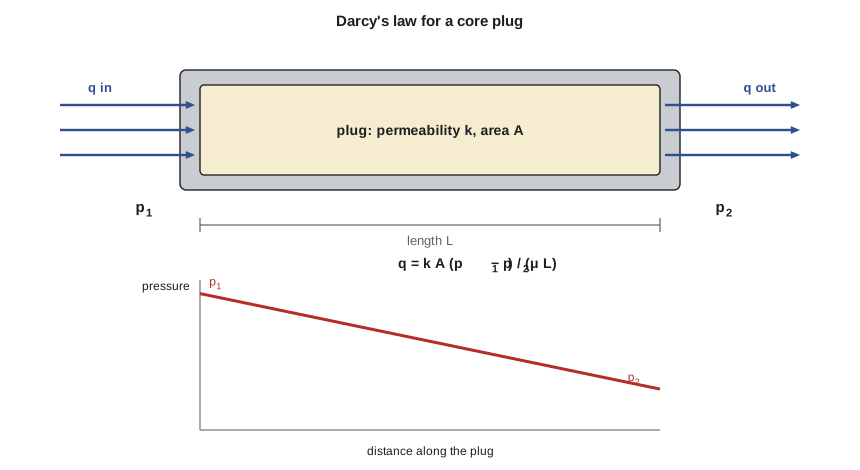
In 1856 Henry Darcy, an engineer designing water filters for the fountains of Dijon in France, measured how fast water flowed down through columns of sand. He found that the flow rate was proportional to the cross-sectional area of the column and to the difference in water level between the top and bottom, and inversely proportional to the length of the column. The constant of proportionality depended on the sand. Later workers separated the effect of the fluid, through its viscosity, from the effect of the rock, which is permeability.
In this form of Darcy's law, q is the volumetric flow rate, A the cross-sectional area, μ the fluid viscosity, Δp the pressure difference across a length L, and k the permeability. Permeability has units of area. It is a property of the rock alone, as long as the pores are filled with a single fluid that does not react with the rock and the flow is slow and steady. Doubling the viscosity halves the flow; doubling the permeability doubles it.
Units of permeability
The darcy is defined so that a rock of 1 darcy passes 1 cm³/s of a fluid with viscosity 1 centipoise through a 1 cm² area under a gradient of 1 atmosphere per centimeter. In SI units, 1 darcy is about 0.987 × 10⁻¹² m², so 1 millidarcy is about 10⁻¹⁵ m². Engineers usually quote permeability in millidarcies. As a rough guide: above 1,000 mD is excellent, 100 to 1,000 mD very good, 10 to 100 mD good, 1 to 10 mD fair, below 1 mD tight, and below 0.001 mD (1 microdarcy) shale-like.
| Rock | Typical permeability |
|---|---|
| Coarse unconsolidated sand | several darcies or more |
| Good conventional sandstone | 100 to 1,000 mD |
| Average sandstone reservoir | 10 to 100 mD |
| Tight gas sandstone | 0.001 to 0.1 mD |
| Tight oil siltstone or dolostone | 0.001 to 0.1 mD |
| Shale | 10 to 1,000 nanodarcies |
Conditions for Darcy's law
Darcy's law holds when flow is laminar: the fluid moves in smooth paths through the pores, and the pressure drop is caused by viscous friction. At high velocity, such as gas near a high-rate well, inertial effects add an extra pressure drop proportional to the square of the velocity. This non-Darcy flow is described by the Forchheimer equation and shows up in gas well tests as a rate-dependent skin. Darcy's law also assumes that the rock is fully saturated with one fluid, that the fluid does not react with the rock, and that the rock does not change during the test. Clays that swell in fresh water, for example, violate the last condition, and fresh water can cut the permeability of some sandstones dramatically.
Measuring permeability in the laboratory
Routine permeability is measured by flowing dry nitrogen or air through a cleaned, dried plug held in a rubber sleeve inside a core holder. Confining pressure squeezes the sleeve against the plug so gas cannot bypass it around the sides. Gas is used because it is fast and does not react with clays, but gas is compressible: as it flows from the high-pressure inlet to the low-pressure outlet it expands and speeds up. Integrating Darcy's law for an ideal gas at constant temperature gives a form that uses the difference of the squared pressures.
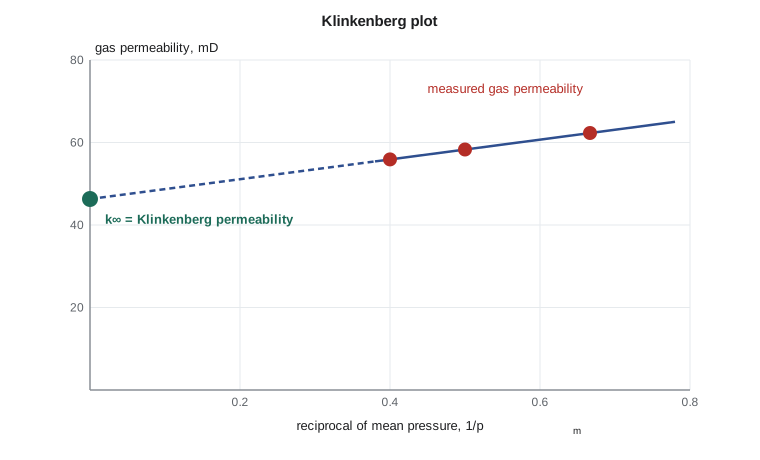
There is a further complication. In narrow pores at low pressure, gas molecules collide with the pore walls almost as often as with each other, and gas slips along the walls instead of having zero velocity there as a liquid would. Gas therefore flows more easily than a liquid would, and the measured gas permeability is higher than the true liquid permeability. The effect, described by L. J. Klinkenberg in 1941, is larger at low mean pressure and in tight rock.
The correction is to measure gas permeability at several mean pressures, plot it against the reciprocal of mean pressure, and extrapolate to infinite pressure, where slip disappears. The intercept, k∞, is the Klinkenberg-corrected or equivalent liquid permeability. The slip factor b is larger for tighter rock. In practice many laboratories report both the air permeability and the Klinkenberg value, and engineers must check which they have been given.
# Permeability from a gas flow test, Klinkenberg correction, and radial flow to a well (oilfield units)
import math
# --- laboratory: nitrogen through a plug (Darcy units: cm, cm3/s, cP, atm)
L, A = 5.08, 11.40                    # plug length cm, area cm2
mu_g = 0.0178                         # nitrogen viscosity, cP
p_out = 1.0                           # atm absolute
tests = [(2.0, 14.9), (3.0, 35.0), (4.0, 62.6)]   # (upstream atm, outlet flow cm3/s)
xs, ys = [], []
for p_in, q in tests:
    pm = (p_in + p_out) / 2
    kg = 2 * q * p_out * mu_g * L / (A * (p_in ** 2 - p_out ** 2)) * 1000   # mD
    xs.append(1 / pm); ys.append(kg)
    print(f"mean pressure {pm:.2f} atm: gas permeability {kg:6.1f} mD")
n = len(xs); mx, my = sum(xs) / n, sum(ys) / n
slope = sum((x - mx) * (y - my) for x, y in zip(xs, ys)) / sum((x - mx) ** 2 for x in xs)
k_inf = my - slope * mx
print(f"Klinkenberg-corrected (liquid-equivalent) permeability {k_inf:.1f} mD")

# --- reservoir: steady radial oil flow in oilfield units
# q (STB/d) = 0.00708 k h dp / (mu B ln(re/rw)), k in mD, h ft, dp psi, mu cP
h, mu, B = 20.0, 1.2, 1.15            # ft, cP, reservoir bbl per stock-tank bbl
re, rw = 660.0, 0.29                  # ft
for dp in (300, 600):
    q = 0.00708 * k_inf * h * dp / (mu * B * math.log(re / rw))
print(f"drawdown {dp} psi: about {q:,.0f} STB/d")mean pressure 1.50 atm: gas permeability 78.8 mD mean pressure 2.00 atm: gas permeability 69.4 mD mean pressure 2.50 atm: gas permeability 66.2 mD Klinkenberg-corrected (liquid-equivalent) permeability 46.3 mD drawdown 300 psi: about 185 STB/d drawdown 600 psi: about 369 STB/d
For this calibration plug from a conventional sandstone above the Bakken, the air permeabilities are 66 to 79 mD, but the Klinkenberg value is about 46 mD, a third lower. In the tight middle member the slip correction is much larger, often a factor of two or more, which is one reason tight-rock permeability is measured by other methods, described in lesson 10. The second half of the program uses the corrected value to estimate steady oil rates from a vertical well.
Liquid permeability can be measured directly by flowing brine or oil through a saturated plug. It avoids gas slip but takes longer, risks moving fine particles, and can be affected by clays. Measuring permeability under reservoir confining stress is important for tight and poorly consolidated rocks: the plug is squeezed in the core holder to the in-situ effective stress, and permeability is often found to fall by 10 to 50 percent compared with a low-stress measurement, more in tight rock with sheet-like pores that close easily.
Directional permeability
Permeability depends on direction. Horizontal plugs, drilled parallel to bedding, measure horizontal permeability kh; vertical plugs measure vertical permeability kv. Because grains tend to lie flat and thin shale and mica layers interrupt vertical flow, kv is usually lower than kh, often by a factor of 2 to 10 and sometimes by much more. The ratio kv/kh controls how fast gas cones down from a gas cap or water cones up from an aquifer toward a well, and how well a horizontal well drains a thick zone. Some rocks also have different permeabilities in different horizontal directions, aligned with old river channels or with natural fractures.
Radial flow to a well
Flow in a reservoir converges toward the well, so the area open to flow shrinks as fluid approaches the wellbore. Integrating Darcy's law for steady flow from an outer radius re, where pressure is maintained, to the wellbore radius rw gives the radial flow equation. Pressure falls logarithmically with distance: half of the total pressure drop happens within a few meters of the well. That is why damage to the rock near the well, from drilling mud or fines, has such a large effect on production, and why fracturing or stimulating the near-well region can increase rates so much.
In oilfield units, with q in stock-tank barrels per day, k in millidarcies, h in feet, pressures in psi and viscosity in centipoise, the constant 2π combines with unit conversions to give 0.00708. The term kh, permeability times thickness, is called flow capacity, and it is what a well test actually measures.
Worked problem
Rate from a well in two permeabilities
A vertical well in a conventional sandstone drains a radius of 660 ft through 20 ft of pay. Oil viscosity is 1.2 cP, B is 1.15 and the drawdown is 450 psi. The wellbore radius is 0.29 ft. Estimate the rate if k = 46 mD, then if k = 4 mD.
Show solution
- ln(re/rw) = ln(660/0.29) = ln(2,276) = 7.73.
- q = 0.00708 × 46 × 20 × 450 / (1.2 × 1.15 × 7.73) = 2,931/10.67 ≈ 275 STB/d.
- At 4 mD the rate is 46/4 = 11.5 times lower, about 24 STB/d.
Answer: The same rock volume and drawdown give about 275 or 24 barrels a day depending only on permeability. The logarithm hardly changes with drainage radius: doubling re changes ln(re/rw) by only 9 percent. Permeability, thickness and near-well condition dominate.
What controls permeability
Permeability depends on the size of the pore throats, the narrow connections between pores, and on how well they connect. Simple models such as the Kozeny-Carman equation treat the rock as a bundle of tubes and predict that permeability rises with the square of grain size and steeply with porosity. They capture the trends: coarser, better-sorted, cleaner rocks are more permeable. But real rocks rarely follow a single equation. Clay minerals lining or bridging pores, cement growing in throats, and compaction all reduce permeability more than porosity. That is why porosity-permeability crossplots show a broad cloud of points, and why engineers group data by rock type before fitting trends, as lesson 12 shows.
In the Kozeny-Carman form shown, S is the specific surface area of the grains per unit grain volume and c is a constant that depends on pore shape. Finer grains have more surface area, which raises S and lowers k, matching the observation that silt and clay are far less permeable than sand at the same porosity.
Common mistakes
MistakeUsing uncorrected air permeability for tight rock.
InsteadApply the Klinkenberg correction or measure liquid permeability; gas slip can double apparent permeability in tight rock.
MistakeAssuming vertical and horizontal permeability are equal.
InsteadMeasure kv on vertical plugs; kv/kh is often 0.1 to 0.5 and controls coning and horizontal well performance.
MistakeForgetting the squared pressures for gas flow.
InsteadFor compressible gas, use the p² form of Darcy's law with the outlet flow rate and absolute pressures.
MistakeIgnoring near-well damage.
InsteadMost of the pressure drop happens close to the well, so damage there has a large effect on rate.
Summary and key terms
- Darcy's law states that flow rate is proportional to permeability, area and pressure gradient and inversely proportional to viscosity.
- Permeability has units of area; 1 darcy is about 10⁻¹² m², and reservoir rocks range from darcies to nanodarcies.
- Gas permeability must be corrected for slip (Klinkenberg) to give liquid-equivalent permeability, especially in tight rock.
- Vertical permeability is usually lower than horizontal; directional permeability affects coning and horizontal wells.
- In radial flow, pressure falls logarithmically toward the well, so near-well conditions strongly affect rate.
- Permeability
- A rock property, with units of area, measuring how easily a single fluid flows through connected pores.
- Darcy's law
- The relation between flow rate, permeability, area, viscosity and pressure gradient for slow laminar flow.
- Klinkenberg effect
- Higher apparent permeability to gas than to liquid, caused by gas slip at pore walls.
- Flow capacity
- Permeability multiplied by thickness, kh; the quantity a well test measures.
- Non-Darcy flow
- Extra pressure drop at high velocity caused by inertia, important near gas wells.
- Kozeny-Carman equation
- A model relating permeability to porosity and grain surface area by treating pores as tubes.
Practice problems
Work each problem on paper first, then reveal the answer to check.
A plug 5 cm long with an area of 11.4 cm² passes 0.50 cm³/s of brine (μ = 1.0 cP) under a pressure difference of 1.5 atm. Find k in mD.
Show answer
k = qμL/(AΔp) = 0.50 × 1.0 × 5/(11.4 × 1.5) = 0.146 darcy ≈ 146 mD.
Gas permeabilities of 12.0 and 10.0 mD are measured at mean pressures of 1.5 and 3.0 atm. Estimate k∞.
Show answer
Plot k against 1/p̄: points (0.667, 12.0) and (0.333, 10.0); slope = 6.0; intercept = 10.0 − 6.0 × 0.333 = 8.0 mD.
If a well's rate is 100 units with re/rw = 2,000, what is it if re is doubled, all else equal?
Show answer
ln 2,000 = 7.60; ln 4,000 = 8.29; rate = 100 × 7.60/8.29 ≈ 92.
Why can fresh water reduce the permeability of some sandstones?
Show answer
Clays such as smectite swell, and other clays disperse and migrate, blocking pore throats.
Lesson quiz · 5 questions
Score 60% or more to complete this lesson.
Create a free account to save your progress, take quizzes and earn a certificate.