
PET-230 · Lesson 2 of 12 · 29 min
Energy, work and heat
Every machine at Northgate exists to move energy from one place or form to another. The boilers turn the chemical energy of natural gas into the thermal energy of steam. The turbine turns part of that thermal energy into shaft work, and the generator turns the shaft work into electricity. The building heat exchangers pass thermal energy from steam to water, and the pumps put work into water to push it around the loop. To write the first law, we need to be precise about two things: the forms of energy a system can store, and the ways energy can cross a boundary. This lesson deals with both.
Forms of energy
The total energy \(E\) of a system is the sum of many forms: thermal, mechanical, kinetic, potential, electrical, magnetic, chemical and nuclear. Thermodynamics divides them into two groups. Macroscopic forms are those the system has as a whole relative to an outside frame of reference: kinetic energy because the system moves, and potential energy because it sits in a gravitational field. Microscopic forms relate to the molecular structure and activity of the system and are lumped together as internal energy \(U\).
Here \(V\) is velocity (do not confuse it with volume; context usually makes the meaning clear) and \(z\) is elevation above a chosen reference. Kinetic and potential energy per unit mass have units of m²/s², which equal J/kg; to add them to internal energies in kJ/kg, divide by 1000. That division is a frequent source of errors, and it also shows why kinetic and potential energies are often negligible. Steam moving at 30 m/s in a pipe has a kinetic energy of 0.45 kJ/kg; raising water by 10 m increases its potential energy by 0.098 kJ/kg. Heating that water by only 1 °C raises its internal energy by about 4.2 kJ/kg.
Internal energy is the sum of the kinetic energies of the molecules (translation, rotation and vibration), called sensible energy because it shows up as temperature; the latent energy associated with the phase of the substance, which is the energy needed to break the attractions between molecules when liquid becomes vapor; and the chemical and nuclear energies stored in molecular and atomic bonds. In this course we deal only with sensible and latent internal energy. Chemical energy released in the boiler flames is the subject of a later course on combustion, and nuclear energy belongs to nuclear engineering.
A system on its own does not have heat or work; it has energy. Heat and work exist only while energy crosses a boundary. That distinction is the heart of this lesson. Saying a hot boiler drum contains a lot of heat is an everyday habit, but in thermodynamics the drum contains internal energy, and heat is what flows out of it through the insulation.
Heat transfer
Heat is energy transferred across a boundary because of a temperature difference. It flows from higher to lower temperature, and it stops when the temperatures become equal. An adiabatic process is one with no heat transfer, either because the system is well insulated or because it is at the same temperature as its surroundings. Adiabatic does not mean isothermal: the temperature of a gas changes markedly when it is compressed adiabatically, because work is still being done on it.
Heat is denoted \(Q\) for a total amount (kJ), \(q = Q/m\) per unit mass (kJ/kg), and \(\dot{Q}\) for a rate (kW). Heat is transferred by three mechanisms. Conduction is transfer through a substance by molecular interaction, as through the steel wall of a heat-exchanger tube or the insulation around a steam pipe. Convection is transfer between a surface and a moving fluid, combining conduction with the motion of the fluid; it governs heat transfer from the steam inside a tube to the tube wall. Radiation is transfer by electromagnetic waves, which needs no medium and dominates in the boiler furnace. A full course on heat transfer develops each mechanism; in thermodynamics we usually need only the amount, which the first law gives us.
Work
Work is energy transfer associated with a force acting through a distance. More generally, any energy interaction across a boundary that is not caused by a temperature difference is work. A rising piston, a rotating shaft and an electric current crossing the boundary all transfer energy as work. Work is denoted \(W\) (kJ), \(w\) per unit mass (kJ/kg), and \(\dot{W}\) for power (kW).
Heat and work are both path functions: their amounts depend on how the process is carried out, not only on the end states. Properties are point functions, depending only on the state. The notation reflects this. A small change in a property is an exact differential, \(dV\), and integrating it gives \(V_2 - V_1\). A small amount of work is an inexact differential, written \(\delta W\), and integrating it gives \(W_{12}\), not \(W_2 - W_1\), because a system does not have work at a state.
Sign conventions vary between textbooks. This course uses the convention common in engineering practice: heat transferred to a system is positive, and work done by a system is positive. A turbine therefore produces positive work, a compressor consumes negative work, a boiler receives positive heat, and a condenser rejects negative heat. When in doubt, many engineers simply track directions with subscripts, such as \(Q_{\text{in}}\) and \(W_{\text{out}}\), taking each as a positive number and writing the balance by inspection. We will do that often, because it avoids sign errors.
Boundary work
The work done when the boundary of a closed system moves is called boundary work or moving-boundary work, and it is the work of every piston engine and reciprocating compressor. Consider gas in a cylinder at pressure \(P\), pushing a piston of area \(A\) through a small distance \(ds\). The force is \(PA\), so the work is \(\delta W_b = PA\,ds = P\,dV\). For a quasi-equilibrium process, in which the pressure is uniform and well defined throughout, integrating from state 1 to state 2 gives
Geometrically, the boundary work is the area under the process curve on a pressure-volume diagram. This picture explains why work is a path function: two different paths between the same end states enclose different areas. It also explains how a cyclic engine produces net work: on a P-V diagram the expansion path lies above the compression path, and the net work is the area enclosed by the cycle.
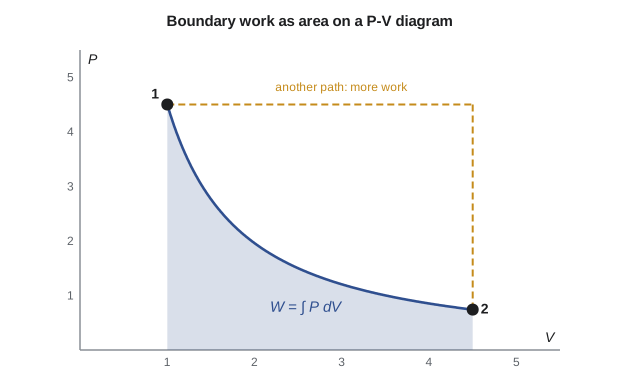
Three special cases cover most practical processes. At constant volume no boundary moves, so \(W_b = 0\). At constant pressure the integral is simply \(W_b = P(V_2 - V_1)\). For a polytropic process, one that follows \(PV^n = C\) for some constant exponent \(n\), the integral gives
Real compressions and expansions are often well described by a polytropic exponent between 1 and the specific-heat ratio \(k\) of the gas (about 1.4 for air). The case \(n = 1\) is an isothermal process for an ideal gas, since \(PV = mRT\) is then constant; \(n = k\) is a reversible adiabatic process for an ideal gas with constant specific heats, as Lesson 11 will show; and \(n = 0\) is a constant-pressure process.
Worked problem
Boundary work in a compressor cylinder
The plant's reciprocating instrument-air compressor draws 0.050 m³ (1.77 ft³) of air at 100 kPa (14.5 psia) into each cylinder and compresses it to 0.010 m³. Find the boundary work if the compression is polytropic with \(n = 1.3\). Compare with an isothermal compression.
Show solution
- Final pressure: \(P_2 = P_1(V_1/V_2)^n = 100(5)^{1.3} = 810.3\ \text{kPa}\).
- \[W_b = \frac{P_2V_2 - P_1V_1}{1 - n} = \frac{810.3(0.010) - 100(0.050)}{1 - 1.3} = \frac{8.103 - 5.000}{-0.3} = -10.34\ \text{kJ}\]
- Isothermal: \(W_b = P_1V_1\ln(V_2/V_1) = 100(0.050)\ln 0.2 = -8.05\ \text{kJ}\), with \(P_2 = 500\ \text{kPa}\).
Answer: The negative sign means work is done on the air: 10.3 kJ (9.8 Btu, or 7,630 ft·lbf) per stroke for the polytropic compression, 8.0 kJ for the isothermal one. Cooling the cylinder during compression saves work, which is why multistage compressors use intercoolers. The program below confirms both values by numerical integration.
# Boundary work for a gas compressed from P1, V1 to V2 along P V^n = constant
import math

P1, V1, V2 = 100.0, 0.050, 0.010      # kPa, m3, m3 (air in a compressor cylinder)

def work_closed_form(n):
    """W_b = integral of P dV, in kJ (negative means work is done on the gas)."""
    C = P1 * V1**n
    if abs(n - 1.0) < 1e-12:
        return P1 * V1 * math.log(V2 / V1)
    P2 = C / V2**n
    return (P2 * V2 - P1 * V1) / (1 - n)

def work_numerical(n, steps=100000):
    C = P1 * V1**n
    dV = (V2 - V1) / steps
    W = 0.0
    for i in range(steps):
        Vm = V1 + (i + 0.5) * dV          # midpoint rule
        W += C / Vm**n * dV
    return W

print(f"{'n':>5s} {'P2 (kPa)':>9s} {'W formula (kJ)':>15s} {'W numeric (kJ)':>15s}")
for n in (0.0, 1.0, 1.3, 1.4):
    P2 = P1 * (V1 / V2)**n
    print(f"{n:5.1f} {P2:9.1f} {work_closed_form(n):15.3f} {work_numerical(n):15.3f}")

# Electrical and shaft work for comparison
I, volts, hours = 20.0, 240.0, 0.5
print(f"\nheater: {volts * I / 1000:.2f} kW for {hours} h = {volts * I * hours * 3600 / 1000:.0f} kJ")
torque, rpm = 150.0, 1780.0
print(f"pump shaft: {torque * rpm * 2 * math.pi / 60 / 1000:.2f} kW")n P2 (kPa) W formula (kJ) W numeric (kJ) 0.0 100.0 -4.000 -4.000 1.0 500.0 -8.047 -8.047 1.3 810.3 -10.344 -10.344 1.4 951.8 -11.296 -11.296 heater: 4.80 kW for 0.5 h = 8640 kJ pump shaft: 27.96 kW
The program shows another useful fact: for the same volume ratio, the final pressure and the work input both grow with the exponent. A hot, uncooled compression (\(n\) near 1.4) needs about 40 percent more work than an isothermal one here, and it also delivers air at a much higher temperature, which must later be cooled before the air reaches the valve actuators.
Other forms of work
Shaft work is transmitted by a rotating shaft, as in the turbine, pumps and fans. A torque \(\tau\) acting on a shaft turning at \(\dot{n}\) revolutions per unit time transmits power \(\dot{W}_{sh} = 2\pi\dot{n}\tau\). The feedwater pump motor delivers 150 N·m at 1780 rev/min, or about 28 kW. Electrical work crosses a boundary when current flows through it: a current \(I\) driven by a voltage \(\mathcal{V}\) transfers power \(\dot{W}_e = \mathcal{V}I\). An electric resistance heater, analyzed as a system, receives electrical work, even though its purpose is to heat something; whether energy crossing a boundary counts as heat or work depends on where the boundary is drawn.
Spring work, done when a linear spring of stiffness \(k\) is stretched or compressed, is also common in thermodynamics problems because many relief valves and some piston-cylinder devices load the piston with a spring. Gravitational work and acceleration work, done when a force raises or accelerates a body, equal the changes in its potential and kinetic energies, so they appear in the energy balance through \(\Delta PE\) and \(\Delta KE\).
Worked problem
Heat or work?
An electric immersion heater warms the deaerator storage tank when the plant restarts after a shutdown. Classify the energy transfer as heat or work for three different systems: (a) the water in the tank, with the heater outside the boundary; (b) the water and the heater together; (c) the whole tank, insulated, with the heater inside.
Show solution
- (a) The heater element is hotter than the water, and energy crosses the boundary because of that temperature difference: heat transfer to the water.
- (b) Electric current crosses the boundary in the heater leads: electrical work done on the system. No heat crosses the boundary unless the tank loses energy to the room.
- (c) Again electrical work enters through the leads. The insulation makes the system adiabatic: \(Q = 0\), but \(W \neq 0\).
Answer: The same physical device gives different answers depending on the boundary. That is not a contradiction: heat and work are names for energy crossing a particular boundary, and the analysis is correct as long as the boundary is stated and kept consistent.
Energy transport by mass
In a control volume, mass crossing the boundary carries energy with it. That energy is not heat or work, but it must be accounted for in the energy balance. Lesson 7 will show that each kilogram of flowing fluid brings in its internal, kinetic and potential energy plus the flow work needed to push it across the boundary, and that internal energy and flow work combine conveniently into a property called enthalpy. For now, note that a closed-system energy balance has only heat and work crossing the boundary, while an open-system balance also has energy carried by mass.
Energy efficiency
Performance is measured by comparing a desired output with a required input. For a boiler, the combustion efficiency or boiler efficiency compares the energy delivered to the steam with the chemical energy in the fuel; modern gas-fired boilers reach 80 to 90 percent on the fuel's higher heating value, more with condensing heat recovery. For a motor, efficiency compares shaft power with electrical power, typically 93 to 96 percent for large premium-efficiency motors. For a pump, it compares the energy given to the water with the shaft work, often 60 to 85 percent. Overall efficiencies multiply: a pump that is 75 percent efficient driven by a motor that is 95 percent efficient converts about 71 percent of the electricity into useful work on the water.
Efficiency in this sense is a first-law quantity: it compares amounts of energy. Lesson 10 introduces a different kind of performance measure, the thermal efficiency of a heat engine, which the second law limits far below 100 percent no matter how good the engineering. Keeping the two ideas separate avoids a great deal of confusion when reading equipment data.
Worked problem
Energy cost of pumping the hot-water loop
The loop circulating pump delivers 60 kW of hydraulic power to the water. The pump is 78 percent efficient and its motor 95 percent efficient. Electricity costs 9.5 cents per kilowatt-hour. What does it cost to run the pump for a heating season of 5,500 hours?
Show solution
- Shaft power: \(\dot{W}_{sh} = 60/0.78 = 76.9\ \text{kW}\).
- Electrical power: \(\dot{W}_e = 76.9/0.95 = 81.0\ \text{kW}\).
- Energy: \(81.0 \times 5500 = 445{,}500\ \text{kWh}\). Cost: \(445{,}500 \times 0.095 = 42{,}300\) dollars.
Answer: About $42,000 a season. Nearly all of the 81 kW eventually becomes internal energy of the water, through friction in the pump and the pipes, so in winter it is not lost: it adds a little heat to the loop. In summer, on the cooling side, the same friction heat must be removed by the chillers.
Common mistakes
MistakeSaying a system contains heat or work.
InsteadA system contains energy; heat and work exist only while crossing a boundary.
MistakeAdding kinetic energy in m²/s² to internal energy in kJ/kg.
InsteadDivide V²/2 by 1000 to get kJ/kg.
MistakeTreating adiabatic as meaning constant temperature.
InsteadAdiabatic means no heat transfer; temperature can still change through work.
MistakeWriting the integral of δW as W₂ − W₁.
InsteadWork is a path function; the integral gives W₁₂, which depends on the path.
MistakeUsing P(V₂ − V₁) for every boundary-work problem.
InsteadThat formula holds only at constant pressure; integrate P dV along the actual path.
Summary and key terms
- Total energy is internal energy plus kinetic and potential energy: E = U + mV²/2 + mgz.
- Internal energy comprises sensible, latent, chemical and nuclear forms; this course uses sensible and latent energy.
- Heat is energy crossing a boundary because of a temperature difference; work is any other energy interaction.
- Heat and work are path functions; properties are point functions.
- Boundary work is the integral of P dV, the area under the process curve on a P-V diagram.
- For a polytropic process PVⁿ = C, W_b = (P₂V₂ − P₁V₁)/(1 − n), or P₁V₁ ln(V₂/V₁) when n = 1.
- Shaft power is 2πṅτ; electrical power is voltage times current.
- Efficiency is desired output over required input; component efficiencies multiply.
- Internal energy
- The sum of the microscopic forms of energy of a system.
- Sensible energy
- The part of internal energy associated with molecular motion, reflected in temperature.
- Latent energy
- The part of internal energy associated with the phase of a substance.
- Heat
- Energy transferred across a boundary because of a temperature difference.
- Work
- Energy transferred across a boundary by any means other than a temperature difference.
- Adiabatic process
- A process with no heat transfer.
- Path function
- A quantity, such as heat or work, whose value depends on the path of a process.
- Point function
- A quantity, such as a property, that depends only on the state.
- Boundary work
- Work done when the boundary of a system moves; the integral of P dV.
- Polytropic process
- A process that follows PVⁿ = constant.
- Shaft work
- Work transmitted by a rotating shaft.
- Efficiency
- The ratio of desired output to required input.
Practice problems
Work each problem on paper first, then reveal the answer to check.
Find the kinetic energy, in kJ/kg, of steam moving at 45 m/s.
Show answer
1.01 kJ/kg.
A gas expands at a constant 300 kPa from 0.02 m³ to 0.05 m³. Find the boundary work.
Show answer
9.0 kJ, done by the gas.
Air at 400 kPa and 0.10 m³ expands polytropically with n = 1.25 to 0.30 m³. Find P₂ and the work.
Show answer
P₂ = 101.3 kPa; W_b = 38.4 kJ.
A shaft transmits 820 N·m at 3600 rev/min. What power does it transmit?
Show answer
309 kW.
A 5 kW motor is 91 percent efficient and drives a fan that is 70 percent efficient. What power reaches the air if the motor draws its rated input?
Show answer
About 3.2 kW.
In the program, compute the work for n = 1.2. Is it closer to the isothermal or the n = 1.4 value?
Show answer
−9.49 kJ, between the isothermal −8.05 kJ and the n = 1.3 value of −10.34 kJ, and a little closer to the latter.
Lesson quiz · 5 questions
Score 60% or more to complete this lesson.
Create a free account to save your progress, take quizzes and earn a certificate.