
PET-230 · Lesson 10 of 12 · 26 min
The second law, heat engines and the Carnot cycle
The first law is a law of bookkeeping: energy is conserved in every process. But it says nothing about which processes can actually happen. A cup of hot coffee cools in a room; it never warms itself by drawing energy from the cooler air, even though that would conserve energy perfectly well. Steam in the turbine expands and turns the shaft; turning the shaft backwards does not reassemble the steam. And no engine, however well made, can turn all the heat from the boiler fires into work. These observations are summarized by the second law of thermodynamics, which gives processes a direction and energy a quality. This lesson states the second law, applies it to heat engines, refrigerators and heat pumps, and derives the absolute limits on their performance.
Thermal energy reservoirs
It helps to imagine a thermal energy reservoir: a body so large that it can supply or absorb any amount of heat without changing temperature. The atmosphere, a lake, a large river in winter, and the flame zone of a boiler all approximate reservoirs. A reservoir that supplies heat is a source; one that absorbs heat is a sink. Real reservoirs are only approximately constant in temperature, but the idealization lets us state the second law cleanly.
Heat engines
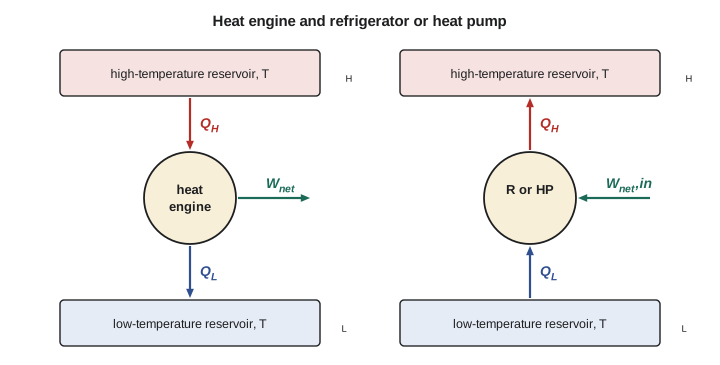
A heat engine is a device that receives heat from a high-temperature source, converts part of it to work, rejects the rest to a low-temperature sink, and operates in a cycle. A steam power plant is the clearest example: the working fluid, water, receives heat \(Q_H\) in the boiler, produces net work \(W_{\text{net}}\) in the turbine (less the small pump work), rejects heat \(Q_L\) in the condenser, and returns to its starting state. Applying the first law to the cycle gives \(W_{\text{net}} = Q_H - Q_L\). The fraction of the heat input converted to net work is the thermal efficiency:
Here \(Q_H\) and \(Q_L\) are magnitudes, positive numbers, with directions shown by the diagram. Typical thermal efficiencies: automobile gasoline engines about 25 to 30 percent, large diesel engines up to about 50 percent, modern coal-fired steam plants about 40 percent, combined-cycle gas-turbine plants about 60 percent. In every case, a large part of the heat input is rejected. A large thermal power station rejects more heat to its cooling water or cooling towers than it delivers as electricity.
The Kelvin-Planck statement
Why must an engine reject heat at all? Experience, distilled by Kelvin and Planck, says so. The Kelvin-Planck statement of the second law is: it is impossible for any device that operates on a cycle to receive heat from a single reservoir and produce an equivalent amount of net work. In other words, no heat engine can have a thermal efficiency of 100 percent. A device that violated this statement, say a ship's engine that drew heat from the ocean and turned all of it into work, would be a perpetual-motion machine of the second kind. It would not violate the first law, but it has never been built, and the second law says it never will be.
The Kelvin-Planck statement is not a limitation of engineering skill or materials. It applies to ideal engines as well as real ones. As we will see shortly, it implies a definite upper limit on the efficiency of any engine operating between two given temperatures.
Refrigerators and heat pumps
Heat flows naturally from hot to cold. Moving it the other way takes a refrigerator or a heat pump, a device that receives heat \(Q_L\) from a cold space, receives work \(W_{\text{net,in}}\), and rejects heat \(Q_H = Q_L + W_{\text{net,in}}\) to a warm space, all in a cycle. The two devices are the same machine with different purposes: a refrigerator's purpose is to remove \(Q_L\) from the cold space, while a heat pump's purpose is to supply \(Q_H\) to the warm space. Their performance is measured by a coefficient of performance (COP), the desired output divided by the required input:
Unlike efficiency, COP can exceed 1, and usually does: a domestic refrigerator typically has a COP of 1.5 to 3, a building chiller 4 to 7, and an air-source heat pump 2 to 4 depending on the weather. A heat pump with a COP of 3 delivers 3 kW of heat for each kilowatt of electricity, because it moves 2 kW from the cold surroundings and adds the 1 kW of work. That is why heat pumps are central to plans for decarbonizing heating, including Northgate's.
The Clausius statement
The second statement of the second law comes from Clausius: it is impossible to construct a device that operates in a cycle and produces no effect other than the transfer of heat from a lower-temperature body to a higher-temperature body. A refrigerator does move heat from cold to hot, but only with the help of work from outside. A refrigerator that needed no work would violate the Clausius statement.
The two statements look different, but they are equivalent: a device that violated one could be combined with an ordinary engine or refrigerator to violate the other. Suppose a perfect refrigerator, needing no work, existed. Run an ordinary heat engine between the same reservoirs, and use the perfect refrigerator to return the engine's rejected heat to the hot reservoir. The combination draws heat only from the hot reservoir and turns all of it into work, violating Kelvin-Planck. The reverse argument works too. So either statement can serve as the second law.
Reversible and irreversible processes
A reversible process is one that can be reversed without leaving any trace on the surroundings: after the forward process and its reverse, both the system and the surroundings return exactly to their initial states. Reversible processes do not occur in nature; they are idealizations, like frictionless surfaces. Real processes are irreversible, and the factors that make them so are called irreversibilities. The main ones are friction, unrestrained expansion of a gas, mixing of two fluids, heat transfer across a finite temperature difference, electrical resistance, inelastic deformation and chemical reactions.
Reversible processes matter because they are the best possible. A reversible turbine or compressor delivers the most work, or needs the least, for given end states. A reversible heat engine has the highest efficiency possible between two reservoirs. Comparing a real device with its reversible counterpart shows how much room for improvement remains. A process is internally reversible if no irreversibilities occur within the system, and externally reversible if none occur in the surroundings; a totally reversible process is both.
Heat transfer is reversible only in the limit of an infinitesimal temperature difference, which would require infinite area or infinite time. Every real heat exchanger works across a finite temperature difference, and the larger the difference, the larger the irreversibility. The building heat exchangers at Northgate, which heat water from 60 °C to 85 °C with steam condensing at 180 °C, transfer heat across differences of 95 to 120 °C, a large irreversibility. That observation, made quantitative in Lesson 11, is one of the strongest thermodynamic arguments for lower-temperature district systems.
The Carnot cycle
In 1824 the French engineer Sadi Carnot described the most efficient possible heat engine. The Carnot cycle consists of four reversible processes: (1-2) reversible isothermal heat addition from the source at \(T_H\); (2-3) reversible adiabatic expansion, during which the working fluid cools from \(T_H\) to \(T_L\) while producing work; (3-4) reversible isothermal heat rejection to the sink at \(T_L\); and (4-1) reversible adiabatic compression back to \(T_H\). Because every process is reversible, the cycle can also run backwards as a Carnot refrigerator or heat pump.
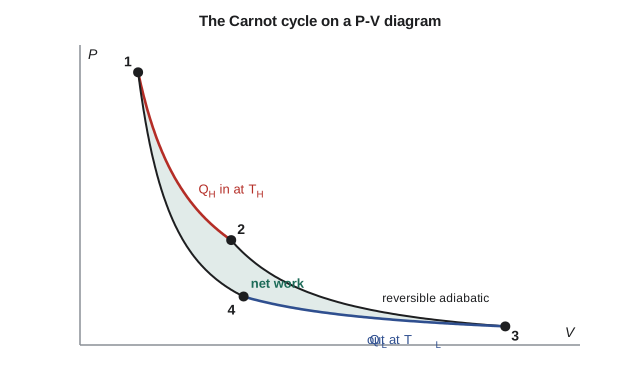
Two Carnot principles follow from the Kelvin-Planck statement. First, the efficiency of an irreversible heat engine is always less than that of a reversible engine operating between the same two reservoirs. Second, the efficiencies of all reversible engines operating between the same two reservoirs are the same. The second principle means that the efficiency of a reversible engine depends only on the reservoir temperatures, not on the working fluid or the details of the cycle.
The thermodynamic temperature scale
Since the reversible efficiency depends only on the two temperatures, the ratio \(Q_H/Q_L\) for a reversible engine must be a function of the temperatures alone. Kelvin proposed defining temperature itself by this relation: the ratio of the absolute temperatures of two reservoirs equals the ratio of the heats exchanged by a reversible engine operating between them, \((Q_H/Q_L)_{\text{rev}} = T_H/T_L\). This thermodynamic temperature scale is independent of any substance. Fixing the size of the degree by assigning 273.16 K to the triple point of water gives the kelvin scale, which is identical to the ideal-gas temperature scale used throughout this course. Absolute temperature is, at bottom, a second-law quantity.
Carnot efficiency and COP
Substituting \(Q_L/Q_H = T_L/T_H\) into the definitions gives the maximum efficiency of any heat engine, and the maximum COPs of any refrigerator or heat pump, operating between reservoirs at \(T_H\) and \(T_L\), in kelvins:
These limits teach a great deal. Engine efficiency rises with the source temperature and falls with the sink temperature, which is why power stations push steam temperatures as high as materials allow and are built beside cold rivers and lakes. Heat-pump COP rises as the temperature lift \(T_H - T_L\) shrinks, which is why heat pumps work best delivering moderate temperatures from moderate sources, and why a district system running at 60 °C suits heat pumps far better than one running at 180 °C. Comparing a real device with its Carnot limit gives its second-law efficiency, \(\eta_{II} = \eta_{th}/\eta_{th,\text{rev}}\) for an engine or \(\text{COP}/\text{COP}_{\text{rev}}\) for a heat pump.
# Carnot limits for heat engines and heat pumps at Northgate
def eta_carnot(TH, TL):
    return 1 - TL / TH

def cop_hp_carnot(TH, TL):
    return TH / (TH - TL)

K = 273.15
print("Carnot efficiency of an engine rejecting heat at 25 C:")
for tH in (100, 250, 400, 600, 1200):
    print(f"  source {tH:5d} C: {100 * eta_carnot(tH + K, 25 + K):5.1f} %")

# Sewer heat pump: treated effluent at 12 C, delivering hot water at various temperatures.
# Allow 5 K temperature differences in the evaporator and condenser.
print("\nheat pump from 12 C effluent (5 K approach each side, real COP = 50 % of Carnot):")
print(f"{'supply C':>9s} {'Carnot COP':>11s} {'real COP':>9s} {'kW elec per MW heat':>20s}")
for tsup in (45, 55, 70, 90):
    TH, TL = tsup + 5 + K, 12 - 5 + K
    cop = cop_hp_carnot(TH, TL)
    real = 0.5 * cop
    print(f"{tsup:9d} {cop:11.2f} {real:9.2f} {1000 / real:20.0f}")

# Is an inventor's claim possible? 1.2 MW heat in at 180 C, 0.5 MW work out, sink at 15 C
QH, W, TH, TL = 1200.0, 500.0, 180 + K, 15 + K
print(f"\nclaimed efficiency {W / QH:.3f}, Carnot limit {eta_carnot(TH, TL):.3f} ->",
"impossible" if W / QH > eta_carnot(TH, TL) else "possible")Carnot efficiency of an engine rejecting heat at 25 C:
source 100 C: 20.1 %
source 250 C: 43.0 %
source 400 C: 55.7 %
source 600 C: 65.9 %
source 1200 C: 79.8 %
heat pump from 12 C effluent (5 K approach each side, real COP = 50 % of Carnot):
supply C Carnot COP real COP kW elec per MW heat
45 7.52 3.76 266
55 6.29 3.14 318
70 5.12 2.56 391
90 4.18 2.09 478
claimed efficiency 0.417, Carnot limit 0.364 -> impossibleThe program puts numbers on these ideas. An engine supplied at 400 °C, the boiler outlet temperature, and rejecting at 25 °C can never exceed 55.7 percent efficiency. For the sewer heat pump, real machines achieve roughly half the Carnot COP; supplying water at 45 °C needs 266 kW of electricity per megawatt of heat, while supplying at 90 °C needs 478 kW, nearly twice as much.
Worked problem
The sewer heat pump
Northgate's heat pump draws heat from treated effluent at 12 °C (54 °F) leaving the city's wastewater plant and heats district water to 70 °C (158 °F). With 5 K temperature differences in its evaporator and condenser, its refrigerant evaporates at 7 °C and condenses at 75 °C. It delivers 4.0 MW (13.6 million Btu/h) of heat and draws 1.6 MW of electricity. Find its COP, its Carnot COP and its second-law efficiency, and the heat extracted from the effluent.
Show solution
- Actual COP: \(\text{COP}_{HP} = Q_H/W = 4.0/1.6 = 2.50\).
- \[\text{COP}_{HP,\text{rev}} = \frac{T_H}{T_H - T_L} = \frac{348.15}{348.15 - 280.15} = 5.12\]
- Second-law efficiency: \(2.50/5.12 = 0.49\).
- Heat from the effluent: \(Q_L = Q_H - W = 4.0 - 1.6 = 2.4\ \text{MW}\).
Answer: For every megawatt of electricity, 2.5 MW of heat reaches the district loop, 1.5 MW of it recovered from water that would otherwise flow into the river. If the loop temperature could be lowered to 55 °C, the same machine's COP would rise toward 3.1. Lowering the supply temperature, not just buying better heat pumps, is the larger lever.
Worked problem
Checking a vendor claim
A vendor offers an organic Rankine cycle unit that would take 1.2 MW of heat from a waste-heat stream at 180 °C and reject heat to cooling water at 15 °C. The brochure claims 500 kW of net power. Is the claim possible?
Show solution
- Claimed efficiency: \(500/1200 = 0.417\).
- \[\eta_{th,\text{rev}} = 1 - \frac{288.15}{453.15} = 0.364\]
Answer: The claim exceeds the Carnot limit and is therefore impossible, whatever the machine's design. In fact, since the heat source cools as heat is drawn from it, and real cycles have irreversibilities, a realistic unit would deliver perhaps 10 to 15 percent, around 150 kW. Elena replied politely asking the vendor to check their figures.
Common mistakes
MistakeUsing Celsius temperatures in the Carnot efficiency.
InsteadUse kelvins: η = 1 − T_L/T_H with absolute temperatures.
MistakeBelieving a better design could reach 100 percent efficiency.
InsteadKelvin-Planck forbids it; even a reversible engine rejects heat.
MistakeThinking COP above 1 violates energy conservation.
InsteadA heat pump moves heat; it delivers Q_H = Q_L + W.
MistakeAssuming all reversible engines between two temperatures differ by working fluid.
InsteadAll reversible engines between the same reservoirs have the same efficiency.
MistakeComparing a heat pump's COP with a boiler's efficiency directly.
InsteadCOP compares heat delivered with work input; boiler efficiency compares heat delivered with fuel energy.
Summary and key terms
- The second law gives processes a direction and limits the conversion of heat to work.
- Heat engine: η_th = W_net/Q_H = 1 − Q_L/Q_H.
- Kelvin-Planck: no cyclic device can turn heat from a single reservoir entirely into work.
- Clausius: no cyclic device can move heat from cold to hot with no other effect; the two statements are equivalent.
- Refrigerators and heat pumps are rated by COP_R = Q_L/W and COP_HP = Q_H/W = COP_R + 1.
- Irreversibilities include friction, unrestrained expansion, mixing and heat transfer across finite temperature differences.
- The Carnot cycle consists of two reversible isothermal and two reversible adiabatic processes.
- Carnot limits: η = 1 − T_L/T_H; COP_R = T_L/(T_H − T_L); COP_HP = T_H/(T_H − T_L).
- Thermal energy reservoir
- A body that can supply or absorb heat without changing temperature.
- Heat engine
- A cyclic device that converts part of the heat it receives into work.
- Thermal efficiency
- The ratio of net work output to heat input of a heat engine.
- Kelvin-Planck statement
- No cyclic device can receive heat from a single reservoir and produce an equal amount of work.
- Clausius statement
- No cyclic device can transfer heat from a colder to a hotter body with no other effect.
- Refrigerator
- A cyclic device that uses work to remove heat from a cold space.
- Heat pump
- A cyclic device that uses work to supply heat to a warm space.
- Coefficient of performance
- The desired heat transfer of a refrigerator or heat pump divided by its work input.
- Reversible process
- A process that can be reversed leaving no trace on system or surroundings.
- Irreversibility
- A factor, such as friction or finite temperature difference, that makes a process irreversible.
- Carnot cycle
- A reversible cycle of two isothermal and two adiabatic processes.
- Second-law efficiency
- The ratio of actual performance to the best possible (reversible) performance.
Practice problems
Work each problem on paper first, then reveal the answer to check.
A heat engine receives 800 kW and rejects 500 kW. Find its thermal efficiency.
Show answer
37.5 percent.
What is the Carnot efficiency of an engine between 550 °C and 30 °C?
Show answer
63.2 percent.
A chiller removes 300 kW from chilled water at 6 °C, rejecting heat at 35 °C, with a COP of 5.5. Find its power and its Carnot COP.
Show answer
54.5 kW; Carnot COP = 9.62.
A heat pump delivers 12 kW with a COP of 3.2. How much heat does it draw from outdoors?
Show answer
8.25 kW.
An inventor claims an engine with 45 percent efficiency between 300 °C and 20 °C. Possible?
Show answer
The Carnot limit is 48.9 percent, so it is possible in principle but very ambitious.
In the program, add a 35 °C supply temperature. What real COP results?
Show answer
About 4.7, needing about 211 kW of electricity per MW of heat.
Lesson quiz · 5 questions
Score 60% or more to complete this lesson.
Create a free account to save your progress, take quizzes and earn a certificate.