
MSAZ-319 · Lesson 8 of 12 · 20 min
Common distractors
▶ Video coming soon A video version of this lesson is on the way.
A distractor is a wrong option written to look right. On a well-made exam, every wrong option is chosen because some candidates will pick it: it names a real feature, it would work in a slightly different scenario, or it solves the problem in a way the item rules out. Learning the common patterns of distractors is one of the fastest ways to raise a practice score, because the same few patterns repeat across hundreds of items. On Thursday, December 3, Marisol went through Keiko's error log from the diagnostic with her and sorted every wrong answer by the kind of distractor that had caught her.
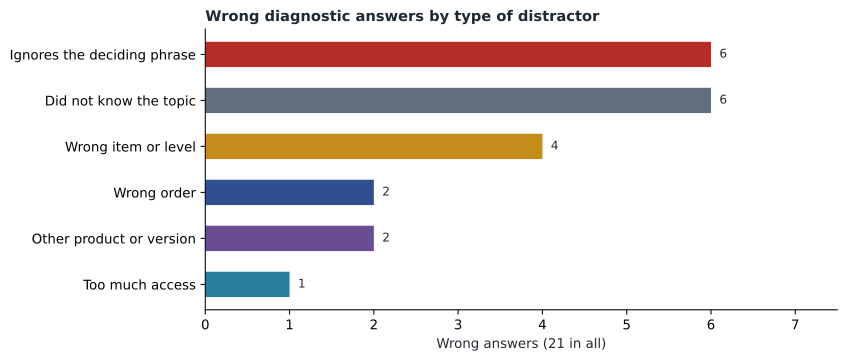
The result was striking. Of the 21 items Keiko got wrong, only 6 were about something she did not know at all. The other 15 were items where she knew the feature but chose an option that was real and plausible and wrong for that scenario. That is good news for the plan: knowledge gaps need hours of study, but distractor habits can be fixed with a few weeks of deliberate practice.
| Pattern | Items missed | Example from the diagnostic |
|---|---|---|
| Works, but ignores the deciding phrase | 6 | Chose a five-minute refresh where Direct Lake met the "minimize load" requirement |
| Right feature, wrong item or level | 4 | Chose a workspace role where an item permission was enough |
| Right idea, wrong order | 2 | Put the deployment before the Git merge |
| From another product or an older version | 2 | Chose a Synapse feature not available in Fabric |
| Too much access or effort | 1 | Chose Admin where Contributor was enough |
| Did not know the topic | 6 | KQL, project files, the XMLA endpoint |
It works, but it ignores the deciding phrase
The most common distractor on DP-600 is an option that would meet the requirement but not in the way the item asks. Items often contain phrases such as 'minimize administrative effort', 'minimize cost', 'with the least development effort', 'without changing the existing reports' or 'ensure data is always current'. Several options may meet the main requirement; the deciding phrase picks one. A candidate who reads the requirement and stops will choose the first option that works, which is exactly what the distractor relies on.
The defense is the stem-reading habit from lesson 2: underline the deciding phrase before reading the options, then cross out every option that meets the requirement but fails the phrase. In Keiko's example, the requirement was data no more than five minutes old and the deciding phrase was 'minimize the refresh load on the source'. Scheduling refresh every five minutes works but loads the source heavily; DirectQuery works but sends every visual's query to the source; Direct Lake over the lakehouse tables meets the freshness requirement with no scheduled import at all. Once the deciding phrase is underlined, the answer is plain.
The right feature on the wrong item or level
Fabric has several layers of access and configuration: tenant, capacity, workspace, item, and data inside the item. A common distractor offers the right kind of setting at the wrong layer. Row-level security set in the warehouse when the item says it must apply in the semantic model; a workspace role when an item permission is enough; a capacity setting when the item asks about a workspace setting; a tenant setting to allow something that is already allowed and only needs a permission. The defense is to ask, for every option, 'at which layer does this act?', and to compare the answer with the layer the item names.
| Layer | Typical settings | Who changes them |
|---|---|---|
| Tenant | Which features are on, who can create workspaces, export rules | Fabric administrator |
| Capacity | Size, XMLA read-write, which workspaces are assigned | Capacity administrator |
| Workspace | Roles, Git connection, license mode, Spark settings | Workspace Admin or Member |
| Item | Sharing, Build, ReadData, ReadAll, endorsement, labels | Item owner or workspace roles |
| Data in the item | Row, column and object security, masking, model roles | Item developers |
The right idea in the wrong order
Ordering items, and multiple choice items whose options are sequences, often contain the right steps in a wrong order. The usual errors are deploying before merging, refreshing before setting up the parameters that incremental refresh needs, testing security before publishing, and enabling a feature at the workspace before the tenant allows it. The defense is to ask what each step needs to exist before it can run. A deployment needs the content to be in the development workspace, so the merge into the connected branch must come first. An incremental refresh policy needs RangeStart and RangeEnd to filter the source query, so the parameters come first.
Another product or an older version
Fabric grew out of Power BI, Azure Synapse Analytics and Azure Data Factory, and many distractors name a feature from one of those that does not exist, or works differently, in Fabric. Dedicated SQL pools, Synapse workspaces, mapping data flows and integration runtimes are all real, but they are not Fabric items. Older Power BI features, such as dataflows Gen1 and some legacy dataset settings, also appear. The study guide is the guide here: if a feature is not named in it and is not part of Fabric, it is unlikely to be the answer. Keiko lost two items this way, both by choosing a Synapse term she remembered from an older project.
Too much access or too much effort
When several options meet a requirement, the exam nearly always prefers the one with the least privilege and the least effort that still meets it. Admin when Contributor would do, Contributor when Build on one model would do, a new capacity when resizing the existing one would do, a notebook when a shortcut would do. These distractors are easy to spot once the habit is in place: for each option that works, ask whether a smaller one would also work.
The patterns that are not distractors
Two things look like distractors but are not. First, an unfamiliar term is not automatically wrong. Fabric changes often, and the exam includes features that may be new to a candidate who has used only part of the platform. Second, the longest or most detailed option is not automatically right. Some candidates have learned that test writers make the correct answer the most precise; on a professionally edited exam such as DP-600, options are written to similar lengths, so length is not a clue.
Three items, taken apart
Marisol's favorite exercise is to take a practice item apart after answering it: label every wrong option with its pattern, and write one line saying what scenario would have made it right. The exercise is slow at first, about five minutes an item, but after a few weeks the labels come without effort, and the patterns start to show up during the first reading. Here are three items she wrote for Keiko in the style of the exam, with the analysis that followed.
Item one. 'A semantic model in import mode takes 70 minutes to refresh each night because it reloads seven years of sales. Only the last few days change. You need to reduce refresh time with the least development effort.' Options: switch the model to DirectQuery; configure incremental refresh on the sales table; build an aggregation table; move the model to a larger capacity. Incremental refresh is correct. DirectQuery removes the refresh but slows every report and changes how the model behaves, which is not least effort; the scenario that would make it right is one that requires current data. An aggregation table speeds queries, not refresh, so it is the right feature for the wrong problem. A larger capacity may make the refresh a little faster but still reloads seven years; it is too much cost for too little gain.
Item two. 'You manage a deployment pipeline with development, test and production stages. The test stage must connect to the test warehouse and production to the production warehouse. You need to ensure the correct connection is used after each deployment without manual changes.' Options: create a deployment rule for the data source in each stage; edit the connection in each stage after deployment; use a separate Git branch for each stage; create a parameter in Power Query and change it after deployment. Deployment rules are correct. Editing after deployment works but breaks 'without manual changes'. Branches per stage is the right idea from another tool, version control, applied to the wrong problem. A parameter is half right: parameters can be changed by a deployment rule, but changing it by hand fails the deciding phrase.
Item three. 'A lakehouse table receives a small file every five minutes. After a month, queries on it are slow. You need to improve query performance.' Options: run OPTIMIZE on the table; partition the table by minute; convert the table to CSV; increase the capacity size. OPTIMIZE is correct, because the problem is the number of small files. Partitioning by minute makes the files even smaller, which is the right feature family used the wrong way. CSV removes Delta's statistics and is slower. A larger capacity spends money without fixing the cause.
| Item | Correct | Wrong options and their patterns |
|---|---|---|
| Slow full refresh | Incremental refresh | DirectQuery (ignores least effort); aggregations (wrong problem); larger capacity (too much cost) |
| Connections per stage | Deployment rules | Manual edits (ignores no manual changes); branches per stage (wrong tool); manual parameter (half right) |
| Many small files | OPTIMIZE | Partition by minute (wrong way); CSV (older approach); larger capacity (too much cost) |
Keeping the error log useful
An error log becomes useful once it has enough rows to show patterns, and useless once it has so many that nobody reads it. Keiko's log has five columns: date, item topic, the option she chose, the pattern, and one line on what she will look for next time. Each Saturday she reads the week's rows and counts them by pattern. If one pattern accounts for more than a third of the week's errors, the next week's practice includes ten items chosen to test that pattern. In the first two weeks of the plan she expects 'ignores the deciding phrase' to dominate, as it did on the diagnostic; by the August checkpoint, her target is that no single pattern accounts for more than a quarter of her errors.
There is a second use for the log. When the same topic appears under different patterns, for example deployment pipelines missed once for order and once for layer, the problem is probably the topic rather than the reading habit, and the topic goes back into the study plan with a lab from lesson 10. Marisol checks the log with Keiko once a month, on the Saturday after each checkpoint, and asks only two questions: which pattern fell, and which topic keeps returning under different patterns. Everything else in the log is for Keiko alone.
Worked problem
Eliminating by pattern
Item: 'You have a Fabric workspace with a lakehouse. Analysts in another workspace must query its tables with T-SQL. You must grant the least access needed.' Options: A, add the analysts as Contributors to the lakehouse workspace; B, share the lakehouse with Read and ReadData; C, give the analysts ReadAll on the lakehouse; D, create a warehouse in the analysts' workspace and copy the tables. Which is correct?
Show solution
- A works but gives too much access; it lets them change everything in the workspace.
- C allows reading files and tables through OneLake from Spark; it is more than T-SQL needs.
- D works but adds effort and duplicates data; it ignores 'least access needed' and is the wrong layer.
- B grants SQL access to the tables and nothing more.
Answer: B; the others are too much access, the wrong kind of access, or too much effort.
Common mistakes
MistakeChoose the first option that works.
InsteadUnderline the deciding phrase and choose the option that meets it.
MistakeAssume every setting can be made at the workspace.
InsteadCheck the layer each option acts at against the layer the item names.
MistakeA familiar term from Synapse is probably right.
InsteadCheck that the feature exists in Fabric and in the study guide.
MistakeThe longest option is usually correct.
InsteadOption length is not a clue on a professionally edited exam.
MistakeMore access is safer.
InsteadThe exam prefers the least access and effort that meets the requirement.
Summary and key terms
- Most wrong answers come from real, plausible options, not from unknown topics.
- The commonest distractor works but ignores the deciding phrase in the stem.
- Other patterns: wrong layer, wrong order, another product or version, and too much access or effort.
- Fabric settings act at the tenant, capacity, workspace, item or data layer.
- Unfamiliar terms are not automatically wrong, and long options are not automatically right.
- Sorting the error log by pattern shows which habits to fix.
- Distractor
- A wrong option written to look right.
- Deciding phrase
- The words in a stem, such as "minimize cost", that choose one option from several that work.
- Least privilege
- Giving only the access needed for a task.
- Layer
- The level at which a setting acts, such as tenant, capacity, workspace, item or data.
- Error log
- A record of wrong practice answers with the reason each was missed.
Practice problems
Work each problem on paper first, then reveal the answer to check.
What is the most common distractor pattern?
Show answer
An option that works but ignores the deciding phrase.
How many of Keiko's 21 wrong answers were about topics she did not know?
Show answer
Six.
Name two Synapse features that are not Fabric items.
Show answer
Dedicated SQL pools and mapping data flows, for example.
At which layer is XMLA read-write enabled?
Show answer
The capacity.
Is the longest option usually correct?
Show answer
No.
Lesson quiz · 5 questions
Score 60% or more to complete this lesson.
Create a free account to save your progress, take quizzes and earn a certificate.