
MSAZ-319 · Lesson 1 of 12 · 23 min
The Fabric Analytics Engineer certification
▶ Video coming soon A video version of this lesson is on the way.
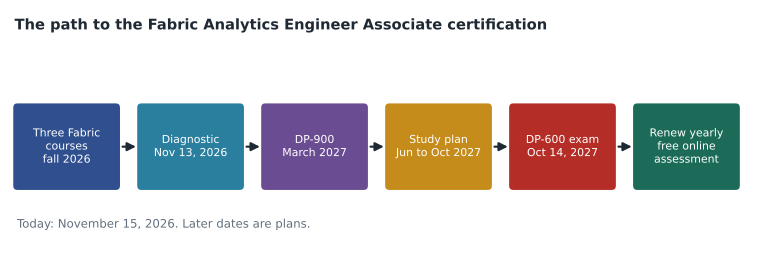
On Friday, November 13, 2026, after the last lunchtime tune session on the Finance Margin model, Marisol Vega booked the small meeting room for the afternoon and asked Keiko Tanabe to bring a notebook. Keiko had spent the fall in three courses at Harrow & Finch Home Supply in Des Moines: the Fabric foundations course with the data hub team, then preparing and modeling data with Marisol, then the enterprise semantic model sessions that cut the Finance Margin store page from more than eleven seconds to under two. Marisol wrote one line on the whiteboard: 'DP-600, Thursday, October 14, 2027.'
Keiko had already planned DP-900, the data fundamentals exam, for March 2027, and the two of them agreed that DP-600 would follow in the autumn, once the January pilot on the F16 capacity had settled. That leaves almost eleven months. 'It sounds like a lot of time,' Marisol said, 'but the pilot will eat most of the winter. What we decide today is how you use the time that is left.' This course is the plan they built. It explains the certification and the exam, reviews each part of the skills outline, practices reading the DAX, SQL and other code that appears in questions, looks at how wrong answers are built, works through a full scenario, plans hands-on practice and a timed schedule, and ends with exam day and renewal.
What the certification is
Exam DP-600, Implementing Analytics Solutions Using Microsoft Fabric, leads to the Microsoft Certified: Fabric Analytics Engineer Associate certification. It is a role-based certification at the associate level, the middle of Microsoft's three levels, above the fundamentals certifications such as DP-900 and below the expert certifications. There are no formal prerequisites; DP-900 is useful background, not a requirement. Microsoft describes the candidate as someone who designs, creates and deploys enterprise-scale analytics solutions: someone who turns raw data into reusable semantic models, prepares and serves the data those models need, and maintains the whole solution with proper security, version control and deployment.
That description tells Keiko what the exam is about and what it is not. It is not mainly an exam about building report pages, although reports appear as the place where performance and security problems show. It is not an exam about loading every kind of source at scale with pipelines and Spark; most of that belongs to DP-700, the Fabric Data Engineer exam that Ines Duarte is taking in May 2027. And it is not an exam about the Power BI service alone. The analytics engineer sits between the data engineer and the report author, and the exam tests the decisions in that middle space: which storage mode a model should use, where a transformation belongs, how a model is secured and deployed, and how to find out what a change will break.
Marisol put it in terms of the hub. 'Everything you touched this fall is on the outline,' she told Keiko. 'The star schema in wh_sales is preparing data. The Direct Lake model on top of it is semantic models. The deployment pipeline, the column rename impact check and the certification of Finance Margin are maintaining the solution. The exam asks about all of it at once, in somebody else's company.'
The exam at a glance
Microsoft's certification page gives the basic facts. The exam is 100 minutes long. It is offered in seven languages: English, Japanese, Chinese (Simplified), German, French, Spanish and Portuguese (Brazil). It is proctored and scheduled through Pearson VUE, either at a test center or online from a suitable room. The page says candidates may have interactive components to complete, which means some questions can ask for more than picking from a list. The price is not a single figure: Microsoft sets it by the country or region where the exam is proctored, so a candidate in the United States sees the local price when booking.
The passing score is 700 on a scale of 1 to 1,000. That is a scaled score, not a count of correct answers. Microsoft adjusts the score for the difficulty of the questions each candidate receives, so 700 does not mean that exactly 70 answers in 100 must be right. Some questions can be worth more than one point, and a few unscored questions may be included to try out new material; candidates cannot tell which ones they are, so every question deserves full effort. The result is reported as pass or fail with the scaled score, along with a breakdown that shows relative strength in each skill area.
| Item | DP-600 fact | Where it comes from |
|---|---|---|
| Certification | Microsoft Certified: Fabric Analytics Engineer Associate | Certification page |
| Exam title | Implementing Analytics Solutions Using Microsoft Fabric | Study guide |
| Exam length | 100 minutes | Certification page |
| Languages | Seven, including English, French, Spanish and Japanese | Certification page |
| Passing score | 700 on a scaled score of 1 to 1,000 | Study guide |
| Skill areas | Three on the certification page (see below) | Certification page |
| Delivery | Proctored, through Pearson VUE, at a test center or online | Certification page |
| Price | Set by the country or region where the exam is proctored | Certification page |
| Retake after a first failure | 24 hours | Retake policy |
| Renewal | Every 12 months, by a free online assessment | Certification page |
Two pages that disagree
The most important document for any Microsoft exam is the study guide, which lists every skill the exam can test. For DP-600, Keiko found a problem the first evening she looked. The certification page, with an 'at a glance' date of October 19, 2026, lists three skill areas: maintain a data analytics solution, prepare data, and implement and manage semantic models. The study guide page, which said it was last updated on October 30, 2026, still showed an older outline with four groups and weights: plan, implement and manage a solution for data analytics, 10 to 15 parts in 100; prepare and serve data, 40 to 45; implement and manage semantic models, 20 to 25; and explore and analyze data, 20 to 25. The study guide page had no change log to explain the difference.
Marisol had seen this before. Microsoft revised DP-600 in November 2024, moving from four skill groups to three. Commentators who follow the exam describe the change this way: the old planning group became 'maintain a data analytics solution' and grew to roughly a quarter of the exam; exploring and analyzing data stopped being a separate group, and querying with SQL moved into preparing data; work with streaming data in eventhouses and KQL was added; and some topics, such as most PySpark and several admin portal settings, were reduced or moved toward DP-700. The weights most often quoted for the current outline are about 25 to 30 parts in 100 for maintaining the solution, 45 to 50 for preparing data and 25 to 30 for semantic models.
Those weights come from third-party guides, not from the Microsoft page Keiko could see, so the course treats them as the best available estimate. The three-area outline on the certification page is the current one, and this course is organized around it. The rule Marisol gave Keiko is simple: a month before booking, open both pages again, look for a change log or a notice of an update to the English exam, and use whichever outline the study guide shows at that point. If the pages still disagree, trust the certification page for the areas and the study guide for the detailed skills it lists, and study anything that appears in either.
| Older study guide outline (four groups) | Weight shown | Where it sits in the current three areas |
|---|---|---|
| Plan, implement and manage a solution for data analytics | 10 to 15 | Maintain a data analytics solution (larger, about 25 to 30) |
| Prepare and serve data | 40 to 45 | Prepare data (about 45 to 50) |
| Implement and manage semantic models | 20 to 25 | Implement and manage semantic models (about 25 to 30) |
| Explore and analyze data | 20 to 25 | Mostly folded into prepare data (querying with SQL, the visual query editor and KQL) |
The study guide also says that most questions cover features that are generally available, but that preview features can appear if they are commonly used. That matters in Fabric, where some things Keiko used this fall, such as parts of Direct Lake on OneLake and some Copilot features, were previews. The safe approach is to know what each feature does and whether it is in preview, without relying on preview details that might change.
The practice assessment and the sandbox
Microsoft offers a free practice assessment for DP-600. In 2026 it moved to a new experience on AI Skills Navigator, which Microsoft says matches the exam more closely; the older practice assessment on Microsoft Learn is no longer updated. Keiko will use the new one twice: once at the end of the focused review in late August, and once before the last full timed set in September. Microsoft also provides an exam sandbox, a demonstration of the exam interface with sample question types, so that nothing on exam day looks unfamiliar. A practice assessment is not a copy of the exam, and a high score on it is a sign of readiness, not a guarantee.
Renewal and retakes
Associate certifications must be renewed every 12 months. Renewal is free: the candidate passes a short, unproctored online assessment on Microsoft Learn that focuses on recent changes to the technology. If Keiko passes in October 2027, her first renewal will fall in the autumn of 2028, and lesson 12 covers how to plan for it. The certification page recommends registering for exams with a personal Microsoft account rather than a work account, because records tied to a work account can be lost if the person leaves the organization.
If a candidate fails, the retake policy applies. After a first failed attempt, the candidate must wait 24 hours before trying again. After each later failure, the wait is 14 days. No more than five attempts are allowed in the 12 months after the first attempt, and an exam that has been passed cannot be retaken unless the certification has expired. Each attempt is paid for unless an offer covers it. Renewal assessments have their own, gentler rules: they can be retried immediately after a first failure and then after 24 hours, as many times as needed before the certification expires.
Keiko's diagnostic
Before the meeting, Marisol had built a 60-question diagnostic set from the quizzes in the three courses Keiko had just finished, 20 questions for each current skill area. Keiko took it on Friday morning. She answered 13 of 20 on maintaining a data analytics solution, 11 of 20 on preparing data and 15 of 20 on semantic models, 39 of 60 in all, or 65 in 100. A set this small is noisy: on another day the same knowledge could have produced 36 or 42. Its value is the pattern, not the total.
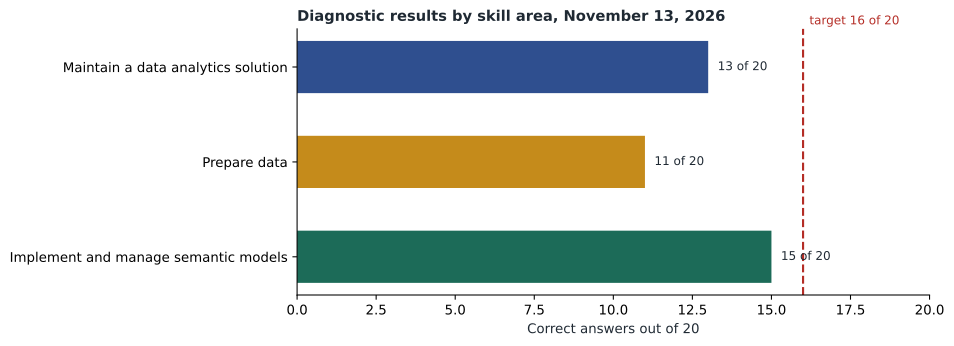
The pattern surprised Keiko. She expected preparing data to be her strongest area, because the star schema was the part of the fall she was proudest of. But many of her misses there were on topics she had touched only briefly: choosing between a dataflow, a notebook and T-SQL for a transformation, file sizes and partitioning in lakehouse tables, and querying an eventhouse with KQL, which she had never done. Her strongest area was semantic models, the subject of the last two courses. Her misses on maintaining the solution were mostly about version control and deployment details: what a Power BI project file contains, which items a deployment pipeline can move, and what the XMLA endpoint allows.
Marisol set a target of 16 of 20, or 80 in 100, in every area on practice sets by September. A good average is not enough, because the exam is scored as a whole but built from all three areas, and a candidate who is weak in the largest area can fail even with strong results elsewhere. Lesson 3 turns the diagnostic into a study budget, and lesson 11 turns the budget into dates.
Worked problem
Reading a diagnostic result
Keiko scored 13, 11 and 15 out of 20 in the three skill areas. Her target is 16 of 20 in each. How many more correct answers does she need in each area, and in total, and what fraction of the gap is in preparing data?
Show solution
- Maintain a data analytics solution: 16 − 13 = 3 more.
- Prepare data: 16 − 11 = 5 more.
- Implement and manage semantic models: 16 − 15 = 1 more.
- Total gap: 3 + 5 + 1 = 9 more correct answers out of 60.
- Share of the gap in preparing data: 5 ÷ 9 ≈ 0.56, a little over half.
Answer: She needs 3, 5 and 1 more correct answers, 9 in all, and just over half of the gap is in preparing data, the area with the largest weight.
Common mistakes
MistakeA scaled score of 700 means exactly 70 in 100 answers were correct.
InsteadThe score is scaled for the difficulty of each candidate's questions; 700 is the pass mark, not a percentage of correct answers.
MistakeThe weights on the study guide page are always current.
InsteadIn November 2026 the DP-600 study guide page still showed an older four-group outline while the certification page listed three areas. Check both, and any change log, before booking.
MistakeDP-600 is a Power BI report-building exam.
InsteadIt is about designing, preparing, modeling, securing and maintaining analytics solutions in Fabric; reports appear mainly where performance and security show.
MistakeA strong total on a diagnostic means the plan can be light.
InsteadA small diagnostic is noisy, and a weak area with a large weight can sink the result. Plan by area, not by the total.
MistakeRegister for the exam with a work account so the company can see it.
InsteadMicrosoft recommends a personal Microsoft account, because records tied to a work account can be lost if the person leaves.
Summary and key terms
- Exam DP-600 leads to the Microsoft Certified: Fabric Analytics Engineer Associate certification, a role-based associate certification with no formal prerequisites.
- The exam is 100 minutes, offered in seven languages, proctored through Pearson VUE, priced by country, and passed with a scaled score of 700.
- In November 2026 the certification page listed three skill areas while the study guide page still showed an older four-group outline; the current outline has three areas, with third-party weight estimates of about 25 to 30, 45 to 50 and 25 to 30.
- Check both pages and any change log a month before booking, and study anything either lists.
- The certification is renewed every 12 months by a free online assessment; retakes need 24 hours after a first failure and 14 days after later ones, with at most five attempts in 12 months.
- Keiko's diagnostic of 13, 11 and 15 out of 20 shows the largest gap in preparing data, which is also the largest area.
- Role-based certification
- A certification that measures the skills of a job role, such as analytics engineer, rather than knowledge of one product.
- Scaled score
- A score from 1 to 1,000 adjusted for question difficulty; 700 or more passes.
- Study guide
- Microsoft's list of the skills an exam measures, with weights and update notes.
- Practice assessment
- A free set of sample questions from Microsoft that shows the style of the exam.
- Exam sandbox
- A demonstration of the exam interface and question types, available before booking.
- Renewal assessment
- A free, unproctored online test that keeps a certification current for another year.
Practice problems
Work each problem on paper first, then reveal the answer to check.
How long is the DP-600 exam?
Show answer
100 minutes.
What score is needed to pass?
Show answer
A scaled score of 700 or more.
Which three skill areas does the certification page list?
Show answer
Maintain a data analytics solution, prepare data, and implement and manage semantic models.
What did the study guide page show in November 2026?
Show answer
An older outline with four groups, including a separate explore and analyze data group.
How long must a candidate wait after a second failed attempt?
Show answer
14 days.
Why is Keiko's diagnostic total less important than its pattern?
Show answer
A 60-question set is noisy; the pattern of strengths and gaps by area is what the plan is built on.
Lesson quiz · 5 questions
Score 60% or more to complete this lesson.
Create a free account to save your progress, take quizzes and earn a certificate.