
MEC-499 · Lesson 3 of 12 · 21 min
Concept generation
With twelve requirements agreed, the team could have started drawing the obvious answer. Every rental pump the cooperative had used was a diesel engine bolted to a self-priming centrifugal pump on a steel skid, and Tidewater makes self-priming wet ends. The temptation to draw that and move on was strong. Professor Leger asked a single question at the proposal review that stopped it: 'How do you know the obvious answer is the best one if you have not seriously considered any others?'
Concept generation is the stage where a team deliberately produces many possible solutions before judging any of them. Research on design teams consistently finds that the quality of the final design depends heavily on the range of concepts considered early, and that teams who fix on their first idea tend to defend it rather than improve it. This lesson covers the tools the TDX-150 team used: functional decomposition, research into existing solutions, brainstorming, the morphological chart, and a short introduction to the contradiction-solving ideas of TRIZ.
Functional decomposition
A product is easier to invent if it is first described by what it must do rather than by what it is. Functional decomposition breaks the overall function into subfunctions, each stated as a verb and a noun, and traces the flows of energy, material and signals between them. The figure shows the team's function structure for a dewatering pump set.
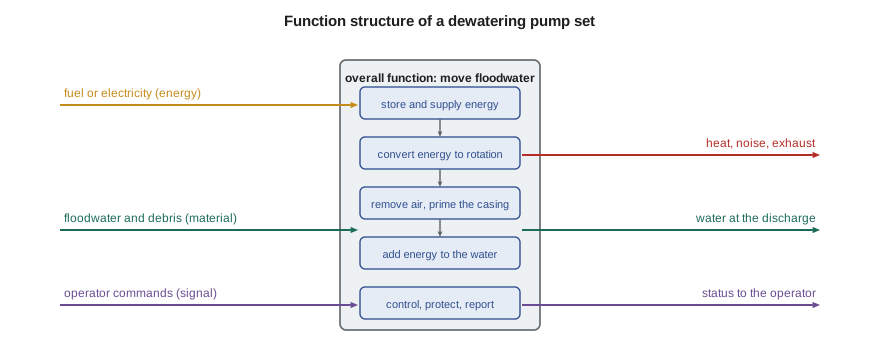
Stating functions without solutions is harder than it sounds. 'Run the engine' is not a function; it presumes an engine. 'Convert stored energy to rotation' is a function, and it immediately suggests alternatives: a diesel engine, a gasoline engine, an electric motor fed by a battery or a generator, a hydraulic motor fed from a power pack. 'Prime the pump' is more subtle. Priming means removing air from the suction line and pump casing so the impeller can lift water, and it is needed only because the pump sits above the water. A pump that sits in the water needs no priming at all, which opens the whole family of submersible designs.
The decomposition also exposed side effects that every concept must deal with: heat, noise and exhaust leave the system and affect the people near it. Listing them as outputs made the team think about where they go, which later shaped the canopy layout and the exhaust outlet height.
Looking at what exists
Before inventing, the team surveyed existing solutions. Hannah collected brochures and manuals for dewatering pumps from several manufacturers and summarized them in a table of flow, head, mass, fuel use, noise and price. Rafael read the cooperative's maintenance records for the rented units. Kwame searched patents for priming systems, which showed three main families: vacuum pumps with float-operated separators that keep water out of the vacuum pump, air compressors driving venturi ejectors, and flooded-suction designs that keep water in a large casing so the impeller can recirculate it until air is cleared.
Benchmarking is not copying. Its value is in learning what problems others have already solved and what trade-offs they chose. The survey showed that commercial 150 mm diesel units with vacuum priming weigh between 1,000 and 1,600 kg on their own skids, more than the cooperative's trailers can carry. That single fact told the team the obvious answer would not work off the shelf; it would need to be lighter than the market norm. Patent searches also matter for another reason: a team designing a product that might be sold must know whether its ideas infringe someone else's protected invention, a topic lesson 11 returns to.
Brainstorming and its rules
With functions defined, the team brainstormed solutions to each subfunction in a timed session. The classic rules apply: defer judgment, aim for quantity, build on each other's ideas and welcome unusual suggestions. Rafael enforced a rule borrowed from design studios: anyone who said 'that won't work' had to add two new ideas before speaking again. The session produced 47 ideas in 40 minutes, including several the team later rejected and a few that survived.
Spoken brainstorming favors confident speakers. The team also used brainwriting, in which each member writes three ideas on a sheet, passes it to the next person, who adds three more building on what is written, and so on. Brainwriting doubled Hannah's contributions, since she preferred to think before speaking, and produced the idea of mounting the pump wet end at the end of the skid so it could be lowered closer to the water on a short cantilever, reducing suction lift by half a meter.
The morphological chart
A morphological chart organizes options systematically. Each row is a subfunction; each cell in the row is a way of performing it. A concept is formed by choosing one option from every row. The figure shows a simplified version of the team's chart.
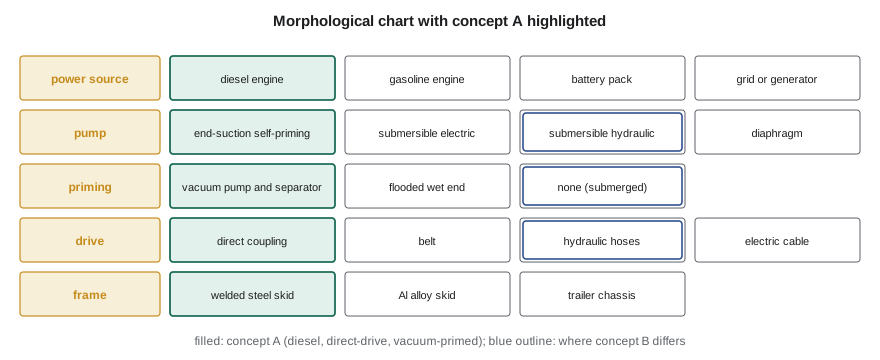
The chart is powerful because the number of combinations multiplies. Five rows with four, four, three, four and three options give 576 combinations. Most are nonsense, such as a submersible pump with a vacuum priming system or a battery driving hydraulic hoses for 24 hours, but checking them systematically finds combinations nobody suggested in the brainstorm. The program counts the combinations, removes those that break compatibility rules, and then screens the rest against two must-have requirements.
# Morphological chart for the dewatering skid: count combinations and filter the incompatible ones
from itertools import product

options = {
    "power source": ["diesel engine", "gasoline engine", "battery pack", "grid or generator"],
    "pump": ["end-suction self-priming", "submersible electric", "submersible hydraulic", "diaphragm"],
    "priming": ["vacuum pump and separator", "flooded wet-end casing", "none needed (submerged)"],
    "drive": ["direct coupling", "belt", "hydraulic hoses", "electric cable"],
    "frame": ["welded steel skid", "aluminum skid", "trailer chassis"],
}
total = 1
for f, opts in options.items():
    total *= len(opts)
print("Functions:", len(options), " raw combinations:", total)

def ok(c):
    power, pump, priming, drive, frame = c
    sub = pump.startswith("submersible")
    if sub and priming != "none needed (submerged)": return False
    if not sub and priming == "none needed (submerged)": return False
    if pump == "submersible electric" and drive != "electric cable": return False
    if pump == "submersible hydraulic" and drive != "hydraulic hoses": return False
    if drive == "electric cable" and pump != "submersible electric": return False
    if drive == "hydraulic hoses" and pump != "submersible hydraulic": return False
    if power == "battery pack" and drive == "hydraulic hoses": return False   # very low run time
    if pump == "diaphragm" and drive == "direct coupling": return False       # needs speed reduction
    return True

feasible = [c for c in product(*options.values()) if ok(c)]
print("Feasible after compatibility rules:", len(feasible))
# Screen against two must-have requirements: 24 h unattended run and 90 L/s
def screen(c):
    power, pump = c[0], c[1]
    if power == "battery pack": return False      # about 560 kWh for 24 h at 23 kW: far too heavy
    if pump == "diaphragm": return False          # diaphragm pumps of this size give far below 90 L/s
    return True
short = [c for c in feasible if screen(c)]
print("Pass the must-have screen:", len(short))
for p in sorted({(c[0], c[1]) for c in short}):
print(" ", p[0], "+", p[1])Functions: 5 raw combinations: 576 Feasible after compatibility rules: 93 Pass the must-have screen: 54 diesel engine + end-suction self-priming diesel engine + submersible electric diesel engine + submersible hydraulic gasoline engine + end-suction self-priming gasoline engine + submersible electric gasoline engine + submersible hydraulic grid or generator + end-suction self-priming grid or generator + submersible electric grid or generator + submersible hydraulic
Compatibility rules cut 576 combinations to 93, and the must-have screen cut those to 54. Two screens are worth explaining. A battery pack fails on run time: at about 23 kW of shaft power for 24 hours, the skid would need over 550 kWh of stored energy, which with current lithium-ion packs means several metric tons of battery. Diaphragm pumps fail on flow: they are excellent at handling solids and running dry, but the sizes that fit on a skid deliver a fraction of 90 L/s. These screens are not prejudices; each is a quick calculation, recorded in the concept log, that could be revisited if the technology changed.
The 54 survivors group into nine families by power source and pump type. From them, plus ideas from the brainstorm, the team developed four concepts to a level where they could be compared fairly.
| Concept | Description | Main advantage | Main concern |
|---|---|---|---|
| A | Diesel engine directly coupled to a self-priming end-suction pump with vacuum-assisted priming, on a welded steel skid | Simple, efficient, uses Tidewater's wet end | Suction lift limited by physics; mass |
| B | Diesel power pack driving a hydraulic submersible pump through hoses | No priming; any depth the hoses reach | Hydraulic losses; hoses heavy and vulnerable; cost |
| C | Diesel generator feeding an electric submersible pump through a cable | No priming; long cable runs possible | Two energy conversions; generator weight; electrical safety in floodwater |
| D | Two smaller gasoline trash pumps used together | Light, cheap, familiar to crews | Gasoline storage; lower flow and head; two machines to tend |
Resolving contradictions: TRIZ
The house of quality's roof showed that improving flow, run time and noise each tended to add mass. Engineers usually handle such conflicts by compromise: a bit more mass for a bit more run time. TRIZ, a method developed in the former Soviet Union from the study of many patents, suggests a different attitude. It treats a conflict between two parameters as a contradiction to be resolved, and offers a set of 40 inventive principles that patents have repeatedly used to resolve them, such as segmentation, taking out, nesting, and using composite materials.
The team applied a few principles informally to the run time against mass contradiction. 'Taking out' suggested separating the long-run fuel from the skid: a standard 450 L transfer tank on a second trailer could feed several skids, so the skid's own tank could be smaller for transport. 'Segmentation' suggested a two-piece canopy whose panels lift off for service, making each piece light enough for one person. 'Dynamics' suggested lowering engine speed at night when the water level has fallen, reducing both noise and fuel use. Not all of these survived, but the transfer-tank idea became an option the cooperative liked, and the night-speed idea appears in the control design.
Worked problem
Applying a TRIZ principle to noise
Noise must fall to 75 dB(A) at 7 m (23 ft), but a heavier canopy adds mass. Use TRIZ principles to suggest two ideas.
Show solution
- State the contradiction: reducing noise (improving parameter) worsens mass (worsening parameter).
- Principle 'local quality': make only the parts of the canopy facing the main noise paths heavy, and leave the rest light.
- Principle 'another dimension': turn the cooling-air inlet and outlet upward rather than sideways, so noise radiates upward instead of toward homes.
- Check each idea against the requirements and record it in the concept log for the selection stage.
Answer: Targeted mass on the noisiest faces and upward-facing air paths both reduce noise at 7 m with little added mass.
Keeping a concept log
Every idea, sketch and rejection was recorded in a shared concept log with a date and a reason. Rejected ideas were not deleted. Twice in the project an idea rejected early came back: the cantilevered wet end, set aside in week four as too complicated, returned in week eight when the suction-lift analysis showed every half-meter mattered. A log also protects the team at review. When Farah asked at the preliminary design review whether they had considered submersibles, Émilie could show not only that they had, but exactly why concept B scored as it did.
Avoiding fixation
Design fixation is the tendency to cling to early ideas or to features of examples one has seen. Showing a team a picture of an existing product before brainstorming measurably reduces the variety of ideas it produces. The TDX-150 team guarded against fixation in three ways: they brainstormed before looking at commercial products, not after; they generated at least three options for every subfunction before discussing any; and they assigned Rafael to argue the case for whichever concept the others were leaning against at each meeting. That last practice was uncomfortable, but it surfaced the strongest arguments for concept B, which made the eventual choice of concept A much more defensible.
Common mistakes
MistakeDeveloping the first idea in detail before generating alternatives.
InsteadGenerate many concepts across functions before judging any.
MistakeStating subfunctions as components, such as 'run the engine'.
InsteadState them as verbs and nouns that presume no solution, such as 'convert stored energy to rotation'.
MistakeRejecting options in brainstorming without recording why.
InsteadKeep a concept log with the reason for every rejection, so ideas can return if conditions change.
MistakeLooking at existing products before brainstorming.
InsteadBrainstorm first, then benchmark, to reduce fixation.
MistakeTreating every conflict as a compromise.
InsteadUse contradiction thinking, such as TRIZ principles, to look for ways to improve both parameters.
Summary and key terms
- Functional decomposition describes what the product must do as verb-noun subfunctions with energy, material and signal flows.
- Benchmarking showed commercial 150 mm diesel units are heavier than the cooperative's trailers allow.
- Brainstorming and brainwriting produced 47 ideas; a morphological chart organized them systematically.
- 576 combinations fell to 93 compatible ones and 54 that pass must-have screens, grouped into nine families.
- Four concepts went forward: direct-drive self-priming (A), hydraulic submersible (B), electric submersible (C) and twin trash pumps (D).
- TRIZ principles suggested a separate transfer tank, a segmented canopy and reduced night speed.
- Functional decomposition
- Breaking an overall function into subfunctions and the flows between them.
- Function structure
- A diagram of subfunctions linked by energy, material and signal flows.
- Benchmarking
- A systematic survey of existing products and their trade-offs.
- Brainwriting
- Written idea generation in which ideas are passed around and built upon.
- Morphological chart
- A table of subfunctions and options from which concepts are assembled.
- Compatibility rule
- A constraint that removes combinations whose options cannot work together.
- TRIZ
- A method of resolving technical contradictions using principles drawn from patents.
- Design fixation
- Clinging to early ideas or features of familiar examples.
- Priming
- Removing air from the suction line and casing so the pump can lift water.
- Concept log
- A dated record of every idea, sketch and rejection with reasons.
Practice problems
Work each problem on paper first, then reveal the answer to check.
A chart has rows with 3, 4, 2 and 5 options. How many combinations?
Show answer
3 × 4 × 2 × 5 = 120.
Restate 'add a radiator' as a function.
Show answer
Reject heat from the engine to the surroundings.
Why does a submersible pump need no priming?
Show answer
It sits in the water, so its casing is always flooded and there is no suction line to evacuate.
Estimate the battery energy for 24 h at 23 kW and say why concept screening rejected batteries.
Show answer
23 × 24 = 552 kWh; at roughly 150 to 200 Wh/kg for packs, that is about 3 to 4 metric tons, far above the mass limit.
Give one TRIZ-style idea for the contradiction between flow and fuel use.
Show answer
For example 'dynamics': vary engine speed with the water level so the pump runs at reduced flow and fuel use once the level falls.
Lesson quiz · 5 questions
Score 60% or more to complete this lesson.
Create a free account to save your progress, take quizzes and earn a certificate.