
MEC-440 · Lesson 9 of 12 · 21 min
Nuclear power
Nuclear power supplies about a sixth to a fifth of the electricity in both Canada and the United States, almost all of it from large reactors built between the 1960s and the 1990s. Minnesota gets about a fifth of its electricity from two nuclear plants, Prairie Island and Monticello, both on the Mississippi upstream and downstream of the Twin Cities. Interest in new nuclear has revived, driven by the need for firm, low-carbon electricity, and the first small modular reactors are now under construction in North America. The board has asked whether nuclear has any place in Northgate's plan, either as a source of electricity for heat pumps or, more ambitiously, as a source of heat. This lesson gives an engineering overview of how nuclear plants work and what their prospects are; it stays at the level of a power engineering textbook.
Energy from fission
When a heavy nucleus such as uranium-235 absorbs a neutron, it can split into two lighter nuclei, releasing about 200 MeV of energy and two or three further neutrons. Most of the energy appears as kinetic energy of the fragments, which is turned into heat as they slow down in the fuel. If, on average, exactly one of the released neutrons goes on to cause another fission, the chain reaction is steady, and the reactor is said to be critical. Reactors are controlled by adjusting the balance between neutron production and loss, using control rods or absorbers dissolved in the coolant, and they are designed so that a rise in temperature naturally reduces the reaction rate.
The energy density of nuclear fuel is enormous. Complete fission of 1 kg of uranium-235 releases about 82 TJ, as much heat as burning about 1,500 t of natural gas. Real fuel is mostly uranium-238, with a few percent or less of uranium-235, and only part of it is fissioned before the fuel is removed. The useful measure is burnup, the thermal energy released per metric ton of heavy metal in the fuel, in gigawatt-days per metric ton.
# Nuclear energy from fission: energy per kilogram, fuel needs of a small modular reactor
SITE = 'us'
MeV = 1.602e-13          # J
E_fis = 200*MeV          # energy released per fission, about 200 MeV
N_A = 6.022e23
per_kg_U235 = E_fis*N_A*1000/235.0          # J per kg of U-235 fissioned
print(f"Complete fission of 1 kg of U-235: {per_kg_U235/3.6e9:,.0f} MWh of heat ({per_kg_U235/1e12:.0f} TJ)")
print(f"Same heat from natural gas: about {per_kg_U235/55.5e6/1000:,.0f} t of gas (55.5 MJ/kg)")
# Burnup: thermal energy per metric ton of heavy metal in the fuel
for name, burnup in (('CANDU natural uranium', 7.5), ('light water reactor, enriched', 50.0)):
    print(f"  {name:30s}: about {burnup:.1f} GWd/t -> {burnup*24:,.0f} GWh of heat per metric ton")
# A 300 MWe boiling water small modular reactor
P_e, eta, cf = 300.0, 0.33, 0.93
P_th = P_e/eta
E_e = P_e*8760*cf/1000                      # GWh electric per year
fuel_t = P_th/1000*365*cf/45.0              # metric tons heavy metal per year at 45 GWd/t
print(f"\nSMR {P_e:.0f} MWe at {eta*100:.0f} % efficiency: {P_th:.0f} MW thermal")
print(f"At capacity factor {cf}: {E_e:,.0f} GWh/yr, fuel about {fuel_t:.1f} t heavy metal per year")
print(f"Condenser heat rejected: {P_th - P_e:.0f} MW  (enough, in principle, for {(P_th-P_e)/80:.0f} networks the size of Northgate's peak)")
# Decay heat after shutdown (Way-Wigner approximation)
for t in (1, 3600, 86400, 30*86400):
    frac = 0.066*(t**-0.2 - (t + 3.15e7)**-0.2)
print(f" {t:>8d} s after shutdown: decay heat about {frac*100:.2f} % of full power = {frac*P_th:.1f} MW")Complete fission of 1 kg of U-235: 22,807 MWh of heat (82 TJ)
Same heat from natural gas: about 1,479 t of gas (55.5 MJ/kg)
CANDU natural uranium : about 7.5 GWd/t -> 180 GWh of heat per metric ton
light water reactor, enriched : about 50.0 GWd/t -> 1,200 GWh of heat per metric ton
SMR 300 MWe at 33 % efficiency: 909 MW thermal
At capacity factor 0.93: 2,444 GWh/yr, fuel about 6.9 t heavy metal per year
Condenser heat rejected: 609 MW (enough, in principle, for 8 networks the size of Northgate's peak)
1 s after shutdown: decay heat about 6.39 % of full power = 58.1 MW
3600 s after shutdown: decay heat about 1.07 % of full power = 9.8 MW
86400 s after shutdown: decay heat about 0.47 % of full power = 4.3 MW
2592000 s after shutdown: decay heat about 0.14 % of full power = 1.3 MWReactor types
Most power reactors in the world are light water reactors, which use ordinary water as both coolant and moderator; the moderator slows the fast neutrons so they are more likely to cause fission in uranium-235. Because ordinary water absorbs some neutrons, light water reactors need fuel enriched to about 3 to 5 percent uranium-235. Pressurized water reactors keep the primary coolant at about 15 MPa so it does not boil at about 320 °C, and transfer heat in steam generators to a separate secondary circuit that drives the turbine. Boiling water reactors let the coolant boil in the core at about 7 MPa and send the steam directly to the turbine, which simplifies the plant but means the turbine handles slightly radioactive steam.
The CANDU reactor, developed in Canada, uses heavy water, in which the hydrogen is the heavier deuterium, as moderator and coolant. Heavy water absorbs very few neutrons, so CANDU reactors can run on natural uranium without enrichment. The fuel sits in hundreds of horizontal pressure tubes rather than in one large pressure vessel, and fuel bundles are changed while the reactor is running, which gives high availability. The trade-offs are the cost of heavy water and the larger size of the core. Ontario's CANDU units are being refurbished, replacing pressure tubes and other components, to run for another thirty years or more.
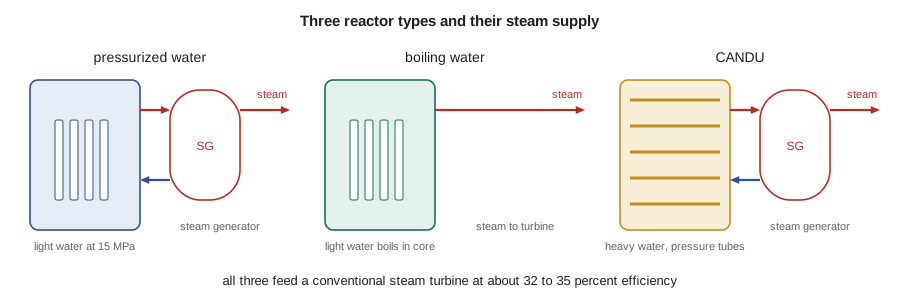
All three types feed a steam turbine, and because their coolant temperature is limited to about 300 °C, their steam conditions are modest and their efficiency is about 32 to 35 percent. A large unit of 1,000 MWe therefore rejects about 2,000 MW of heat to its condenser, a point the team will return to.
| Type | Moderator and coolant | Fuel | Typical steam pressure | Efficiency |
|---|---|---|---|---|
| Pressurized water reactor | Light water at about 15 MPa | Enriched uranium, 3 to 5 % | About 6 to 7 MPa | About 33 to 35 % |
| Boiling water reactor | Light water boiling at about 7 MPa | Enriched uranium, 3 to 5 % | About 7 MPa | About 33 % |
| CANDU | Heavy water, pressurized | Natural uranium | About 4.5 to 5 MPa | About 30 to 33 % |
| Sodium fast reactor (advanced) | No moderator; liquid sodium coolant | Enriched or recycled fuel | Higher, about 16 MPa | About 40 % |
Safety
Nuclear safety rests on three functions: controlling the reaction, cooling the fuel and containing the radioactive material. The difficult one is cooling. When a reactor shuts down, the fission chain stops within seconds, but the radioactive fission products continue to release decay heat: about 6 to 7 percent of full power immediately after shutdown, about 1 percent after an hour and still a few tenths of a percent after days. A 900 MW thermal core still produces several megawatts of heat a day after shutdown, which must be removed or the fuel will overheat. The accidents at Three Mile Island in 1979 and Fukushima Daiichi in 2011 were both, at root, failures to remove decay heat; Chernobyl in 1986 was a reactivity accident in a reactor design with unstable characteristics that is not used in North America.
Modern designs therefore emphasize passive safety: cooling that works by natural circulation, gravity and stored water without pumps or operator action for days. Defense in depth adds multiple independent barriers, from the ceramic fuel pellet and its cladding to the pressure boundary and the containment building, and multiple layers of systems and procedures. Regulators, the Canadian Nuclear Safety Commission in Canada and the Nuclear Regulatory Commission in the United States, license every stage from site preparation through construction, operation and decommissioning.
Fuel cycle and waste
Uranium is mined, milled and, for light water reactors, converted and enriched before being made into fuel. Canada is one of the world's largest uranium producers, mainly from northern Saskatchewan. After use, fuel is highly radioactive and hot. It is stored in pools at the reactor for several years and then in dry casks on site. Its volume is small: all the used fuel from decades of Canadian nuclear power would fill about seven hockey rinks to the top of the boards. The long-term plan in both countries is disposal in a deep geological repository, where the fuel would be isolated in stable rock for hundreds of thousands of years.
The United States has no operating repository for used commercial fuel after work on the Yucca Mountain site in Nevada was halted, so used fuel remains in dry storage at reactor sites, including Prairie Island and Monticello; the search for a consent-based siting process continues. Low- and intermediate-level wastes from operations and decommissioning are handled separately and are a much simpler problem.
Small modular reactors
Large nuclear plants have suffered from long construction times and cost overruns in North America and Europe. Small modular reactors, of up to about 300 MWe per unit, aim to cut cost and schedule by building smaller units with more factory fabrication, simpler passive safety systems and repeated designs. They also fit smaller grids and could replace coal units on existing sites.
The first examples are under construction. In Wyoming, TerraPower received a construction permit from the Nuclear Regulatory Commission in March 2026 for its Natrium plant at Kemmerer, a 345 MWe sodium-cooled fast reactor with a molten salt heat store that can boost output to about 500 MWe for several hours. In Canada, the first BWRX-300 boiling water reactor, a 300 MWe design, is under construction at Darlington in Ontario, with completion targeted for about 2030. How much these first units cost, and how quickly costs fall for later ones, will decide the future of the technology.
Some advanced designs run at higher temperatures. Sodium-cooled, molten salt and high-temperature gas-cooled reactors can supply heat at 500 to 750 °C, which could serve industrial processes as well as power. Micro-reactors of a few megawatts are being developed for remote communities and mines, where they would replace diesel generation.
Nuclear heat and district energy
A nuclear plant's condenser heat is, in principle, a huge resource for district heating. Some reactors in Switzerland, Russia and eastern Europe have supplied heat to towns for decades by extracting steam from the turbine, and China has started similar schemes. A 300 MWe small modular reactor rejects about 600 MW of heat, several times Northgate's peak demand. The obstacles are distance, because reactors are usually sited away from cities and long transmission pipelines are costly; public acceptance; and the economics of a very large, inflexible heat source for a demand that varies seasonally.
Worked problem
Fuel for a small modular reactor
A 300 MWe small modular reactor is 33 percent efficient and runs at a capacity factor of 0.93. Its fuel reaches an average burnup of 45 GWd/t. How much electricity does it produce in a year, how much heavy metal does it use, and how much natural gas would a 57 percent combined cycle burn to make the same electricity? Take the lower heating value of natural gas as 50 MJ/kg.
Show solution
- Thermal power: \(300/0.33 = 909\) MW. Annual electricity: \(300 \times 8760 \times 0.93 = 2{,}444\) GWh.
- Fuel: \(0.909\ \text{GW} \times 365 \times 0.93/45 = 6.9\) t of heavy metal per year.
- Gas: \(2{,}444 \times 3.6 \times 10^6/0.57 = 1.54 \times 10^{10}\) MJ, or \(1.54 \times 10^{10}/50 = 3.1 \times 10^8\) kg, about 310,000 t.
Answer: The reactor uses about 7 t of fuel a year where a combined cycle would burn about 310,000 t of gas. The tiny fuel mass is why nuclear fuel costs are small and why the economics of nuclear power are dominated by capital.
The team's conclusion is that nuclear power matters to Northgate indirectly. Minnesota's two existing plants are a large part of its carbon-free supply, and their continued operation, along with any new reactors in the region, is one of the main assumptions behind the falling grid factor in the model. The state has had a moratorium on new large nuclear plants, which the legislature has debated changing. No pathway in the plan depends on nuclear heat, but the team notes it as a long-term option if a reactor is ever built near the city.
Common mistakes
MistakeAssuming a reactor stops producing heat when it shuts down.
InsteadAccount for decay heat, about 6 to 7 percent of full power at first and still significant for days.
MistakeConfusing a reactor's thermal and electrical ratings.
InsteadState MWt and MWe; at 33 percent efficiency, thermal power is about three times electric power.
MistakeTreating all reactor types as the same.
InsteadDistinguish light water, CANDU and advanced reactors by coolant, moderator, fuel and temperature.
MistakeJudging nuclear costs by first-of-a-kind projects alone, or ignoring them.
InsteadRecognize that first units carry extra costs and that learning on later units is uncertain.
MistakeAssuming nuclear heat is easy to use for district heating.
InsteadConsider distance, pipeline cost, acceptance and seasonal demand.
Summary and key terms
- Fission of uranium-235 releases about 200 MeV per event; burnup measures energy per metric ton of fuel.
- Light water reactors use enriched fuel; CANDU reactors use heavy water and natural uranium with on-power refueling.
- Reactor coolant temperatures limit steam conditions and efficiency to about 32 to 35 percent.
- Decay heat after shutdown is the central safety challenge; modern designs use passive cooling.
- Used fuel is small in volume and is planned for disposal in deep geological repositories.
- Small modular reactors are under construction; their costs will decide their future, and nuclear heat for district energy faces distance and acceptance hurdles.
- Fission
- Splitting of a heavy nucleus into lighter nuclei with release of energy and neutrons.
- Moderator
- A material that slows neutrons so that they cause fission more readily.
- Enrichment
- Increasing the fraction of uranium-235 in uranium.
- Burnup
- Thermal energy produced per metric ton of heavy metal in nuclear fuel, often in GWd/t.
- Decay heat
- Heat produced by radioactive decay of fission products after a reactor shuts down.
- CANDU
- A Canadian reactor design using heavy water and natural uranium in horizontal pressure tubes.
- Passive safety
- Safety functions achieved by natural forces such as gravity and natural circulation without pumps or operators.
- Small modular reactor
- A reactor of up to about 300 MWe designed for factory fabrication and simpler construction.
Practice problems
Work each problem on paper first, then reveal the answer to check.
A 1,000 MWe reactor is 34 percent efficient. How much heat does its condenser reject?
Show answer
Thermal power \(1{,}000/0.34 = 2{,}940\) MW; condenser about 1,940 MW.
Fuel reaches 50 GWd/t. How much heat does one metric ton produce, in GWh?
Show answer
\(50 \times 24 = 1{,}200\) GWh.
Estimate the decay heat of a 900 MWt core one hour after shutdown at 1 percent.
Show answer
About 9 MW.
Why can CANDU reactors use natural uranium?
Show answer
Heavy water absorbs very few neutrons, so enough remain to sustain the chain reaction without enrichment.
Give one advantage and one challenge of using nuclear plant heat for district heating.
Show answer
Advantage: a very large low-carbon heat source; challenge: plants are far from cities and the heat demand varies seasonally.
Lesson quiz · 5 questions
Score 60% or more to complete this lesson.
Create a free account to save your progress, take quizzes and earn a certificate.