
MEC-440 · Lesson 11 of 12 · 21 min
Energy storage
Every lesson so far has run into the same obstacle: the energy is not available when it is needed. Solar peaks in summer, wind drops in calm weeks, cogeneration is most valuable when electricity prices are high, and heat pumps would be cheapest to run at night when the grid is lightly loaded. Storage moves energy in time. For a district energy utility it comes in two forms, electrical storage such as batteries and pumped hydro, and thermal storage in water, the ground or other materials. Graham has wanted a large hot-water tank at the plant for years. Kofi has been asked by the local utility whether Northgate would host a battery. This lesson compares the options and gives the team the tools to size and cost them.
Power, energy and duration
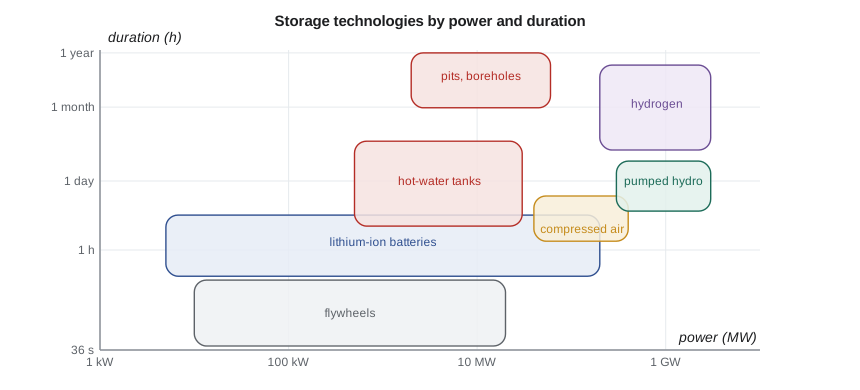
A store has two ratings. Its power rating, in megawatts, is how fast it can charge or discharge. Its energy rating, in megawatt-hours, is how much it holds. Their ratio is the duration: a 10 MW, 40 MWh battery can discharge at full power for four hours. Different technologies suit different durations, and the cost structure differs: for batteries the energy component dominates, so long durations are expensive; for pumped hydro and thermal storage the energy component is cheap, so long durations are affordable.
Three other numbers matter. Round-trip efficiency is the energy recovered divided by the energy put in. Self-discharge or standing loss is the energy lost while the store sits idle. Life is measured in years and in cycles, and many technologies degrade, holding less energy as they age.
Batteries
Lithium-ion batteries have become the dominant technology for grid storage of up to about four hours, following the fall in their cost driven by electric vehicles. Grid installations increasingly use lithium iron phosphate cells, which are less energy-dense than the nickel-manganese-cobalt cells of many vehicles but safer, longer-lived and cheaper. A large battery installation consists of containers of cells and modules with a battery management system, inverters, transformers, cooling and fire protection. Round-trip efficiency at the grid connection is about 85 to 90 percent.
Capacity fades with both cycling and calendar age. Typical warranties guarantee 60 to 80 percent of the original capacity after 10 to 20 years or several thousand full cycles. Projects therefore either oversize at the start or add new modules during their life, a practice called augmentation. Batteries earn money in several ways: shifting energy from low-price to high-price hours, providing fast frequency response and reserves, deferring transmission and distribution upgrades, and providing backup power. A battery that does only energy shifting rarely pays on its own; most projects stack several revenues.
Batteries carry a fire risk. A cell that fails internally can enter thermal runaway, heating itself and its neighbors. Modern installations use cell chemistries and module designs that limit propagation, spacing between containers, gas detection, explosion venting and fire suppression, and fire codes in both countries now set requirements for large installations.
# Energy storage: a hot-water tank for Northgate, a battery's round trip and degradation, and levelized cost of storage
SITE = 'us'
cur = 'USD'
import math
# 1) Hot-water storage tank charged to 95 C and discharged to 55 C
V = 20000.0                     # m3
rho, cp = 965.0, 4.2            # kg/m3, kJ/(kg K)
E_MWh = V*rho*cp*(95 - 55)/3600/1000
print(f"Hot-water tank {V:,.0f} m3, 95/55 C: {E_MWh:,.0f} MWh of heat")
print(f"  covers {E_MWh/80:.1f} h at the 80 MW peak, or {E_MWh/30:.1f} h at a 30 MW winter average")
d = (4*V/math.pi/1.0)**(1/3)    # diameter for height = diameter
print(f"  a tank with height = diameter is about {d:.0f} m")
loss = 0.01                     # fraction of stored heat lost per day
print(f"  standing loss at {loss*100:.0f} %/day: {E_MWh*loss:.0f} MWh per day")
# 2) Lithium iron phosphate battery: round trip and capacity fade
E_bat, P_bat = 40.0, 10.0       # MWh, MW (4-hour)
rte = 0.87
fade_cycle, fade_cal = 0.000035, 0.005   # fraction of capacity lost per full cycle, and per year of age
cycles = 330
cap = 1.0; throughput = 0.0
for yr in range(1, 21):
    cap -= fade_cycle*cycles + fade_cal
    throughput += E_bat*cap*cycles*rte
    if yr in (5, 10, 15, 20): print(f"  year {yr:2d}: capacity {cap*100:5.1f} %, cumulative energy delivered {throughput/1000:5.1f} GWh")
# 3) Levelized cost of storage, discounting energy delivered as well as cost
r = 0.06; N = 20
capex = E_bat*1000*420.0         # per kWh installed (study assumption, USD)
om = 0.015*capex
charge_price = {'ca': 0.035, 'us': 0.040}[SITE]   # off-peak price paid to charge, per kWh
pv_cost = capex; pv_E = 0.0; cap = 1.0
for yr in range(1, N + 1):
    cap -= fade_cycle*cycles + fade_cal
    out = E_bat*1000*cap*cycles*rte           # kWh delivered
    pv_cost += (om + out/rte*charge_price)/(1 + r)**yr
    pv_E += out/(1 + r)**yr
print(f"\nLCOS of the {E_bat:.0f} MWh battery: {pv_cost/pv_E:.3f} {cur}/kWh delivered (capital {capex/1e6:.1f} million)")
# 4) Pumped hydro and compressed air for comparison: energy in a reservoir
for name, V2, H2, eta in (('pumped hydro', 5.0e6, 300.0, 0.78),):
    E2 = 1000*9.81*V2*H2*eta/3.6e9
print(f"{name}: {V2/1e6:.0f} million m3 through {H2:.0f} m -> {E2:,.0f} MWh at {eta*100:.0f} % round trip")Hot-water tank 20,000 m3, 95/55 C: 901 MWh of heat covers 11.3 h at the 80 MW peak, or 30.0 h at a 30 MW winter average a tank with height = diameter is about 29 m standing loss at 1 %/day: 9 MWh per day year 5: capacity 91.7 %, cumulative energy delivered 54.6 GWh year 10: capacity 83.5 %, cumulative energy delivered 104.4 GWh year 15: capacity 75.2 %, cumulative energy delivered 149.5 GWh year 20: capacity 66.9 %, cumulative energy delivered 189.8 GWh LCOS of the 40 MWh battery: 0.220 USD/kWh delivered (capital 16.8 million) pumped hydro: 5 million m3 through 300 m -> 3,188 MWh at 78 % round trip
Levelized cost of storage
The levelized cost of storage spreads the lifetime costs of a store over the energy it delivers, both discounted to present value:
where \(C_0\) is the capital cost, \(O_t\) the operating cost, \(C_{\text{charge},t}\) the cost of the energy bought to charge, \(E_{\text{out},t}\) the energy delivered and \(r\) the discount rate. Discounting the energy as well as the costs is essential: it reflects that energy delivered in year 15 is worth less today than energy delivered in year 1, in the same way that money is. The battery in the study, at about 0.22 per kilowatt-hour delivered, costs far more per kilowatt-hour than the grid electricity it stores; its value comes from the price difference between the hours it charges and discharges, and from the other services it provides.
Pumped hydro and compressed air
Pumped hydro storage pumps water from a lower reservoir to an upper one when power is cheap and generates when it is valuable, using reversible pump-turbines. It provides most of the world's grid storage by energy, with round-trip efficiencies of about 70 to 80 percent, lives of 50 years or more and durations of hours to days. The energy stored is \(\rho g V H\), so a site needs a large height difference and room for two reservoirs; 5 million cubic meters through 300 m stores about 3 GWh. The prairies have little relief, so pumped hydro is not an option near Minneapolis, although the hydro reservoirs of the region do much the same job by holding water back.
Compressed air energy storage compresses air into underground caverns and expands it through turbines later. Two large plants have operated for decades, in Germany and Alabama, burning gas to reheat the air on expansion. Newer adiabatic designs store the heat of compression and reuse it, aiming for round-trip efficiencies of 60 to 70 percent. Like pumped hydro, compressed air storage depends on geology.
Thermal storage
For a heating utility, thermal storage is by far the cheapest way to store energy. Water has a high heat capacity, about 4.2 kJ/(kg K), and steel tanks or lined pits are cheap per cubic meter. A tank between 95 °C and 55 °C stores about 45 kWh per cubic meter. A 20,000 m³ tank, about 29 m in diameter and 29 m tall, holds about 900 MWh, enough to supply Northgate's whole network at its peak for 11 hours, or at an average winter load for more than a day. Insulated tanks lose about 1 percent of their heat a day, so they are excellent for daily and weekly storage.
Thermal storage lets Northgate decouple production from demand. Heat pumps and electric boilers can run in the low-price hours of the night and on windy days, and stop during the grid's peak hours. Cogeneration units can run when electricity prices are high and store the heat. On the design day, a full tank can cover the morning peak, reducing the peaking plant needed. Well-designed tanks keep a sharp thermocline between hot water above and cool water below, so the water delivered stays hot until the tank is nearly empty.
For seasonal storage the scale changes. Pit thermal storage, a large excavated pit lined with a polymer membrane and covered with a floating insulated lid, holds tens or hundreds of thousands of cubic meters of water at very low cost per cubic meter; Danish towns use them to store summer solar heat for the autumn and winter. Borehole fields, discussed in lesson 8, store heat in the ground itself. Seasonal stores lose more heat in absolute terms but are cheap enough per unit of capacity to be worthwhile when paired with cheap summer heat.
| Technology | Typical duration | Round trip | Relative cost of energy capacity | Notes |
|---|---|---|---|---|
| Lithium-ion battery | 1 to 4 h | 85 to 90 % | High | Fast response, degrades, fire precautions |
| Pumped hydro | 6 h to days | 70 to 80 % | Low to moderate | Needs height and reservoirs |
| Compressed air | Hours to days | 50 to 70 % | Low to moderate | Needs caverns |
| Hydrogen | Days to seasons | About 30 % (power to power) | Low for storage, high for conversion | See lesson 10 |
| Hot-water tank | Hours to a week | 90 to 98 % as heat | Very low | Ideal for district heating |
| Pit or borehole thermal storage | Seasonal | 50 to 80 % as heat | Very low | Large area, slow response |
Thermal storage instead of batteries
The team compares the two proposals on one question: which is the better way to let Northgate's future heat pumps avoid the grid's peak hours? A battery would store electricity at about 87 percent round trip and then run the heat pumps; a tank would store the heat the heat pumps have already made, at over 95 percent. The tank stores heat, which is what the network sells, and its energy capacity costs a small fraction of a battery's. A 900 MWh tank holds as much heat as a battery of about 300 MWh would produce through heat pumps at a coefficient of performance of 3, at a cost of roughly 10 to 15 million against more than 100 million for the battery at the study's cost of 420 per kilowatt-hour. The utility's interest in a battery is mainly for grid services, which Northgate can support by hosting one on its land under a separate agreement.
Worked problem
Sizing a heat storage tank to avoid the grid peak
On a cold winter day Northgate's heat pumps produce 60 MW of heat, and the grid operator asks large loads to avoid a 4-hour evening peak. How large a tank, charged to 95 °C and discharged to 55 °C, would let the heat pumps switch off during that window? Take the density of water as 965 kg/m³ and its specific heat as 4.2 kJ/(kg K).
Show solution
- Heat to store: \(60 \times 4 = 240\) MWh.
- Energy per cubic meter: \(965 \times 4.2 \times 40/3600 = 45.0\) kWh/m³.
- Volume: \(240{,}000/45.0 = 5{,}330\) m³, plus about 10 percent for the thermocline and dead volume, about 6,000 m³.
Answer: A tank of about 6,000 m³, roughly 20 m across and 20 m tall, would carry the heat pumps' output through the 4-hour peak. The team recommends a larger 20,000 m³ tank so that it can also smooth wind variation and cover the design-day morning peak.
The tank becomes part of every pathway in lesson 12. It is cheap, proven and useful whatever heat sources Northgate chooses, the kind of no-regret investment that planners look for.
Common mistakes
MistakeComparing storage technologies on capital cost per megawatt only.
InsteadCompare cost per megawatt-hour of capacity, round-trip efficiency, life and the service needed.
MistakeLeaving out degradation when estimating a battery's lifetime output.
InsteadModel capacity fade with cycles and age, and plan augmentation.
MistakeComputing levelized cost of storage without discounting the energy.
InsteadDiscount both costs and energy delivered.
MistakeStoring electricity to make heat later when the product sold is heat.
InsteadStore heat directly; it is much cheaper and more efficient.
MistakeDesigning a hot-water tank without regard to stratification.
InsteadUse diffusers and controlled flow to keep a sharp thermocline.
Summary and key terms
- A store has a power rating, an energy rating and a duration; their costs scale differently.
- Lithium-ion batteries suit durations of up to about four hours, at 85 to 90 percent round trip, with capacity fade over time.
- Levelized cost of storage discounts both costs and delivered energy.
- Pumped hydro and compressed air store large amounts of energy but depend on geography and geology.
- Hot-water tanks store about 45 kWh/m³ between 95 and 55 °C at very low cost and lose about 1 percent a day.
- For a heating utility, thermal storage is the cheapest way to shift heat pump operation away from grid peaks.
- Duration
- Energy rating of a store divided by its power rating.
- Round-trip efficiency
- Energy discharged from a store divided by energy used to charge it.
- Capacity fade
- Loss of a battery's usable energy capacity with cycling and age.
- Augmentation
- Adding modules to a battery over its life to restore lost capacity.
- Levelized cost of storage
- Present value of lifetime costs divided by present value of energy delivered.
- Thermocline
- The layer in a stratified tank separating hot water above from cool water below.
- Pit thermal storage
- A large lined and covered excavation holding hot water for seasonal storage.
- Thermal runaway
- An uncontrolled self-heating failure of a battery cell.
Practice problems
Work each problem on paper first, then reveal the answer to check.
A 25 MW battery holds 100 MWh. What is its duration?
Show answer
4 hours.
How much heat does 10,000 m³ of water store between 90 °C and 50 °C?
Show answer
\(10{,}000 \times 965 \times 4.2 \times 40/3.6 \times 10^{-6} \approx 450\) MWh.
A battery has 87 percent round-trip efficiency and charges with electricity at 0.04 per kWh. What is the energy cost per kWh delivered?
Show answer
\(0.04/0.87 = 0.046\) per kWh.
Find the energy stored by 2 million m³ of water raised 150 m, with 80 percent round trip.
Show answer
\(1000 \times 9.81 \times 2 \times 10^6 \times 150 \times 0.80/3.6 \times 10^9 = 654\) MWh.
Why is a hot-water tank more useful to Northgate than a battery of the same cost?
Show answer
It stores the product the network sells, at higher efficiency and much lower cost per unit of energy.
Lesson quiz · 5 questions
Score 60% or more to complete this lesson.
Create a free account to save your progress, take quizzes and earn a certificate.