
MEC-440 · Lesson 8 of 12 · 22 min
Geothermal, biomass and waste-to-energy
Wind, solar and hydro make electricity. A heating utility also has access to renewable heat sources that make heat directly: the heat of the ground, the chemical energy of wood and agricultural residues, the energy in municipal waste and the methane from digesters and landfills. These thermal renewables can be burned or tapped when needed, which gives them something that wind and solar lack: they can supply heat on the coldest night. Graham has a long memory of biomass proposals that came to nothing and is skeptical. Kofi points out that several cities with climates like Minneapolis's now run large biomass plants in their district heating systems. The team looks at each option on its merits.
Geothermal energy
The Earth's interior is hot, and heat flows outward through the crust at about 0.06 W/m² on average. In most places the temperature rises by about 25 to 30 K per kilometer of depth. Where hot rock and permeable formations full of water lie at shallow depth, as in Iceland, New Zealand, Italy, California and Nevada, wells can tap steam or hot water at 150 to 350 °C to drive turbines. Flash plants let high-pressure hot water boil as it rises and feed the steam to a turbine; binary plants pass moderately hot water through a heat exchanger that boils an organic working fluid, such as a hydrocarbon or a refrigerant, in an organic Rankine cycle. Geothermal power plants run at high capacity factors, often above 80 percent, and provide firm, low-carbon electricity.
Neither Minnesota nor most of the surrounding region has high-temperature resources at accessible depth. Some deep sedimentary basins in the western United States have warm water at moderate depth, and new techniques adapted from the oil and gas industry, including horizontal drilling and hydraulic stimulation of hot dry rock, are being tested to create artificial geothermal reservoirs. For a district heating network, deep wells at 2 to 3 km that produce water at 60 to 90 °C can be directly useful, because a fourth-generation network can use that temperature with little or no boosting. Such projects are expensive and carry drilling risk, because the flow rate a well will produce is not known until it is drilled and tested.
Shallow geothermal is a different and much more widely available resource. At depths of 10 to 200 m the ground stays at roughly the annual mean air temperature, a few degrees above freezing on the prairies. Ground-source heat pumps use closed loops of pipe in vertical boreholes or horizontal trenches, or open loops that pump groundwater, to extract heat in winter and reject it in summer. MEC-430 screened a borefield for the health center. At district scale, large borefields of hundreds of boreholes can serve as seasonal storage, recharged with summer heat from cooling and solar collectors. The ground is a heat source at low temperature, so a heat pump is always needed, and the borefield must be balanced over the years so the ground does not slowly cool.
Biomass for heat
Biomass fuels include wood chips and pellets from forestry and sawmill residues, agricultural residues such as straw, energy crops, and purpose-grown willow or poplar. Wood is about half carbon by dry mass and has a heating value of about 18 to 20 MJ/kg dry. As delivered it is usually wet: fresh chips may contain 40 to 55 percent water on a wet basis. Evaporating that water uses some of the fuel's energy, so the lower heating value as received is
where \(w\) is the moisture fraction on a wet basis and 2.443 MJ/kg is the latent heat of water at 25 °C. At 40 percent moisture the heating value as received is only about 10 MJ/kg, little more than half the dry value. A flue gas condenser recovers much of the latent heat back by cooling the flue gas below its dew point, which can raise the efficiency of a biomass boiler on a low-temperature network above 100 percent of the lower heating value, as MEC-330 showed for gas.
# Biomass boiler for Northgate: wood chip fuel, deliveries and the carbon question
SITE = 'us'
LHV_dry = 18.8            # MJ/kg dry wood, typical
for w in (0.25, 0.35, 0.45):  # moisture content, wet basis
    LHV_wet = LHV_dry*(1 - w) - 2.443*w     # MJ per kg as received
    print(f"moisture {w*100:2.0f} %: LHV as received {LHV_wet:5.2f} MJ/kg")
w = 0.40
LHV = LHV_dry*(1 - w) - 2.443*w
size_MW, eta_b, flh = 15.0, 0.85, 5000.0      # boiler output, efficiency on LHV, full-load hours
heat_GWh = size_MW*flh/1000
fuel_t = heat_GWh*3.6e6/eta_b/LHV/1000        # metric tons per year as received
trucks = fuel_t/30.0                           # 30 t chip trucks
print(f"\nBoiler {size_MW:.0f} MW at {flh:.0f} full-load hours: {heat_GWh:.0f} GWh of heat")
print(f"Chips at 40 % moisture (LHV {LHV:.2f} MJ/kg): {fuel_t:,.0f} t per year, about {trucks:,.0f} truckloads")
print(f"Peak day at full output: {size_MW*24*3.6/eta_b/LHV:,.0f} t, {size_MW*24*3.6/eta_b/LHV/30:.1f} trucks")
# Stack CO2 is real; whether it counts depends on the accounting rules and the forest
co2_bio = fuel_t*(1 - w)*0.50*44/12          # t CO2 from carbon (50 % of dry mass)
co2_gas_avoided = heat_GWh*1e6/0.90*0.181/1000
print(f"Biogenic CO2 at the stack: {co2_bio:,.0f} t/yr; fossil CO2 avoided from gas boilers: {co2_gas_avoided:,.0f} t/yr")
# Waste-to-energy and renewable natural gas: scale check
msw_t, msw_LHV, eta_wte = 200000.0, 10.5, 0.22
print(f"Waste-to-energy: {msw_t:,.0f} t/yr at {msw_LHV} MJ/kg, {eta_wte*100:.0f} % electric -> {msw_t*msw_LHV*eta_wte/3600:,.0f} GWh/yr")
rng_GWh = 15.0
print(f"RNG purchase of {rng_GWh:.0f} GWh would replace {rng_GWh/262*100:.1f} % of Northgate's gas")moisture 25 %: LHV as received 13.49 MJ/kg moisture 35 %: LHV as received 11.36 MJ/kg moisture 45 %: LHV as received 9.24 MJ/kg Boiler 15 MW at 5000 full-load hours: 75 GWh of heat Chips at 40 % moisture (LHV 10.30 MJ/kg): 30,831 t per year, about 1,028 truckloads Peak day at full output: 148 t, 4.9 trucks Biogenic CO2 at the stack: 33,914 t/yr; fossil CO2 avoided from gas boilers: 15,083 t/yr Waste-to-energy: 200,000 t/yr at 10.5 MJ/kg, 22 % electric -> 128 GWh/yr RNG purchase of 15 GWh would replace 5.7 % of Northgate's gas
The numbers show the logistics of biomass. A 15 MW boiler running 5,000 full-load hours burns about 31,000 t of chips a year, a thousand truckloads, and on the coldest days about five trucks a day must arrive, in all weather. The fuel yard must hold several days of supply under cover, the boiler must handle variation in moisture and particle size, and the ash, a few percent of the fuel, must be disposed of or used as a soil amendment. Biomass boilers need more maintenance than gas boilers, run best at steady load, and are typically sized for the base of the load duration curve, with gas or electric boilers for peaks.
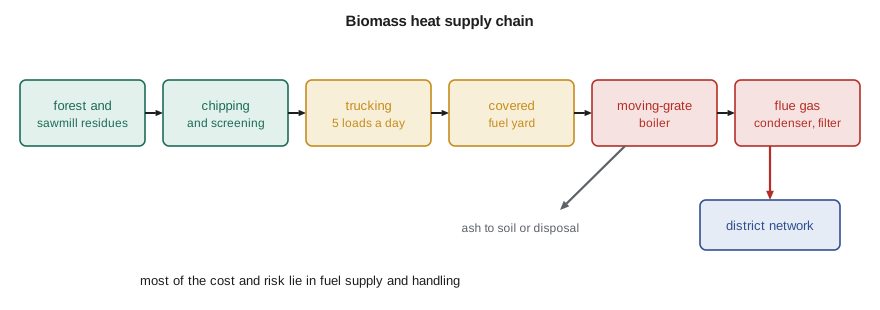
Emissions control is essential in a city. Wood combustion produces fine particulate matter, which baghouses or electrostatic precipitators reduce to very low levels, and nitrogen oxides, which staged combustion and sometimes selective non-catalytic reduction control. Modern plants with good filters emit much less particulate per unit of heat than small domestic wood stoves, which is one argument for district systems in towns where many homes burn wood.
The biomass carbon question
Burning wood releases carbon dioxide at the stack, about 34,000 t a year for the 15 MW boiler, more than twice the 15,000 t of fossil carbon dioxide it would avoid by displacing gas, because wood has more carbon per unit of heat and the boiler is less efficient. Whether biomass is low carbon therefore depends entirely on what happens to the carbon outside the plant. If the fuel is residue that would otherwise rot or be burned in the forest, releasing its carbon within a few years, using it for heat adds little. If the fuel comes from trees cut for the purpose, the carbon released at the stack is reabsorbed only as the forest regrows, which takes decades, and in the meantime the atmosphere holds more carbon than it would have.
Accounting rules generally treat biogenic carbon dioxide at the stack as zero for the energy user, on the assumption that it is counted in the land-use sector. That is a convention, not a physical fact. A responsible plan uses only residues from sustainably managed sources, verifies the supply chain, prefers short supply distances, and reports stack emissions alongside the accounting figure. The team adopts that approach and limits biomass to the residue supply that regional sawmills and forestry operations can provide without new harvesting.
Waste-to-energy
Municipal solid waste has a heating value of about 9 to 12 MJ/kg as collected, about half of it from biogenic material such as paper, food and wood and half from plastics, which are fossil. Waste-to-energy plants burn mixed waste on moving grates, raise steam at moderate conditions, typically 40 bar and 400 °C, to limit corrosion from chlorine in the flue gas, and generate electricity at 20 to 25 percent efficiency or supply heat and power to a district network at much higher total efficiency. Their emissions control systems are extensive, because waste contains metals, chlorine and other contaminants: scrubbers, activated carbon, fabric filters and nitrogen oxide control. Minneapolis has a waste-to-energy plant downtown that has burned much of the county's waste since the late 1980s and generates electricity and steam; its future has been debated as the county and city pursue zero-waste goals.
Waste-to-energy recovers energy from waste that cannot be recycled and reduces landfill methane, but its fossil carbon from plastics is real, and it can compete with recycling for material. Most climate plans treat it as a declining resource as waste reduction improves.
Biogas and renewable natural gas
Anaerobic digestion of manure, food waste, wastewater sludge and crop residues produces biogas of about 55 to 65 percent methane, the rest mostly carbon dioxide. Landfills produce a similar gas as buried organic waste decomposes. Biogas can be burned directly in engines or boilers near where it is made, or upgraded by removing the carbon dioxide and impurities to pipeline-quality renewable natural gas, which can then be injected into the gas network and bought by any user under contract. Renewable natural gas is chemically identical to fossil gas, so Northgate's existing boilers could burn it without modification. Its supply is limited by the feedstocks available, and its price is typically several times that of fossil gas. The team treats it as a premium fuel for peaking boilers that run only a few hundred hours a year, where a small quantity goes a long way.
| Source | Temperature or fuel | Firm on design day? | Main constraints |
|---|---|---|---|
| Deep geothermal wells | 60 to 90 °C water at 2 to 3 km | Yes | Drilling cost and risk, uncertain flow |
| Ground-source borefield | About 5 to 10 °C, heat pump needed | Yes, with heat pump | Land, balance over years |
| Wood chip boiler | Chips at 35 to 50 percent moisture | Yes | Fuel supply, trucks, emissions, carbon accounting |
| Waste-to-energy | Mixed municipal waste | Yes | Public acceptance, fossil plastics, declining waste |
| Renewable natural gas | Pipeline methane from digesters and landfills | Yes | Limited supply, high price |
Worked problem
Fuel trucks for a biomass boiler
A 15 MW biomass boiler is 85 percent efficient on the lower heating value and burns chips at 40 percent moisture. The dry heating value is 18.8 MJ/kg. How many 30 t truckloads are needed on a design day when the boiler runs at full output for 24 hours, and how large a covered fuel store holds five days at that rate, if chips have a bulk density of 300 kg/m³?
Show solution
- Heating value as received: \(18.8(0.60) - 2.443(0.40) = 11.28 - 0.98 = 10.30\) MJ/kg.
- Fuel per day: \(15 \times 24 \times 3.6/0.85/10.30 = 148\) t, about 5 truckloads.
- Five days: \(740\) t, or \(740{,}000/300 = 2{,}470\) m³ of covered storage.
Answer: The boiler needs about five truckloads a day in the coldest weather and a covered store of about 2,500 m³, a building roughly 30 m by 30 m with chips piled 3 m deep. The team checks the route the trucks would take through the neighborhood around the plant before going further.
The team's conclusion is that geothermal at depth is not proven in Minnesota, ground-source borefields are better suited to individual buildings and small clusters than to the whole network, waste-to-energy is not within Northgate's control, and renewable natural gas is too limited to be the main fuel. Biomass is the one thermal renewable that could supply a large share of base-load heat. It goes into pathway C, limited to a 15 MW boiler fueled by residues, with its stack carbon reported separately.
Common mistakes
MistakeUsing the dry heating value for wet fuel.
InsteadCorrect for moisture on a wet basis, including the latent heat of the water.
MistakeCalling biomass carbon neutral without examining the fuel source.
InsteadCheck what would have happened to the carbon without the plant, and report stack emissions.
MistakeAssuming deep geothermal wells will deliver their target flow.
InsteadAllow for drilling risk; flow is known only after testing.
MistakePlanning biomass without fuel logistics.
InsteadPlan truck traffic, covered storage, fuel quality and ash disposal from the start.
MistakeTreating renewable natural gas as unlimited.
InsteadRecognize its limited supply and high price, and reserve it for low-hour uses.
Summary and key terms
- High-temperature geothermal power needs hot, permeable rock near the surface; it is absent from most of the prairies and upper Midwest.
- Deep sedimentary wells can supply 60 to 90 °C water for low-temperature networks, with drilling risk.
- Shallow ground-source systems need heat pumps and balanced annual loads.
- Wood's heating value falls steeply with moisture: about 10 MJ/kg at 40 percent moisture, against 18.8 dry.
- Biomass carbon depends on the fuel source; residues are better than purpose-cut trees, and stack emissions should be reported.
- Waste-to-energy and renewable natural gas are useful but limited resources.
- Binary geothermal plant
- A geothermal plant that boils an organic working fluid with hot well water in a heat exchanger.
- Organic Rankine cycle
- A Rankine cycle that uses an organic fluid, suited to low-temperature heat sources.
- Wet-basis moisture
- Mass of water divided by total mass of the wet fuel.
- Flue gas condenser
- A heat exchanger that cools flue gas below its dew point to recover latent heat.
- Biogenic carbon
- Carbon in biomass that was recently absorbed from the atmosphere by plants.
- Waste-to-energy
- Combustion of municipal waste to produce electricity, heat or both.
- Anaerobic digestion
- Breakdown of organic matter by microbes without oxygen, producing biogas.
- Renewable natural gas
- Biogas upgraded to pipeline quality and injected into the gas network.
Practice problems
Work each problem on paper first, then reveal the answer to check.
Find the heating value as received of wood at 50 percent moisture with a dry value of 19.0 MJ/kg.
Show answer
\(19.0 \times 0.5 - 2.443 \times 0.5 = 8.28\) MJ/kg.
A 10 MW boiler is 82 percent efficient on fuel at 11 MJ/kg. How much fuel does it burn per hour at full load?
Show answer
\(10 \times 3600/0.82/11 = 3{,}990\) kg/h.
The ground temperature increases by 28 K/km from a surface value of 6 °C. Estimate the temperature at 2.5 km.
Show answer
\(6 + 28 \times 2.5 = 76\) °C.
Why can a biomass boiler with a flue gas condenser exceed 100 percent efficiency on the lower heating value?
Show answer
The condenser recovers latent heat of the water vapor, which the lower heating value excludes.
Give two reasons renewable natural gas suits peaking boilers better than base-load supply.
Show answer
Its supply is limited and its price is high, so it is best used for the few hours when other sources cannot meet demand.
Lesson quiz · 5 questions
Score 60% or more to complete this lesson.
Create a free account to save your progress, take quizzes and earn a certificate.