
MEC-440 · Lesson 5 of 12 · 20 min
Hydroelectric power
Hydroelectric power is the oldest large-scale renewable electricity, and it is the reason Minnesota's grid can import clean power from Manitoba. A chain of large stations on the Nelson River in northern Manitoba sends power south to the province's cities and, over interconnections that were expanded around 2020, to Minnesota and the Midwest. Northgate will never own a large hydro station, but its plan depends on how much hydro power the region has and when. Kofi has also been asked to look at a small hydro unit at a weir on the Mississippi, an idea that comes up at every planning review. This lesson covers the physics and engineering of hydro power and gives the team the tools to answer both questions.
Power from falling water
Water falling through a height \(H\) loses potential energy \(g H\) per kilogram. A turbine converts part of it to shaft work. The hydraulic power available from a flow \(Q\) through a net head \(H\) is
where \(\eta\) is the overall efficiency of the turbine, generator and transformer, typically 0.85 to 0.93 for large modern units. Net head is the gross head between the headwater and tailwater levels minus the friction and form losses in the intake, penstock and draft tube. Power is proportional to both flow and head, so a high-head mountain station can produce large power from a small flow, while a prairie river station needs enormous flows at low head. A Nelson River station with 4,000 m³/s through about 18 m of head produces about 650 MW; a site on an urban river with 120 m³/s through 4.5 m produces less than 5 MW.
# Hydroelectric power: output from head and flow, annual energy from a flow duration curve, turbine type
SITE = 'us'
import math
rho, g = 1000.0, 9.81
# 1) A large northern station of the kind on the Nelson River, and a low-head urban site
for name, Q, H, eta in (('large northern station', 4000.0, 18.0, 0.92), ('low-head weir site', 120.0, 4.5, 0.85)):
    P = rho*g*Q*H*eta/1e6
    print(f"{name:24s}: Q {Q:6.0f} m3/s, H {H:4.1f} m, eta {eta:.2f} -> {P:7.1f} MW")
# 2) Annual energy at the low-head site from a flow duration curve (flow exceeded p % of the time)
fdc = [(0, 600), (10, 380), (20, 260), (30, 190), (40, 150), (50, 120), (60, 95), (70, 75), (80, 58), (90, 42), (100, 25)]
Qd, Qmin = 120.0, 30.0        # design flow and minimum turbine flow
H = 4.5
E = 0.0
for (p1, q1), (p2, q2) in zip(fdc, fdc[1:]):
    for j in range(10):
        p = p1 + (p2 - p1)*(j + 0.5)/10; qq = q1 + (q2 - q1)*(j + 0.5)/10
        qt = min(qq, Qd) if qq >= Qmin else 0.0
        h = H - 1.5*max(0.0, (qq - 300)/300)      # head drops in floods as tailwater rises
        E += rho*g*qt*max(h, 0)*0.85/1e6 * 8760*(p2 - p1)/10/100   # MWh
P_inst = rho*g*Qd*H*0.85/1e6
print(f"\nLow-head site: installed {P_inst:.2f} MW, annual energy {E/1000:.1f} GWh, capacity factor {E/(P_inst*8760):.2f}")
# 3) Turbine choice by specific speed  n_s = n*sqrt(P_kW)/H^1.25  (n in rpm, P in kW, H in m)
def ns(n, P_kW, Hm): return n*math.sqrt(P_kW)/Hm**1.25
for name, n, P_kW, Hm in (('mountain site', 600, 20000, 600), ('mid-head dam', 150, 100000, 60), ('low-head weir site', 75, P_inst*1000/3, 4.5)):
    s = ns(n, P_kW, Hm)
    kind = 'Pelton' if s < 60 else ('Francis' if s < 400 else 'Kaplan or bulb')
print(f" {name:18s}: n_s = {s:6.0f} -> {kind}")large northern station : Q 4000 m3/s, H 18.0 m, eta 0.92 -> 649.8 MW low-head weir site : Q 120 m3/s, H 4.5 m, eta 0.85 -> 4.5 MW Low-head site: installed 4.50 MW, annual energy 29.8 GWh, capacity factor 0.75 mountain site : n_s = 29 -> Pelton mid-head dam : n_s = 284 -> Francis low-head weir site: n_s = 443 -> Kaplan or bulb
Flow duration and annual energy
River flow varies through the year: high in spring when snow melts, low in late winter. A flow duration curve, constructed like the load duration curve of lesson 4, shows the percentage of time a given flow is equalled or exceeded. A run-of-river plant, which has little or no storage, takes whatever flow the river provides up to its design flow; above that, the extra water spills. Below the turbine's minimum flow, typically 20 to 40 percent of design flow for a single Kaplan unit, the plant stops. In floods the tailwater rises faster than the headwater and the net head falls, so output can drop just when flow is highest.
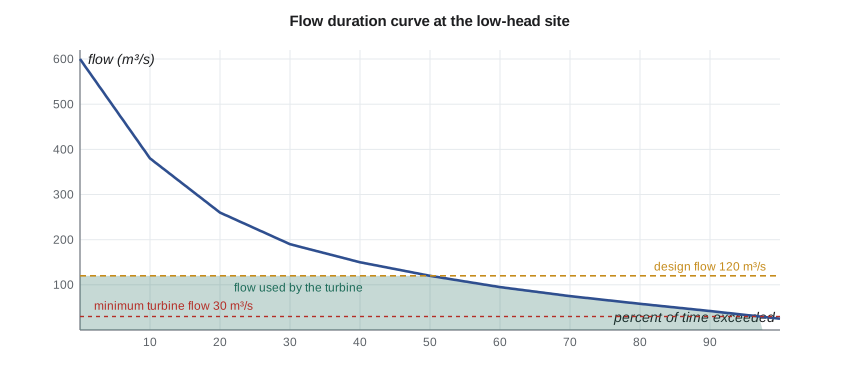
The design flow is an economic choice. A larger turbine captures more flood water but runs at part load for most of the year; a smaller one runs near full load but spills more. For run-of-river plants the design flow is often near the flow exceeded 20 to 40 percent of the time. The team's example site uses a design flow near the median, which gives a capacity factor of about 0.75 because the plant runs nearly all year. Real projects must also leave a minimum environmental flow in any bypassed reach and pass fish safely, both of which reduce energy.
Turbine types and selection
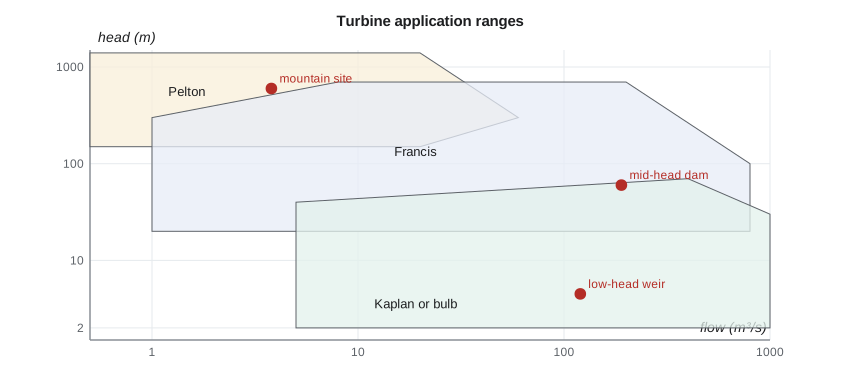
Three families of turbine cover the range of heads. Impulse turbines, of which the Pelton wheel is the common type, use nozzles to turn the head into high-velocity jets that strike buckets on a wheel in open air; they suit high heads above about 200 m and small flows. Reaction turbines run full of water under pressure. The Francis turbine, with fixed blades in a spiral casing, covers medium heads from about 20 to 600 m and is the most common type in the world. Propeller turbines, including the Kaplan with adjustable blades and the bulb turbine with its generator sealed in a capsule in the flow, suit low heads below about 30 m and large flows. Kaplan blades, which change pitch with the flow, keep efficiency high over a wide range, which suits rivers with variable flow.
The specific speed combines the rotational speed, power and head into one number that characterizes the shape of the runner.
Low specific speeds, below about 60 in these units, mean impulse turbines; intermediate values from about 60 to 400 mean Francis turbines; high values above about 400 mean propeller types. The ranges overlap, and manufacturers' charts of head against flow, like the one below, are used in practice. Specific speed was introduced for pumps in MEC-370, and the same similarity laws apply.
Storage, flexibility and the grid
Hydro stations with reservoirs can store water and release it when power is most valuable. That flexibility is as important as the energy itself. A reservoir system can follow load within minutes, back up wind and solar, and provide spinning reserve and frequency control. Pumped storage plants, which pump water uphill when power is cheap and generate when it is valuable, are covered in lesson 11. Even run-of-river plants on a regulated river system benefit from upstream reservoirs that smooth the flow.
Minnesota has relatively little hydro of its own, mostly small stations on the Mississippi and other rivers, including the long-established station at St. Anthony Falls in Minneapolis. Its larger hydro contribution comes from imports from Manitoba under long-term contracts, carried on transmission lines that were expanded around 2020. Hydro supply varies with precipitation: in a dry year such as 2024, Manitoba's generation fell and exports to the US were reduced, which reminds planners that hydro imports are an energy resource that varies year to year rather than a guaranteed quantity.
Hydro in a cold climate
Northern rivers add problems that engineers in warmer places rarely meet. In early winter, before an ice cover forms, supercooled water in fast reaches produces frazil ice, fine crystals that stick to trash racks and intake gates and can block them within hours. Operators control it by heating racks, raising water levels to promote a stable ice cover, or reducing flow until the cover forms. Once a cover is in place, it adds friction to the flow, raising upstream water levels and, at low-head plants, reducing the effective head. Spring break-up can bring ice jams and sudden floods, and stations on northern rivers are designed to pass ice safely over their spillways. Winter is also when river flows are lowest and demand highest, so a hydro system in the north depends on storage from the previous summer and autumn to meet its winter load. These effects are well understood, but they add cost and complexity, and every small hydro study in the region must account for them.
Environmental and social effects
Large hydro is renewable but not without impact. Reservoirs flood land, change river ecology, trap sediment, alter water temperature and can release methane from flooded vegetation, especially in the first years and in warm climates. Dams block fish migration unless fish passage is built. In northern Canada, hydro development has deeply affected Indigenous communities whose lands and waters were flooded and whose ways of life depended on the rivers; recent projects have been developed in partnership with First Nations, who share in ownership and decisions, and past impacts have been the subject of settlements and apologies. Engineers working on hydro must treat these effects as central to the project, not as afterthoughts.
Small run-of-river plants at existing weirs avoid most of the reservoir effects, because the weir already exists, but they still affect fish, flows over the weir and recreation, and they often face long permitting processes for a small amount of energy.
Worked problem
Small hydro at the weir
A weir on the river has a net head of 4.5 m. The team considers a turbine with a design flow of 120 m³/s and overall efficiency 0.85. The flow duration analysis gives 29.8 GWh a year. The installed cost is estimated at 9,000 per kilowatt and annual operation and maintenance at 2.5 percent of capital. With a capital recovery factor of 0.071, what is the cost per megawatt-hour?
Show solution
- Power: \(P = 0.85 \times 1000 \times 9.81 \times 120 \times 4.5 = 4.50\) MW.
- Capital: \(4{,}500 \times 9{,}000 = 40.5\) million. Annual capital charge: \(0.071 \times 40.5 = 2.88\) million; O&M: \(0.025 \times 40.5 = 1.01\) million.
- Cost: \((2.88 + 1.01) \times 10^6/29{,}800 = 131\) per MWh.
Answer: About 130 per megawatt-hour, roughly twice the price Northgate pays for grid electricity. Small low-head hydro is expensive because the civil works cost nearly as much as for a larger plant. The team records the option and does not include it in the main pathways.
The example shows a pattern that recurs in this course. Many energy options that are technically sound and renewable are uneconomic at a particular site because of scale. A district energy utility's best use of hydro is usually indirect: buying it through the grid, or through a long-term contract, and turning it into heat efficiently with heat pumps.
Hydro and the 2040 plan
For the pathway model the team draws two conclusions. First, Minnesota's path to carbon-free electricity by 2040 relies on wind, solar, nuclear and imports including Manitoba hydro, so the grid factor in the model falls steadily to zero by 2040 under the standard. The risk is that the decline is slower than the law intends, so every pathway is tested with a slower decline as well. Second, any heat that Northgate makes from electricity will be most valuable if the network can store it and shift its demand away from the system's peak hours, which is the role of the storage studied in lesson 11.
Common mistakes
MistakeUsing gross head in the power equation.
InsteadSubtract intake, penstock and draft tube losses to obtain net head.
MistakeSizing a run-of-river turbine for the flood flow.
InsteadChoose a design flow from the flow duration curve, often exceeded 20 to 40 percent of the time.
MistakeAssuming hydro output is constant from year to year.
InsteadAllow for dry and wet years in energy planning.
MistakeChoosing a turbine type by head alone.
InsteadUse specific speed or manufacturers' head–flow charts, considering the flow range.
MistakeTreating small hydro at an existing weir as free of environmental issues.
InsteadPlan for fish passage, minimum flows and recreation from the start.
Summary and key terms
- Hydraulic power is \(P = \eta \rho g Q H\) with net head and an overall efficiency of about 0.85 to 0.93.
- Flow duration curves set the design flow and annual energy of run-of-river plants.
- Pelton turbines suit high heads, Francis turbines medium heads and Kaplan or bulb turbines low heads; specific speed guides the choice.
- Reservoir hydro provides valuable flexibility as well as energy, but output varies with precipitation.
- Large hydro has significant environmental and social effects, especially for Indigenous communities.
- Small low-head hydro is often uneconomic at district energy scale; buying hydro power through the grid is usually better.
- Net head
- Gross head minus hydraulic losses in the waterways.
- Flow duration curve
- A plot of river flow against the percentage of time it is equalled or exceeded.
- Run-of-river plant
- A hydro plant with little storage that uses the river flow as it comes.
- Pelton wheel
- An impulse turbine driven by high-speed jets, suited to high heads.
- Francis turbine
- A reaction turbine with fixed blades, used for medium heads.
- Kaplan turbine
- A propeller turbine with adjustable blades, used for low heads and variable flows.
- Specific speed
- A dimensionless-like parameter combining speed, power and head that characterizes runner shape.
- Environmental flow
- A minimum flow left in a river reach to protect its ecology.
Practice problems
Work each problem on paper first, then reveal the answer to check.
Find the power from 50 m³/s through a net head of 80 m at 0.90 efficiency.
Show answer
\(0.90 \times 1000 \times 9.81 \times 50 \times 80 = 35.3\) MW.
A turbine runs at 300 rpm, produces 20,000 kW at 40 m head. Find its specific speed and likely type.
Show answer
\(300\sqrt{20{,}000}/40^{1.25} = 42{,}430/100.6 = 422\); a Kaplan or high-speed Francis.
A run-of-river plant of 8 MW produces 42 GWh. What is its capacity factor?
Show answer
\(42{,}000/(8 \times 8760) = 0.60\).
Why does output sometimes fall during floods at low-head plants?
Show answer
Tailwater rises more than headwater, reducing net head.
Give two reasons small low-head hydro is often expensive per megawatt-hour.
Show answer
Civil works are costly relative to output, and permitting, fish passage and minimum flows add cost and reduce energy.
Lesson quiz · 5 questions
Score 60% or more to complete this lesson.
Create a free account to save your progress, take quizzes and earn a certificate.