
MEC-440 · Lesson 3 of 12 · 21 min
Gas turbines and combined cycles in practice
In MEC-330 Tomás analyzed a 6 MW gas turbine on the Brayton cycle and found that its exhaust, at about 450 °C, could raise steam for the network. The board now wants to know what gas turbines can and cannot do in a decarbonizing system. They remain the fastest-growing source of firm capacity on many grids, they will be needed for decades to meet peaks, and their exhaust heat makes them natural partners for district heating. This lesson looks at how real gas turbines and combined-cycle plants are rated, how they behave in cold and hot weather and at part load, how their emissions are controlled, and whether they can run on hydrogen.
Types of gas turbine
Gas turbines for power generation come in two families. Heavy-duty or industrial frame machines are large, robust and designed for long continuous runs; the largest single units now exceed 500 MW in simple cycle. Aeroderivative machines are adapted from aircraft engines; they are lighter, start in minutes, tolerate frequent cycling and are built in sizes from a few to about 100 MW. A third group, small industrial turbines and microturbines from tens of kilowatts to a few megawatts, serves cogeneration in hospitals, campuses and factories. The choice depends on duty: a combined-cycle plant running most of the year suits a frame machine, a peaking plant that starts every winter evening suits an aeroderivative.
Every gas turbine is rated at standard conditions set by ISO 3977: air at 15 °C, 60 percent relative humidity and sea-level pressure, with no inlet or exhaust losses. Real sites differ. Inlet filters and silencers add pressure drop at the compressor; heat recovery boilers add back pressure at the exhaust; altitude reduces air density. A site rating, sometimes 5 to 10 percent below the ISO rating, is what the plant actually delivers.
The effect of ambient temperature
A gas turbine is a constant-volume-flow machine: at a given speed its compressor draws roughly the same volume of air. Cold air is denser, so in winter the mass flow and the output rise, and the compressor work per kilogram falls; in summer the reverse happens. A typical rule is that output changes by about 0.5 to 0.8 percent per kelvin, and heat rate by about 0.1 to 0.2 percent per kelvin, around the ISO point. In very cold weather the machine reaches limits on shaft torque, generator capacity or compressor surge margin, and its control system holds output flat. In Minneapolis that is useful: the coldest days, when heat demand peaks, are also when a gas turbine produces the most. Cold also brings a hazard. Inlet air near 0 °C and high humidity can form ice in the inlet ducts, so turbines in northern climates have inlet heating, often using compressor bleed air or a glycol coil.
# Gas turbine and combined cycle in practice: ambient temperature and part load
SITE = 'us'
import math
iso_MW, iso_hr = 60.0, 9800.0         # simple-cycle aeroderivative rating at ISO conditions (15 C), heat rate kJ/kWh LHV
def gt(Tamb_C):
    # output falls about 0.7 % per K above 15 C and rises below it (flattened below -10 C by control limits)
    T = max(Tamb_C, -10.0)
    P = iso_MW*(1 - 0.007*(T - 15))
    hr = iso_hr*(1 + 0.0012*(T - 15))
    return P, hr
temps = {'ca': (-30, -10, 15, 30), 'us': (-25, -10, 15, 32)}[SITE]
print("Ambient effects on the gas turbine:")
for T in temps:
    P, hr = gt(T)
    print(f"  {T:4d} C ({T*9/5+32:4.0f} F): {P:5.1f} MW, heat rate {hr:,.0f} kJ/kWh, efficiency {3600/hr*100:4.1f} %")
# Part load of a single gas turbine (fraction of rated output -> relative heat rate)
print("\nPart load, one unit at 15 C:")
for f in (1.0, 0.8, 0.6, 0.4):
    rel = 1 + 0.45*(1 - f)**1.6/(f**0.6)
    print(f"  {f*100:3.0f} % load: heat rate x {rel:.2f}, efficiency {3600/(iso_hr*rel)*100:4.1f} %")
# Combined cycle: gas turbine plus a steam bottoming cycle using the exhaust heat
eta_gt, eta_st, recov = 0.38, 0.33, 0.88   # steam cycle efficiency on recovered heat, fraction of exhaust heat recovered
eta_cc = eta_gt + (1 - eta_gt)*recov*eta_st
print(f"\nCombined cycle: {eta_gt:.2f} + (1 - {eta_gt:.2f}) x {recov:.2f} x {eta_st:.2f} = {eta_cc:.3f}")
print(f"  heat rate {3600/eta_cc:,.0f} kJ/kWh ({3600/eta_cc*0.9478:,.0f} Btu/kWh), CO2 {0.20/eta_cc:.3f} kg/kWh (LHV gas 0.20 kg/kWh)")
# Hydrogen blending: CO2 reduction is much smaller than the volume fraction
for xv in (0.05, 0.20, 0.30):
    e_h2 = xv*10.8/(xv*10.8 + (1 - xv)*35.8)     # energy fraction from hydrogen (LHV MJ/m3)
print(f" {xv*100:2.0f} % hydrogen by volume -> {e_h2*100:4.1f} % of fuel energy, CO2 cut {e_h2*100:4.1f} %")Ambient effects on the gas turbine:
-25 C ( -13 F): 70.5 MW, heat rate 9,506 kJ/kWh, efficiency 37.9 %
-10 C ( 14 F): 70.5 MW, heat rate 9,506 kJ/kWh, efficiency 37.9 %
15 C ( 59 F): 60.0 MW, heat rate 9,800 kJ/kWh, efficiency 36.7 %
32 C ( 90 F): 52.9 MW, heat rate 10,000 kJ/kWh, efficiency 36.0 %
Part load, one unit at 15 C:
100 % load: heat rate x 1.00, efficiency 36.7 %
80 % load: heat rate x 1.04, efficiency 35.3 %
60 % load: heat rate x 1.14, efficiency 32.2 %
40 % load: heat rate x 1.34, efficiency 27.3 %
Combined cycle: 0.38 + (1 - 0.38) x 0.88 x 0.33 = 0.560
heat rate 6,428 kJ/kWh (6,092 Btu/kWh), CO2 0.357 kg/kWh (LHV gas 0.20 kg/kWh)
5 % hydrogen by volume -> 1.6 % of fuel energy, CO2 cut 1.6 %
20 % hydrogen by volume -> 7.0 % of fuel energy, CO2 cut 7.0 %
30 % hydrogen by volume -> 11.4 % of fuel energy, CO2 cut 11.4 %Hot-weather output loss matters on summer-peaking grids. Plants recover some of it with inlet cooling: evaporative coolers or foggers that spray water into the inlet air, or chillers that cool the air with a refrigeration plant. MEC-330 analyzed evaporative inlet cooling on the psychrometric chart. In a cold-climate district energy system the summer loss is less important, because summer heat demand is low.
Part load
Gas turbines are most efficient at full load. To reduce output, the control system lowers the firing temperature and, in many machines, closes the compressor's inlet guide vanes to reduce airflow, which keeps the exhaust temperature high for a downstream heat recovery boiler. Either way, efficiency falls: at half load a simple-cycle turbine typically uses 25 to 40 percent more fuel per kilowatt-hour than at full load. Below about 40 to 50 percent load, many dry low-NOx combustors can no longer hold their emissions guarantee, which sets a practical minimum load.
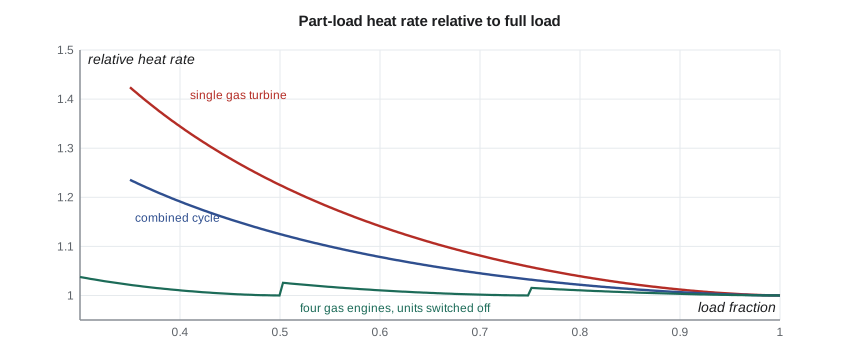
Plants that must follow a widely varying load often use several smaller units instead of one large one, starting and stopping units so that each runs near full load. Reciprocating gas engines in banks of six to twenty units are a popular choice for this reason; they also keep their efficiency well at part load and start in a few minutes. MEC-330 found that a pair of 16-cylinder gas engines suited Northgate's summer base load. The same logic applies to heat pumps and electric boilers later in this course: modularity buys efficient part-load operation and redundancy.
Combined-cycle plants
The exhaust of a heavy-duty gas turbine is at about 550 to 650 °C. In a combined-cycle plant it passes through a heat recovery steam generator, which raises steam, often at three pressure levels with reheat, for a steam turbine. The steam cycle adds roughly half as much again to the gas turbine's output without burning more fuel. If the gas turbine has efficiency \(\eta_{GT}\) and the bottoming cycle recovers a fraction \(\varepsilon\) of the exhaust heat at a cycle efficiency \(\eta_{ST}\), the combined efficiency is
With a 38 percent gas turbine, 88 percent heat recovery and a 33 percent steam cycle, the combined efficiency is 56 percent. The best modern plants with the largest frame turbines claim about 63 to 64 percent on the lower heating value. That makes combined cycles the most efficient way to turn fuel into electricity at large scale, with carbon dioxide emissions of about 0.33 to 0.37 kg/kWh, roughly a third of a coal plant's.
Combined cycles have their own operating constraints. The steam side takes longer to start than the gas turbine, from under an hour for a hot start to several hours from cold, so many modern plants are designed for fast starts with thinner-walled drums or once-through boilers. At part load the combined cycle also loses efficiency, though less steeply than a simple-cycle turbine because the bottoming cycle partly compensates.
| Plant type | Typical efficiency (LHV) | Start time | Best duty |
|---|---|---|---|
| Aeroderivative simple cycle | 38 to 42 % | 5 to 10 min | Peaking, backup, flexible support |
| Heavy-duty simple cycle | 35 to 41 % | 10 to 30 min | Peaking |
| Reciprocating gas engines | 42 to 48 % | 2 to 5 min | Flexible mid-merit and cogeneration |
| Combined cycle | 55 to 64 % | 30 min to several hours | Base and mid-merit |
| Gas turbine cogeneration | 30 to 40 % electric, 75 to 85 % total | 10 to 60 min | Industrial and district heat |
Emissions and their control
Natural gas burns cleanly in terms of particulates and sulfur, so the main pollutant from a gas turbine is nitrogen oxides, formed when nitrogen and oxygen combine at high flame temperatures. Older turbines injected water or steam into the combustor to cool the flame. Modern dry low-NOx combustors premix fuel and air lean before burning, keeping the flame temperature below the range where nitrogen oxides form quickly; they reach single-digit parts per million at full load. Where tighter limits apply, selective catalytic reduction in the exhaust converts the remaining nitrogen oxides to nitrogen and water using ammonia or urea. Carbon monoxide catalysts reduce carbon monoxide, which rises at low loads.
Carbon dioxide cannot be removed by combustion tuning. At about 0.2 kg per kWh of gas burned (lower heating value), a gas plant's carbon emissions depend entirely on its efficiency and its hours. Federal rules for carbon emissions from power plants have changed several times over the past decade and remain uncertain, so the emissions of new gas plants are governed mainly by state policies such as Minnesota's 2040 carbon-free standard.
Hydrogen and other low-carbon fuels
Gas turbine manufacturers now offer combustors that can burn blends of natural gas and hydrogen, and some machines are designed for 100 percent hydrogen. Hydrogen burns faster and hotter than methane, which raises the risk of flashback and nitrogen oxide formation, so high blends need redesigned combustors. A less obvious point is that hydrogen has only about a third of the energy of methane per unit volume. Blending 20 percent hydrogen by volume replaces only about 7 percent of the fuel energy, and therefore cuts carbon dioxide by only about 7 percent. Large cuts need very high blends, and the hydrogen itself must be made with low-carbon electricity, a subject for lesson 10.
Other options include renewable natural gas from digesters and landfills, which is chemically interchangeable with fossil gas but limited in supply, and synthetic fuels made from hydrogen and captured carbon dioxide, which are expensive. The realistic role of gas turbines in a 2040 system is therefore mainly as firm capacity that runs a few hundred hours a year, burning whatever low-carbon fuel can be had for those hours.
Worked problem
Combined-cycle efficiency and carbon
A gas turbine is 39 percent efficient (lower heating value). Its exhaust passes through a heat recovery steam generator that captures 85 percent of the exhaust heat, raising steam for a cycle that is 34 percent efficient. Natural gas emits 0.20 kg CO₂ per kWh of fuel on the lower heating value. Find the combined efficiency, the heat rate and the carbon intensity, and compare with a 39 percent simple-cycle unit.
Show solution
- \(\eta_{CC} = 0.39 + (1 - 0.39)(0.85)(0.34) = 0.39 + 0.176 = 0.566\).
- Heat rate: \(3600/0.566 = 6{,}360\) kJ/kWh.
- Carbon intensity: \(0.20/0.566 = 0.353\) kg/kWh; simple cycle \(0.20/0.39 = 0.513\) kg/kWh.
Answer: The combined cycle is 57 percent efficient, with a heat rate of about 6,360 kJ/kWh and 0.35 kg CO₂ per kWh, about 31 percent less carbon than the same turbine in simple cycle.
For Northgate the conclusions are practical. A gas turbine or a bank of gas engines could provide firm capacity for the coldest week of the year, and its waste heat would go into the network rather than up a stack. It cannot be the main source of heat in a plan that ends fossil combustion by 2040 unless it can burn a low-carbon fuel. The team keeps a modest peaking unit in every pathway as insurance and asks, in lesson 4, whether cogeneration still makes sense on the Minnesota grid.
Common mistakes
MistakeUsing ISO ratings as site output.
InsteadCorrect for inlet and exhaust losses, altitude and the site's design temperatures.
MistakeAssuming a gas turbine is equally efficient at all loads.
InsteadUse part-load curves, or use several smaller units that run near full load.
MistakeEquating the hydrogen volume fraction with the carbon reduction.
InsteadConvert to an energy fraction; 20 percent hydrogen by volume is only about 7 percent of the energy.
MistakeTreating combined-cycle plants as fast-start peakers.
InsteadAllow for the steam side's start-up time and minimum load.
MistakeForgetting inlet icing protection in cold climates.
InsteadProvide inlet heating for humid air near freezing.
Summary and key terms
- Gas turbines are rated at ISO conditions; site ratings are lower because of inlet, exhaust and altitude effects.
- Output rises in cold weather and falls in hot weather by roughly 0.5 to 0.8 percent per kelvin.
- Efficiency falls at part load; multiple smaller units keep efficiency high and add redundancy.
- Combined cycles add a steam bottoming cycle and reach 55 to 64 percent efficiency.
- Dry low-NOx combustors and selective catalytic reduction control nitrogen oxides; carbon dioxide depends on efficiency and hours.
- Hydrogen blending cuts carbon only in proportion to its energy share, about a third of its volume share.
- ISO rating
- Gas turbine performance at 15 °C, 60 percent humidity, sea-level pressure and no inlet or exhaust losses.
- Aeroderivative
- A gas turbine derived from an aircraft engine, light and quick to start.
- Heat recovery steam generator
- A boiler heated by gas turbine exhaust that raises steam for a turbine or for process use.
- Combined cycle
- A plant in which a gas turbine's exhaust heat drives a steam cycle.
- Dry low-NOx combustor
- A combustor that premixes fuel and air lean to limit flame temperature and nitrogen oxide formation.
- Inlet guide vanes
- Adjustable vanes at the compressor inlet that change airflow at part load.
- Firm capacity
- Generating capacity that can be relied on when needed, independent of weather.
- Flashback
- Propagation of a flame upstream into a premixer, a risk with fast-burning fuels such as hydrogen.
Practice problems
Work each problem on paper first, then reveal the answer to check.
A turbine rated at 60 MW at 15 °C loses 0.7 percent of output per kelvin above 15 °C. What does it deliver at 30 °C?
Show answer
\(60(1 - 0.007 \times 15) = 53.7\) MW.
Find the combined efficiency for a 40 percent gas turbine, 90 percent heat recovery and a 32 percent steam cycle.
Show answer
\(0.40 + 0.60 \times 0.90 \times 0.32 = 0.573\).
Hydrogen has a lower heating value of about 10.8 MJ/m³ and natural gas about 35.8 MJ/m³. What energy fraction is 30 percent hydrogen by volume?
Show answer
\(0.3 \times 10.8/(0.3 \times 10.8 + 0.7 \times 35.8) = 0.114\).
Why does a combined cycle lose less efficiency at part load than a simple-cycle turbine with the same gas turbine?
Show answer
Inlet guide vane control keeps the exhaust hot, so the steam cycle recovers more of the extra waste heat.
Name two ways to recover a gas turbine's hot-weather output loss.
Show answer
Evaporative or fogging inlet coolers, and chiller-based inlet cooling.
Lesson quiz · 5 questions
Score 60% or more to complete this lesson.
Create a free account to save your progress, take quizzes and earn a certificate.