
MEC-440 · Lesson 2 of 12 · 22 min
Steam power plants in practice
Northgate's own plant began as a steam plant: high-pressure boilers feeding a back-pressure turbine that makes some electricity while passing steam on to the heating network. Graham Okoro has run it for twenty years and knows its habits. Before the team can judge any new option, it needs a working understanding of how large steam plants behave in practice, because steam turbines sit at the heart of coal, nuclear, biomass, waste-to-energy and combined-cycle plants alike, and because the regional grid that Minneapolis's heat pumps would draw on has been shaped by them. MEC-330 analyzed the Rankine cycle and its improvements. This lesson looks at the plant around the cycle.
The parts of a steam power plant
A utility steam plant has four main systems. The steam generator, or boiler, burns fuel in a furnace lined with water-cooled tubes, produces superheated steam at high pressure, and in large units reheats the steam after it has passed through the high-pressure turbine. The turbine-generator converts the steam's enthalpy drop into shaft work and electricity, usually in several casings: high, intermediate and low pressure. The condenser receives the exhaust steam at a pressure far below atmospheric and condenses it on tubes carrying cooling water. The feedwater system pumps the condensate back to boiler pressure through a train of feedwater heaters, which use steam bled from the turbine to preheat the water, and a deaerator that removes dissolved oxygen.
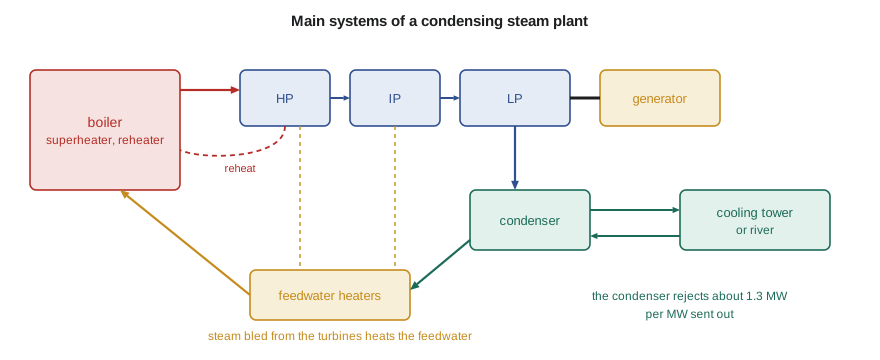
Around these sit the balance of plant: fuel handling, coal mills or gas trains, fans that push combustion air in and draw flue gas out, air heaters that recover heat from the flue gas, emissions control equipment, water treatment, the cooling system, the electrical switchyard and the control room. The balance of plant is where most of the capital cost and most of the operating problems are found. A plant engineer spends far more time on fans, pumps, valves, tube leaks and water chemistry than on the cycle diagram.
Gross output, net output and heat rate
The generator's output is the gross output. The plant's own equipment, the auxiliary load, takes a share of it: feed pumps, fans, coal mills, cooling water pumps, flue gas scrubbers and lighting. Auxiliary load is typically 4 to 8 percent of gross output for a coal plant and less for a gas-fired plant. What leaves the fence and is sold is the net output. Utilities describe efficiency in terms of the heat rate, the fuel energy needed per kilowatt-hour sent out.
A heat rate of 9,700 kJ/kWh corresponds to a net efficiency of 37 percent. In the United States heat rates are usually quoted in British thermal units per kilowatt-hour on the higher heating value; 1 kJ/kWh is 0.948 Btu/kWh, so 9,700 kJ/kWh is about 9,200 Btu/kWh. Manufacturers often quote the lower heating value, so check before comparing.
A modern supercritical coal unit reaches a net efficiency of about 40 to 45 percent on the higher heating value; older subcritical units are in the low to middle thirties. Plants that burn biomass or municipal waste are smaller, run at lower steam conditions to limit corrosion, and usually reach 20 to 30 percent. Nuclear steam plants, limited by the temperature of the reactor coolant, are about 33 percent efficient.
# A condensing steam plant in practice: heat rate, auxiliary load, condenser and cooling water
SITE = 'us'
gross_MW = 400.0           # generator output
aux_frac = 0.07            # auxiliary power (fans, pumps, mills, scrubbers) as a fraction of gross
fuel_MW = 1000.0           # fuel energy input, higher heating value
net_MW = gross_MW*(1 - aux_frac)
eta_net = net_MW/fuel_MW
hr_kJ = 3600/eta_net       # net heat rate, kJ per kWh
print(f"Gross {gross_MW:.0f} MW, auxiliaries {gross_MW*aux_frac:.0f} MW, net {net_MW:.0f} MW")
print(f"Net efficiency {eta_net*100:.1f} %  -> net heat rate {hr_kJ:,.0f} kJ/kWh = {hr_kJ*0.9478:,.0f} Btu/kWh")
# Heat rejected to the condenser (boiler and stack losses about 12 % of fuel)
boiler_loss = 0.12*fuel_MW
cond_MW = fuel_MW - boiler_loss - gross_MW - 0.01*fuel_MW   # 1 % other losses
print(f"Heat to condenser about {cond_MW:.0f} MW, {cond_MW/net_MW:.2f} MW per MW sent out")
# Cooling water: once-through with a 10 K rise, or a wet tower that evaporates the heat
cw = cond_MW*1000/(4.19*10)          # kg/s
evap = cond_MW*1000/2400             # kg/s evaporated if a wet tower rejects all of it (latent heat about 2,400 kJ/kg)
print(f"Once-through cooling at 10 K rise: {cw:,.0f} kg/s ({cw*15.85:,.0f} US gpm)")
print(f"Wet tower evaporation: {evap:.0f} kg/s, about {evap*3.6:,.0f} m3 per hour at full load")
# Effect of condenser pressure on turbine output (rough sensitivity for a large unit)
print("\nCondenser pressure vs output (illustrative sensitivity):")
for p_kPa, sat_C in ((5.0, 32.9), (7.0, 39.0), (10.0, 45.8), (15.0, 54.0)):
    dP = (p_kPa - 7.0)*0.9           # percent of output lost per kPa above 7 kPa, typical order
    print(f"  {p_kPa:4.1f} kPa (saturation {sat_C:4.1f} C): output change {-dP:+5.1f} %")
# Annual energy and fuel at a capacity factor
cf = 0.55
E = net_MW*8760*cf/1000            # GWh
print(f"\nAt capacity factor {cf:.2f}: {E:,.0f} GWh sent out, fuel {E/eta_net:,.0f} GWh")Gross 400 MW, auxiliaries 28 MW, net 372 MW Net efficiency 37.2 % -> net heat rate 9,677 kJ/kWh = 9,172 Btu/kWh Heat to condenser about 470 MW, 1.26 MW per MW sent out Once-through cooling at 10 K rise: 11,217 kg/s (177,792 US gpm) Wet tower evaporation: 196 kg/s, about 705 m3 per hour at full load Condenser pressure vs output (illustrative sensitivity): 5.0 kPa (saturation 32.9 C): output change +1.8 % 7.0 kPa (saturation 39.0 C): output change -0.0 % 10.0 kPa (saturation 45.8 C): output change -2.7 % 15.0 kPa (saturation 54.0 C): output change -7.2 % At capacity factor 0.55: 1,792 GWh sent out, fuel 4,818 GWh
The calculation makes the most striking fact about thermal power visible. The condenser rejects about 1.3 MW of heat for every megawatt sent out. A 372 MW plant throws away about 470 MW into a river, a lake or the atmosphere. That is why steam plants are built beside water, why their cooling towers are their most visible feature, and why the idea of using that heat for district heating, the subject of lesson 4, is so attractive.
Where the fuel energy goes
An energy balance on a steam unit shows the losses in order of size. The largest is the heat rejected in the condenser, typically 45 to 55 percent of the fuel energy. Next is the stack loss: hot flue gas and water vapor leaving the chimney, together with unburned fuel and radiation from the boiler casing, about 10 to 14 percent for a coal unit burning a typical fuel. The generator, transformers and auxiliary load take a few percent more. What is left, 35 to 45 percent, is sold.
The condenser loss is not a sign of poor engineering. The second law requires a heat engine to reject heat to a cold reservoir, and the condenser is where that happens. Lowering the condenser pressure lowers the temperature of heat rejection and raises efficiency, which is why condensers run at deep vacuum, about 4 to 10 kPa absolute, corresponding to saturation temperatures of about 29 to 46 °C. What engineers can reduce is the irreversibility within the boiler, where combustion gas at 1,500 °C heats water at a few hundred degrees. Higher steam pressures and temperatures, reheat and regenerative feedwater heating all attack that loss, as MEC-330 showed.
The condenser and the cooling system
A surface condenser is a large shell-and-tube heat exchanger. Cooling water flows through thousands of tubes; steam condenses on the outside and drains to a hotwell. Non-condensable gases that leak in must be removed by steam jet ejectors or vacuum pumps, or they blanket the tubes and raise the pressure. Fouling inside the tubes, by silt, scale or biological growth, has the same effect. A rise in condenser pressure of a few kilopascals can cost several percent of the unit's output, so plant operators watch the condenser closely and clean the tubes regularly.
There are three main ways to reject the condenser heat. Once-through cooling draws water from a river, lake or sea, passes it through the condenser with a temperature rise of about 8 to 12 K, and returns it. It is the cheapest and most efficient method but needs a very large flow and affects aquatic life through intake screens and warm discharges, so regulators in both countries have tightened the rules for intakes and thermal plumes. Wet cooling towers recirculate the water and reject the heat largely by evaporation; they need only make-up water but consume much of it. Dry, air-cooled condensers use no water at all but run at higher condenser pressure, especially in summer, and cost more.
| Cooling method | Water withdrawn | Water consumed | Effect on efficiency | Typical use |
|---|---|---|---|---|
| Once-through | Very large | Small (some evaporation downstream) | Best | Large rivers, lakes, coasts |
| Wet cooling tower | Moderate | Large, about 1.5 to 2 L per kWh | Slightly lower in hot weather | Most inland plants |
| Dry air-cooled condenser | Almost none | Almost none | Several percent lower in summer | Arid regions, water-limited sites |
Emissions and their control
Steam plants that burn coal produce sulfur dioxide, nitrogen oxides, particulate matter, mercury and carbon dioxide. Over fifty years, regulation has driven the installation of electrostatic precipitators or fabric filters for particulates, flue gas desulfurization scrubbers for sulfur dioxide, low-NOx burners and selective catalytic reduction for nitrogen oxides, and activated carbon injection for mercury. These systems are effective but take power and water, and none of them touches carbon dioxide. In the United States coal generation has fallen by more than half since its peak around 2007, as plants have closed in the face of cheaper gas and renewables and tighter rules, although the pace of closures depends on federal policy, which has shifted more than once in recent years.
Carbon capture and storage can be added to a steam plant by scrubbing carbon dioxide from the flue gas with an amine solvent and compressing it for storage underground. It works, and a few large demonstration units have operated, but it takes a large amount of steam to regenerate the solvent, cutting the plant's net output by roughly 20 to 30 percent, and adds substantial capital cost. For a small district heating utility it is not a realistic option; it is mentioned here because it shapes how the regional grid may evolve.
Operating a steam plant
Large steam units are designed for steady output. Starting from cold takes many hours, because thick-walled drums, headers and turbine casings must be heated slowly to limit thermal stress. Running at part load lowers efficiency, and running down to minimum stable load, often 30 to 40 percent of rating, is limited by the furnace and the water circuit. As wind and solar have grown, many older steam units have been forced to cycle daily, which accelerates fatigue cracking in thick components and raises maintenance costs. Plant availability, the fraction of time a unit is able to run, is typically 85 to 90 percent; the rest is planned outages for inspection and repair, and forced outages for failures such as boiler tube leaks.
Northgate's own steam plant shows these behaviors on a small scale. Its boilers take a few hours to come up to pressure, its back-pressure turbine produces electricity only when the network is taking steam, and its heat rate, counting only the electricity, would look excellent because most of the fuel energy leaves as useful heat rather than being thrown away in a condenser. Comparing it with a condensing utility plant on electrical heat rate alone would be misleading, and lesson 4 introduces the measures that do justice to cogeneration.
Worked problem
Heat rate and fuel cost
A condensing steam unit sends out 372 MW at a net heat rate of 9,700 kJ/kWh. Fuel costs 6.80 dollars per MMBtu. Find the fuel cost per megawatt-hour sent out and the fuel cost of one day at full load.
Show solution
- Heat rate: \(9{,}700 \times 0.9478 = 9{,}190\) Btu/kWh, so 9.19 MMBtu per MWh.
- Fuel cost: \(9.19 \times 6.80 = 62.5\) dollars per MWh.
- One day: \(372 \times 24 = 8{,}928\) MWh, costing \(8{,}928 \times 62.5 = 558{,}000\) dollars.
Answer: Fuel is about 63 dollars per megawatt-hour, more than half a million dollars a day at full load. A 1 percent improvement in heat rate saves over 2 million dollars a year at a 55 percent capacity factor, which is why plant engineers chase small gains in condenser vacuum, feedwater temperature and excess air.
What steam plants mean for Northgate
Northgate will not build a large condensing steam plant; it is far too small a utility, and the trend in both countries is away from new fossil steam plants. Steam technology still matters to the study in three ways. First, any biomass or waste-to-energy plant Northgate might build will be a small steam plant, with all the issues of this lesson in miniature. Second, the electricity that heat pumps would use comes from a grid whose evolution depends on decisions about the remaining steam plants. Third, the condenser heat of large plants, including nuclear plants, is the largest untapped heat source in many regions, a point lesson 9 returns to.
Common mistakes
MistakeComparing heat rates without checking whether they are on the higher or lower heating value.
InsteadConvert both to the same basis; the difference is about 10 percent for natural gas.
MistakeCalling the condenser loss a design failure.
InsteadRecognize that the second law requires heat rejection; reduce it by lowering the rejection temperature and the irreversibilities upstream.
MistakeQuoting gross output as plant output.
InsteadSubtract auxiliary load to obtain net output and heat rate.
MistakeAssuming a steam plant can follow load as quickly as a gas turbine.
InsteadAllow for long start-ups, minimum stable load and the fatigue cost of cycling.
MistakeIgnoring water use when choosing a cooling system.
InsteadCompare withdrawal, consumption and the effect on summer output.
Summary and key terms
- A steam plant has a boiler, turbine-generator, condenser and feedwater system, surrounded by a large balance of plant.
- Net heat rate is fuel energy per kilowatt-hour sent out; 3,600 kJ/kWh divided by heat rate gives efficiency.
- The condenser rejects about 1.3 MW of heat per MW sent out from a typical unit.
- Cooling can be once-through, by wet tower or by dry air-cooled condenser, trading water use against efficiency and cost.
- Emissions controls handle particulates, sulfur and nitrogen oxides and mercury; carbon capture is possible but costly.
- Large steam units prefer steady output; cycling raises costs and wear.
- Heat rate
- Fuel energy needed per kilowatt-hour of electricity, usually net of auxiliary load.
- Auxiliary load
- Electric power used by the plant's own equipment.
- Surface condenser
- A shell-and-tube heat exchanger that condenses turbine exhaust steam on tubes carrying cooling water.
- Feedwater heater
- A heat exchanger that heats boiler feedwater with steam extracted from the turbine.
- Once-through cooling
- Cooling in which water is drawn from a natural body, used once in the condenser and returned.
- Availability
- Fraction of time a unit is able to operate, whether or not it is dispatched.
- Selective catalytic reduction
- A process that converts nitrogen oxides to nitrogen and water using ammonia over a catalyst.
- Balance of plant
- All the systems of a power plant other than the main steam generator and turbine.
Practice problems
Work each problem on paper first, then reveal the answer to check.
A plant burns fuel at 1,200 MW and sends out 420 MW. What are its net efficiency and heat rate?
Show answer
35 percent; \(3600/0.35 = 10{,}290\) kJ/kWh.
A 500 MW gross unit has auxiliaries of 6 percent. What is its net output?
Show answer
470 MW.
A condenser rejects 600 MW with a 9 K cooling water rise. What flow is needed?
Show answer
\(600{,}000/(4.19 \times 9) = 15{,}900\) kg/s.
Roughly how much water does a wet tower evaporate to reject 470 MW?
Show answer
About \(470{,}000/2{,}400 = 196\) kg/s.
Why do biomass steam plants have lower efficiency than large coal units?
Show answer
They are smaller and run at lower steam temperatures and pressures to limit corrosion from the fuel's ash and chlorine.
Lesson quiz · 5 questions
Score 60% or more to complete this lesson.
Create a free account to save your progress, take quizzes and earn a certificate.