
MEC-380 · Lesson 3 of 12 · 21 min
Damped free vibration
Tidewater has designed a new fabricated baseplate for the TP-80, made of formed channel with welded cross members, to replace the cast iron base that customers found heavy and expensive. Before it is released, Lucie wants its first structural mode measured. Owen bolts a pump and motor to a prototype on the test floor, attaches an accelerometer at the pump-end feet and taps the base with an instrumented hammer. The trace on the analyzer rings at a little over 33 Hz and dies away in a fraction of a second. From that decay he must extract two numbers: the natural frequency and the damping. This lesson explains how, and why the damping value, small as it is, controls how violently the base will respond if anything ever drives it at that frequency.
The viscously damped oscillator
Adding a viscous damper with coefficient c to the mass-spring system gives
Trying \(x = Ce^{st}\) gives the characteristic equation \(ms^2 + cs + k = 0\), with roots
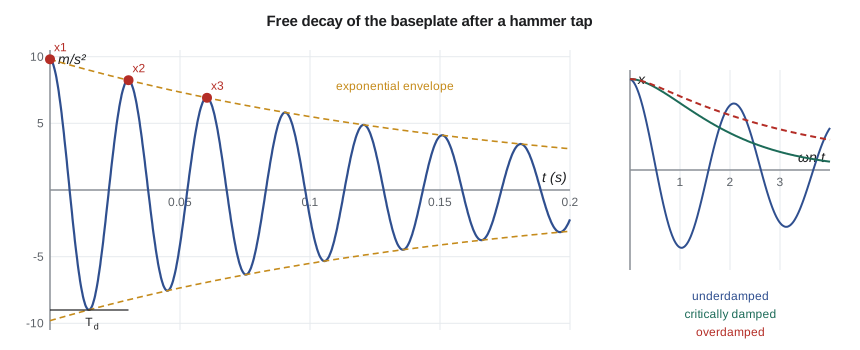
The damping ratio ζ compares the actual damping with the critical damping c_cr, the smallest value for which the system returns to rest without oscillating. Three cases follow. If ζ > 1, the system is overdamped: both roots are real and negative, and the mass creeps back to equilibrium. If ζ = 1, it is critically damped and returns fastest without overshoot; door closers and some instrument movements are designed near this value. If ζ < 1, the system is underdamped and oscillates within a decaying envelope:
The damped natural frequency ω_d is slightly lower than ω_n. For ζ = 0.05, the difference is only 0.13 percent, so for machinery structures the distinction rarely matters for frequency, but it matters a great deal for amplitude, as Lesson 4 shows. Almost every machine and structure Owen will meet is underdamped, with ζ somewhere between 0.005 and 0.10.
Measuring damping: the logarithmic decrement
Because the envelope decays exponentially, the ratio of successive peaks is constant. Its natural logarithm is the logarithmic decrement:
Taking the ratio over n cycles rather than one averages out reading errors and noise. Solving for the damping ratio, \(\zeta = \delta/\sqrt{4\pi^2 + \delta^2}\). The relation holds for displacement, velocity or acceleration peaks, because each is the same exponential envelope multiplied by a constant.
# Damping from a bump test on the TP-80 baseplate, and friction (Coulomb) decay of a pipe support
import math
fs = 2000.0                        # sample rate of the recorded decay, Hz
# Peak accelerations (m/s^2) read from successive cycles of the ring-down after a hammer tap
peaks = [9.80, 8.23, 6.92, 5.81, 4.88, 4.10, 3.45]
t_peaks = [0.0, 0.0302, 0.0604, 0.0906, 0.1208, 0.1510, 0.1812]   # s
n = len(peaks) - 1
delta = math.log(peaks[0] / peaks[-1]) / n
zeta = delta / math.sqrt(4 * math.pi**2 + delta**2)
Td = (t_peaks[-1] - t_peaks[0]) / n
fd = 1 / Td
fn = fd / math.sqrt(1 - zeta**2)
print(f"Log decrement over {n} cycles: delta = {delta:.4f}")
print(f"Damping ratio zeta = {zeta:.4f} ({zeta*100:.2f} % of critical)")
print(f"Damped frequency {fd:.2f} Hz, natural frequency {fn:.2f} Hz")
print(f"Cycles to halve the amplitude: {math.log(2)/delta:.1f}")

# Equivalent mass and stiffness of the baseplate mode from a static push test
k = 4.9e6                          # N/m, measured with a jack and dial gauge at the pump feet
m = k / (2 * math.pi * fn)**2
c_cr = 2 * math.sqrt(k * m); c = zeta * c_cr
print(f"\nModal mass {m:.0f} kg, critical damping {c_cr/1e3:.1f} kN s/m, actual c = {c:.0f} N s/m")

# Free response of the damped model, x(t) = X e^(-zeta wn t) cos(wd t)
wn = 2 * math.pi * fn; wd = wn * math.sqrt(1 - zeta**2)
for t in (0.0, 0.05, 0.10, 0.20, 0.40):
    print(f"  t = {t:.2f} s: envelope {math.exp(-zeta*wn*t):.3f} of the first peak")

# Coulomb friction: a sliding pipe support with friction force F loses 4F/k of amplitude per cycle
F = 25.0                           # friction force at the support, N
k_pipe = 1.2e6                     # lateral stiffness of the pipe span, N/m
X0 = 0.50e-3                       # initial amplitude after a valve slam, m
loss = 4 * F / k_pipe
cycles = 0; X = X0
while X > F / k_pipe:              # motion stops inside the dead band +/- F/k
    X -= loss; cycles += 1
print(f"\nCoulomb decay: {loss*1e6:.0f} um lost per cycle, motion stops after about {cycles} cycles")
print(f" stopping band +/- {F/k_pipe*1e6:.0f} um; decay is linear, not exponential")Log decrement over 6 cycles: delta = 0.1740 Damping ratio zeta = 0.0277 (2.77 % of critical) Damped frequency 33.11 Hz, natural frequency 33.13 Hz Cycles to halve the amplitude: 4.0 Modal mass 113 kg, critical damping 47.1 kN s/m, actual c = 1303 N s/m t = 0.00 s: envelope 1.000 of the first peak t = 0.05 s: envelope 0.750 of the first peak t = 0.10 s: envelope 0.562 of the first peak t = 0.20 s: envelope 0.316 of the first peak t = 0.40 s: envelope 0.100 of the first peak Coulomb decay: 83 um lost per cycle, motion stops after about 6 cycles stopping band +/- 21 um; decay is linear, not exponential
Owen reads seven successive positive peaks from the trace, from 9.80 down to 3.45 m/s² over six cycles. The program gives δ = 0.174 and ζ = 0.0277, just under 3 percent of critical. Six cycles take 0.181 s, so the damped frequency is 33.11 Hz and the undamped natural frequency 33.13 Hz, the difference being invisible in practice. The amplitude halves every four cycles and is down to 10 percent after 0.4 s. A separate static test, jacking the pump feet upward and reading a dial gauge, gave a stiffness of 4.9 MN/m at the same point; dividing by ω_n² gives a modal mass of 113 kg, less than half the weight of the pump and motor because only part of the mass moves fully in this bending mode. The viscous coefficient that reproduces the decay is about 1,300 N·s/m, under 3 percent of the critical 47 kN·s/m.
Worked problem
Damping from a strip-chart recording
A technician at a customer site records the free decay of a pump discharge pipe after a valve closure. The first peak is 0.84 mm/s and the eleventh peak, ten cycles later, is 0.38 mm/s. The ten cycles take 0.80 s. Find the damping ratio and natural frequency.
Show solution
- \(\delta = \tfrac{1}{10}\ln(0.84/0.38) = 0.0793\).
- \(\zeta = 0.0793/\sqrt{4\pi^2 + 0.0793^2} = 0.0126\).
- \(f_d = 10/0.80 = 12.5\) Hz, and \(f_n = f_d/\sqrt{1 - \zeta^2} \approx 12.5\) Hz.
Answer: The pipe has about 1.3 percent damping, typical of welded steel piping with few supports. A dynamic magnification of about 40 at resonance should be expected if anything excites it near 12.5 Hz.
Energy dissipated per cycle
A viscous damper dissipates energy in each cycle of harmonic motion of amplitude X at frequency ω:
Comparing this with the maximum strain energy \(U = \tfrac12 kX^2\) gives a measure called the loss factor, \(\eta = \Delta E/(2\pi U)\). At resonance, \(\eta = 2\zeta\). Materials data and rubber-mount catalogs often quote a loss factor rather than a damping ratio: natural rubber has η of about 0.05 to 0.1, highly damped elastomers 0.2 or more, and steel well under 0.001. The low material damping of steel is why a welded steel baseplate rings so clearly, and why most damping in a real structure comes from bolted joints, grout and the attached piping rather than from the metal.
Hysteretic and structural damping
Measurements on many structures show that the energy lost per cycle hardly depends on frequency, which is inconsistent with a purely viscous model. The usual fix is hysteretic, or structural, damping: a complex stiffness \(k(1 + i\eta)\) used in harmonic analysis. Over a narrow frequency band around a single resonance, the viscous and hysteretic models give almost identical results if \(\zeta = \eta/2\), so Owen can use whichever is convenient. For time-domain simulation of transients (Lesson 7) the viscous model is simpler, and finite element programs usually let the user specify modal damping ratios directly.
| Structure or component | Typical damping ratio ζ | Notes |
|---|---|---|
| Welded steel frame, bolted down, no grout | 0.01 to 0.03 | the TP-80 prototype base: 0.028 |
| Grouted baseplate on a concrete block | 0.03 to 0.08 | grout and concrete add friction and hysteresis |
| Welded steel piping | 0.005 to 0.02 | more with insulation and many supports |
| Steel spring isolator | about 0.005 | often paired with dampers |
| Rubber or elastomer mount | 0.03 to 0.15 | temperature dependent |
| Oil-film journal bearing (rotor modes) | 0.05 to 0.3 | depends on speed and load |
Coulomb (dry friction) damping
Friction at a sliding support or a loose joint produces a force of constant magnitude F opposing the velocity. The equation of motion is \(m\ddot x + F\,\mathrm{sgn}(\dot x) + kx = 0\), which is nonlinear but can be solved half-cycle by half-cycle. Each half-cycle is a harmonic motion about a shifted equilibrium at ±F/k, and the amplitude falls by 2F/k per half-cycle, or 4F/k per full cycle. The decay is linear rather than exponential, and the motion stops when the amplitude falls inside the band ±F/k, where the spring force can no longer overcome friction. The frequency stays at ω_n.
The program shows the effect on a pipe span with a sliding support. With a friction force of 25 N and a lateral stiffness of 1.2 MN/m, each cycle loses 83 µm, and a 0.5 mm disturbance from a valve slam dies in about six cycles, leaving the pipe stuck somewhere inside a band of ±21 µm. A plot of peak amplitude against cycle number distinguishes the two mechanisms at a glance: a straight line on linear axes means friction; a straight line on a logarithmic amplitude scale means viscous damping. Real structures often show both: friction at large amplitudes and viscous-like behavior at small ones.
Damping and design
Lucie's guidance to the design group is that damping is a safety margin, not a design tool. It is uncertain, it changes with temperature, bolt preload and age, and it cannot be relied on to make a resonance acceptable. The primary defense is frequency placement: keep natural frequencies away from forcing frequencies. Damping becomes the main tool only when the forcing covers a broad band, as with variable-speed drives that must run through a resonance, or with random excitation. The 2.8 percent of the new baseplate is typical of bolted, ungrouted steel; once grouted on site the damping will probably rise and the frequency will rise too, which Lesson 4 exploits.
Owen's test report records f_n = 33.1 Hz and ζ = 0.028 at the pump end, with a note that the value will change once the base is grouted. Farah, reviewing it, immediately asks about the variable-speed option: Tidewater offers the TP-80 on a drive up to 2,000 rpm, which is 33.3 Hz. Lesson 4 answers her question.
Common mistakes
MistakeComputing ζ from one pair of peaks on a noisy trace.
InsteadUse the ratio over several cycles: δ = ln(x₀/x_n)/n.
MistakeMixing peak-to-peak and peak values in the decrement.
InsteadUse the same kind of reading for every cycle; ratios cancel the constant.
MistakeAssuming the damped frequency is noticeably lower than f_n.
InsteadFor ζ below 0.1, the difference is under 0.5 percent.
MistakeTreating a linear decay as viscous damping.
InsteadLinear decay on linear axes is the signature of Coulomb friction.
MistakeRelying on damping to make a resonance acceptable.
InsteadSeparate natural and forcing frequencies first; damping is uncertain.
Summary and key terms
- With viscous damping, mẍ + cẋ + kx = 0; the damping ratio is ζ = c/(2√(km)).
- Underdamped systems (ζ < 1) oscillate at ω_d = ω_n√(1 − ζ²) inside an envelope e^(−ζω_n t).
- The logarithmic decrement δ = ln(x₀/x_n)/n gives ζ = δ/√(4π² + δ²) ≈ δ/2π.
- The prototype TP-80 baseplate has f_n = 33.1 Hz and ζ = 0.028, with a modal mass of 113 kg.
- Energy lost per cycle is πcωX²; the loss factor η equals 2ζ at resonance.
- Coulomb friction gives a linear decay of 4F/k per cycle and leaves the system stuck within ±F/k.
- Damping ratio
- The ratio of the actual damping coefficient to the critical value.
- Critical damping
- The damping that returns a system to rest fastest without oscillation, c_cr = 2√(km).
- Damped natural frequency
- The frequency of free oscillation with damping, ω_n√(1 − ζ²).
- Logarithmic decrement
- The natural logarithm of the ratio of successive peak amplitudes.
- Bump test
- An impact test that excites free vibration to measure natural frequency and damping.
- Modal mass
- The effective mass of a structure in one of its modes at a chosen point.
- Loss factor
- Energy lost per cycle divided by 2π times the maximum strain energy.
- Hysteretic damping
- Damping with energy loss per cycle independent of frequency.
- Coulomb damping
- Damping by dry friction, with a constant force opposing the motion.
- Overdamped
- Having ζ greater than 1, so that the system returns to rest without oscillating.
Practice problems
Work each problem on paper first, then reveal the answer to check.
Successive peaks are 5.0 and 4.6 mm/s. Find ζ.
Show answer
δ = 0.0834, ζ = 0.0133.
A mount has k = 400 kN/m and carries 100 kg. Find c_cr.
Show answer
2√(400000 × 100) = 12.6 kN·s/m.
How many cycles does it take to halve the amplitude when ζ = 0.01?
Show answer
ln 2/(2π × 0.01) ≈ 11 cycles.
A support has F = 40 N and k = 2 MN/m. How much amplitude does it lose per cycle?
Show answer
4F/k = 80 µm.
In the program, change the last peak to 2.40 m/s². What damping ratio results?
Show answer
δ = 0.2344 and ζ ≈ 0.037.
Why does grouting a baseplate usually raise both its natural frequency and its damping?
Show answer
Grout adds stiffness by full contact with the foundation, and friction and hysteresis at the interface.
Lesson quiz · 5 questions
Score 60% or more to complete this lesson.
Create a free account to save your progress, take quizzes and earn a certificate.