
MEC-380 · Lesson 2 of 12 · 23 min
Free vibration of undamped single-degree-of-freedom systems
Lucie's second lesson for Owen starts with a complaint from the field. A customer's TP-80, installed on four rubber pads to keep noise out of a control room, shakes noticeably more than the same model bolted down on the test stand. Before measuring anything, she asks him to estimate the natural frequency of the package bouncing on its pads. If that frequency is near 29.3 Hz, the running speed, the explanation is almost certain. The tool for the estimate is the simplest model in vibration: one mass, one spring, no damping. It is worth learning thoroughly, because every more complicated system in this course is analyzed by breaking it into pieces that behave like this one.
The equation of motion
Take a mass m on a spring of stiffness k, with x measured from the static equilibrium position. When the mass is displaced by x, the spring force changes by kx and opposes the displacement. Newton's second law gives
Gravity does not appear. Measured from static equilibrium, the weight is balanced by the initial spring compression, \(k\delta_{st} = mg\), and the two cancel. This is true for any linear system in which gravity acts along the line of motion, and it saves effort: the static and dynamic problems can be solved separately and added.
The general solution is harmonic:
where ω_n is the undamped natural frequency in rad/s. The constants come from the initial displacement x₀ and initial velocity v₀: \(A = x_0\) and \(B = v_0/\omega_n\). The amplitude of the free motion is \(X = \sqrt{x_0^2 + (v_0/\omega_n)^2}\). Without damping the motion would continue forever; real systems decay, as Lesson 3 shows, but for light damping the frequency hardly changes, so the undamped natural frequency is the number engineers compute first.
Natural frequency from static deflection
Because \(k\delta_{st} = mg\), the natural frequency can be written in terms of the static deflection alone:
This formula is extremely useful in the field. A mount that compresses 1 mm under its load has a natural frequency of about 15.8 Hz; one that compresses 25 mm, about 3.2 Hz. Isolator catalogs are often organized by static deflection for exactly this reason, and Lesson 5 uses this rule to select springs. It applies only when gravity loads the spring along the direction of motion; a horizontal mode on the same mounts has a different stiffness and a different frequency.
# Natural frequencies of single-degree-of-freedom models in the Tidewater test lab
import math
g = 9.81
# 1. The TP-80 package on four rubber pads (stiffness from Lesson 1)
m_pkg = 310.0                      # pump, motor and baseplate, kg
k_pads = 8.8e6                     # N/m, four pads in parallel
wn = math.sqrt(k_pads / m_pkg)
print(f"Package bounce: wn = {wn:.0f} rad/s, fn = {wn/2/math.pi:.1f} Hz")
d_st = m_pkg * g / k_pads
print(f"Static deflection {d_st*1000:.2f} mm -> fn from deflection {math.sqrt(g/d_st)/2/math.pi:.1f} Hz")

# 2. Discharge pressure gauge on a cantilevered pipe nipple (Rayleigh's method)
E = 200e9; L = 0.150               # steel nipple, length m
do, di = 0.0213, 0.0158            # 1/2 in schedule 80 nipple, m
I = math.pi * (do**4 - di**4) / 64
rho_s = 7850; A = math.pi * (do**2 - di**2) / 4
m_beam = rho_s * A * L
m_tip = 0.65                       # gauge and fitting, kg
k_tip = 3 * E * I / L**3           # cantilever tip stiffness
for name, meff in (("tip mass only", m_tip), ("Rayleigh, 33/140 of nipple mass added", m_tip + 33 / 140 * m_beam)):
    fn = math.sqrt(k_tip / meff) / 2 / math.pi
    print(f"Gauge nipple, {name}: fn = {fn:.0f} Hz")
print(f"  (k = {k_tip/1e3:.0f} kN/m, nipple mass {m_beam:.3f} kg); vane pass is {6*1760/60:.0f} Hz")
L2 = 0.250                         # a longer nipple seen at a customer site
k2 = 3 * E * I / L2**3; m2 = m_tip + 33 / 140 * rho_s * A * L2
print(f"With a 250 mm nipple: fn = {math.sqrt(k2/m2)/2/math.pi:.0f} Hz")

# 3. Water in the U-tube manometer on the test stand: energy method gives wn = sqrt(2g/Lc)
Lc = 1.20                          # length of liquid column, m
print(f"\nManometer column of {Lc} m: fn = {math.sqrt(2*g/Lc)/2/math.pi:.2f} Hz, period {2*math.pi/math.sqrt(2*g/Lc):.2f} s")

# 4. Torsional: pump impeller on the shaft end, held by the coupling
G = 79e9; d = 0.030; Ls = 0.42     # shaft from coupling to impeller, m
kt = G * math.pi * d**4 / 32 / Ls
J = 0.052                          # impeller polar inertia, kg m^2
print(f"Torsional: kt = {kt/1e3:.1f} kN m/rad, fn = {math.sqrt(kt/J)/2/math.pi:.0f} Hz")Package bounce: wn = 168 rad/s, fn = 26.8 Hz Static deflection 0.35 mm -> fn from deflection 26.8 Hz Gauge nipple, tip mass only: fn = 221 Hz Gauge nipple, Rayleigh, 33/140 of nipple mass added: fn = 214 Hz (k = 1252 kN/m, nipple mass 0.189 kg); vane pass is 176 Hz With a 250 mm nipple: fn = 97 Hz Manometer column of 1.2 m: fn = 0.64 Hz, period 1.55 s Torsional: kt = 15.0 kN m/rad, fn = 85 Hz
The first result answers the field complaint. The package weighs 310 kg, and the four pads together have a stiffness of 8.8 MN/m (Lesson 1). The bounce natural frequency is 26.8 Hz, and the pads deflect only 0.35 mm under the weight. Running speed is 29.33 Hz, only 9 percent above. The pads were chosen as noise pads, not as vibration isolators, and they have put the bounce mode right under the running speed. Lesson 4 will show why such a small separation amplifies the unbalance force several times, and Lesson 5 why the cure is a much softer mount, not a stiffer one.
The energy method
For a conservative system, the sum of kinetic energy T and potential energy U is constant. Differentiating \(T + U = \text{constant}\) with respect to time gives the equation of motion directly, often more easily than drawing forces. For harmonic motion, there is an even quicker route. At the extreme position all energy is potential, \(U_{max}\); at the equilibrium position all energy is kinetic, \(T_{max}\). Setting them equal gives the natural frequency. With \(x = X\cos\omega_n t\):
The method shines when the motion is not a simple translation. Consider the U-tube manometer on the test stand. A column of water of total length L_c and cross-sectional area A is displaced so that one side rises by x and the other falls by x. The potential energy is that of lifting a column of length 2x by a height x, so \(U = \rho g A x^2\), and the kinetic energy is \(\tfrac12 \rho A L_c \dot x^2\). Equating maxima gives \(\omega_n = \sqrt{2g/L_c}\), independent of the fluid density and the tube area. For the 1.2 m column, the program gives 0.64 Hz, a period of 1.55 s. Owen has seen the manometer slosh slowly after a valve change; now he knows why it is so slow, and why the operators read its average.
Rayleigh's method and the mass of the spring
Springs and beams have mass. Rayleigh's method accounts for it by assuming a shape for the vibration, computing the kinetic energy of the distributed mass with that shape, and adding it to the kinetic energy of the concentrated mass. For a coil spring of mass m_s fixed at one end, with the velocity varying linearly along it, the kinetic energy is that of a mass \(m_s/3\) moving with the free end, so
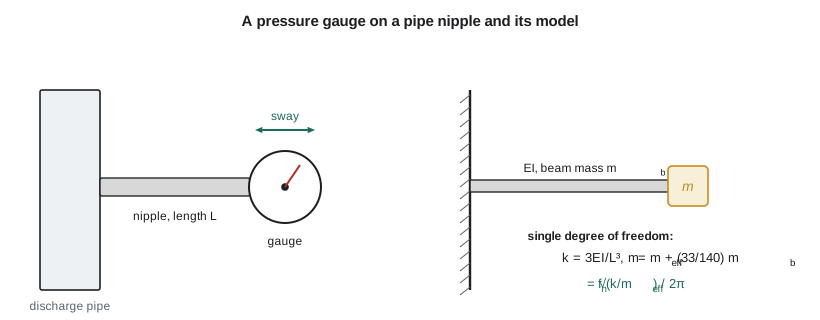
For a cantilever of mass m_b carrying a tip mass, using the static deflection curve as the assumed shape gives an effective mass of \(\tfrac{33}{140}m_b \approx 0.236\,m_b\) at the tip. Because the assumed shape is never exactly the true mode, Rayleigh's method always overestimates the natural frequency slightly, but with a sensible shape the error is usually a percent or less. Lesson 10 extends the idea to the Rayleigh-Ritz method with several assumed shapes.
The second result in the program applies this to a smaller problem that Tidewater sees often. The discharge pressure gauge, 0.65 kg with its fitting, sits on a 150 mm half-inch schedule 80 nipple. As a cantilever, the nipple has a tip stiffness of 1.25 MN/m. With only the gauge mass, f_n = 221 Hz; adding 33/140 of the nipple's 0.19 kg mass lowers it to 214 Hz. That is 22 percent above the 176 Hz vane-pass frequency, which is enough on a fixed-speed pump. At one customer site, however, the gauge sits on a 250 mm nipple with a valve, and its natural frequency drops to about 97 Hz, which a variable-speed pump could excite at a vane-pass frequency of 97 Hz when running at about 970 rpm. Gauge needles that vibrate into a blur, and nipples that crack at the thread root, are classic results.
Worked problem
Nipple fatigue check by frequency placement
A customer wants to run a TP-80 on a variable-frequency drive between 900 and 1,760 rpm. Vane-pass frequency then ranges from 90 to 176 Hz. Which nipple lengths keep the gauge mode at least 20 percent above 176 Hz?
Show solution
- Required f_n ≥ 1.2 × 176 = 211 Hz.
- For a cantilever with a tip mass, \(f_n \propto L^{-3/2}\) when the tip mass dominates. From 214 Hz at 150 mm, \(L \le 150\,(214/211)^{2/3} \approx 151\) mm.
- The 150 mm nipple barely passes; any longer nipple, or a heavier gauge with a valve, fails.
Answer: Lucie's standard detail is a short nipple with a snubber and a remote gauge on a flexible hose for variable-speed pumps, which moves the gauge off the pipe altogether.
Torsional and other single-degree-of-freedom systems
The same mathematics applies to rotation. A rotor of polar inertia J on a shaft of torsional stiffness \(k_t = GJ_p/L\) twists according to \(J\ddot\theta + k_t\theta = 0\), so \(\omega_n = \sqrt{k_t/J}\). The program's fourth result treats the TP-80 impeller, J = 0.052 kg·m², on the 420 mm length of 30 mm shaft between coupling and impeller, assuming the coupling end is held: k_t = 15.0 kN·m/rad and f_n = 85 Hz. A torsional mode cannot be seen with a hand-held vibration meter on a bearing housing, because the shaft twists without moving sideways. Torsional problems announce themselves through coupling wear, keyway cracks or gear noise, and Lesson 9 analyzes them with several inertias.
Gravity can also act as a spring. A simple pendulum of length l has \(\omega_n = \sqrt{g/l}\); a floating body, such as a pontoon-mounted pump at a lagoon, bobs with a stiffness \(\rho g A_w\) where A_w is the waterline area. Fluid columns, gas volumes (a pulsation dampener on a reciprocating pump is a gas spring) and even a long column of water in a vertical pipe all store potential energy in ways that can be modeled as springs. Owen's lesson notes list these alongside the elastic elements of Lesson 1.
| System | Stiffness | Inertia | Natural frequency in the program |
|---|---|---|---|
| Package on four rubber pads | 8.8 MN/m | 310 kg | 26.8 Hz |
| Gauge on 150 mm nipple | 1.25 MN/m | 0.65 + 0.045 kg | 214 Hz |
| Gauge on 250 mm nipple | 0.27 MN/m | 0.65 + 0.074 kg | 97 Hz |
| Manometer water column | 2ρgA | ρAL_c | 0.64 Hz |
| Impeller on shaft (torsion) | 15.0 kN·m/rad | 0.052 kg·m² | 85 Hz |
When is one degree of freedom enough?
A single-degree-of-freedom model is adequate when one mode dominates the response near the frequencies of interest and the rest of the system is either much stiffer or much softer. The package on its pads has six rigid-body modes: bounce, two horizontal translations and three rotations. The bounce mode is the one excited most strongly by the vertical component of unbalance, and for that question one coordinate is enough. Rocking, which couples horizontal translation with rotation, needs at least two (Lesson 8), and the bending of the baseplate itself needs a continuous or many-degree model. Lucie's habit is to sketch the expected mode shape first, then decide whether a simple model can represent it.
Owen writes up the field complaint in a single page: the pads give a bounce frequency of 26.8 Hz, 9 percent below running speed; unbalance within tolerance is being amplified by resonance; the cure is either to bolt the package down on a grouted base, moving the mode far above running speed, or to use proper spring isolators, moving it far below. He recommends the second, because the customer installed the pads for noise, and Lesson 5 will size the springs.
Common mistakes
MistakeIncluding the weight in the equation of motion as a forcing term.
InsteadMeasure from static equilibrium; the weight and initial spring force cancel.
MistakeUsing the static deflection formula for a horizontal mode.
Instead√(g/δ) holds only when gravity loads the spring along the line of motion.
MistakeIgnoring the mass of a long nipple or spring.
InsteadAdd an effective mass, 1/3 for a spring and 33/140 for a cantilever.
MistakeAssuming a soft mount always reduces vibration.
InsteadA mount whose natural frequency is near the forcing frequency amplifies it.
MistakeLooking for torsional vibration with a bearing housing probe.
InsteadTorsional modes need strain gauges, torsional sensors or careful speed measurement.
Summary and key terms
- For an undamped single-degree-of-freedom system, mẍ + kx = 0 and ω_n = √(k/m); measured from equilibrium, gravity drops out.
- The static deflection gives f_n ≈ 15.76/√δ_st with δ_st in millimeters, valid for vertical modes loaded by gravity.
- The energy method sets T_max = U_max and handles systems such as fluid columns and pendulums neatly.
- Rayleigh's method adds effective mass for distributed parts: 1/3 of a spring's mass, 33/140 of a cantilever's.
- The TP-80 package on noise pads bounces at 26.8 Hz, only 9 percent below the 29.3 Hz running speed, which explains the field complaint.
- Torsional modes follow ω_n = √(k_t/J) and are invisible to ordinary bearing housing measurements.
- Equation of motion
- The differential equation that relates forces to accelerations for a system.
- Undamped natural frequency
- ω_n = √(k/m) for a single-degree-of-freedom system.
- Static deflection
- The compression of a spring under the weight it supports.
- Energy method
- Finding the equation of motion or natural frequency from conservation of energy.
- Rayleigh's method
- Estimating a natural frequency from an assumed deflected shape by equating maximum energies.
- Effective mass
- The point mass that has the same kinetic energy as a distributed mass in the assumed motion.
- Torsional stiffness
- Torque per unit angle of twist, GJ_p/L for a uniform shaft.
- Polar mass moment of inertia
- The rotational inertia of a body about its spin axis.
- Initial conditions
- The displacement and velocity at the start of free motion.
- Rigid-body mode
- A mode in which a body moves without deforming, such as bounce or rocking on mounts.
Practice problems
Work each problem on paper first, then reveal the answer to check.
A mount compresses 4 mm under its load. Estimate its vertical natural frequency.
Show answer
15.76/√4 = 7.9 Hz.
A 50 kg motor on a spring of 2 MN/m is released from 1 mm with no velocity. Find the frequency and amplitude.
Show answer
f_n = 31.8 Hz; X = 1 mm.
Find the period of a 2.0 m water column in a U-tube.
Show answer
2π√(L/2g) = 2.0 s.
A 0.4 kg spring with k = 50 kN/m carries 2 kg. By how much does the spring's mass lower f_n?
Show answer
From 25.2 to 24.4 Hz, about 3 percent.
In the program, change the pad stiffness so that the package bounce is at 9 Hz. What stiffness is needed?
Show answer
k = 310 (2π·9)² ≈ 0.99 MN/m.
Why does the manometer frequency not depend on the liquid density?
Show answer
Both the restoring force and the inertia are proportional to density.
Lesson quiz · 5 questions
Score 60% or more to complete this lesson.
Create a free account to save your progress, take quizzes and earn a certificate.