
MEC-380 · Lesson 10 of 12 · 21 min
Vibration of continuous systems
Tidewater's largest product is the VT-12 vertical turbine pump, used in municipal raw-water intakes and cooling-water systems. Its bowl assembly hangs deep in a wet pit on a long column, and on top, at floor level, a cast discharge head carries a 75 kW vertical motor weighing 1,150 kg. A tall, heavy motor on a relatively slender head makes a structure that sways like an inverted pendulum, and its first bending frequency, known in the pump industry as the reed critical frequency, is often uncomfortably close to running speed. For a new intake order, Farah has a revised discharge head with large access windows for the seal, and she asks Owen to check its reed frequency before the drawings are released. The head and motor stand have mass and stiffness spread along their height, so the lumped models used so far need to be reconsidered. This lesson treats continuous systems: strings, bars, shafts and beams.
The vibrating string and the wave equation
A taut string of tension T and mass per unit length ρA, displaced by y(x, t), obeys the wave equation
Separating variables, \(y = Y(x)\cos\omega t\), gives \(Y'' + (\omega/c)^2 Y = 0\) with solutions \(Y = A\sin(\omega x/c) + B\cos(\omega x/c)\). For a string fixed at both ends, the boundary conditions allow only the frequencies \(\omega_n = n\pi c/L\), n = 1, 2, 3, and so on, with mode shapes \(\sin(n\pi x/L)\). A continuous system has an infinite number of natural frequencies, here in the exact ratios 1 : 2 : 3, and each mode shape has n − 1 nodes. The string itself is rarely found in pump work, except as a model of guy wires and long instrument cables, but it shows the pattern for all continuous systems: a partial differential equation, a separation of variables, and boundary conditions that pick out the allowed frequencies.
Axial and torsional vibration of rods
The same equation governs axial vibration of a bar, with \(c = \sqrt{E/\rho}\), and torsional vibration of a circular shaft, with \(c = \sqrt{G/\rho}\). For steel, the axial wave speed is about 5,100 m/s and the torsional wave speed about 3,200 m/s. For a bar fixed at one end and free at the other, the frequencies are \(\omega_n = (2n - 1)\pi c/(2L)\). A 10 m steel line shaft in a deep-well pump therefore has its first axial mode at about 128 Hz and its first torsional mode, if fixed at the motor end, at about 80 Hz, with the impellers' inertia lowering both. These frequencies are found by the lumped methods of Lesson 9 once the impellers are included; the continuous solution checks the shaft's own contribution.
Bending of beams
Transverse vibration of a slender beam, the Euler-Bernoulli model, is governed by a fourth-order equation:
Harmonic solutions give \(Y'''' = \beta^4 Y\) with \(\beta^4 = \rho A\omega^2/EI\), whose general solution combines sin βx, cos βx, sinh βx and cosh βx. Applying two boundary conditions at each end gives a characteristic equation whose roots β_nL fix the natural frequencies:
| Boundary conditions | β₁L | β₂L | β₃L | Example |
|---|---|---|---|---|
| Pinned-pinned | π = 3.142 | 2π | 3π | pipe span on simple supports |
| Fixed-free (cantilever) | 1.875 | 4.694 | 7.855 | vertical motor stand, gauge nipple |
| Fixed-fixed | 4.730 | 7.853 | 10.996 | pipe span between anchors |
| Fixed-pinned | 3.927 | 7.069 | 10.210 | span from an anchor to a guide |
| Free-free | 4.730 | 7.853 | 10.996 | baseplate on soft mounts (plus two rigid-body modes) |
Unlike strings, the frequencies of beams are not in integer ratios: for a cantilever, the second mode is 6.27 times the first. This matters in diagnosis: a structure that responds at several frequencies in harmonic ratios is more likely being forced by harmonics of running speed than resonating in several of its own modes. The Euler-Bernoulli model neglects shear deformation and rotary inertia, which become important for short, deep beams and for higher modes; the Timoshenko beam model includes them.
Cantilever with a tip mass
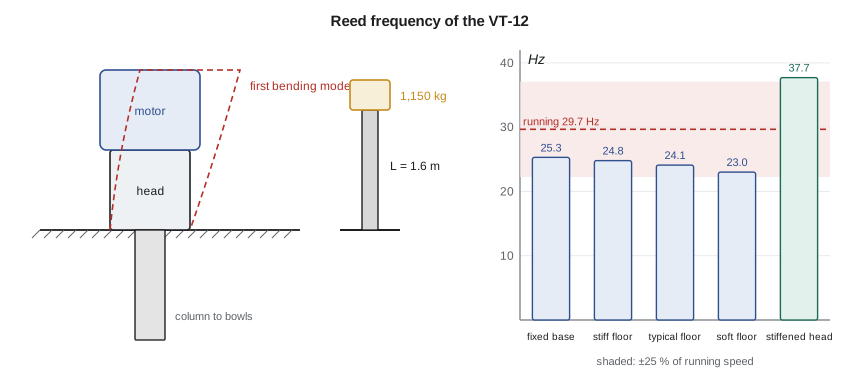
The VT-12 head and motor are modeled as a uniform cantilever of height L = 1.6 m to the motor's center of mass, with an effective bending stiffness EI = 4.5×10⁷ N·m² that accounts for the access windows, a distributed mass of 650 kg and a tip mass of 1,150 kg. The tip mass changes the boundary condition at the free end: the shear force there must accelerate the mass. The characteristic equation becomes
which is solved numerically. With a heavy tip mass, the root falls from 1.875 for the bare cantilever to a much smaller value.
# Continuous systems: the VT-12 vertical turbine pump structure and a suction pipe span
import math
f_run = 1780 / 60                       # VT-12 speed, Hz
# 1. Discharge head and motor stand as a uniform cantilever with the motor as a tip mass
L = 1.6                                 # height to the motor center of mass, m
EI = 4.5e7                              # effective bending stiffness of the head with its access windows, N m^2
m_head = 650.0                          # distributed mass of the head and stand, kg
m_motor = 1150.0                        # 75 kW vertical motor, kg
rhoA = m_head / L
def char(bl):                           # frequency equation of a cantilever with a tip mass
    r = m_motor / (rhoA * L)
    return 1 + math.cos(bl) * math.cosh(bl) + r * bl * (math.cos(bl) * math.sinh(bl) - math.sin(bl) * math.cosh(bl))
lo, hi = 0.05, 1.875                    # first root lies below the bare-cantilever value 1.875
for _ in range(100):
    mid = (lo + hi) / 2
    if char(lo) * char(mid) <= 0: hi = mid
    else: lo = mid
bl = (lo + hi) / 2
f_exact = bl**2 / L**2 * math.sqrt(EI / rhoA) / (2 * math.pi)
print(f"Exact (Euler-Bernoulli with tip mass): beta L = {bl:.4f}, f1 = {f_exact:.2f} Hz")
# Rayleigh with the static deflection shape: tip mass plus 33/140 of the beam mass
k = 3 * EI / L**3
f_ray = math.sqrt(k / (m_motor + 33 / 140 * m_head)) / (2 * math.pi)
print(f"Rayleigh estimate: k = {k/1e6:.1f} MN/m, f1 = {f_ray:.2f} Hz (error {(f_ray/f_exact-1)*100:+.2f} %)")
# Rayleigh-Ritz with two shape functions (x/L)^2 and (x/L)^3: solve the 2x2 eigenproblem
n = 400; dx = L / n
phis = [lambda x: (x / L)**2, lambda x: (x / L)**3]
d2 = [lambda x: 2 / L**2, lambda x: 6 * x / L**3]
Kr = [ [sum(EI * d2[i]((j + .5) * dx) * d2[k]((j + .5) * dx) * dx for j in range(n)) for k in range(2)] for i in range(2)]
Mr = [ [sum(rhoA * phis[i]((j + .5) * dx) * phis[k]((j + .5) * dx) * dx for j in range(n)) + m_motor * phis[i](L) * phis[k](L)
       for k in range(2)] for i in range(2)]
a = Mr[0][0] * Mr[1][1] - Mr[0][1]**2
b = -(Kr[0][0] * Mr[1][1] + Kr[1][1] * Mr[0][0] - 2 * Kr[0][1] * Mr[0][1])
c = Kr[0][0] * Kr[1][1] - Kr[0][1]**2
lam = (-b - math.sqrt(b * b - 4 * a * c)) / (2 * a)
print(f"Rayleigh-Ritz, two terms: f1 = {math.sqrt(lam)/(2*math.pi):.2f} Hz")
print(f"Running speed {f_run:.2f} Hz: separation {(f_run - f_exact)/f_run:.1%} below running speed")
# Stiffness needed to put the first mode 25 % above running speed (frequency scales with the square root of EI)
EI_need = EI * (1.25 * f_run / f_exact)**2
print(f"For 25 % above running speed: EI about {EI_need/1e6:.0f} MN m^2 ({EI_need/EI:.2f} times the present head)")
# A flexible foundation (soil-supported slab) adds a rotational spring at the base: model as k_theta
for kth in (2e9, 8e8, 4e8):
    keff = 1 / (1 / k + L**2 / kth)
    f = math.sqrt(keff / (m_motor + 33 / 140 * m_head)) / (2 * math.pi)
    print(f"  base rotational stiffness {kth/1e6:6.0f} MN m/rad: f1 about {f:.1f} Hz")

# 2. Suction pipe span, pinned at both supports, full of water
E = 200e9; do, t = 0.2191, 0.00818     # 8 in schedule 40 steel pipe, m
di = do - 2 * t
I = math.pi * (do**4 - di**4) / 64
m_line = 7850 * math.pi * (do**2 - di**2) / 4 + 1000 * math.pi * di**2 / 4
for span in (4.0, 6.0, 8.0):
    fs = [(k * math.pi / span)**2 * math.sqrt(E * I / m_line) / (2 * math.pi) for k in (1, 2)]
print(f"Pipe span {span:.0f} m: f1 = {fs[0]:5.1f} Hz, f2 = {fs[1]:5.1f} Hz")Exact (Euler-Bernoulli with tip mass): beta L = 1.1059, f1 = 25.31 Hz Rayleigh estimate: k = 33.0 MN/m, f1 = 25.31 Hz (error +0.02 %) Rayleigh-Ritz, two terms: f1 = 25.31 Hz Running speed 29.67 Hz: separation 14.7% below running speed For 25 % above running speed: EI about 97 MN m^2 (2.15 times the present head) base rotational stiffness 2000 MN m/rad: f1 about 24.8 Hz base rotational stiffness 800 MN m/rad: f1 about 24.1 Hz base rotational stiffness 400 MN m/rad: f1 about 23.0 Hz Pipe span 4 m: f1 = 27.9 Hz, f2 = 111.5 Hz Pipe span 6 m: f1 = 12.4 Hz, f2 = 49.6 Hz Pipe span 8 m: f1 = 7.0 Hz, f2 = 27.9 Hz
The exact solution gives βL = 1.106 and a reed frequency of 25.3 Hz. Running speed is 1,780 rpm, 29.7 Hz, so the first mode lies 14.7 percent below running speed: the pump passes through it on every start, and runs only slightly above it. Rayleigh's method, with the cantilever's static deflection as the shape and an effective tip mass of 1,150 + 33/140 × 650 kg, gives the same 25.3 Hz to within 0.02 percent, because the heavy tip mass dominates. The two-term Rayleigh-Ritz model agrees too. When a lumped mass dominates, simple methods are very accurate; when the distributed mass dominates, the shape assumption matters more.
Foundation flexibility
The calculation assumes the head is fixed rigidly at its base. In reality it is bolted to a sole plate on a concrete floor over the wet pit, and both the floor and the bolts add flexibility. A rotational spring k_θ at the base acts in series with the cantilever, so the effective tip stiffness becomes \(1/k_{eff} = 1/k + L^2/k_\theta\). The program shows the reed frequency falling to 24.8, 24.1 and 23.0 Hz as the base rotational stiffness drops from 2,000 to 400 MN·m/rad. Field-measured reed frequencies on vertical pumps are often 10 to 20 percent below calculated fixed-base values for this reason, and pump industry guidance, such as that of the Hydraulic Institute, recommends that the calculation account for the foundation and that the result be checked by an impact test on site.
Design: how much separation?
Guidance for vertical pumps asks for a separation of the reed frequency from running speed of the order of 25 percent, either above or below. Placing it below means the structure is soft, and the pump runs in the mass-controlled region, as an isolated machine does; placing it above means a stiff structure, and the pump runs in the stiffness-controlled region. For a fixed-speed pump, either is acceptable; for a variable-speed pump, the reed frequency must lie outside the whole speed range plus the margin. The program finds that a stiffness 2.15 times the present value, EI of about 97 MN·m², would put the reed frequency 25 percent above running speed. Alternatively, a frequency of 22.3 Hz or below would be 25 percent below; the flexible-foundation case already approaches that, but relying on uncertain foundation flexibility is poor design.
Farah's choice is to stiffen the head: closing two of the four windows with bolted covers that carry load and adding ribs raises the effective EI to about 1.0×10⁸ N·m², putting the reed frequency near 37.7 Hz. The seal can still be reached through the remaining windows. Owen notes that the change also raises the second bending mode, which was nowhere near a forcing frequency, and that the motor manufacturer must confirm that its own frame frequency, which adds in series, is high enough.
Worked problem
Suction pipe spans
The intake's 200 mm (8 in) steel suction header is full of water and supported on pipe stands. The pump runs at 1,780 rpm, 29.7 Hz. Which spans keep the first mode clear of running speed?
Show solution
- For a pinned-pinned span, \(f_1 = \frac{\pi}{2L^2}\sqrt{EI/m}\), where m includes the pipe and the water.
- The program gives f₁ = 27.9 Hz for a 4 m span, 12.4 Hz for 6 m and 7.0 Hz for 8 m.
- The 4 m span is within 6 percent of running speed and must be avoided; 6 m and 8 m spans are well below. But the 8 m span's second mode is 27.9 Hz.
Answer: A 6 m span, with first and second modes at 12.4 and 49.6 Hz, is clear of running speed on both sides. Alternatively, spans of 3 m or less put the first mode at about 50 Hz or higher. Piping layouts should be checked this way whenever a span is near a rotating machine.
Rayleigh-Ritz and orthogonality in continuous systems
The Rayleigh-Ritz method generalizes Rayleigh's method by assuming the deflection as a sum of several shape functions, \(y = \sum a_i\psi_i(x)\), each satisfying at least the geometric boundary conditions. Substituting into the energy expressions gives stiffness and mass matrices, \(K_{ij} = \int EI\,\psi_i''\psi_j''\,dx\) and \(M_{ij} = \int \rho A\,\psi_i\psi_j\,dx\) plus terms for point masses, and the eigenvalue problem of Lesson 9. The result is always an upper bound to the true frequencies, improving as functions are added. The finite element method is a Rayleigh-Ritz method with simple local shape functions on many small elements, which is why MEC-450 builds on this lesson. The modes of continuous systems are orthogonal in the same sense as discrete ones, \(\int \rho A\,Y_iY_j\,dx = 0\), and modal superposition applies in the same way.
Common mistakes
MistakeAssuming beam frequencies are in integer ratios like a string's.
InsteadUse the β_nL values; a cantilever's second mode is 6.27 times its first.
MistakeTreating the base of a vertical pump head as perfectly fixed.
InsteadInclude foundation and bolt flexibility, which can lower the reed frequency 10 to 20 percent.
MistakeForgetting the water in a pipe span's mass.
InsteadInclude the contents; water roughly doubles the mass of a thin-walled pipe.
MistakeChecking only the first mode of a long span.
InsteadHigher modes can fall near running speed on long spans.
MistakeChoosing shape functions that violate geometric boundary conditions.
InsteadRayleigh-Ritz shapes must at least satisfy displacement and slope conditions.
Summary and key terms
- Continuous systems have infinitely many natural frequencies; strings, bars and torsional shafts follow the wave equation.
- Euler-Bernoulli beams have ω_n = (β_nL)²√(EI/ρAL⁴), with β_nL set by the boundary conditions.
- The VT-12 head and motor, as a cantilever with a 1,150 kg tip mass, have a reed frequency of 25.3 Hz, 14.7 percent below running speed.
- Rayleigh's method is very accurate when a point mass dominates; Rayleigh-Ritz extends it to several shapes and leads to finite elements.
- Foundation flexibility lowers reed frequencies; stiffening the head to EI ≈ 10⁸ N·m² gives about 37.7 Hz.
- Water-filled pipe spans must be checked so that no mode lies near running speed; for the 200 mm header, 6 m spans work.
- Continuous system
- A system whose mass and stiffness are distributed, with infinitely many degrees of freedom.
- Wave equation
- The partial differential equation for strings, bars and torsional shafts.
- Euler-Bernoulli beam
- A beam model neglecting shear deformation and rotary inertia.
- Characteristic equation
- The equation whose roots give the allowed natural frequencies.
- Reed critical frequency
- The first bending frequency of a vertical pump's head and motor structure.
- Separation of variables
- Writing a solution as a product of a function of position and a function of time.
- Boundary conditions
- Conditions on displacement, slope, moment or shear at the ends of a member.
- Rayleigh-Ritz method
- Approximating modes by combinations of assumed shape functions.
- Timoshenko beam
- A beam model that includes shear deformation and rotary inertia.
- Wave speed
- The speed at which disturbances travel along a string, bar or shaft.
Practice problems
Work each problem on paper first, then reveal the answer to check.
A steel bar 2 m long is fixed at one end. Find its first axial natural frequency.
Show answer
c/(4L) = 5,100/8 ≈ 640 Hz.
A pinned-pinned beam has f₁ = 20 Hz. Find f₂ and f₃.
Show answer
80 Hz and 180 Hz.
By what factor does halving a cantilever's length change its first frequency?
Show answer
A factor of 4, since ω ∝ 1/L².
Why does the tip mass reduce βL for the VT-12 cantilever?
Show answer
The heavy mass at the free end lowers the frequency far below that of the bare beam.
In the program, raise EI to 1.0×10⁸ N·m². What reed frequency results?
Show answer
About 37.7 Hz, 27 percent above running speed.
A 5 m span of the suction header: is it acceptable?
Show answer
f₁ ≈ 17.9 Hz and f₂ ≈ 71 Hz, both clear of 29.7 Hz, so yes.
Lesson quiz · 5 questions
Score 60% or more to complete this lesson.
Create a free account to save your progress, take quizzes and earn a certificate.