
MEC-360 · Lesson 7 of 12 · 22 min
Journal bearings and lubrication
Not every pump runs on rolling bearings. Tidewater's largest product, the TM-4 multistage boiler feed pump, runs at 3,560 rpm with a heavy rotor and is fitted with plain journal bearings: a steel journal turning in a bronze or babbitt-lined sleeve, separated by a film of oil a few hundredths of a millimeter thick. A customer in the power industry has asked whether the TM-4's bearings can run on a lighter oil to reduce friction losses. Farah hands the question to Owen, with the warning that a plain bearing that runs well is one of the most reliable machine elements there is, and one that runs badly destroys itself in seconds. Answering the question needs the theory of hydrodynamic lubrication.
Regimes of lubrication
Lubrication works in several regimes, distinguished by how much of the load is carried by the fluid film and how much by contact between the surfaces. In hydrodynamic lubrication, the relative motion of the surfaces drags oil into a converging gap and builds up enough pressure to carry the whole load; the surfaces never touch, and friction and wear are very low. In mixed lubrication, the film is thin enough that the tallest surface asperities touch, and wear begins. In boundary lubrication, the load is carried almost entirely by asperity contact, protected only by thin layers of adsorbed lubricant and additives; friction is high. Elastohydrodynamic lubrication, in which the surfaces deform elastically under very high pressure and the oil's viscosity rises enormously, is the regime of rolling bearings and gear teeth.
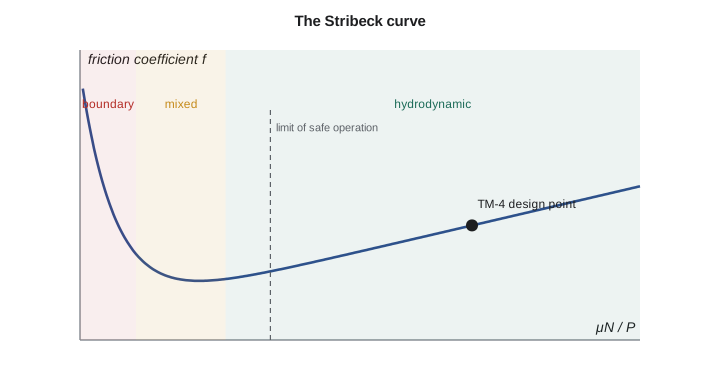
The regimes are shown on a Stribeck curve, which plots the coefficient of friction against the dimensionless group \(\mu N/P\), where \(\mu\) is the absolute viscosity, N the speed and P the load per unit projected area. Friction is high at low values (boundary), falls to a minimum in the mixed regime, and rises slowly again in the hydrodynamic regime, where viscous shearing of the oil dominates. A journal bearing is designed to run safely on the hydrodynamic side of the minimum, so that a drop in speed or a rise in temperature does not push it into the mixed regime.
Viscosity
Viscosity is the property that makes hydrodynamic lubrication possible. Absolute (dynamic) viscosity \(\mu\) is the ratio of shear stress to shear rate in the fluid, in pascal-seconds (Pa·s); the older unit, the centipoise, equals 1 mPa·s. Kinematic viscosity \(\nu = \mu/\rho\) is in m²/s or, more conveniently, mm²/s (centistokes). Industrial oils are graded by ISO viscosity grade (VG), the kinematic viscosity at 40 °C: ISO VG 32, 46 and 68 are common for pump and turbine bearings. Viscosity falls steeply with temperature, roughly halving for every 15 to 20 °C rise in the operating range, and the relation is described by the Walther equation used in ASTM D341 charts. This temperature sensitivity is central to bearing design: the bearing's friction heats the oil, which lowers its viscosity, which changes the friction.
Petroff's equation
The simplest model, due to Nikolai Petroff in 1883, treats a lightly loaded journal running concentric with its bearing. The oil film of thickness c (the radial clearance) is sheared by the journal surface moving at speed \(U = 2\pi r N\). The friction torque and coefficient of friction are
where r is the journal radius, L the bearing length, N in revolutions per second and \(P = W/(2rL)\) the load per unit projected area. Petroff's equation ignores the eccentricity that a loaded journal must have to generate pressure, so it slightly underestimates friction at heavy loads, but it gives the right trends and orders of magnitude, and it introduces two key groups: the clearance ratio \(c/r\), typically about 0.001 to 0.002, and the bearing characteristic \(\mu N/P\).
The Sommerfeld number and bearing charts
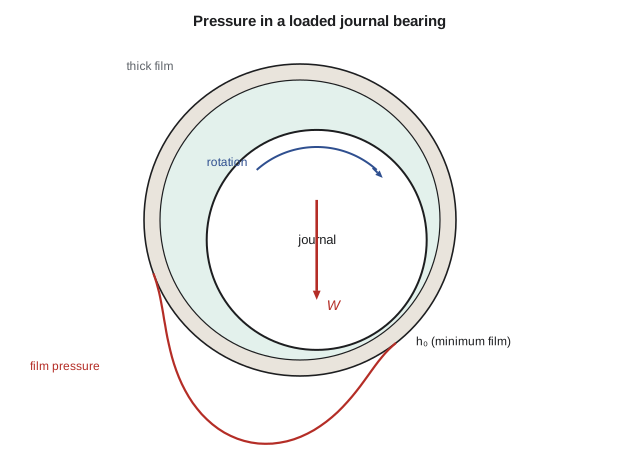
A loaded journal runs eccentric in its bearing, with eccentricity e and a minimum film thickness \(h_0 = c - e = c(1 - \varepsilon)\), where \(\varepsilon = e/c\) is the eccentricity ratio. Reynolds' equation for the pressure in a thin viscous film, derived by Osborne Reynolds in 1886, describes how the oil pressure builds up in the converging wedge. Its solutions show that the behavior of a journal bearing of given length-to-diameter ratio depends on a single dimensionless group, the Sommerfeld number:
A large S means a lightly loaded, fast or viscous bearing that runs nearly concentric; a small S means a heavily loaded bearing with a thin film. Raimondi and Boyd published charts in 1958, based on numerical solutions of Reynolds' equation, that give the minimum film thickness, friction, oil flow and temperature rise as functions of S for L/D ratios of 1/4, 1/2 and 1. These charts are still the standard design tool in textbooks, alongside modern computer programs. For quick estimates without charts, the short-bearing approximation of Ocvirk, which neglects pressure flow around the circumference, gives a closed form for the load capacity:
It is accurate for L/D below about 0.5 and tends to underestimate the load capacity, and so overestimate eccentricity, for longer bearings, so it is conservative for the TM-4's L/D of 0.75.
The TM-4 bearing
Each TM-4 bearing carries about 4 kN on an 80 mm journal with a 60 mm long sleeve, so the unit load is \(P = 4000/(0.060 \times 0.080) = 0.83\) MPa, a moderate value for a babbitt-lined bearing (typical limits are about 1.5 to 2.5 MPa for steady loads). The radial clearance is 0.060 mm, a clearance ratio of 0.0015. The bearings run on ISO VG 46 turbine oil, which at a typical film temperature of 50 °C has a viscosity of about 26 mPa·s.
# Plain journal bearing for the TM-4 multistage pump: Petroff, Sommerfeld number and a short-bearing solution
import math
W = 4000.0              # N, radial load
D, L = 0.080, 0.060     # m, journal diameter and bearing length (L/D = 0.75)
c = 0.060e-3            # m, radial clearance (c/r = 0.0015)
rpm = 3560
N = rpm / 60            # rev/s
r = D / 2
P = W / (L * D)         # unit load, Pa
U = math.pi * D * N     # journal surface speed, m/s
# ISO VG 46 turbine oil viscosity vs temperature (Walther-type fit through 40 C and 100 C values)
def mu(Tc, nu40=46.0, nu100=6.8, rho=860.0):
    A = lambda v: math.log10(math.log10(v + 0.7))
    T1, T2 = 313.15, 373.15
    B = (A(nu40) - A(nu100)) / (math.log10(T2) - math.log10(T1))
    a = A(nu40) + B * math.log10(T1)
    v = 10 ** (10 ** (a - B * math.log10(Tc + 273.15))) - 0.7
    return v * 1e-6 * rho                     # Pa.s
print(f"unit load P = {P/1e6:.2f} MPa, journal speed U = {U:.1f} m/s")
for T in (40, 50, 60, 70):
    m = mu(T)
    S = (r / c) ** 2 * m * N / P
    f_pet = 2 * math.pi**2 * (m * N / P) * (r / c)
    torque = f_pet * W * r
    print(f"oil at {T} C: mu = {m*1000:5.1f} mPa.s  S = {S:.3f}  Petroff f = {f_pet:.4f}  "
          f"friction power {torque * 2 * math.pi * N:.0f} W")

# Short-bearing (Ocvirk) theory: solve for eccentricity ratio at 50 C, then minimum film thickness
m = mu(50)
def load(e):
    return m * U * L**3 / (4 * c**2) * e / (1 - e**2)**2 * math.sqrt(math.pi**2 * (1 - e**2) + 16 * e**2)
lo, hi = 1e-4, 0.999
for _ in range(100):
    e = (lo + hi) / 2
    lo, hi = (e, hi) if load(e) < W else (lo, e)
hmin = c * (1 - e)
print(f"\nshort-bearing theory at 50 C: eccentricity ratio = {e:.3f}, h_min = {hmin*1e6:.1f} um")
h_trump = (0.00508 + 0.00004 * D * 1000) / 1000     # Trumpler's design minimum, converted from inches to m
print(f"Trumpler's minimum film for this journal: {h_trump*1e6:.1f} um -> margin {hmin/h_trump:.1f}x")unit load P = 0.83 MPa, journal speed U = 14.9 m/s oil at 40 C: mu = 39.6 mPa.s S = 1.252 Petroff f = 0.0371 friction power 2211 W oil at 50 C: mu = 25.8 mPa.s S = 0.816 Petroff f = 0.0242 friction power 1441 W oil at 60 C: mu = 17.7 mPa.s S = 0.561 Petroff f = 0.0166 friction power 991 W oil at 70 C: mu = 12.8 mPa.s S = 0.404 Petroff f = 0.0120 friction power 714 W short-bearing theory at 50 C: eccentricity ratio = 0.201, h_min = 47.9 um Trumpler's minimum film for this journal: 8.3 um -> margin 5.8x
Worked problem
Friction and film thickness at 50 °C
For the TM-4 bearing at 3,560 rpm with ISO VG 46 oil at 50 °C, find the Sommerfeld number, the Petroff friction coefficient and the minimum film thickness from short-bearing theory.
Show solution
- \(N = 3560/60 = 59.3\) rev/s; \(\mu = 0.0258\) Pa·s; \(r/c = 40/0.060 = 667\).
- \[S = 667^2 \times \frac{0.0258 \times 59.3}{0.833 \times 10^6} = 0.82\]
- \[f = 2\pi^2 \times 1.84 \times 10^{-6} \times 667 = 0.024\]
- Solving the short-bearing equation for W = 4,000 N gives \(\varepsilon \approx 0.20\), so \(h_0 = 0.060(1 - 0.20) = 0.048\) mm.
Answer: The film is 48 µm thick, nearly six times Trumpler's design minimum of about 8 µm for this journal, so the bearing has a large margin. The friction power is about 1.4 kW per bearing, which the oil must carry away as heat; it explains why the customer wants a lighter oil.
Answering the customer
Switching from VG 46 to VG 32 would lower the viscosity at the same temperature by about 30 percent. Friction falls roughly in proportion, saving perhaps 400 to 500 W per bearing. The Sommerfeld number falls too, so the eccentricity rises and the film thins. With the large margin shown above, the film would remain well above the minimum. But Owen points out three other considerations. The lower friction also lowers the oil temperature, which partly offsets the viscosity change. At start-up and shutdown, when speed is low, the film is thinnest, and a lighter oil spends longer in the mixed regime; the TM-4 has a jacking oil system that lifts the rotor at low speed, which removes this concern. And the oil also lubricates the thrust bearing and the coupling, which have their own requirements. His recommendation, which Farah adopts, is that VG 32 is acceptable for the journal bearings if the thrust bearing check also passes and the oil temperature is monitored.
A full thermal analysis finds the operating temperature by iteration: guess a film temperature, find the viscosity, compute the friction and oil flow from the charts, find the temperature rise of the oil, and repeat until the assumed and calculated temperatures agree. Raimondi and Boyd's charts and modern software include this loop.
Bearing materials and design details
Journal bearing linings must be softer than the journal, so that dirt particles embed in the lining rather than scoring the journal; they must conform to small misalignments, resist fatigue under the oil film pressure, and survive brief boundary contact. Babbitts (tin- or lead-based white metals) excel at embeddability and conformability and are standard for turbines and large pumps. Bronzes are stronger and used where loads are higher or where the bearing may run with little lubrication. Polymer and composite bearings are used for water-lubricated pump bearings, such as the line-shaft bearings of vertical turbine pumps, where the pumped water is the lubricant.
Oil is fed through a hole or groove in the unloaded part of the bearing, never in the high-pressure zone, where it would destroy the film. The clearance is a compromise: a small clearance gives a thick film and good load capacity but more friction and heat; a large clearance runs cooler but less stably. High-speed, lightly loaded rotors can suffer oil whirl, a self-excited instability at about half the running speed, which is controlled with tilting-pad or lobed bearings.
In US units, the TM-4 journal is 3.15 in in diameter with a radial clearance of about 0.0024 in, the unit load is about 121 psi, and the viscosity of VG 46 oil at 50 °C (122 °F) is about 3.7 microreyn. Trumpler's design rule for minimum film thickness, \(h_0 \ge 0.0002 + 0.00004\,d\) in, gives about 0.00033 in for this journal. US power plants commonly monitor journal bearings to API 670 machinery protection practice.
Common mistakes
MistakeUsing kinematic viscosity in the Sommerfeld number.
InsteadUse absolute viscosity μ in Pa·s, with N in rev/s and P in Pa.
MistakeFeeding oil into the loaded zone of the bearing.
InsteadFeed oil into the unloaded region so the pressure film is not disturbed.
MistakeIgnoring the temperature rise of the oil.
InsteadIterate between temperature and viscosity; viscosity falls steeply with temperature.
MistakeAssuming a lighter oil is always better because it reduces friction.
InsteadCheck the minimum film thickness, low-speed operation and other components on the same oil.
MistakeApplying short-bearing theory to long bearings without caution.
InsteadIt is accurate for L/D below about 0.5; for longer bearings use charts or numerical solutions.
Summary and key terms
- Lubrication regimes range from boundary through mixed to hydrodynamic; journal bearings are designed to run in the hydrodynamic regime.
- Viscosity, graded by ISO VG at 40 °C, falls steeply with temperature and controls film formation.
- Petroff's equation f = 2π²(μN/P)(r/c) gives the friction of a lightly loaded concentric journal.
- The Sommerfeld number S = (r/c)²μN/P characterizes a journal bearing; Raimondi-Boyd charts give its performance.
- The TM-4 bearing at 50 °C has S ≈ 0.82, f ≈ 0.024, about 1.4 kW of friction and a 48 µm minimum film.
- A lighter oil is acceptable if the film, low-speed operation and other oil-lubricated parts are checked.
- Hydrodynamic lubrication
- Lubrication in which a fluid film generated by relative motion carries the whole load.
- Boundary lubrication
- Lubrication in which the load is carried by surface contact protected by thin adsorbed films.
- Stribeck curve
- A plot of friction coefficient against μN/P showing the lubrication regimes.
- ISO viscosity grade
- The kinematic viscosity of an oil at 40 °C in mm²/s.
- Petroff's equation
- The friction of a lightly loaded, concentric journal bearing.
- Sommerfeld number
- The dimensionless bearing characteristic (r/c)²μN/P.
- Eccentricity ratio
- The journal offset divided by the radial clearance.
- Babbitt
- A soft white-metal bearing alloy based on tin or lead.
- Oil whirl
- A self-excited vibration of a lightly loaded journal at about half the running speed.
Practice problems
Work each problem on paper first, then reveal the answer to check.
A journal bearing has r = 25 mm, c = 0.025 mm, L = 50 mm, μ = 0.03 Pa·s and runs at 30 rev/s with W = 2 kN. Find P and S.
Show answer
P = 0.8 MPa; S = 1.125.
For the same bearing, find Petroff's coefficient of friction.
Show answer
f ≈ 0.0222.
Find the friction power for the bearing above.
Show answer
About 209 W.
In the program, change the oil to VG 32 (40 °C value 32 mm²/s, 100 °C value 5.4 mm²/s). What is the film thickness at 50 °C?
Show answer
About 44 µm.
An oil has a kinematic viscosity of 46 mm²/s and a density of 860 kg/m³. Find μ.
Show answer
About 0.040 Pa·s.
Why are babbitt linings used in large pump and turbine bearings?
Show answer
They embed dirt, conform to misalignment and survive brief contact without damaging the journal.
Lesson quiz · 5 questions
Score 60% or more to complete this lesson.
Create a free account to save your progress, take quizzes and earn a certificate.