
MEC-360 · Lesson 6 of 12 · 22 min
Rolling-element bearings
The TP-80's shaft is now sized; the next job is to choose the bearings that carry it. Rolling-element bearings are among the most refined products in engineering: a few grams of hardened steel balls running between precision rings can carry metric tons of load for tens of thousands of hours at thousands of revolutions per minute. They are also the most common reason a pump comes back for repair. Unlike a shaft, a bearing does not have an endurance limit in the usual sense. Every bearing eventually fails by rolling contact fatigue if nothing else kills it first, so bearings are rated by life, not by a safe stress, and the designer's job is to choose a bearing whose expected life meets the requirement with the reliability the customer needs.
Types of rolling bearing
Rolling bearings are divided by the shape of their rolling elements and the direction of load they carry. Ball bearings have point contact, low friction and high speed capability. Roller bearings have line contact and carry heavier loads in the same space but generally at lower speeds.
| Type | Radial load | Axial load | Typical use |
|---|---|---|---|
| Deep-groove ball | Good | Moderate, both directions | Electric motors, small pumps, general machinery |
| Angular-contact ball | Good | High, one direction (pairs for both) | Pump thrust bearings, machine tool spindles |
| Cylindrical roller | Very high | None to small, depending on rib design | Pump inboard bearings, gearboxes |
| Tapered roller | High | High, one direction | Wheel hubs, gear reducers |
| Spherical roller | Very high | Moderate | Heavy shafts with misalignment, fans, paper machines |
| Needle roller | High in small space | None | Gear trains, rocker arms |
A typical end-suction pump power end uses a radial bearing on the inboard side, which takes the heavy radial load, and a thrust bearing on the outboard side, which locates the shaft axially and takes the impeller's thrust along with a smaller radial load. The outboard bearing is often a back-to-back pair of angular-contact ball bearings; the inboard bearing is a deep-groove ball bearing or, for heavier loads, a cylindrical roller bearing that also allows the shaft to grow thermally without loading the bearings axially.
Rolling contact fatigue and the rating life
Under load, each ball or roller compresses the raceway at a tiny contact patch, producing very high Hertzian contact stresses, often above 1,500 MPa. The largest shear stress lies a short distance below the surface. Repeated millions of times, it eventually starts a subsurface crack that grows to the surface and releases a flake of metal, called spalling. Once a spall forms, the bearing becomes noisy and rough and fails quickly.
Fatigue life of identical bearings under identical conditions scatters widely: the longest-lived bearing in a group may last 20 times longer than the shortest. Bearing life is therefore described statistically. The basic rating life \(L_{10}\) is the life that 90 percent of a large group of identical bearings will reach or exceed before the first sign of fatigue. The distribution of lives follows a Weibull distribution closely, which allows the life at other reliabilities to be estimated.
Bearing makers rate each bearing by its basic dynamic load rating C: the constant radial load under which the bearing has an \(L_{10}\) life of one million revolutions. The life at any other load P follows the load-life relation:
with p = 3 for ball bearings and p = 10/3 for roller bearings, and n the speed in rpm. Doubling the load cuts ball bearing life to one-eighth. This steep dependence is why accurate loads matter so much in bearing selection and why application factors are applied to the calculated loads.
Equivalent load
When a bearing carries both a radial load \(F_r\) and an axial load \(F_a\), the life equation uses an equivalent radial load P that would give the same life:
For deep-groove ball bearings, catalogs tabulate X and Y against the ratio \(F_a/C_0\), where \(C_0\) is the basic static load rating. If \(F_a/F_r\) is below a limit e, the axial load is ignored and P = \(F_r\); otherwise X = 0.56 and Y is read from the table, typically between 1 and 2.3. Angular-contact and tapered roller bearings have their own factors and, because their contact angle turns radial load into an induced axial load, pairs must be analyzed together.
An application factor \(a_f\), also called a load factor or service factor, is applied to the calculated loads to cover shock and vibration not included in the analysis. Values of about 1.0 to 1.2 are used for smooth electric drives such as centrifugal pumps and fans, 1.2 to 1.5 for gear drives, and higher for machinery with impact. Farah uses 1.2 for the TP-80, because pumps that run off their best efficiency point see hydraulic pulsation.
Life at other reliabilities
Because \(L_{10}\) corresponds to 90 percent reliability, a requirement for higher reliability means a shorter life for the same bearing. ISO 281 gives life modification factors \(a_1\) for reliability:
| Reliability | 90 % | 95 % | 96 % | 97 % | 98 % | 99 % |
|---|---|---|---|---|---|---|
| \(a_1\) | 1.00 | 0.64 | 0.55 | 0.47 | 0.37 | 0.25 |
The factor \(a_{\text{ISO}}\) in the modified rating life of ISO 281 accounts for lubrication quality, contamination and the fatigue load limit of the material. With clean, well-lubricated bearings it can be several times larger than one; with contaminated grease or water ingress, which is common in pumps, it can fall well below one. This is why seals that keep water out of the bearing frame, such as labyrinth or bearing isolator seals, often extend real bearing life more than a larger bearing would.
Selecting the TP-80 bearings
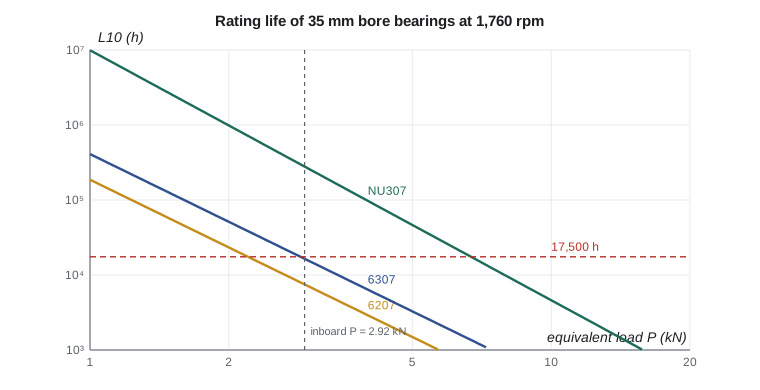
The requirement is an \(L_{10}\) life of at least 17,500 hours at the worst allowed operating point, a figure that comes from industry practice for process pumps. The program checks three candidate 35 mm bore bearings for each position, using approximate catalog ratings. Actual ratings vary between makers and series, and the final selection uses the chosen maker's data.
# Rolling-bearing selection for the TP-80 frame (inboard and outboard positions)
import math
rpm = 1760
L10h_req = 17500                         # hours, a common minimum for process pumps
a1 = {0.90: 1.00, 0.95: 0.64, 0.96: 0.55, 0.97: 0.47, 0.98: 0.37, 0.99: 0.25}   # ISO 281 reliability factors
af = 1.2                                 # application factor for pump service (moderate shock)
# Approximate published ratings (kN): bore 35 mm deep-groove ball bearings
cat = {"6207": (27.0, 15.3, 3), "6307": (35.1, 19.0, 3), "NU307": (64.0, 63.0, 10/3)}   # (C, C0, life exponent)
# Deep-groove X, Y from the ratio Fa/C0 (tabulated values, interpolated)
tab = [(0.014, 0.19, 2.30), (0.021, 0.21, 2.15), (0.028, 0.22, 1.99), (0.042, 0.24, 1.85),
       (0.056, 0.26, 1.71), (0.070, 0.27, 1.63), (0.084, 0.28, 1.55), (0.110, 0.30, 1.45),
       (0.170, 0.34, 1.31), (0.280, 0.38, 1.15), (0.420, 0.42, 1.04), (0.560, 0.44, 1.00)]
def eY(r):
    if r <= tab[0][0]: return tab[0][1:]
    for (r1, e1, y1), (r2, e2, y2) in zip(tab, tab[1:]):
        if r <= r2:
            t = (r - r1) / (r2 - r1); return e1 + t * (e2 - e1), y1 + t * (y2 - y1)
    return tab[-1][1:]
def P_eq(Fr, Fa, C0):
    if Fa == 0: return Fr
    e, Y = eY(Fa / C0)
    return Fr if Fa / Fr <= e else 0.56 * Fr + Y * Fa
positions = {"inboard (radial only)": (2.43, 0.0), "outboard (radial + thrust)": (1.08, 0.60)}
for pos, (Fr, Fa) in positions.items():
    print(pos)
    for name, (C, C0, p) in cat.items():
        if name.startswith('NU') and Fa > 0: continue   # a cylindrical roller bearing of this type takes no thrust
        P = af * P_eq(Fr, Fa, C0)
        L10h = (C / P) ** p * 1e6 / (60 * rpm)
        L99 = a1[0.99] * L10h
        print(f"  {name}: P = {P:.2f} kN  L10 = {L10h:>9,.0f} h  L1 (99 %) = {L99:>8,.0f} h  {'OK' if L10h >= L10h_req else 'short'}")
# Required rating for the inboard bearing at 99 % reliability over 17,500 h
P = af * 2.43
C_req = P * (a1[0.99] ** -1 * L10h_req * 60 * rpm / 1e6) ** (1 / 3)
print(f"\nC needed for 17,500 h at 99 % reliability, inboard: {C_req:.1f} kN")
# Life at a higher load: doubling load cuts ball-bearing life by 2^3 = 8
print(f"doubling the load divides ball-bearing life by {2**3}; for rollers by {2**(10/3):.1f}")inboard (radial only) 6207: P = 2.92 kN L10 = 7,517 h L1 (99 %) = 1,879 h short 6307: P = 2.92 kN L10 = 16,516 h L1 (99 %) = 4,129 h short NU307: P = 2.92 kN L10 = 280,314 h L1 (99 %) = 70,078 h OK outboard (radial + thrust) 6207: P = 2.08 kN L10 = 20,778 h L1 (99 %) = 5,195 h OK 6307: P = 2.13 kN L10 = 42,210 h L1 (99 %) = 10,552 h OK C needed for 17,500 h at 99 % reliability, inboard: 56.8 kN doubling the load divides ball-bearing life by 8; for rollers by 10.1
Worked problem
Life of a 6307 at the inboard position
The inboard bearing carries 2.43 kN of radial load with an application factor of 1.2. A 6307 deep-groove ball bearing has C ≈ 35.1 kN. Find its L10 life at 1,760 rpm.
Show solution
- \(P = 1.2 \times 2.43 = 2.92\) kN.
- \[L_{10h} = \frac{10^6}{60 \times 1760}\Big(\frac{35.1}{2.92}\Big)^3 = 9.47 \times 1737 \approx 16\,500\ \text{h}\]
Answer: The 6307 falls just short of 17,500 hours. A 6207 is much shorter at about 7,500 hours. Farah chooses an NU307 cylindrical roller bearing for the inboard position, with C ≈ 64 kN and a life of more than 250,000 hours by the same calculation; it also allows the shaft to expand axially. The roller bearing has a large margin at 90 percent reliability and over 70,000 hours at 99 percent, so the inboard bearing will rarely be the cause of a repair.
Worked problem
The outboard thrust position
The outboard bearing carries 1.08 kN radial and the impeller's 0.60 kN thrust. For a 6307 (C₀ ≈ 19.0 kN), find the equivalent load and life.
Show solution
- \(F_a/C_0 = 0.6/19.0 = 0.032\), so e ≈ 0.23 and Y ≈ 1.95 from the table.
- \(F_a/F_r = 0.556 > e\), so \(P = 0.56(1.08) + 1.95(0.60) = 1.77\) kN; with \(a_f = 1.2\), P = 2.13 kN.
- \(L_{10h} = 9.47 \times (35.1/2.13)^3 \approx 42\,000\) h.
Answer: The 6307 is satisfactory at the outboard position, with a 99 percent life of about 10,500 hours. In production, Tidewater uses a pair of angular-contact bearings back to back at this position, which takes thrust in both directions with a higher rating, but the deep-groove bearing shows the method.
Lubrication, fits and mounting
Most bearing failures are not classical fatigue but come from lubrication problems, contamination, poor mounting or misalignment. Grease suits speeds well below the bearing's limiting speed and sealed-for-life arrangements; oil bath or oil mist lubrication is common in process pumps because it carries heat away and can be monitored. Oil viscosity at the operating temperature must be high enough to form an elastohydrodynamic film, typically a kinematic viscosity of at least about 13 mm²/s for ball bearings, and the viscosity ratio between actual and required viscosity enters the \(a_{\text{ISO}}\) factor.
Fits matter as much as size. The ring that rotates relative to the load direction must have an interference fit, or it will creep and wear its seat. On the TP-80 the inner rings rotate with the shaft under a fixed load direction, so the shaft seats are toleranced for a light interference (for example k5 or m5 for this size), and the frame bores are toleranced for a sliding or transition fit so the outer ring of the floating bearing can move axially. MEC-260 introduced these ISO fit designations. Mounting should apply force only to the ring being pressed, never through the rolling elements, and induction heaters are used to expand inner rings for assembly.
In the United States, ANSI/ABMA standards 9 and 11 give load ratings and fatigue life for ball and roller bearings and are closely aligned with ISO 281. In US units the TP-80's inboard design load is 656 lbf, and a 6307's rating of 35.1 kN is about 7,890 lbf. The 17,500 hour figure is a common US process pump requirement and is cited in several industry specifications.
Common mistakes
MistakeUsing the static rating C₀ in the life equation.
InsteadUse the dynamic rating C for life; C₀ is for static load and permanent deformation.
MistakeUsing an exponent of 3 for roller bearings.
InsteadUse p = 10/3 for roller bearings.
MistakeTreating L10 as the life of every bearing.
InsteadTen percent fail before L10; apply a₁ for higher reliability.
MistakeChoosing a bigger bearing to cure contamination.
InsteadKeep water and dirt out; contamination can cut life far more than size can add.
MistakeGiving both rings the same fit.
InsteadThe rotating ring relative to the load needs interference; the floating ring needs a clearance or transition fit.
Summary and key terms
- Rolling bearings fail by rolling contact fatigue and are rated by life, with L10 the life reached by 90 percent of bearings.
- L10 = (C/P)^p × 10⁶ revolutions, with p = 3 for ball bearings and 10/3 for roller bearings.
- The equivalent load P = XF_r + YF_a combines radial and axial loads; application factors cover shock.
- Reliability factors a₁ (0.25 at 99 percent) and the ISO a_ISO factor for lubrication and contamination modify the life.
- For the TP-80, a 6307 inboard gives about 16,500 h, short of 17,500 h, so an NU307 roller bearing is chosen; a 6307 is adequate outboard.
- Fits, lubrication and sealing determine real bearing life as much as the rating calculation.
- Rolling contact fatigue
- Fatigue of raceways and rolling elements under repeated contact stress, ending in spalling.
- L10 life
- The life reached or exceeded by 90 percent of a group of identical bearings.
- Basic dynamic load rating
- The constant load for an L10 life of one million revolutions.
- Basic static load rating
- The load that causes a stated small permanent deformation of the raceway.
- Equivalent load
- A radial load giving the same life as the actual combined radial and axial loads.
- Application factor
- A multiplier on calculated loads to account for shock and vibration.
- Weibull distribution
- A statistical distribution that describes the scatter of bearing lives.
- Spalling
- Flaking of metal from a raceway caused by fatigue cracks.
- Floating bearing
- A bearing whose outer ring can move axially to allow thermal expansion of the shaft.
Practice problems
Work each problem on paper first, then reveal the answer to check.
A ball bearing has C = 20 kN and carries P = 2 kN at 1,500 rpm. Find L10 in hours.
Show answer
About 11,100 h.
The same bearing must reach 99 percent reliability. Find the life.
Show answer
About 2,780 h.
A roller bearing has C = 50 kN and P = 5 kN at 1,000 rpm. Find L10 in hours.
Show answer
About 36,000 h.
Find the C needed for a ball bearing at P = 3 kN, 1,760 rpm and 20,000 h at 90 percent reliability.
Show answer
About 38.5 kN.
In the program, reduce the application factor to 1.0. Does the 6307 now meet 17,500 h at the inboard position?
Show answer
Yes, about 28,500 h.
Why is a cylindrical roller bearing used at the inboard end rather than the outboard end?
Show answer
It carries heavy radial load and allows axial float; the outboard bearing must locate the shaft and take thrust.
Lesson quiz · 5 questions
Score 60% or more to complete this lesson.
Create a free account to save your progress, take quizzes and earn a certificate.