
MEC-330 · Lesson 6 of 12 · 25 min
Reheat, regenerative and supercritical Rankine cycles
Lesson 5 ended with a puzzle. Raising the boiler pressure raises efficiency but wets the turbine exhaust, and even at high pressure the average temperature of heat addition stays far below the turbine inlet temperature because so much heat goes into warming cold feedwater. Large steam plants solve both problems with two modifications, reheat and regenerative feedwater heating, and the most advanced ones go further by operating above the critical pressure of water. To see what these changes are worth, Tomás builds a model of a utility-scale plant at 8 MPa and 500 °C with a 10 kPa condenser, and then adds the modifications one at a time. He also discovers that Northgate already has one of them: its deaerator is an open feedwater heater.
The ideal reheat Rankine cycle
In a reheat cycle, steam expands in a high-pressure turbine to an intermediate pressure, returns to the boiler to be reheated at roughly that pressure, and then expands in a low-pressure turbine to the condenser. Reheating moves the low-pressure expansion line to the right on the T-s diagram, so the exhaust is much drier. Total heat input and total turbine work are
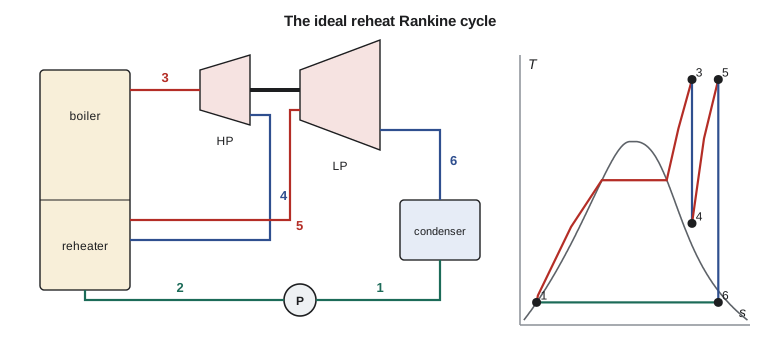
Reheat is mainly a way to keep the exhaust dry so that higher boiler pressures can be used. Its effect on efficiency depends on the reheat pressure. If the reheat pressure is high, the added heat goes in at a high average temperature but the gain in exit quality is small; if it is low, the exhaust is very dry but the added heat goes in at a low average temperature. The best reheat pressure is usually about a quarter of the boiler pressure. Very large plants use double reheat, though the extra boiler and piping costs limit it to the largest, highest-pressure units.
The regenerative cycle and feedwater heaters
The second weakness of the simple cycle is the cold feedwater. In Tomás's base plant, the pump delivers water at about 46 °C to a boiler that boils at 295 °C, and all the heat needed to warm the water is added at low temperature. The regenerative cycle warms the feedwater internally with steam bled, or extracted, from the turbine. The bled steam has already done some work; it gives up its remaining latent heat to the feedwater instead of to the condenser. The average temperature of heat addition rises, and so does the efficiency.
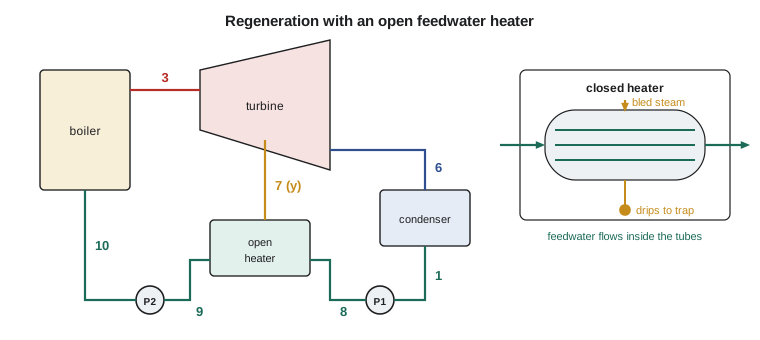
In an open feedwater heater, also called a direct-contact heater, the bled steam mixes with the feedwater. Both streams enter at the same pressure, and the mixture leaves as saturated liquid at that pressure, which then needs its own pump to reach boiler pressure. With a fraction \(y\) of the steam bled at state 7, the heater's energy balance gives
In a closed feedwater heater, the bled steam condenses on the outside of tubes through which the feedwater flows, so the two streams can be at different pressures. The condensed steam, called drips, is either pumped forward into the feedwater line or cascaded backward through a trap to a lower-pressure heater or the condenser. Closed heaters avoid the need for a pump after each heater, but they are more expensive and cannot heat the feedwater quite to the saturation temperature of the bled steam. Most plants combine several closed heaters with one open heater that also serves as a deaerator.
That last point is Northgate's. Its deaerator at 120 kPa is an open feedwater heater: steam from the district main, or from the turbine exhaust, mixes with condensate returning from the buildings, heats it to saturation and drives out dissolved oxygen and carbon dioxide that would corrode the boilers. Graham has always thought of the deaerator as water treatment. Tomás points out that it also raises the feedwater temperature to about 105 °C, which is regeneration.
Modeling the improvements
The program runs three ideal cycles: (a) the simple cycle at 8 MPa and 500 °C, (b) the same with reheat at 1 MPa back to 500 °C, and (c) reheat plus one open feedwater heater at 0.5 MPa fed with steam bled from the low-pressure turbine. Superheated-steam properties at intermediate states are found by linear interpolation in the steam tables, which the program does explicitly.
# Reheat and regeneration for a utility-scale plant: 8 MPa, 500 C, 10 kPa condenser (ideal cycles)
def interp(x, x1, y1, x2, y2): return y1 + (x - x1) * (y2 - y1) / (x2 - x1)

# Saturation (kPa): hf, hfg, sf, sfg, vf; superheat (kPa, C): (h, s), rounded from standard steam tables
sat = {10: (191.81, 2392.1, 0.6492, 7.4996, 0.001010), 500: (640.09, 2108.0, 1.8604, 4.9603, 0.001093)}
sup = {(8000, 500): (3399.5, 6.7266), (1000, 200): (2828.3, 6.6956), (1000, 250): (2943.1, 6.9265),
       (1000, 500): (3479.1, 7.7642), (500, 300): (3064.6, 7.4614), (500, 400): (3272.4, 7.7956)}

def wet(P, s):
    hf, hfg, sf, sfg, vf = sat[P]; x = (s - sf) / sfg
    return hf + x * hfg, x

h1, vf10 = sat[10][0], sat[10][4]
h3, s3 = sup[(8000, 500)]

# (a) simple cycle
wp = vf10 * (8000 - 10); h2 = h1 + wp
h4, x4 = wet(10, s3)
eta_a = ((h3 - h4) - wp) / (h3 - h2)
print(f"(a) simple:   eta = {eta_a:.3f}, exit quality = {x4:.3f}, wnet = {h3 - h4 - wp:.1f} kJ/kg")

# (b) reheat at 1 MPa back to 500 C
(hA, sA), (hB, sB) = sup[(1000, 200)], sup[(1000, 250)]
h4r = interp(s3, sA, hA, sB, hB); T4r = interp(s3, sA, 200, sB, 250)
h5, s5 = sup[(1000, 500)]
h6, x6 = wet(10, s5)
wt = (h3 - h4r) + (h5 - h6); qin = (h3 - h2) + (h5 - h4r)
eta_b = (wt - wp) / qin
print(f"(b) reheat:   HP exit {T4r:.1f} C, h = {h4r:.1f}; eta = {eta_b:.3f}, exit quality = {x6:.3f}, wnet = {wt - wp:.1f} kJ/kg")

# (c) reheat plus one open feedwater heater at 0.5 MPa, fed by steam bled from the LP turbine
(hC, sC), (hD, sD) = sup[(500, 300)], sup[(500, 400)]
h7 = interp(s5, sC, hC, sD, hD); T7 = interp(s5, sC, 300, sD, 400)
wp1 = vf10 * (500 - 10); h8 = h1 + wp1                       # condensate pump to the heater
h9, vf5 = sat[500][0], sat[500][4]                           # saturated liquid leaves the heater
wp2 = vf5 * (8000 - 500); h10 = h9 + wp2                      # feed pump to the boiler
y = (h9 - h8) / (h7 - h8)                                    # fraction bled, from the heater energy balance
wt = (h3 - h4r) + (h5 - h7) + (1 - y) * (h7 - h6)
wpump = (1 - y) * wp1 + wp2
qin = (h3 - h10) + (h5 - h4r)
eta_c = (wt - wpump) / qin
print(f"(c) + FWH:    bleed at 0.5 MPa, {T7:.1f} C, h = {h7:.1f}; y = {y:.4f}; eta = {eta_c:.3f}, wnet = {wt - wpump:.1f} kJ/kg")

# Average heat-addition temperatures and steam flow for 500 MW net
Tl = 45.81 + 273.15
for name, eta in (("simple", eta_a), ("reheat", eta_b), ("reheat + FWH", eta_c)):
    print(f"   {name:13s} average heat-addition temperature = {Tl / (1 - eta) - 273.15:5.1f} C")
print(f"steam to the HP turbine for 500 MW net, case (c): {500e3 / (wt - wpump):.0f} kg/s")(a) simple: eta = 0.394, exit quality = 0.810, wnet = 1261.2 kJ/kg (b) reheat: HP exit 206.7 C, h = 2843.7; eta = 0.408, exit quality = 0.949, wnet = 1565.6 kJ/kg (c) + FWH: bleed at 0.5 MPa, 390.6 C, h = 3252.9; y = 0.1463; eta = 0.428, wnet = 1449.2 kJ/kg simple average heat-addition temperature = 253.3 C reheat average heat-addition temperature = 265.8 C reheat + FWH average heat-addition temperature = 284.4 C steam to the HP turbine for 500 MW net, case (c): 345 kg/s
Worked problem
Adding reheat
Steam at 8 MPa and 500 °C (\(h_3 = 3399.5\), \(s_3 = 6.7266\)) expands isentropically to 1 MPa, is reheated to 500 °C (\(h_5 = 3479.1\), \(s_5 = 7.7642\)) and expands to 10 kPa. At 1 MPa, superheated steam has \(h = 2828.3\), \(s = 6.6956\) at 200 °C and \(h = 2943.1\), \(s = 6.9265\) at 250 °C. Find the efficiency and the exhaust quality.
Show solution
- HP exit by interpolation at \(s = 6.7266\): \(h_4 = 2828.3 + \frac{6.7266 - 6.6956}{6.9265 - 6.6956}(2943.1 - 2828.3) = 2843.7\) kJ/kg, at about 206.7 °C.
- LP exit: \(x_6 = (7.7642 - 0.6492)/7.4996 = 0.949\); \(h_6 = 191.81 + 0.949(2392.1) = 2461.3\) kJ/kg.
- Pump: \(w_p = 0.001010(7990) = 8.07\) kJ/kg; \(h_2 = 199.9\) kJ/kg.
- \(w_t = (3399.5 - 2843.7) + (3479.1 - 2461.3) = 1573.6\) kJ/kg; \(q_{\text{in}} = (3399.5 - 199.9) + (3479.1 - 2843.7) = 3835.0\) kJ/kg.
- \[\eta = \frac{1573.6 - 8.1}{3835.0} = 0.408\]
Answer: Reheat lifts the efficiency from 0.394 to 0.408 and, more important, the exhaust quality from 0.810 to 0.949. The net work per kilogram rises by a quarter, so a smaller steam flow, and smaller pumps, boiler and condenser, produce the same power.
Worked problem
Adding an open feedwater heater
In the reheat cycle, a fraction \(y\) of the steam is bled from the low-pressure turbine at 0.5 MPa, where by interpolation \(h_7 = 3252.9\) kJ/kg (about 391 °C). Condensate is pumped to 0.5 MPa (\(h_8 = 192.3\)), mixed with the bled steam and leaves as saturated liquid at 0.5 MPa (\(h_9 = 640.09\), \(v = 0.001093\)), then is pumped to 8 MPa. Find \(y\) and the efficiency.
Show solution
- \(y = (640.09 - 192.3)/(3252.9 - 192.3) = 0.1463\).
- Feed pump: \(w_{p2} = 0.001093(7500) = 8.20\) kJ/kg; \(h_{10} = 648.3\) kJ/kg.
- Turbine work per kilogram entering the HP turbine: \((3399.5 - 2843.7) + (3479.1 - 3252.9) + (1 - 0.1463)(3252.9 - 2461.3) = 1457.8\) kJ/kg.
- Pump work: \((1 - 0.1463)(0.495) + 8.20 = 8.62\) kJ/kg; \(q_{\text{in}} = (3399.5 - 648.3) + (3479.1 - 2843.7) = 3386.6\) kJ/kg.
- \[\eta = \frac{1457.8 - 8.6}{3386.6} = 0.428\]
Answer: One open heater raises the efficiency by two more percentage points, to 0.428. The net work per kilogram falls, because 14.6 percent of the steam leaves the turbine early, but the heat input falls more. A real plant with seven or eight heaters and an economizer recovers much more; feedwater reaches the boiler at 250 to 300 °C.
The last lines of output convert each efficiency into an equivalent average temperature of heat addition with \(\bar T_H = T_L/(1 - \eta)\): 253 °C for the simple cycle, 266 °C with reheat and 284 °C with reheat and regeneration. Every improvement works by lifting \(\bar T_H\), exactly as the Carnot-like form of the efficiency predicts.
| Cycle (ideal, 8 MPa, 500 °C, 10 kPa) | Efficiency | Exhaust quality | Net work (kJ/kg) | Average heat-addition temperature |
|---|---|---|---|---|
| Simple | 0.394 | 0.810 | 1261 | 253 °C |
| With reheat at 1 MPa | 0.408 | 0.949 | 1566 | 266 °C |
| Reheat plus open heater at 0.5 MPa | 0.428 | 0.949 | 1449 | 284 °C |
Choosing extraction pressures
With one heater, the best extraction pressure gives a feedwater temperature roughly halfway between the condensing and boiling temperatures. With several heaters, a good first estimate divides the temperature rise from condenser to boiler into equal steps. Each added heater raises efficiency by a smaller amount, and the number in a plant is an economic choice: typical large units have six to eight. The deaerator usually sits near the middle of the train at a pressure of several hundred kilopascals to a megapascal, so that it operates above atmospheric pressure and air leaks out rather than in.
Supercritical and ultra-supercritical plants
Above the critical point of water, 22.06 MPa and 374 °C, there is no boiling: the water warms continuously from a dense liquid-like fluid to a light vapor-like one without a two-phase region. A supercritical boiler is therefore a once-through design without a steam drum, and the heat-addition line on the T-s diagram climbs above the dome rather than crossing it. Removing the constant-temperature boiling plateau raises the average temperature of heat addition substantially.
Supercritical units typically operate at about 24 MPa with main and reheat temperatures of 540 to 570 °C; ultra-supercritical units go to 25 to 30 MPa and about 600 to 620 °C. Their net efficiencies reach roughly 42 to 47 percent on the lower heating value of the fuel, against 35 to 38 percent for older subcritical units. Research programs on advanced ultra-supercritical steam aim at 700 °C and above, which requires nickel-based alloys in the hottest parts. Carbon dioxide can also be used as the working fluid in a supercritical Brayton-like cycle; supercritical CO2 cycles are compact and promising for nuclear, solar and waste-heat applications.
Many US coal units have retired over the past fifteen years and few new ones are planned, but the same steam-cycle principles apply to the remaining supercritical coal units, to the steam side of combined-cycle plants and to biomass, nuclear and concentrated solar plants. Nuclear plants are a special case: their steam is saturated or only slightly superheated at about 6 to 7 MPa (roughly 900 to 1000 psia), so their efficiency is near 33 to 35 percent, and moisture separators and reheaters between turbine stages keep the low-pressure turbines dry.
Back at Northgate
The utility-plant model was a detour, but it pays off at Northgate. The deaerator, as an open feedwater heater, sets the feedwater temperature that the boilers see. Raising the deaerator pressure from 120 kPa to 300 kPa would raise the feedwater temperature from about 105 °C to 134 °C and reduce the fuel used to make steam, at the cost of using more 1 MPa district steam in the deaerator. Whether that pays depends on how the steam would otherwise be used, a question that Lesson 7's cogeneration analysis answers. Tomás also notices that the district condensate returns from the buildings at 60 to 80 °C, already warm: a district system is, in effect, a giant regenerative loop in which the buildings are the feedwater heaters.
Kofi adds a design point. If Northgate adds a heat-recovery steam generator behind a gas turbine, its economizer section will do the job that feedwater heaters do in a utility plant, using exhaust heat that would otherwise go up the stack. In combined-cycle plants, bleeding steam for feedwater heating is usually avoided, because the exhaust gas is a better source of low-temperature heat.
For US customary readers, the same analysis works with steam tables in Btu/lbm, psia and °F: 8 MPa and 500 °C is about 1160 psia and 932 °F, with \(h = 1462\) Btu/lbm, and the reheat pressure of 1 MPa is 145 psia. Utility heat rates are quoted in Btu/kWh; 42.8 percent corresponds to 3412/0.428 = 7970 Btu/kWh for the ideal cycle alone, and real plants with boiler and auxiliary losses report net heat rates of roughly 8,700 to 10,500 Btu/kWh.
Common mistakes
MistakeForgetting that the bled fraction does not pass through the low-pressure turbine.
InsteadMultiply the LP work after the bleed point by (1 − y).
MistakeAssuming an open feedwater heater can feed the boiler directly.
InsteadAn open heater operates at its own pressure; a pump is needed after it.
MistakeTreating reheat mainly as an efficiency improvement.
InsteadIts main purpose is to keep the exhaust dry so that higher pressures can be used.
MistakeApplying the boiling-plateau idea to supercritical boilers.
InsteadAbove 22.06 MPa there is no two-phase region; heat is added without boiling.
MistakeUsing the turbine inlet enthalpy at the bleed point.
InsteadFind the bleed-point state at the bleed pressure with the turbine-inlet entropy (ideal) or with the turbine efficiency (actual).
Summary and key terms
- Reheat expands steam in stages with reheating between them; it dries the exhaust and allows higher boiler pressures.
- Regeneration heats feedwater with steam bled from the turbine, raising the average temperature of heat addition.
- Open heater balance: y = (h₉ − h₈)/(h₇ − h₈); open heaters need a pump after each one.
- Closed heaters keep the streams separate; drips are pumped forward or cascaded back.
- Deaerators are open feedwater heaters that also remove dissolved gases.
- Supercritical cycles avoid the boiling plateau and reach about 42 to 47 percent efficiency.
- Reheat cycle
- A Rankine cycle in which steam is reheated between turbine stages.
- Regenerative cycle
- A Rankine cycle in which feedwater is heated with steam bled from the turbine.
- Open feedwater heater
- A heater in which bled steam mixes directly with the feedwater.
- Closed feedwater heater
- A shell-and-tube heater in which bled steam condenses without mixing with the feedwater.
- Bleed steam
- Steam extracted from an intermediate turbine stage, usually for feedwater heating.
- Deaerator
- An open feedwater heater that strips dissolved oxygen and carbon dioxide from the water.
- Drips
- The condensate formed from bled steam in a closed feedwater heater.
- Supercritical cycle
- A cycle with heat added above the critical pressure, so that no boiling plateau occurs.
- Once-through boiler
- A boiler without a drum, in which water passes once through the tubes and leaves as steam.
Practice problems
Work each problem on paper first, then reveal the answer to check.
In the reheat example, what is the heat rejected per kilogram?
Show answer
About 2269.5 kJ/kg (2461.3 − 191.8).
An open heater receives bled steam at h = 2900 and liquid at h = 400 and delivers saturated liquid at h = 700. Find y.
Show answer
0.12.
What steam flow does the reheat-plus-heater plant need for 500 MW net?
Show answer
About 345 kg/s.
Why is the best reheat pressure neither very high nor very low?
Show answer
High gives little drying; low adds heat at a low average temperature.
In the program, change the bleed to 1 MPa saturated-liquid conditions (h₉ = 762.51, v = 0.001127) and bleed at h₇ = 3479.1 just after reheat. Does efficiency rise?
Show answer
No: y ≈ 0.173 and η ≈ 0.425, slightly lower, because the bled steam has just been reheated and still carries that heat.
Name two things a deaerator does.
Show answer
Heats the feedwater to saturation and strips dissolved gases.
Lesson quiz · 5 questions
Score 60% or more to complete this lesson.
Create a free account to save your progress, take quizzes and earn a certificate.