
MEC-330 · Lesson 1 of 12 · 29 min
Exergy and second-law analysis
Thermodynamics I ended with the cycles that turn heat into work and work into cooling. Thermodynamics II studies those cycles in depth: gas-turbine and engine cycles, steam power plants, cogeneration, refrigeration and heat pumps, and then the gas mixtures, moist air and combustion that feed and surround them. Before any cycle, though, we need a sharper tool than the first law. An energy balance tells us where energy goes, but every joule counts the same in it, whether it is high-pressure steam that could drive a turbine or lukewarm water that could do almost nothing. Exergy measures the useful work a stream or a quantity of heat could deliver, and an exergy balance shows where that potential is destroyed. It is the language engineers use to decide which part of a plant is worth improving.
Northgate's expansion study
We return to Northgate District Energy in Minneapolis, the steam district-heating plant of Thermodynamics I. Three gas-fired boilers make steam at 4 MPa and 400 °C. A back-pressure turbine expands part of it to 1 MPa and 250 °C for the district main, and a pressure-reducing valve (PRV) bypasses the turbine when the turbine is down or the demand is high. The plant's owners have asked plant engineer Elena Varga to lead a study of how Northgate should grow over the next fifteen years. The options include a gas turbine with a heat-recovery steam generator, gas engines, a condensing turbine for summer, a district cooling loop with electric and steam-driven chillers, a large heat pump, biogas from the wastewater plant next door, and better combustion control in the existing boilers. Chief operator Graham Okoro knows how the plant really runs; consulting engineer Kofi Mensah brings experience from other district systems; and Tomás Reyes, who worked at Northgate as a co-op student two years ago, is back for a second work term after finishing Thermodynamics II. Each lesson of this course takes up one part of the study.
Elena's first request is simple to state: rank the losses in the plant as it runs today. Tomás starts with an energy balance and finds that the boilers lose about 15 percent of the fuel energy up the stack and the turbine loses almost nothing. The PRV, by the same energy balance, loses nothing at all, since it is adiabatic and enthalpy is unchanged across it. Graham shakes his head: every operator knows that running steam through the PRV instead of the turbine throws away electricity. The energy balance cannot see that loss. The exergy balance can.
Exergy and the dead state
The exergy of a system is the maximum useful work that can be obtained as the system is brought into equilibrium with its surroundings, interacting with nothing but the surroundings. When the system reaches the temperature \(T_0\) and pressure \(P_0\) of the surroundings, it can do no more work; that condition is the dead state, and the system's exergy there is zero. Exergy is therefore a property of the system and its surroundings together. Unlike energy, it is not conserved: every irreversibility destroys some of it.
For a closed system, the exergy (per unit mass) is
The \(P_0(v - v_0)\) term subtracts the work spent pushing back the atmosphere, which is not useful. For a flowing stream, the flow work is already included in enthalpy, and the flow exergy is
Kinetic and potential energies are pure work potential and count in full. The term \(T_0(s - s_0)\) is the part of the enthalpy that would have to be rejected to the surroundings as heat in any reversible process that brings the stream to the dead state. Steam with high entropy carries much energy but comparatively little exergy.
Choosing the dead state is an engineering decision. Textbook tables often use 25 °C and 101.325 kPa. For a plant that runs all year, a single reference is convenient for comparing designs, and Elena's team adopts 25 °C and 100 kPa. When the question is about a particular season, the actual surroundings make more sense: on a January day in Minneapolis the outdoor air may be at −25 °C, and heat delivered to a building at 21 °C then has real work potential, because a heat engine could run between the room and the outdoors. We return to that point later in this lesson.
Exergy of heat and of work
Work is pure exergy. Heat is not: heat \(Q\) transferred at a boundary temperature \(T\) carries exergy
The factor in parentheses is the Carnot efficiency between \(T\) and the surroundings. Heat at 2000 K, roughly a natural-gas flame, has an exergy factor of 0.85 against a 298 K dead state; heat at 400 K has 0.25; heat at 310 K, just above the dead state, has 0.04. This one expression explains why burning gas to make warm water is wasteful in exergy terms even when the boiler is 95 percent efficient: the flame's exergy has been turned into heat with an exergy factor of a few percent.
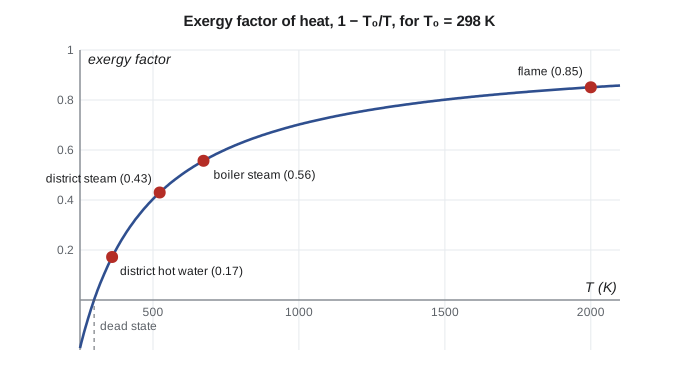
The exergy balance and exergy destruction
Combining the first and second laws gives an exergy balance. For a steady-flow device with heat transfer \(\dot Q_k\) at boundary temperatures \(T_k\), it reads
The exergy destroyed is proportional to the entropy generated. This is the Gouy-Stodola theorem:
Every irreversibility met in Thermodynamics I, from friction and unrestrained expansion to mixing and heat transfer through a finite temperature difference, generates entropy and so destroys exergy. A second kind of loss, exergy lost to the surroundings with exhaust gas or cooling water, is not destroyed inside the device but is wasted all the same. An exergy analysis separates the two, so that the engineer can see which components to improve and which waste streams might be put to use.
The performance of a device in exergy terms is its second-law efficiency, the ratio of the exergy recovered to the exergy supplied. For a turbine it is the work produced divided by the decrease in the steam's flow exergy; for a compressor or pump it is the increase in flow exergy divided by the work input; for a heat engine it is the thermal efficiency divided by the reversible (Carnot) efficiency; and for a boiler or heat exchanger it is the exergy gained by the cold stream divided by the exergy given up by the hot stream or the fuel.
Ranking Northgate's losses
Tomás repeats his analysis in exergy terms using the steam properties from Thermodynamics I. The program below finds the flow exergy of the main streams, then the exergy destroyed in the turbine, in the PRV and in the boilers. Run it and read the numbers before the worked examples that follow.
# Exergy at Northgate District Energy: steam, the pressure-reducing valve, the turbine and the boilers
# Steam properties rounded from standard steam tables; dead state 25 C, 100 kPa
T0 = 298.15
h0, s0 = 104.83, 0.3672                      # compressed liquid water at the dead state (taken as saturated liquid)

def psi(h, s):
    """Flow exergy per unit mass (kinetic and potential energy neglected)."""
    return (h - h0) - T0 * (s - s0)

states = {
    "boiler steam, 4 MPa 400 C":   (3214.5, 6.7714),
    "district main, 1 MPa 250 C":  (2943.1, 6.9265),
    "after PRV, 1 MPa 376.5 C":    (3214.5, 7.3898),
    "feedwater, 445.1 kJ/kg":      (445.1, 1.3609),
}
for name, (h, s) in states.items():
    print(f"{name:30s} h = {h:7.1f}  s = {s:6.4f}  psi = {psi(h, s):7.1f} kJ/kg")

# Turbine: 4 MPa 400 C to 1 MPa 250 C, adiabatic
h1, s1 = states["boiler steam, 4 MPa 400 C"]
h2, s2 = states["district main, 1 MPa 250 C"]
w = h1 - h2
x_dest_t = T0 * (s2 - s1)
eta_II_t = w / (psi(h1, s1) - psi(h2, s2))
print(f"\nturbine: w = {w:.1f} kJ/kg, exergy destroyed = {x_dest_t:.1f} kJ/kg, second-law efficiency = {eta_II_t:.3f}")

# Pressure-reducing valve: same inlet, throttled to 1 MPa
hp, sp = states["after PRV, 1 MPa 376.5 C"]
print(f"PRV:     w = 0, exergy destroyed = {T0 * (sp - s1):.1f} kJ/kg")

# Boiler: feedwater to steam, 85 % energy efficiency, natural-gas fuel exergy about 1.04 x LHV
hf_, sf_ = states["feedwater, 445.1 kJ/kg"]
q = h1 - hf_
fuel = q / 0.85
fuel_exergy = 1.04 * fuel
gain = psi(h1, s1) - psi(hf_, sf_)
print(f"boiler:  energy to steam = {q:.1f}, fuel energy = {fuel:.1f}, fuel exergy = {fuel_exergy:.1f} kJ/kg steam")
print(f"         exergy gained by steam = {gain:.1f} kJ/kg, second-law efficiency = {gain / fuel_exergy:.3f}")

# Exergy of heat delivered to a building at 21 C for two choices of dead state
for T0_case, label in ((298.15, "25 C reference"), (253.15, "-20 C winter day")):
    factor = 1 - T0_case / (21 + 273.15)
print(f"exergy factor of heat at 21 C, {label:17s}: {factor:6.3f}")boiler steam, 4 MPa 400 C h = 3214.5 s = 6.7714 psi = 1200.3 kJ/kg
district main, 1 MPa 250 C h = 2943.1 s = 6.9265 psi = 882.6 kJ/kg
after PRV, 1 MPa 376.5 C h = 3214.5 s = 7.3898 psi = 1015.9 kJ/kg
feedwater, 445.1 kJ/kg h = 445.1 s = 1.3609 psi = 44.0 kJ/kg
turbine: w = 271.4 kJ/kg, exergy destroyed = 46.2 kJ/kg, second-law efficiency = 0.854
PRV: w = 0, exergy destroyed = 184.4 kJ/kg
boiler: energy to steam = 2769.4, fuel energy = 3258.1, fuel exergy = 3388.4 kJ/kg steam
exergy gained by steam = 1156.3 kJ/kg, second-law efficiency = 0.341
exergy factor of heat at 21 C, 25 C reference : -0.014
exergy factor of heat at 21 C, -20 C winter day : 0.139Worked problem
Exergy destroyed in the PRV and the turbine
Steam at 4 MPa and 400 °C (\(h = 3214.5\) kJ/kg, \(s = 6.7714\) kJ/kg·K) can either pass through the turbine to 1 MPa and 250 °C (\(h = 2943.1\), \(s = 6.9265\)) or be throttled in the PRV to 1 MPa, which leaves it at 376.5 °C with \(s = 7.3898\). Take \(T_0 = 298.15\) K. Find the exergy destroyed per kilogram in each path and the turbine's second-law efficiency.
Show solution
- PRV: adiabatic with no work, so \(s_{\text{gen}} = 7.3898 - 6.7714 = 0.6184\) kJ/kg·K and \(x_{\text{dest}} = 298.15(0.6184) = 184.4\) kJ/kg.
- Turbine: \(w = 3214.5 - 2943.1 = 271.4\) kJ/kg; \(s_{\text{gen}} = 6.9265 - 6.7714 = 0.1551\) kJ/kg·K; \(x_{\text{dest}} = 46.2\) kJ/kg.
- Flow exergies, with \(h_0 = 104.83\) and \(s_0 = 0.3672\): \(\psi_1 = 1200.3\) and \(\psi_2 = 882.6\) kJ/kg.
- \[\eta_{II} = \frac{271.4}{1200.3 - 882.6} = 0.854\]
Answer: The PRV destroys 184 kJ/kg, four times what the turbine destroys, while producing nothing. The turbine converts 85 percent of the exergy the steam gives up into shaft work. At a steam flow of 12 kg/s, running through the PRV instead of the turbine forgoes about 3.3 MW of shaft work, which is Graham's lost electricity in numbers.
Two features of this example generalize. First, a throttling valve is a pure exergy destroyer: whenever a plant drops pressure across a valve, an engineer should ask whether a turbine, an expander or a better pressure level could do the same job. Second, the turbine's isentropic efficiency (0.779 in Thermodynamics I) and its second-law efficiency (0.854) are different numbers. The isentropic efficiency compares the turbine with an ideal turbine that ends at the same pressure; the second-law efficiency recognizes that the exit steam of the real turbine still carries useful exergy into the district main.
Worked problem
Second-law efficiency of a Northgate boiler
A boiler heats feedwater (\(h = 445.1\), \(s = 1.3609\)) to steam at 4 MPa and 400 °C with an energy efficiency of 85 percent. The chemical exergy of natural gas is about 1.04 times its lower heating value. Find the boiler's second-law efficiency.
Show solution
- Energy to the steam: \(3214.5 - 445.1 = 2769.4\) kJ/kg; fuel energy \(= 2769.4/0.85 = 3258.1\) kJ per kg of steam.
- Fuel exergy \(= 1.04(3258.1) = 3388.4\) kJ per kg of steam.
- Exergy gained by the steam: \(\psi_{\text{steam}} - \psi_{\text{fw}} = 1200.3 - 44.0 = 1156.3\) kJ/kg.
- \[\eta_{II,\text{boiler}} = \frac{1156.3}{3388.4} = 0.341\]
Answer: Two thirds of the fuel's exergy is gone before the steam leaves the boiler, even though only 15 percent of its energy is lost. Most of the destruction happens in combustion itself, where fuel and air react unrestrained, and in heat transfer from a flame near 1800 °C to water boiling at 250 °C. The stack loss is a smaller exergy term because the flue gas leaves at a modest temperature.
| Component | Energy view | Exergy view (per kg of steam) |
|---|---|---|
| Boilers | 15 % of fuel energy lost up the stack | About 2230 kJ/kg destroyed or lost; second-law efficiency 0.34 |
| Back-pressure turbine | Adiabatic; work 271 kJ/kg | 46 kJ/kg destroyed; second-law efficiency 0.85 |
| PRV | No loss (enthalpy unchanged) | 184 kJ/kg destroyed, no work produced |
| Steam to buildings | Delivered heat | Most of the remaining 883 kJ/kg destroyed in building heat exchangers |
The table changes the conversation. The boiler, which looked respectable at 85 percent, is the dominant loss. No better burner can fix that, because the destruction is built into the idea of burning gas just to raise steam at 250 °C. The way to use the fuel's exergy is to put a high-temperature work-producing process ahead of the boiler: a gas turbine or engine that converts part of the fuel exergy into electricity and passes its hot exhaust on to make steam. That is cogeneration, and exergy analysis is the reason Northgate's study takes it seriously. Lessons 2 to 4 develop the gas cycles that could sit at the top of the plant, and Lesson 7 assembles the combined system.
Exergy of heat delivered to buildings
The last two lines of the program compute the exergy factor of heat delivered to a room at 21 °C. Against the 25 °C reference it is slightly negative, which simply says that the reference is wrong for winter heating: with surroundings at 25 °C, no one would need heat at 21 °C. Against a −20 °C winter day, the factor is 0.139. A building that needs 100 kW of heat at 21 °C on that day needs only about 14 kW of exergy in principle, and a reversible heat pump could supply the heat with 14 kW of work. That is why heat pumps, with real coefficients of performance of 2.5 to 4, are attractive for heating: they deliver low-exergy heat from a small amount of work instead of degrading the high exergy of a flame. Lesson 8 studies them in detail.
District heating sits between these extremes. Northgate's steam leaves at 1 MPa with 883 kJ/kg of exergy, and almost all of it is destroyed in the buildings' heat exchangers, where 180 °C condensing steam heats water for radiators at 60 to 80 °C. Many district systems around the world have moved from steam to hot water at 70 to 90 °C for this reason: lower supply temperatures let them use waste heat, heat pumps and turbine extraction at lower pressure, which leaves more of the fuel's exergy for electricity. Elena adds a note to the study: any long-term plan should ask whether Northgate's network could be converted, building by building, to lower-temperature hot water.
Using exergy well
Exergy analysis does not replace energy analysis; it adds to it. Energy balances fix flow rates, heat duties and fuel consumption. Exergy balances show where the work potential is going and therefore which improvements are possible in principle. A few rules guide practice:
First, look for large temperature differences in heat transfer, which destroy exergy in proportion to \(T_0 \Delta T / T^2\) roughly; they are worst at low temperatures, which is why refrigeration heat exchangers are designed with small approach temperatures. Second, look for throttling, mixing of streams at different temperatures and unrestrained expansion. Third, value streams by their exergy, not their energy: a kilojoule of electricity is worth far more than a kilojoule of 40 °C cooling water, and economic analysis that prices them by exergy (sometimes called thermoeconomics or exergoeconomics) gives better design decisions than one that prices them by energy. Finally, remember that some destruction is the price of a finite plant: heat exchangers with zero temperature difference would be infinitely large. The engineer's task is to find the economic balance, and exergy analysis shows where the balance lies.
In Minnesota, electricity comes from a mix of coal, natural gas, nuclear, wind and other sources, which affects how Northgate's options compare. Exergy analysis says that cogeneration makes better use of natural gas than a boiler does, and that is true everywhere. Whether it also lowers greenhouse-gas emissions depends on which electricity it displaces: displacing electricity from fossil plants saves carbon, while displacing wind or nuclear saves little. The capstone in Lesson 12 returns to this trade-off.
For US customary work, flow exergy is calculated in exactly the same way with properties in Btu/lbm and \(T_0\) in rankine; 1 kJ/kg equals 0.4299 Btu/lbm, so the 184 kJ/kg destroyed in the PRV is 79 Btu/lbm.
Common mistakes
MistakeSaying that an adiabatic valve has no losses because enthalpy is unchanged.
InsteadThrottling generates entropy; the exergy destroyed is T₀s_gen.
MistakeUsing the closed-system exergy φ for a flowing stream.
InsteadUse the flow exergy ψ = (h − h₀) − T₀(s − s₀) + V²/2 + gz for streams.
MistakeTreating heat and work as equally valuable.
InsteadWork is pure exergy; heat at T carries only (1 − T₀/T) of its value.
MistakeConfusing isentropic efficiency with second-law efficiency.
InsteadIsentropic efficiency compares with an ideal device to the same pressure; second-law efficiency compares with the exergy actually given up.
MistakeForgetting that the dead state must be stated.
InsteadExergy values depend on T₀ and P₀; give them with every result.
Summary and key terms
- Exergy is the maximum useful work obtainable as a system comes to equilibrium with its surroundings; it is zero at the dead state.
- Flow exergy: ψ = (h − h₀) − T₀(s − s₀) + V²/2 + gz.
- Heat Q at temperature T carries exergy (1 − T₀/T)Q; work is pure exergy.
- Exergy is destroyed by irreversibility: X_dest = T₀S_gen (Gouy-Stodola).
- Second-law efficiency compares the exergy recovered with the exergy supplied.
- At Northgate, the boilers destroy far more exergy than any other component, and the PRV destroys four times as much as the turbine while producing no work.
- Putting a work-producing process ahead of heat supply (cogeneration) and using heat pumps for low-temperature heat are the main ways to use exergy well.
- Exergy
- The maximum useful work obtainable from a system as it comes to equilibrium with its surroundings.
- Dead state
- The state of equilibrium with the surroundings, at T₀ and P₀, where exergy is zero.
- Flow exergy
- The exergy of a flowing stream per unit mass, including the flow work.
- Exergy destruction
- Loss of work potential caused by irreversibility, equal to T₀ times the entropy generated.
- Gouy-Stodola theorem
- The result that exergy destroyed equals T₀ times the entropy generated.
- Second-law efficiency
- The ratio of exergy recovered to exergy supplied in a device or process.
- Exergy factor
- The fraction 1 − T₀/T of heat at temperature T that could be converted to work.
- Chemical exergy
- The work obtainable from a substance by bringing it into chemical equilibrium with the environment; for natural gas it is close to its heating value.
Practice problems
Work each problem on paper first, then reveal the answer to check.
Find the flow exergy of saturated steam at 1 MPa (h = 2777.1, s = 6.5850) with T₀ = 298.15 K.
Show answer
About 818 kJ/kg: (2777.1 − 104.83) − 298.15(6.5850 − 0.3672).
Heat of 500 kW is delivered at 600 K. How much exergy does it carry with T₀ = 298 K?
Show answer
About 252 kW.
A heat engine has a thermal efficiency of 0.38 between 900 K and 300 K. Find its second-law efficiency.
Show answer
0.57 (0.38/0.667).
How much shaft power is forgone when 8 kg/s of steam passes through the PRV instead of the turbine?
Show answer
About 2.2 MW (8 × 271.4 kJ/kg), of which 8 × 184.4 = 1.5 MW is exergy destroyed in the valve itself and the rest stays in the hotter steam.
In the program, change the boiler efficiency to 0.92. What is the new second-law efficiency?
Show answer
About 0.369.
A building needs 100 kW of heat at 21 °C when it is −30 °C outdoors. What is the minimum work a heat pump would need?
Show answer
About 17 kW (100 × (1 − 243.15/294.15)).
Lesson quiz · 5 questions
Score 60% or more to complete this lesson.
Create a free account to save your progress, take quizzes and earn a certificate.