
MEC-330 · Lesson 11 of 12 · 30 min
Psychrometrics and air-conditioning processes
District heating and cooling end in air-handling units. Riverside General Hospital, Northgate's largest customer, runs dozens of them, and its engineers have asked for help. In winter its operating suites need outdoor air heated from as low as −30 °C and humidified, because air that cold holds almost no water and becomes painfully dry when warmed. In summer the same units must cool and dehumidify. The hospital's steam humidifiers and reheat coils are fed from Northgate's steam, and its cooling coils would be fed from the proposed district cooling loop. Elena assigns Tomás to model the main unit. This lesson develops psychrometrics, the thermodynamics of moist air, and applies it to his model, to the evaporative cooling of a gas turbine inlet and to the cooling tower that serves a chiller.
Moist air as an ideal-gas mixture
Atmospheric air is a mixture of dry air and water vapor. At the low partial pressures involved, both behave as ideal gases, and Dalton's law of Lesson 10 applies: \(P = P_a + P_v\). The vapor cannot exceed the saturation pressure of water at the mixture temperature; air holding that much vapor is saturated. Because the dry-air mass passing through a device does not change, psychrometric quantities are expressed per kilogram of dry air. The specific (or absolute) humidity, also called the humidity ratio, is
and the relative humidity compares the vapor present with the most the air could hold at the same temperature:
The enthalpy of moist air, per kilogram of dry air, adds the enthalpies of the two components. With the common reference of zero enthalpy for dry air and liquid water at 0 °C, and the vapor's enthalpy approximated by \(h_g \approx 2501 + 1.82T\) kJ/kg,
Because humidity depends on total pressure, psychrometric calculations need the local barometric pressure. Minneapolis lies at about 240 to 260 m above sea level, where the standard atmospheric pressure is about 98.5 kPa; the program uses that value. Standard charts drawn for 101.325 kPa give slightly wrong humidity ratios at altitude.
Dew point, adiabatic saturation and wet-bulb temperature
Three temperatures describe moist air. The dry-bulb temperature is the ordinary temperature. The dew-point temperature is the temperature at which the air becomes saturated when cooled at constant pressure and humidity ratio, \(T_{dp} = T_{sat}(P_v)\); surfaces colder than it collect condensation. The adiabatic saturation temperature is the temperature reached when air flows over water in a long insulated channel until it is saturated, with the evaporating water supplied at that same temperature. An energy balance on the channel gives
from which the inlet humidity follows if \(T_1\) and the outlet (saturation) temperature \(T_2\) are measured. A long channel is impractical, but a thermometer with a wet wick in moving air, the wet-bulb thermometer, reads very nearly the same temperature for air-water mixtures. The wet-bulb temperature is therefore the practical way to measure humidity, and it sets the lowest temperature an evaporative cooler or cooling tower can approach.
The psychrometric chart
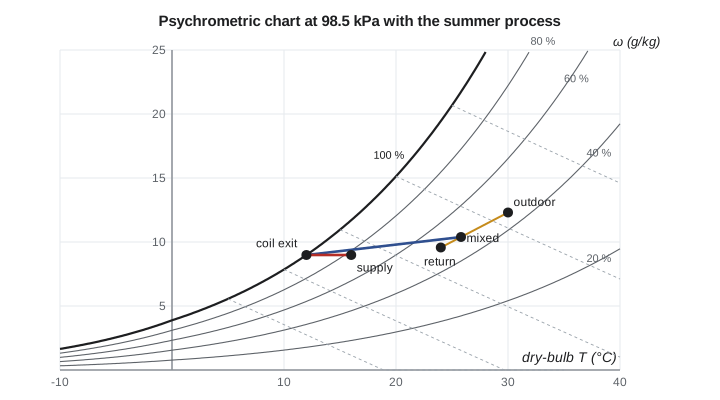
The psychrometric chart plots humidity ratio against dry-bulb temperature, with curves of constant relative humidity, lines of constant wet-bulb temperature, enthalpy and specific volume. Any two properties fix the state, and many processes are straight lines or nearly so on the chart. Simple heating or cooling without moisture change is a horizontal line. Adiabatic mixing of two streams lies on the straight line joining them, divided in inverse proportion to the dry-air flows. Evaporative cooling follows a line of nearly constant wet-bulb temperature. The chart is the air-conditioning engineer's main tool, but every chart reading comes from the equations above, which is how the program does it.
# Psychrometrics for an air-handling unit at the hospital, gas turbine inlet cooling and the cooling tower
import math
P = 98.5                                              # kPa, atmospheric pressure at the plant's elevation

def psat(T):
    """Saturation pressure of water (kPa): IAPWS auxiliary equation above 0 C, over ice below 0 C."""
    if T < 0: return 0.6112 * math.exp(22.46 * T / (272.62 + T))
    t = 1 - (T + 273.15) / 647.096
    a = (-7.85951783, 1.84408259, -11.7866497, 22.6807411, -15.9618719, 1.80122502)
    n = (1, 1.5, 3, 3.5, 4, 7.5)
    return 22064 * math.exp(647.096 / (T + 273.15) * sum(ai * t ** ni for ai, ni in zip(a, n)))

def omega(T, rh): pv = rh * psat(T); return 0.622 * pv / (P - pv)
def rh_of(T, w): return w * P / (0.622 + w) / psat(T)
def h(T, w): return 1.005 * T + w * (2501 + 1.82 * T)          # kJ/kg dry air, zero at 0 C
def dew(w):
    pv = w * P / (0.622 + w); lo, hi = -60.0, 60.0
    for _ in range(60):
        m = (lo + hi) / 2; lo, hi = (m, hi) if psat(m) < pv else (lo, m)
    return (lo + hi) / 2
def wet_bulb(T, w):
    """Adiabatic saturation temperature (close to the thermodynamic wet-bulb temperature)."""
    lo, hi = -40.0, T
    for _ in range(60):
        m = (lo + hi) / 2; ws = omega(m, 1.0)
        f = h(m, ws) - h(T, w) - (ws - w) * 4.18 * m           # energy balance with liquid water added at m
        lo, hi = (m, hi) if f < 0 else (lo, m)
    return (lo + hi) / 2

ma = 8.0                                                        # kg/s of dry air through the unit
# Winter: outdoor air -30 C, 70 % RH; heat to 22 C; steam humidify to 35 % RH
w1 = omega(-30, 0.70)
print(f"winter outdoor: w = {w1 * 1000:.3f} g/kg, RH after heating to 22 C = {rh_of(22, w1) * 100:.1f} %")
Q_heat = ma * (h(22, w1) - h(-30, w1))
w3 = omega(22, 0.35)
steam = ma * (w3 - w1)
h3 = h(22, w3); h_steam = 2676.0                                # steam at about 100 C
T3 = 22 + (ma * h(22, w1) + steam * h_steam - ma * h(22, w3)) / (ma * (1.005 + 1.82 * w3))
print(f"  heating {Q_heat:.0f} kW; steam humidifier adds {steam * 3600:.0f} kg/h (w to {w3 * 1000:.2f} g/kg); air leaves at {T3:.1f} C")

# Summer: 30 % outdoor air (30 C, 45 %) mixed with return air (24 C, 50 %); coil to 12 C saturated; reheat to 16 C
wo, wr = omega(30, 0.45), omega(24, 0.50)
x = 0.30
wm = x * wo + (1 - x) * wr; hm = x * h(30, wo) + (1 - x) * h(24, wr)
Tm = (hm - wm * 2501) / (1.005 + 1.82 * wm)
wc = omega(12, 1.0)
cond = ma * (wm - wc)
Q_coil = ma * (hm - h(12, wc)) - cond * 4.18 * 12
Q_reheat = ma * (h(16, wc) - h(12, wc))
print(f"\nsummer mix: {Tm:.1f} C, w = {wm * 1000:.2f} g/kg, dew point {dew(wm):.1f} C, wet bulb {wet_bulb(Tm, wm):.1f} C")
print(f"  coil load {Q_coil:.0f} kW, condensate {cond * 3600:.0f} kg/h, reheat {Q_reheat:.0f} kW, supply RH {rh_of(16, wc) * 100:.0f} %")

# Gas turbine inlet: evaporative cooler with 85 % effectiveness on a 30 C, 35 % day
Tw = wet_bulb(30, omega(30, 0.35))
T_out = 30 - 0.85 * (30 - Tw)
print(f"\nturbine inlet: wet bulb {Tw:.1f} C, evaporative cooler outlet {T_out:.1f} C")

# Cooling tower for the 3500 kW chiller: about 4100 kW rejected, mostly by evaporation
hfg = 2420.0
print(f"cooling tower evaporation for 4100 kW: about {4100 / hfg:.2f} kg/s ({4100 / hfg * 3.6:.1f} m3/h)")winter outdoor: w = 0.168 g/kg, RH after heating to 22 C = 1.0 % heating 418 kW; steam humidifier adds 165 kg/h (w to 5.90 g/kg); air leaves at 22.8 C summer mix: 25.8 C, w = 10.39 g/kg, dew point 14.2 C, wet bulb 18.3 C coil load 141 kW, condensate 41 kg/h, reheat 33 kW, supply RH 77 % turbine inlet: wet bulb 18.9 C, evaporative cooler outlet 20.6 C cooling tower evaporation for 4100 kW: about 1.69 kg/s (6.1 m3/h)
Winter: heating with humidification
At −30 °C and 70 percent relative humidity, the outdoor air holds only 0.168 grams of water per kilogram of dry air. Heated to 22 °C without adding water, its relative humidity falls to about 1 percent, far below the 30 to 50 percent typically maintained in hospital operating suites to control static, comfort and infection risk. The unit must add water. Steam humidifiers inject dry steam into the air stream; spray humidifiers evaporate water, which cools the air and must be made up with more heating.
Worked problem
Winter heating and steam humidification
The unit handles 8.0 kg/s of dry air drawn from outdoors at −30 °C and 70 percent relative humidity. It heats the air to 22 °C, then injects steam at about 100 °C (\(h_g = 2676\) kJ/kg) to reach 35 percent relative humidity. Find the heating load, the steam flow and the final temperature.
Show solution
- Outdoor: \(P_g = 0.038\) kPa (over ice), so \(\omega_1 = 0.622(0.70)(0.038)/(98.5 - 0.027) = 0.000168\).
- Heating: \(\dot Q = 8.0[h(22) - h(-30)] = 8.0(1.005 + 1.82\omega_1)(52) = 418\) kW.
- Target: at 22 °C, \(P_g = 2.645\) kPa, so \(\omega_3 = 0.622(0.35)(2.645)/(98.5 - 0.926) = 0.00590\).
- Steam: \(\dot m_s = 8.0(0.00590 - 0.000168) = 0.0459\) kg/s, about 165 kg/h.
- The steam brings in enthalpy \(0.0459 \times 2676 = 123\) kW but only about 115 kW is needed to vaporize water at 22 °C, so the air warms slightly, to about 22.8 °C.
Answer: Steam humidification adds almost no extra heating load; the heater could be set slightly lower. A spray humidifier would instead need about 115 kW of extra heat to evaporate the water. For a hospital running such units around the clock through a Minneapolis winter, the humidification steam alone is a significant Northgate load.
Summer: cooling and dehumidifying, then reheat
In summer, air must be cooled below its dew point so that moisture condenses on the cooling coil. The coil's outlet air is close to saturated, so the coil temperature sets the humidity ratio of the supply air. Air leaving a coil at 12 °C saturated has a humidity ratio of about 9.0 g/kg; that keeps the rooms near 50 percent relative humidity at 24 °C. Because 12 °C saturated air is uncomfortably cold and damp for some spaces, it is often reheated slightly, which hospitals can do with steam or with heat recovered from the chillers.
Worked problem
Mixing, cooling and reheat
The unit mixes 30 percent outdoor air (30 °C, 45 percent) with 70 percent return air (24 °C, 50 percent), all by dry-air mass, cools the mixture to 12 °C saturated, and reheats it to 16 °C. For 8.0 kg/s of dry air, find the mixed state, the coil load, the condensate flow and the reheat.
Show solution
- Outdoor \(\omega = 12.31\) g/kg; return \(\omega = 9.57\) g/kg. Mixed: \(\omega_m = 0.3(12.31) + 0.7(9.57) = 10.39\) g/kg; enthalpy average gives \(T_m = 25.8\) °C, dew point 14.2 °C.
- Coil exit: 12 °C saturated, \(\omega_c = 9.00\) g/kg.
- Condensate: \(8.0(0.01039 - 0.00900) = 0.0112\) kg/s, about 41 kg/h.
- Coil load: \(\dot Q = \dot m_a(h_m - h_c) - \dot m_w h_w = 141\) kW.
- Reheat: \(8.0(1.005 + 1.82 \times 0.0090)(4) = 33\) kW; supply relative humidity about 77 percent.
Answer: The cooling coil load of 141 kW includes both sensible cooling and the latent load of condensing 41 kg/h of water. Mixing in return air saves a great deal compared with 100 percent outdoor air, but some hospital spaces require all outdoor air, which raises loads sharply. The 33 kW of reheat is pure energy waste unless it comes from recovered heat, which is why designers look hard at whether it is needed.
Evaporative cooling
In dry climates, evaporating water into air cools it at nearly constant wet-bulb temperature, using little energy. An evaporative cooler's effectiveness compares the actual temperature drop with the drop to the wet-bulb temperature. Lesson 3 showed that gas turbines lose output on hot days; evaporative coolers at the turbine inlet are a common remedy.
Worked problem
Cooling the gas turbine inlet
On a 30 °C day at 35 percent relative humidity, the gas turbine's inlet air passes through an evaporative cooler with an effectiveness of 0.85. Find the air temperature leaving the cooler.
Show solution
- The program finds the wet-bulb temperature: about 18.9 °C.
- \[T_{\text{out}} = 30 - 0.85(30 - 18.9) = 20.6\ \text{°C}\]
Answer: A drop of about 9 °C would recover roughly 5 to 7 percent of the turbine's output, using the typical sensitivity of 0.5 to 0.8 percent per degree. The benefit shrinks on humid days, when the wet-bulb temperature is close to the dry-bulb temperature. In Minneapolis's climate the summer heat load is low anyway, so the team lists inlet cooling as an option to revisit only if the plant ends up selling summer power.
Cooling towers
A wet cooling tower cools water by exposing it to air, mostly by evaporation. Warm water from a chiller's condenser is sprayed over fill material while air is drawn through by fans; a small fraction evaporates, carrying away its latent heat, and the rest falls into the basin cooler. The water can approach, but not reach, the air's wet-bulb temperature. Two terms describe performance: the range, the water temperature drop through the tower, and the approach, the difference between the cold-water temperature and the inlet air's wet-bulb temperature, typically 3 to 5 K.
The mass and energy balances of the tower are a direct application of this lesson. The dry air entering and leaving is the same; the water evaporated equals the gain in the air's humidity; and the energy released by the water equals the enthalpy gained by the air. As a quick estimate, nearly all the heat rejected leaves as latent heat, so the evaporation rate is about \(\dot Q/h_{fg}\). For the 3500 kW chiller of Lesson 8, which rejects about 4.1 MW, the program estimates 1.69 kg/s, or about 6 m³ of water per hour. Towers also lose water by drift and must bleed some off as blowdown to limit dissolved solids, so makeup water is somewhat higher.
Worked problem
Cooling tower balance
Air enters a cooling tower at 30 °C dry bulb and 21 °C wet bulb (\(h_1 = 61.7\) kJ/kg dry air, \(\omega_1 = 0.0123\)) and leaves saturated at 29 °C (\(h_2 = 96.5\), \(\omega_2 = 0.0264\)). Water enters at 35 °C and leaves at 27 °C. Find the dry-air flow and the evaporation rate per kilogram per second of water entering, taking \(c_{p,w} = 4.18\) kJ/kg·K.
Show solution
- Energy: \(\dot m_a (h_2 - h_1) = \dot m_3 h_3 - (\dot m_3 - \dot m_a(\omega_2 - \omega_1))h_4\).
- With \(h_3 = 146.3\) and \(h_4 = 112.9\) kJ/kg: \(\dot m_a(34.8) = 146.3 - 112.9 + \dot m_a(0.0141)(112.9)\).
- \(\dot m_a(34.8 - 1.59) = 33.4\), so \(\dot m_a = 1.01\) kg dry air per kg of water.
- Evaporation: \(1.01(0.0264 - 0.0123) = 0.0141\) kg per kg of water entering.
Answer: About 1.4 percent of the circulating water evaporates for an 8 K range, a figure close to the rule of thumb of about 0.15 to 0.18 percent per kelvin of range. The tower moves roughly one kilogram of air for each kilogram of water.
In US practice, humidity ratio is often expressed in grains of moisture per pound of dry air (7000 grains = 1 lbm), enthalpy in Btu/lbm of dry air with dry air at 0 °F as the reference, and air flow in cubic feet per minute. The hospital's winter target of 5.90 g/kg is about 41 grains per pound. US hospital ventilation requirements are set out in ASHRAE/ASHE Standard 170.
Common mistakes
MistakeExpressing humidity per kilogram of moist air.
InsteadPsychrometric quantities are per kilogram of dry air, which is conserved through devices.
MistakeUsing a sea-level chart at altitude.
InsteadHumidity ratio depends on total pressure; use the local barometric pressure.
MistakeForgetting that cooling below the dew point condenses water.
InsteadDehumidification removes condensate; account for its enthalpy and flow.
MistakeAssuming heating changes humidity ratio.
InsteadSimple heating keeps ω constant; relative humidity falls.
MistakeExpecting a cooling tower to cool water below the wet-bulb temperature.
InsteadThe wet-bulb temperature is the lower limit; real towers approach it within a few kelvins.
Summary and key terms
- Moist air is an ideal-gas mixture of dry air and water vapor; ω = 0.622P_v/(P − P_v) and φ = P_v/P_g.
- h = 1.005T + ω(2501 + 1.82T) kJ/kg dry air with T in °C.
- Dew point is the saturation temperature at the vapor partial pressure; wet-bulb temperature approximates adiabatic saturation.
- Heating lowers relative humidity; cold-climate buildings need humidification in winter.
- Cooling below the dew point dehumidifies; reheat may follow.
- Mixing lies on a straight line on the chart; evaporative cooling follows constant wet bulb.
- Cooling towers reject heat mostly by evaporation and approach the wet-bulb temperature.
- Specific humidity
- The mass of water vapor per unit mass of dry air; also called humidity ratio or absolute humidity.
- Relative humidity
- The ratio of the vapor partial pressure to the saturation pressure at the same temperature.
- Dew-point temperature
- The temperature at which air becomes saturated when cooled at constant pressure and humidity ratio.
- Adiabatic saturation temperature
- The temperature reached when air is saturated adiabatically by water at that same temperature.
- Wet-bulb temperature
- The temperature read by a thermometer with a wet wick in moving air, close to the adiabatic saturation temperature.
- Psychrometric chart
- A chart of moist-air properties against dry-bulb temperature at a fixed pressure.
- Evaporative cooling
- Cooling air by evaporating water into it at nearly constant wet-bulb temperature.
- Cooling tower
- A device that cools water by evaporating part of it into an air stream.
- Approach
- In a cooling tower, the difference between the cold-water temperature and the inlet air wet-bulb temperature.
- Range
- In a cooling tower, the temperature drop of the water.
Practice problems
Work each problem on paper first, then reveal the answer to check.
Find ω for air at 25 °C and 60 percent relative humidity at 98.5 kPa (P_g = 3.169 kPa).
Show answer
About 12.2 g/kg.
Find the enthalpy of that air.
Show answer
About 56.3 kJ/kg dry air.
Find its dew point.
Show answer
About 16.7 °C.
In the program, change the winter target to 40 percent. What steam flow is needed?
Show answer
About 190 kg/h.
An evaporative cooler with effectiveness 0.9 treats air at 35 °C with a wet-bulb temperature of 20 °C. Find the outlet temperature.
Show answer
21.5 °C.
Estimate the evaporation from a cooling tower rejecting 2 MW.
Show answer
About 0.83 kg/s.
Lesson quiz · 5 questions
Score 60% or more to complete this lesson.
Create a free account to save your progress, take quizzes and earn a certificate.