
MEC-330 · Lesson 4 of 12 · 25 min
Jet propulsion cycles
One of the turbines on Kofi's shortlist is an aeroderivative: a power-generation machine built around the gas generator of an aircraft engine. Instead of a nozzle that turns hot gas into thrust, it has a free power turbine that turns the same gas into shaft work for a generator. Aeroderivatives are light, start in minutes and reach high efficiency at modest sizes, and much of their design comes straight from aviation. Tomás, who once wanted to work on aircraft engines, takes the chance to study the cycle they came from. This lesson follows his notes: the ideal and actual turbojet, thrust and propulsive efficiency, and why modern airliners use large turbofans.
From gas turbine to jet engine
An aircraft gas turbine runs on the Brayton cycle of Lesson 3 with one crucial difference: the turbine produces only enough work to drive the compressor and accessories. The gas leaves the turbine at a pressure well above ambient and expands in a nozzle to high velocity. The reaction to accelerating the air rearward is the thrust that pushes the aircraft forward. The components of a turbojet, in order, are
a diffuser (the inlet), which slows the incoming air relative to the engine and raises its pressure; a compressor; a combustor; a turbine that drives the compressor; and a nozzle. The stations are numbered 1 (ambient), 2 (diffuser exit), 3 (compressor exit), 4 (turbine inlet), 5 (turbine exit) and 6 (nozzle exit).
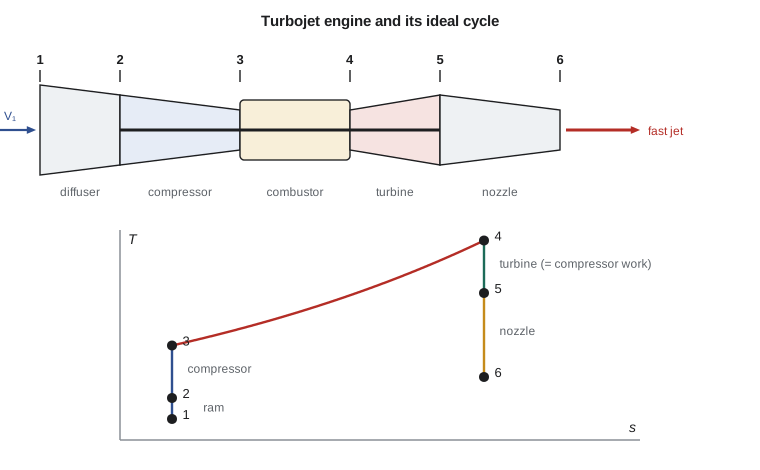
For the ideal turbojet, every process except heat addition is isentropic. In the diffuser, the air's kinetic energy relative to the engine becomes enthalpy: \(h_2 = h_1 + V_1^2/2\), so with constant specific heats \(T_2 = T_1 + V_1^2/(2c_p)\). The turbine work equals the compressor work, so \(T_4 - T_5 = T_3 - T_2\). The nozzle then accelerates the gas from nearly zero velocity at its entrance to the exit velocity
Thrust and propulsive efficiency
Applying the momentum equation to a control volume around the engine, with the nozzle expanding to ambient pressure and the small fuel mass neglected, gives the thrust
where both velocities are relative to the engine. The propulsive power is the thrust times the flight speed, \(\dot W_P = F V_{\text{aircraft}}\). Two efficiencies matter. The overall (or propulsive, in some texts) efficiency compares the propulsive power with the rate of fuel energy input:
The Froude, or propulsive, efficiency compares the propulsive power with the rate at which kinetic energy is added to the air. Kinetic energy left in the jet relative to the ground is wasted. For a single jet velocity,
This simple result drives aircraft engine design. Thrust comes from the velocity difference, but kinetic energy added to the air grows with the square of the velocity. To make a given thrust efficiently, an engine should accelerate a large mass of air by a small amount rather than a small mass by a large amount.
A turbojet at cruise
Tomás models a turbojet flying at 250 m/s near 10 km altitude, where the air is at 26.5 kPa and 223 K. The compressor pressure ratio is 12 and the turbine inlet temperature 1400 K. He first runs the ideal cycle and then an actual one with a diffuser efficiency of 0.92, a compressor efficiency of 0.85, a turbine efficiency of 0.88 and a nozzle efficiency of 0.95.
# Ideal and actual turbojet at cruise, propulsive efficiency, and the effect of bypass
cp, k = 1.005, 1.4
e = (k - 1) / k

def turbojet(V1, T1, P1, rp, T4, eta_c=1.0, eta_t=1.0, eta_n=1.0, eta_d=1.0):
    T2 = T1 + V1 ** 2 / (2 * cp * 1000)                       # stagnation temperature after the diffuser
    P2 = P1 * (1 + eta_d * (T2 - T1) / T1) ** (1 / e)          # diffuser pressure recovery
    P3 = rp * P2
    T3 = T2 * (1 + ((P3 / P2) ** e - 1) / eta_c)
    wc = cp * (T3 - T2)
    T5 = T4 - wc / cp                                         # turbine work equals compressor work
    T5s = T4 - (T4 - T5) / eta_t
    P5 = P3 * (T5s / T4) ** (1 / e)
    T6s = T5 * (P1 / P5) ** e                                  # nozzle expands to ambient pressure
    V6 = (2 * cp * 1000 * eta_n * (T5 - T6s)) ** 0.5
    qin = cp * (T4 - T3)
    return dict(T2=T2, P2=P2, T3=T3, P3=P3, T5=T5, P5=P5, V6=V6, qin=qin)

V1, T1, P1, rp, T4 = 250.0, 223.0, 26.5, 12, 1400.0     # cruise near 10 km altitude
for label, eff in (("ideal", (1, 1, 1, 1)), ("actual", (0.85, 0.88, 0.95, 0.92))):
    r = turbojet(V1, T1, P1, rp, T4, *eff)
    f = r['V6'] - V1                                       # specific thrust, N per kg/s (fuel mass neglected)
    wp = f * V1 / 1000                                     # propulsive power, kJ/kg
    print(f"{label:6s}: T2 = {r['T2']:.0f} K, P2 = {r['P2']:.1f} kPa, T3 = {r['T3']:.0f} K, T5 = {r['T5']:.0f} K,"
          f" P5 = {r['P5']:.0f} kPa, V6 = {r['V6']:.0f} m/s")
    print(f"        specific thrust = {f:.0f} N per kg/s, propulsive power = {wp:.0f} kJ/kg,"
          f" overall efficiency = {wp / r['qin']:.3f}, Froude efficiency = {2 / (1 + r['V6'] / V1):.3f}")

# Turbofan idea: the same core energy shared with a bypass stream, ideal (no losses)
r = turbojet(V1, T1, P1, rp, T4)
ke_jet = (r['V6'] ** 2 - V1 ** 2) / 2                     # J/kg of core air available as jet kinetic energy gain
print("\nshare the same jet kinetic energy among more air (bypass ratio B):")
for B in (0, 1, 3, 6, 10):
    Vj = (V1 ** 2 + 2 * ke_jet / (1 + B)) ** 0.5            # one common jet velocity
    thrust = (1 + B) * (Vj - V1)                          # N per kg/s of core air
    print(f"  B = {B:2d}: jet velocity = {Vj:4.0f} m/s, thrust per kg/s of core air = {thrust:5.0f} N,"
f" Froude efficiency = {2 / (1 + Vj / V1):.3f}")ideal : T2 = 254 K, P2 = 41.8 kPa, T3 = 517 K, T5 = 1137 K, P5 = 243 kPa, V6 = 1035 m/s
specific thrust = 785 N per kg/s, propulsive power = 196 kJ/kg, overall efficiency = 0.221, Froude efficiency = 0.389
actual: T2 = 254 K, P2 = 40.4 kPa, T3 = 563 K, T5 = 1091 K, P5 = 177 kPa, V6 = 933 m/s
specific thrust = 683 N per kg/s, propulsive power = 171 kJ/kg, overall efficiency = 0.203, Froude efficiency = 0.422
share the same jet kinetic energy among more air (bypass ratio B):
B = 0: jet velocity = 1035 m/s, thrust per kg/s of core air = 785 N, Froude efficiency = 0.389
B = 1: jet velocity = 753 m/s, thrust per kg/s of core air = 1006 N, Froude efficiency = 0.498
B = 3: jet velocity = 561 m/s, thrust per kg/s of core air = 1244 N, Froude efficiency = 0.616
B = 6: jet velocity = 455 m/s, thrust per kg/s of core air = 1432 N, Froude efficiency = 0.710
B = 10: jet velocity = 393 m/s, thrust per kg/s of core air = 1570 N, Froude efficiency = 0.778Worked problem
The ideal turbojet
Air at 26.5 kPa and 223 K enters an ideal turbojet at 250 m/s. The compressor pressure ratio is 12 and the turbine inlet temperature 1400 K. Using \(c_p = 1.005\) kJ/kg·K and \(k = 1.4\), find the pressures and temperatures, the jet velocity and the specific thrust.
Show solution
- Diffuser: \(T_2 = 223 + 250^2/(2 \times 1005) = 254.1\) K; \(P_2 = 26.5(254.1/223)^{3.5} = 41.8\) kPa.
- Compressor: \(P_3 = 12(41.8) = 501\) kPa; \(T_3 = 254.1(12)^{0.2857} = 516.8\) K.
- Turbine: \(T_5 = 1400 - (516.8 - 254.1) = 1137.3\) K; \(P_5 = 501(1137.3/1400)^{3.5} = 243\) kPa.
- Nozzle: \(T_6 = 1137.3(26.5/243)^{0.2857} = 604\) K; \(V_6 = \sqrt{2(1005)(1137.3 - 604)} = 1035\) m/s.
- \[\frac{F}{\dot m} = 1035 - 250 = 785\ \text{N per kg/s}\]
Answer: An engine swallowing 50 kg/s of air would produce about 39 kN of thrust. The Froude efficiency is only \(2/(1 + 1035/250) = 0.39\): most of the kinetic energy the engine gives the air is left behind in a jet moving at nearly 800 m/s relative to the ground. The overall efficiency is 0.22.
The actual engine produces 13 percent less thrust per unit of air flow, mainly because the inefficient compressor needs more turbine work, which leaves less pressure for the nozzle (177 kPa instead of 243 kPa at the turbine exit). Its Froude efficiency is slightly higher because the jet is slower, but its overall efficiency is lower.
Turbofans, turboprops and the bypass idea
The last block of the program takes the kinetic energy that the ideal turbojet adds to the core air and shares it with \(B\) kilograms of extra air for every kilogram through the core. With no losses in the sharing, the common jet velocity falls as \(B\) rises, the thrust per kilogram of core air rises, and the Froude efficiency climbs from 0.39 at \(B = 0\) to 0.78 at \(B = 10\). This is the principle of the turbofan engine: a large fan, driven by a low-pressure turbine, pushes bypass air around the core. Modern airliner engines have bypass ratios of roughly 9 to 12, and geared-fan designs that let the fan turn more slowly than its turbine are pushing higher. Their cruise fuel consumption is a fraction of that of the early turbojets.
A turboprop takes the idea further, driving a propeller through a gearbox and accelerating a very large mass of air by a small amount; it is the most efficient choice for speeds below about 650 km/h, which is why regional aircraft use it. At the other extreme, a ramjet has no compressor or turbine at all: at supersonic speeds, the diffuser alone produces enough pressure rise. Military fighters use low-bypass turbofans with afterburners, which burn extra fuel in the exhaust for short bursts of thrust at a high cost in efficiency.
Worked problem
Bypass and thrust for the same core
The ideal core of the previous example adds kinetic energy \((V_6^2 - V_1^2)/2\) per kilogram of core air. If that energy is shared without loss among the core air and three kilograms of bypass air per kilogram of core air, find the common jet velocity, the thrust per kg/s of core air and the Froude efficiency.
Show solution
- Energy per kg of core air: \((1035^2 - 250^2)/2 = 504{,}400\) J/kg.
- Shared among 4 kg: \(V_j^2 = 250^2 + 2(504{,}400)/4\), so \(V_j = 561\) m/s.
- Thrust: \(4(561 - 250) = 1244\) N per kg/s of core air.
- \[\eta_{\text{Froude}} = \frac{2}{1 + 561/250} = 0.62\]
Answer: The same core and the same fuel give 58 percent more thrust. Real fans and low-pressure turbines have losses that reduce the gain, and a large fan adds weight and drag, so the best bypass ratio depends on flight speed and mission.
Aeroderivatives back on the ground
An aeroderivative gas turbine for a power plant keeps the aircraft engine's core (compressor, combustor and high-pressure turbine) and replaces the fan and nozzle with a power turbine on a separate shaft that drives the generator. All of the gas's expansion is now available as shaft work. These machines bring the high pressure ratios, high turbine inlet temperatures and light weight of aviation to the ground, which gives them simple-cycle efficiencies of about 38 to 42 percent in the 30 to 60 MW class, higher than heavy industrial turbines of the same size. They also start and change load quickly, which makes them useful for following variable demand or backing up wind power. Smaller aeroderivatives exist, but in Northgate's 5 to 10 MW range most machines are industrial designs.
The thermodynamic link is direct. A turbojet's gas generator produces a stream of hot, pressurized gas; whether that gas leaves through a nozzle as thrust or through a power turbine as shaft work, the same Brayton-cycle reasoning predicts how much useful energy it carries. Tomás's model of the ideal turbojet's gas generator shows a gas power, the enthalpy drop available below the turbine exit state, of about \(c_p(T_5 - T_6) = 536\) kJ per kilogram of air. A free power turbine with an isentropic efficiency of 0.9 would turn about 480 kJ/kg of it into shaft work, close to the net work of an ideal Brayton cycle with the same overall pressure ratio.
The environmental side of jet propulsion
Aviation's climate effects come from carbon dioxide and also from nitrogen oxides at altitude and contrails, which make its total warming effect larger than its carbon dioxide alone. Engine makers attack fuel burn through higher bypass ratios, higher overall pressure ratios (now above 40 in large engines) and higher turbine inlet temperatures, and combustor designers work to lower nitrogen oxides. Sustainable aviation fuels made from biomass or waste can be blended with conventional jet fuel; the cycle analysis is unchanged, because it depends only on the heat released.
Tomás notes one local connection: aeroderivative units are common in US peaking plants and on offshore platforms, and many airline engine overhaul shops also service industrial versions of the same engine families. Skills in gas turbine thermodynamics transfer between the two.
For US customary units, thrust is quoted in pounds-force (1 lbf = 4.448 N) and specific thrust in lbf per lbm/s; the 785 N per kg/s of the ideal example is about 80 lbf per lbm/s, because 1 N per kg/s is 0.102 lbf per lbm/s. Thrust-specific fuel consumption is quoted in lbm of fuel per hour per lbf of thrust; modern high-bypass engines at cruise are near 0.5 lbm/(lbf·h). In the energy equation, remember \(g_c\): \(V^2/(2 g_c)\) in ft²/s² divided by 25,037 gives Btu/lbm.
Common mistakes
MistakeTreating the turbine of a turbojet as producing net shaft work.
InsteadIn a turbojet the turbine drives only the compressor; the nozzle produces the thrust.
MistakeForgetting the diffuser's temperature and pressure rise.
InsteadAt flight speed, ram compression raises T₂ by V²/(2c_p) before the compressor.
MistakeUsing absolute jet velocity in the thrust equation.
InsteadThrust uses velocities relative to the engine: F = ṁ(V_exit − V_inlet).
MistakeAssuming a faster jet is always better.
InsteadThrust rises with velocity difference, but wasted kinetic energy rises with its square.
MistakeConfusing overall efficiency with Froude efficiency.
InsteadOverall efficiency compares propulsive power with fuel energy; Froude compares it with kinetic energy added.
Summary and key terms
- A turbojet is a Brayton cycle whose turbine drives only the compressor; the nozzle turns the remaining enthalpy into jet velocity.
- Diffuser: T₂ = T₁ + V₁²/(2c_p); turbine: T₄ − T₅ = T₃ − T₂; nozzle: V₆ = √(2c_p(T₅ − T₆)).
- Thrust F = ṁ(V_exit − V_inlet); propulsive power = F·V.
- Froude efficiency = 2/(1 + V_exit/V): accelerate much air a little, not little air a lot.
- Turbofans with high bypass ratios and turboprops achieve high propulsive efficiency at subsonic speeds.
- Aeroderivative gas turbines replace the nozzle with a free power turbine for shaft power.
- Turbojet
- A jet engine in which all the air passes through the compressor, combustor and turbine before the nozzle.
- Diffuser
- The inlet that slows incoming air and raises its pressure (ram compression).
- Nozzle
- A duct that accelerates gas by converting enthalpy into kinetic energy.
- Thrust
- The propulsive force from accelerating air rearward, F = ṁ(V_exit − V_inlet).
- Propulsive power
- Thrust multiplied by flight speed.
- Froude efficiency
- The ratio of propulsive power to the rate of kinetic energy added to the air.
- Turbofan
- A jet engine with a fan that drives bypass air around the core.
- Bypass ratio
- The mass flow of bypass air divided by the mass flow through the core.
- Turboprop
- A gas turbine that drives a propeller through a gearbox.
- Aeroderivative
- A power-generation gas turbine built from an aircraft engine core.
Practice problems
Work each problem on paper first, then reveal the answer to check.
Find the diffuser exit temperature for flight at 300 m/s in air at 220 K.
Show answer
About 265 K.
An engine has a specific thrust of 600 N per kg/s and an air flow of 80 kg/s. Find the thrust.
Show answer
48 kN.
Find the Froude efficiency for a jet velocity of 600 m/s at a flight speed of 240 m/s.
Show answer
0.571.
In the program, raise the turbine inlet temperature to 1500 K. What is the ideal specific thrust?
Show answer
About 839 N per kg/s.
Why does a turbojet's turbine exit pressure exceed ambient pressure?
Show answer
The turbine extracts only the compressor work; the remaining pressure ratio is used by the nozzle.
With a bypass ratio of 6, how much more thrust does the ideal example give than the turbojet?
Show answer
About 82 percent more (1432 versus 785 N per kg/s of core air).
Lesson quiz · 5 questions
Score 60% or more to complete this lesson.
Create a free account to save your progress, take quizzes and earn a certificate.