
MEC-330 · Lesson 12 of 12 · 33 min
Combustion and the capstone plant
Every cycle in this course has started with heat added, and at Northgate that heat comes from burning natural gas. This final lesson replaces the abstract heat input with the chemistry and thermodynamics of combustion: how much air a fuel needs, what the products are, how much energy the reaction releases, how hot the flame can get and where a boiler's losses go. It then brings the whole study together. Elena's report to Northgate's owners must compare the options of Lessons 1 to 11 on fuel, electricity, heat and emissions, and the combustion analysis supplies the last numbers it needs.
Fuels and combustion reactions
Combustion is a rapid chemical reaction of a fuel with oxygen. Natural gas is mostly methane, \(\text{CH}_4\); for most purposes Northgate's gas can be modeled as methane, with corrections for its small fractions of heavier hydrocarbons, nitrogen and carbon dioxide (Lesson 10). The oxygen comes from air, which for combustion work is taken as 21 percent oxygen and 79 percent nitrogen by moles, so each kilomole of oxygen comes with 3.76 kmol of nitrogen. Nitrogen does not react significantly, but it absorbs heat and leaves with the products.
A chemical equation balances atoms, not moles: the moles of reactants and products need not be equal. The minimum air that supplies enough oxygen to burn the fuel completely is the stoichiometric or theoretical air. For methane,
Real burners supply excess air to make sure every fuel molecule finds oxygen. Boilers typically run at 10 to 20 percent excess air; gas turbines run at 200 percent or more to keep the turbine inlet temperature within limits. The air-fuel ratio on a mass basis is
With too little air, combustion is incomplete and the products contain carbon monoxide, hydrogen and unburned hydrocarbons, a waste of fuel and a safety hazard. Flue-gas analyzers measure oxygen and carbon monoxide continuously so that operators can trim the air to the lowest excess that keeps carbon monoxide low.
Enthalpy of formation and heating values
To apply the first law to a reacting system, enthalpies of different substances must share a common reference. The enthalpy of formation, \(\bar h_f^\circ\), is the enthalpy of a compound at the standard reference state of 25 °C and 1 atm relative to its elements, which are assigned zero enthalpy in their stable forms. Values for common substances include \(-74{,}850\) kJ/kmol for methane, \(-393{,}520\) for carbon dioxide, \(-241{,}820\) for water vapor and \(-285{,}830\) for liquid water. The enthalpy of each substance at any state is its enthalpy of formation plus its sensible enthalpy change from 25 °C:
For a steady-flow combustion chamber with no work and negligible kinetic and potential energy changes, the first law becomes
When reactants and products are both at 25 °C and combustion is complete, the heat released is the heating value. It is the higher heating value (HHV) if the water in the products is liquid and the lower heating value (LHV) if it is vapor; the difference is the latent heat of the water formed. For methane, the HHV is 890,330 kJ/kmol (55.5 MJ/kg) and the LHV 802,310 kJ/kmol (50.0 MJ/kg). Efficiencies of engines and turbines are usually quoted on the LHV; boilers, especially condensing ones, are often quoted on the HHV. Always state which.
# Combustion of natural gas at Northgate, flame temperature, boiler losses and the capstone comparison
import math
M = {'CH4': 16.04, 'CO2': 44.01, 'H2O': 18.02, 'O2': 32.00, 'N2': 28.01}
hf = {'CH4': -74850, 'CO2': -393520, 'H2O(g)': -241820, 'H2O(l)': -285830}      # kJ/kmol at 25 C
fit = {'N2': (28.90, -0.1571e-2, 0.8081e-5, -2.873e-9), 'O2': (25.48, 1.520e-2, -0.7155e-5, 1.312e-9),
       'CO2': (22.26, 5.981e-2, -3.501e-5, 7.469e-9), 'H2O': (32.24, 0.1923e-2, 1.055e-5, -3.595e-9)}
def dh(s, T, T0=298.15):
    a, b, c, d = fit[s]
    F = lambda t: a * t + b * t ** 2 / 2 + c * t ** 3 / 3 + d * t ** 4 / 4
    return F(T) - F(T0)                                                         # kJ/kmol

def products(excess):
    """CH4 + (1 + excess) 2 (O2 + 3.76 N2) -> CO2 + 2 H2O + excess*2 O2 + N2, kmol per kmol of fuel."""
    a = 2 * (1 + excess)
    return {'CO2': 1, 'H2O': 2, 'O2': a - 2, 'N2': 3.76 * a}, a

P, af_st = None, 2 * 4.76 * 28.97 / M['CH4']
print(f"stoichiometric air-fuel ratio = {af_st:.2f} kg air per kg CH4")
HHV = -(hf['CO2'] + 2 * hf['H2O(l)'] - hf['CH4']); LHV = -(hf['CO2'] + 2 * hf['H2O(g)'] - hf['CH4'])
print(f"HHV = {HHV:.0f} kJ/kmol = {HHV / M['CH4']:.0f} kJ/kg; LHV = {LHV:.0f} kJ/kmol = {LHV / M['CH4']:.0f} kJ/kg")

def flame(excess, T_air=298.15):
    prod, a = products(excess)
    supply = a * (dh('O2', T_air) + 3.76 * dh('N2', T_air))                    # preheated air, if any
    lo, hi = 300.0, 3500.0
    for _ in range(60):
        T = (lo + hi) / 2
        H = sum(n * dh(s, T) for s, n in prod.items())
        lo, hi = (T, hi) if H < LHV + supply else (lo, T)
    return T

print("\nadiabatic flame temperature, fuel and air at 25 C (cubic cp fits, extrapolated above about 1800 K):")
for ex in (0.0, 0.15, 0.5, 1.0, 2.0):
    print(f"  {int(ex * 100):3d} % excess air: {flame(ex):5.0f} K")

# Boiler with 15 % excess air: dew point and stack losses (LHV basis, per kmol of fuel)
prod, a = products(0.15)
n = sum(prod.values())
pv = prod['H2O'] / n * 98.5
lo, hi = 20.0, 100.0
for _ in range(50):
    m = (lo + hi) / 2
    t = 1 - (m + 273.15) / 647.096
    ps = 22064 * math.exp(647.096 / (m + 273.15) * (-7.85951783 * t + 1.84408259 * t ** 1.5 - 11.7866497 * t ** 3
                                                     + 22.6807411 * t ** 3.5 - 15.9618719 * t ** 4 + 1.80122502 * t ** 7.5))
    lo, hi = (m, hi) if ps < pv else (lo, m)
print(f"\n15 % excess air: H2O mole fraction {prod['H2O'] / n:.3f}, dew point {m:.1f} C")
for T_stack in (160, 120):
    loss = sum(k * dh(s, T_stack + 273.15) for s, k in prod.items())
    print(f"  stack at {T_stack} C: dry-gas and water loss {loss / LHV * 100:4.1f} % of LHV -> efficiency about {100 - loss / LHV * 100 - 1.5:.1f} % (1.5 % other losses)")

# Gas turbine combustor: fuel-air ratio to heat compressed air from 693 K to 1400 K (lean, per kmol fuel)
lo, hi = 0.5, 10.0
for _ in range(60):
    ex = (lo + hi) / 2
    T = flame(ex, 693.0)
    lo, hi = (ex, hi) if T > 1400 else (lo, ex)
a = 2 * (1 + ex)
print(f"\ncombustor: excess air {ex * 100:.0f} %, fuel-air ratio {M['CH4'] / (a * 4.76 * 28.97):.4f} kg/kg")

# Capstone: duct-fired CHP for 5000 h a year against boilers plus grid electricity
hours, fuel, power, heat = 5000, 24.2, 7.33, 12.9          # MW
ef_gas = 44.01 / (LHV / 1000) * 3.6                          # kg CO2 per kWh of fuel (LHV)
ef_grid = 0.35                                           # kg CO2 per kWh, Minnesota grid (study assumption)
chp = fuel * hours * 1000 * ef_gas / 1000
sep = (heat / 0.85 * ef_gas + power * ef_grid) * hours * 1000 / 1000
print(f"\ngas: {ef_gas:.3f} kg CO2 per kWh of fuel; grid: {ef_grid} kg/kWh")
print(f"CHP: fuel {fuel * hours / 1000:.0f} GWh/yr, CO2 {chp:,.0f} t/yr")
print(f"boilers + grid: fuel {heat / 0.85 * hours / 1000:.0f} GWh/yr of gas, CO2 {sep:,.0f} t/yr")
print(f"difference (CHP minus separate): {chp - sep:+,.0f} t CO2 per year")

# Alternative: a 5 MW heat pump (COP 2.5) on a hot-water extension, displacing boiler heat for 5000 h
hp_heat, cop = 5.0, 2.5
saved = hp_heat / 0.85 * hours * 1000 * ef_gas / 1000
added = hp_heat / cop * hours * 1000 * ef_grid / 1000
print(f"heat pump: boiler CO2 avoided {saved:,.0f} t, grid CO2 added {added:,.0f} t, net {added - saved:+,.0f} t per year")stoichiometric air-fuel ratio = 17.19 kg air per kg CH4
HHV = 890330 kJ/kmol = 55507 kJ/kg; LHV = 802310 kJ/kmol = 50019 kJ/kg
adiabatic flame temperature, fuel and air at 25 C (cubic cp fits, extrapolated above about 1800 K):
0 % excess air: 2345 K
15 % excess air: 2133 K
50 % excess air: 1788 K
100 % excess air: 1480 K
200 % excess air: 1138 K
15 % excess air: H2O mole fraction 0.167, dew point 55.9 C
stack at 160 C: dry-gas and water loss 6.2 % of LHV -> efficiency about 92.3 % (1.5 % other losses)
stack at 120 C: dry-gas and water loss 4.4 % of LHV -> efficiency about 94.1 % (1.5 % other losses)
combustor: excess air 228 %, fuel-air ratio 0.0177 kg/kg
gas: 0.197 kg CO2 per kWh of fuel; grid: 0.35 kg/kWh
CHP: fuel 121 GWh/yr, CO2 23,894 t/yr
boilers + grid: fuel 76 GWh/yr of gas, CO2 27,812 t/yr
difference (CHP minus separate): -3,918 t CO2 per year
heat pump: boiler CO2 avoided 5,808 t, grid CO2 added 3,500 t, net -2,308 t per yearWorked problem
Stoichiometric air and heating values
Find the stoichiometric air-fuel ratio for methane and its higher and lower heating values per kilogram.
Show solution
- Air per kmol of fuel: \(2(4.76) = 9.52\) kmol; \(\text{AF} = 9.52(28.97)/16.04 = 17.19\) kg/kg.
- HHV: \(-[-393{,}520 + 2(-285{,}830) - (-74{,}850)] = 890{,}330\) kJ/kmol, or \(890{,}330/16.04 = 55{,}510\) kJ/kg.
- LHV: \(-[-393{,}520 + 2(-241{,}820) - (-74{,}850)] = 802{,}310\) kJ/kmol, or 50,020 kJ/kg.
Answer: The two values differ by 10 percent, the latent heat of 2 kmol of water per kmol of methane. Fuels with more hydrogen, such as hydrogen itself, have larger differences; coal has smaller ones.
Adiabatic flame temperature
If the combustion chamber is adiabatic and does no work, all the chemical energy released goes into heating the products, which reach the adiabatic flame temperature. It is found by setting the enthalpy of the products equal to that of the reactants and solving for the temperature, usually by iteration, as the program does. It is the highest temperature combustion can reach for a given fuel, air supply and inlet temperature, and it falls as excess air dilutes the products.
Worked problem
Flame temperature and excess air
Methane burns with air, both entering at 25 °C. Using temperature-dependent specific heats for the products, find the adiabatic flame temperature for stoichiometric air and for the 15 percent excess air of Northgate's boilers.
Show solution
- Products per kmol of methane at 15 percent excess: 1 \(\text{CO}_2\), 2 \(\text{H}_2\text{O}\), 0.30 \(\text{O}_2\), 8.65 \(\text{N}_2\).
- The program solves \(\sum N_p (\bar h - \bar h^\circ)_p = \text{LHV}\) for the product temperature.
- Stoichiometric: about 2345 K. With 15 percent excess air: about 2133 K.
Answer: Tabulated values for stoichiometric methane-air flames are a little lower, near 2220 to 2330 K, because at such temperatures some carbon dioxide and water dissociate, absorbing energy, and because the specific-heat fits used here are extrapolated beyond about 1800 K. With 100 percent excess air the flame temperature falls to about 1480 K and with 200 percent to about 1140 K, close to gas turbine inlet temperatures. Real flames also lose heat by radiation, so measured furnace temperatures are lower still.
The same calculation fixes a gas turbine's fuel flow. Air leaves the candidate turbine's compressor at 693 K (Lesson 3). The program finds that heating it to 1400 K takes about 228 percent excess air, a fuel-air ratio of 0.0177. The fuel adds about 1.8 percent to the mass flow through the turbine, confirming the estimate of Lesson 3, and the exhaust still holds about two thirds of the oxygen supplied, which is what makes the duct burner of Lesson 7 possible.
Dew point and boiler losses
With 15 percent excess air, the products of methane combustion are 16.7 percent water vapor by moles. At 98.5 kPa the partial pressure of the vapor is 16.4 kPa, and its saturation temperature, the flue gas dew point, is about 56 °C. A conventional boiler keeps its flue gas well above that, at 120 to 200 °C, and loses both the sensible heat of the hot gas and the entire latent heat of the vapor. A condensing boiler or condensing economizer cools the flue gas below the dew point using cold return water, recovering much of the latent heat. That is how condensing boilers exceed 90 percent on the HHV basis and appear to exceed 100 percent on the LHV basis.
Worked problem
Stack loss
Northgate's boilers run at 15 percent excess air with the flue gas leaving at 160 °C. Using the sensible enthalpy of the products relative to 25 °C, find the stack loss as a fraction of the LHV and the boiler's efficiency on the LHV basis, allowing 1.5 percent for radiation and other losses.
Show solution
- Product sensible enthalpy at 433 K, from the program: about 6.2 percent of the LHV.
- Efficiency on LHV: \(100 - 6.2 - 1.5 = 92.3\) percent.
- On the HHV basis: \(92.3 \times 50.02/55.51 = 83.2\) percent.
Answer: Lowering the stack to 120 °C with a better economizer would gain about 1.8 points. Cooling it to 40 to 50 °C in a condensing economizer, possible only if cold water is available, would recover a large part of the latent heat as well. The 85 percent used in earlier lessons is a reasonable seasonal figure on an HHV-like basis once part-load, cycling and blowdown losses are included.
Exergy analysis from Lesson 1 completes the picture. The stack loss is small in exergy terms, because the flue gas is only moderately hot. The large exergy destruction happens in the flame, where fuel and oxygen react unrestrained and the products are created at about 2100 K and then cooled in contact with water at 250 °C. Combustion destroys roughly 25 to 30 percent of the fuel's exergy even before any heat transfer, which is the fundamental reason why fuel cells, which convert chemical energy directly to electricity, and topping cycles such as gas turbines are attractive.
The capstone: comparing Northgate's options
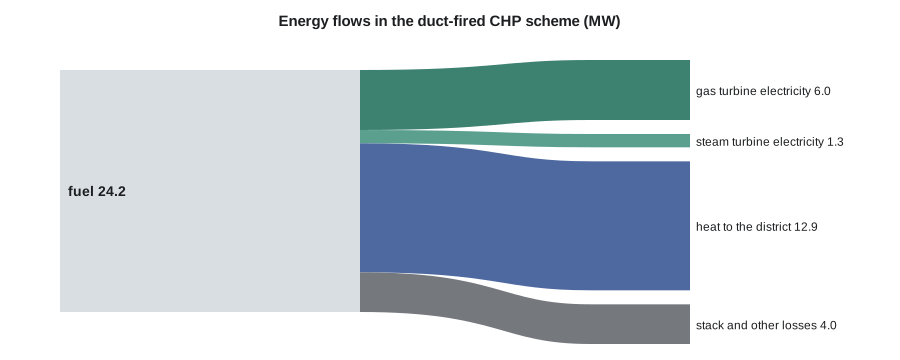
Elena's team now has every number it needs. The base case is today's plant: boilers making all the heat, electricity bought from the grid. The main alternative is the duct-fired CHP scheme of Lesson 7, running 5000 hours a year at 24.2 MW of fuel, 7.33 MW of electricity and 12.9 MW of heat. The other options, the summer condensing turbine (Lesson 5), district cooling with electric or absorption chillers (Lessons 8 and 9), a large heat pump on a hot-water extension (Lesson 8), biogas (Lesson 10) and better combustion control (this lesson), fill in around it. The last part of the program compares annual carbon dioxide emissions for the CHP scheme and for a 5 MW heat pump, using an emission factor for natural gas of 0.197 kg of carbon dioxide per kilowatt-hour of fuel (LHV) and a study assumption for the grid.
For the Minnesota grid, the team assumes an average emission factor of 0.35 kg/kWh, reflecting a mix of coal, gas, nuclear, wind and solar; a more detailed study would use hourly marginal emission rates.
Worked problem
Annual emissions: CHP against separate production
Compare annual carbon dioxide emissions for 5000 hours of CHP operation with producing the same 12.9 MW of heat in 85 percent boilers and buying the same 7.33 MW of electricity from the Minnesota grid at 0.35 kg/kWh.
Show solution
- CHP: \(24.2 \times 5000 = 121{,}000\) MWh of fuel \(\times 0.197 = 23{,}890\) t/yr.
- Boilers: \((12.9/0.85) \times 5000 = 75{,}900\) MWh of fuel \(\times 0.197 = 14{,}980\) t/yr.
- Grid: \(7.33 \times 5000 = 36{,}650\) MWh \(\times 0.35 = 12{,}830\) t/yr; separate total about 27,810 t/yr.
- Difference: CHP emits about 3,900 t/yr less.
Answer: On Minnesota's grid, CHP cuts emissions by about 3,900 t/yr as well as saving fuel, because it displaces electricity that is partly fossil-fired. The heat pump case in the program also cuts emissions, by about 2,300 t/yr: it avoids 5,800 t/yr of boiler emissions and adds 3,500 t/yr on the grid. As the grid adds more wind, solar and storage, the heat pump's advantage grows and the CHP plant's shrinks.
Elena's recommendations
The report Elena sends to the owners draws on every lesson. Exergy analysis (Lesson 1) shows that boilers waste most of the fuel's work potential and that the PRV should be used as little as possible. A gas turbine with a duct-fired HRSG (Lessons 3 and 7) saves fuel and, on today's Minnesota grid, about 3,900 metric tons of carbon dioxide a year, and it improves resilience by letting Northgate run in a grid outage. The team recommends building it, sized for the base heat load, together with better air-fuel control and a condensing economizer on the boilers (this lesson) and a district cooling loop with electric chillers using a low-GWP refrigerant and free cooling in the shoulder seasons (Lessons 8 and 11). A heat pump on the wastewater effluent feeding a new hot-water branch is the next step, and its case strengthens as the grid's emissions fall. Absorption chillers make sense only if the CHP plant runs in summer with spare exhaust heat (Lesson 9), and the condensing turbine is not recommended. The long-term plan should convert the network from steam to hot water building by building.
Graham reads the report twice and says it is the first study he has seen that explains why, not just what. Kofi points out that every recommendation could change if gas prices, electricity prices or emission rules change, which is why the report includes the programs behind its numbers so that the owners can rerun them. Tomás heads back to university for his final year with a clear view of how the thermodynamics he studied turns into decisions about a city's energy.
The course in one plant
Looking back, the course has covered the main tools of engineering thermodynamics beyond the first course: exergy and second-law efficiency; the Otto, Diesel, Brayton and jet propulsion cycles; the Rankine cycle and its reheat, regenerative and supercritical forms; cogeneration and combined cycles; vapor-compression, gas and absorption refrigeration and heat pumps; ideal-gas mixtures; psychrometrics; and combustion. Each is a model, built on the first and second laws and on property data, and each model is useful exactly to the extent that its assumptions match the plant. Heat transfer, fluid mechanics and energy-systems design build on this foundation.
In US practice, combustion calculations often use lbmol and Btu: the HHV of methane is about 23,900 Btu/lbm and the LHV about 21,500 Btu/lbm. EPA's emission factor for natural gas is about 53 kg of CO2 per million Btu (HHV), or 117 lb/MMBtu, consistent with the 0.197 kg/kWh (LHV) used here.
Common mistakes
MistakeBalancing moles instead of atoms in a combustion equation.
InsteadAtoms are conserved; total moles may change.
MistakeForgetting the nitrogen that comes with the oxygen.
InsteadEach kmol of O₂ in air brings 3.76 kmol of N₂, which must be heated.
MistakeQuoting an efficiency without saying HHV or LHV.
InsteadState the basis; they differ by about 10 percent for natural gas.
MistakeExpecting the adiabatic flame temperature in a real furnace.
InsteadHeat loss, dissociation and excess air lower actual temperatures.
MistakeJudging CHP only by fuel saved.
InsteadIts emissions effect depends on the electricity it displaces.
Summary and key terms
- Stoichiometric air supplies just enough oxygen for complete combustion; real burners use excess air.
- Air is modeled as O₂ + 3.76 N₂; for methane the stoichiometric air-fuel ratio is 17.2.
- Enthalpy of formation provides a common reference for reacting systems.
- HHV includes the latent heat of product water; LHV does not; for methane they are 55.5 and 50.0 MJ/kg.
- The adiabatic flame temperature falls as excess air rises.
- Flue gas dew point sets the limit for condensing heat recovery.
- Northgate's best option depends on its grid: CHP where grid power is fossil-fired, heat pumps where it is clean.
- Stoichiometric air
- The minimum air that supplies enough oxygen for complete combustion.
- Excess air
- Air supplied beyond the stoichiometric amount, expressed as a percentage of it.
- Air-fuel ratio
- The mass of air supplied per unit mass of fuel.
- Enthalpy of formation
- The enthalpy of a compound at 25 °C and 1 atm relative to its elements.
- Heating value
- The heat released by complete combustion with reactants and products at 25 °C.
- Higher heating value
- The heating value with the water in the products condensed to liquid.
- Lower heating value
- The heating value with the water in the products remaining as vapor.
- Adiabatic flame temperature
- The temperature of the products of combustion in an adiabatic chamber with no work.
- Dissociation
- The breaking of combustion products such as CO₂ and H₂O into simpler species at high temperature.
- Condensing economizer
- A heat exchanger that cools flue gas below its dew point to recover latent heat.
Practice problems
Work each problem on paper first, then reveal the answer to check.
Find the air-fuel ratio for methane with 15 percent excess air.
Show answer
About 19.8 kg/kg.
Propane, C₃H₈, burns with stoichiometric air. How many kmol of air per kmol of fuel?
Show answer
23.8 (5 kmol O₂ × 4.76).
Find the HHV of propane from h_f° = −103,850 kJ/kmol.
Show answer
About 2,220,000 kJ/kmol (50.3 MJ/kg).
In the program, what is the adiabatic flame temperature with 50 percent excess air?
Show answer
About 1790 K.
What is the dew point of the products of stoichiometric methane combustion at 98.5 kPa?
Show answer
About 58 to 59 °C.
In the program, change the CHP hours to 3000. What is the CO₂ difference?
Show answer
About −2,350 t/yr.
Lesson quiz · 5 questions
Score 60% or more to complete this lesson.
Create a free account to save your progress, take quizzes and earn a certificate.