
MEC-330 · Lesson 10 of 12 · 29 min
Ideal-gas mixtures
Up to now we have treated the working fluids of gas cycles as air and the fuel as a single number, the heat added. Real plants handle mixtures everywhere. The natural gas Northgate buys is mostly methane with some ethane, propane, nitrogen and carbon dioxide. The wastewater plant next door produces biogas, roughly 60 percent methane and 40 percent carbon dioxide, and would like to sell it to Northgate. The gas turbine's exhaust, which the HRSG of Lesson 7 cools, is a mixture of nitrogen, oxygen, carbon dioxide, water vapor and argon. And any plan to capture carbon dioxide from the stack starts from the thermodynamics of separating one gas from a mixture. This lesson develops the tools: how to describe a mixture's composition, how to find its properties from those of its components, and what mixing and separating do to entropy and exergy.
Describing a mixture
A mixture of \(k\) components can be described by mass or by moles. The mass fraction of component \(i\) is \(mf_i = m_i/m_m\) and its mole fraction is \(y_i = N_i/N_m\); each set sums to one. The apparent (or average) molar mass and gas constant of the mixture are
and mass and mole fractions are related by \(mf_i = y_i M_i/M_m\). Gas compositions are usually reported by volume, which for ideal gases is the same as by moles, as the next section shows. Gas analyzers that measure flue gas on a dry basis report the composition after the water vapor has been removed, which matters in combustion calculations (Lesson 12).
Dalton's and Amagat's laws
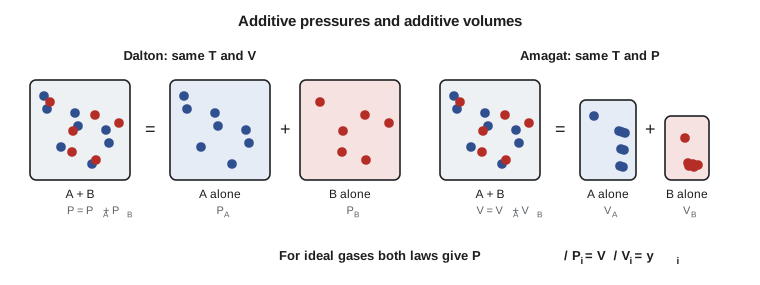
Two models predict how the components of a mixture share pressure and volume. Dalton's law of additive pressures says that the mixture pressure equals the sum of the pressures each component would exert if it existed alone at the mixture temperature and volume. Amagat's law of additive volumes says that the mixture volume equals the sum of the volumes each component would occupy alone at the mixture temperature and pressure. For ideal gases both are exact, and both lead to the same simple result:
The ratio \(P_i/P_m\) is the pressure fraction and \(P_i\) is the partial pressure of component \(i\); \(V_i/V_m\) is the volume fraction. For real gases at high pressure the two laws give different answers, and neither is exact. A simple fix is Kay's rule, which treats the mixture as a pseudo-pure substance with a pseudocritical temperature and pressure equal to the mole-fraction-weighted averages of the components' critical properties, then reads the compressibility factor from the generalized chart. For the pressures in Northgate's gas supply, a few hundred kilopascals to a few megapascals at ordinary temperatures, the ideal-gas model is adequate.
Properties of ideal-gas mixtures
Because the molecules of ideal gases do not interact, each component behaves as if it alone occupied the mixture's volume at the mixture temperature. Extensive properties therefore add: the mixture's internal energy, enthalpy and entropy are sums of the components' values, each evaluated at the mixture temperature and the component's own partial pressure. Per unit mass or per mole,
Internal energy and enthalpy of an ideal gas depend on temperature only, so partial pressure does not matter for them. Entropy depends on pressure, and here partial pressure is essential:
Northgate's fuel gas and biogas
Tomás applies these ideas to the gas Northgate burns and to the biogas the wastewater plant offers. The program finds the pipeline gas's molar mass, gas constant and mass fractions, its higher heating value per cubic meter, its specific gravity relative to air and its Wobbe index, then repeats the calculation for blends with biogas. It goes on to the gas turbine exhaust and to carbon dioxide separation.
# Ideal-gas mixtures at Northgate: pipeline gas, biogas blends, turbine exhaust and the minimum work of CO2 capture
import math
Ru = 8.314                                          # kJ/kmol K
M = {'CH4': 16.04, 'C2H6': 30.07, 'C3H8': 44.10, 'N2': 28.01, 'CO2': 44.01, 'O2': 32.00, 'H2O': 18.02, 'Ar': 39.95}
HHV = {'CH4': 890.3, 'C2H6': 1559.9, 'C3H8': 2219.9}   # MJ/kmol, products at 25 C with liquid water
gas = {'CH4': 0.950, 'C2H6': 0.025, 'C3H8': 0.003, 'N2': 0.015, 'CO2': 0.007}
biogas = {'CH4': 0.62, 'CO2': 0.37, 'N2': 0.01}

def blend(a, b, frac_b):
    return {s: (1 - frac_b) * a.get(s, 0) + frac_b * b.get(s, 0) for s in set(a) | set(b)}

def props(y):
    Mm = sum(y[s] * M[s] for s in y)
    hhv_mol = sum(y[s] * HHV.get(s, 0) for s in y)
    hhv_vol = hhv_mol / 23.645                        # MJ/m3 at 15 C and 101.325 kPa (23.645 m3/kmol)
    sg = Mm / 28.97
    return Mm, Ru / Mm, hhv_vol, sg, hhv_vol / math.sqrt(sg)

y = gas
Mm, R, hv, sg, wobbe = props(y)
print(f"pipeline gas: M = {Mm:.2f} kg/kmol, R = {R:.4f} kJ/kg K, HHV = {hv:.2f} MJ/m3, SG = {sg:.3f}, Wobbe = {wobbe:.1f} MJ/m3")
print("  mass fractions: " + ", ".join(f"{s} {y[s] * M[s] / Mm:.3f}" for s in y))
for f in (0.1, 0.2, 0.3):
    Mm, R, hv, sg, wobbe = props(blend(gas, biogas, f))
    print(f"  {int(f * 100)} % biogas by volume: HHV = {hv:.2f} MJ/m3, SG = {sg:.3f}, Wobbe = {wobbe:.1f} MJ/m3")

# Gas turbine exhaust (mole fractions) and its specific heat from cubic fits, kJ/kmol K
ex = {'N2': 0.751, 'O2': 0.130, 'CO2': 0.035, 'H2O': 0.075, 'Ar': 0.009}
fit = {'N2': (28.90, -0.1571e-2, 0.8081e-5, -2.873e-9), 'O2': (25.48, 1.520e-2, -0.7155e-5, 1.312e-9),
       'CO2': (22.26, 5.981e-2, -3.501e-5, 7.469e-9), 'H2O': (32.24, 0.1923e-2, 1.055e-5, -3.595e-9), 'Ar': (20.79, 0, 0, 0)}
def cp_mol(s, T): a, b, c, d = fit[s]; return a + b * T + c * T ** 2 + d * T ** 3
Mex = sum(ex[s] * M[s] for s in ex)
for T in (400, 600, 700):
    cp = sum(ex[s] * cp_mol(s, T) for s in ex) / Mex
    print(f"exhaust at {T} K: M = {Mex:.2f}, cp = {cp:.3f} kJ/kg K")
print(f"partial pressure of water in the exhaust at 101 kPa: {0.075 * 101:.1f} kPa")

# Minimum work to separate CO2 completely from a mixture at T0 (per kmol of CO2 captured)
T0 = 298.15
for label, yc in (("air (420 ppm)", 0.00042), ("gas turbine exhaust", 0.035), ("gas boiler flue gas", 0.09), ("cement kiln gas", 0.20)):
    w = -Ru * T0 * (math.log(yc) + (1 - yc) / yc * math.log(1 - yc))
print(f" {label:20s} y = {yc:<7}: minimum work = {w / 1000:5.2f} MJ/kmol = {w / M['CO2']:5.0f} kJ/kg CO2")pipeline gas: M = 16.85 kg/kmol, R = 0.4934 kJ/kg K, HHV = 37.70 MJ/m3, SG = 0.582, Wobbe = 49.4 MJ/m3 mass fractions: CH4 0.904, C2H6 0.045, C3H8 0.008, N2 0.025, CO2 0.018 10 % biogas by volume: HHV = 36.27 MJ/m3, SG = 0.615, Wobbe = 46.2 MJ/m3 20 % biogas by volume: HHV = 34.83 MJ/m3, SG = 0.648, Wobbe = 43.3 MJ/m3 30 % biogas by volume: HHV = 33.39 MJ/m3, SG = 0.682, Wobbe = 40.4 MJ/m3 exhaust at 400 K: M = 28.45, cp = 1.063 kJ/kg K exhaust at 600 K: M = 28.45, cp = 1.107 kJ/kg K exhaust at 700 K: M = 28.45, cp = 1.130 kJ/kg K partial pressure of water in the exhaust at 101 kPa: 7.6 kPa air (420 ppm) y = 0.00042: minimum work = 21.75 MJ/kmol = 494 kJ/kg CO2 gas turbine exhaust y = 0.035 : minimum work = 10.74 MJ/kmol = 244 kJ/kg CO2 gas boiler flue gas y = 0.09 : minimum work = 8.33 MJ/kmol = 189 kJ/kg CO2 cement kiln gas y = 0.2 : minimum work = 6.20 MJ/kmol = 141 kJ/kg CO2
Worked problem
Pipeline gas properties
Northgate's gas analysis by volume is 95.0 percent methane, 2.5 percent ethane, 0.3 percent propane, 1.5 percent nitrogen and 0.7 percent carbon dioxide. Find the apparent molar mass, the gas constant and the mass fraction of methane.
Show solution
- \(M_m = 0.950(16.04) + 0.025(30.07) + 0.003(44.10) + 0.015(28.01) + 0.007(44.01) = 16.85\) kg/kmol.
- \(R_m = 8.314/16.85 = 0.4934\) kJ/kg·K.
- \[mf_{\text{CH}_4} = \frac{0.950 \times 16.04}{16.85} = 0.904\]
Answer: Methane is 95 percent of the gas by volume but only 90 percent by mass, because the heavier hydrocarbons and inert gases carry more mass per mole. Gas meters measure volume, while energy content and combustion air depend on composition, so utilities bill by energy, converting measured volume with the gas's heating value.
Whether two gases can be swapped in the same burner depends on the Wobbe index, the higher heating value per unit volume divided by the square root of the specific gravity, \(W = \text{HHV}_v/\sqrt{SG}\). The heat released through a fixed burner orifice at a fixed supply pressure is proportional to it, so gases with similar Wobbe indices give similar heat output and flame behavior. Northgate's pipeline gas has a Wobbe index of about 49.4 MJ/m³. Adding raw biogas lowers it quickly, to about 46 MJ/m³ at 10 percent and 43 at 20 percent by volume, because the carbon dioxide both dilutes the heating value and makes the gas heavier. Burners are typically adjusted to work within a band of perhaps ±5 percent of the design Wobbe index, so raw biogas blending would be limited to a few percent unless the burners were re-tuned. The usual answer is to upgrade biogas to renewable natural gas by removing most of the carbon dioxide, which brings it to pipeline quality; the separation section below shows the thermodynamic cost.
Worked problem
Biogas blending and the Wobbe index
Biogas of 62 percent methane, 37 percent carbon dioxide and 1 percent nitrogen is blended at 10 percent by volume with the pipeline gas. The program gives a higher heating value of 36.27 MJ/m³ and a specific gravity of 0.615 for the blend. Find its Wobbe index and the percentage change from the pipeline gas value of 49.4 MJ/m³.
Show solution
- \[W = \frac{36.27}{\sqrt{0.615}} = 46.2\ \text{MJ/m}^3\]
- Change: \((46.2 - 49.4)/49.4 = -6.5\) percent.
Answer: A 10 percent blend already moves the Wobbe index outside a ±5 percent band. Kofi recommends that any biogas Northgate buys be upgraded first, or burned in a dedicated boiler or engine set up for it.
Gas turbine exhaust
Lesson 7 assumed a specific heat of 1.08 kJ/kg·K for the gas turbine exhaust. The program checks that value with a typical exhaust composition of 75.1 percent nitrogen, 13.0 percent oxygen, 3.5 percent carbon dioxide, 7.5 percent water vapor and 0.9 percent argon, using temperature-dependent molar specific heats for each component. The mixture's molar mass is 28.45 kg/kmol, close to that of air, and its specific heat rises from 1.063 kJ/kg·K at 400 K to 1.107 at 600 K and 1.130 at 700 K. Over the HRSG's temperature range the assumed value is a reasonable average, and a more careful design would integrate the varying specific heat through each section.
The water vapor in the exhaust has a partial pressure of about 7.6 kPa at atmospheric pressure. Its saturation temperature at that pressure, about 40 °C, is the exhaust's dew point: if the HRSG's economizer tubes cool the gas below it, water condenses on them. With natural gas this is harmless, even helpful, since condensing economizers recover the latent heat, but fuels containing sulfur form acids that corrode the tubes, which is why coal and oil boilers keep their stacks well above the acid dew point. Lesson 12 calculates dew points for combustion products in detail.
Entropy of mixing and the work of separation
When two different gases mix at the same temperature and pressure, each expands from its own volume into the whole, and its pressure falls from \(P_m\) to its partial pressure \(y_i P_m\). The entropy generated, per mole of mixture, is
which is always positive because every \(y_i < 1\). Mixing is irreversible, and unmixing, separating a mixture into its components, requires work. The minimum work is that of a reversible separation at the dead-state temperature, \(\bar w_{\min} = T_0 \Delta \bar s_{\text{mix}}\) per mole of mixture. For carbon dioxide capture, the relevant quantity is the minimum work per mole of carbon dioxide removed. If a mixture with mole fraction \(y\) of carbon dioxide is separated completely into pure carbon dioxide and a carbon-dioxide-free remainder,
Worked problem
Minimum work of carbon capture
Find the minimum work, per kilogram of carbon dioxide, to separate it completely from Northgate's boiler flue gas (\(y = 0.09\)) at \(T_0 = 298.15\) K.
Show solution
- \(\ln 0.09 = -2.408\); \((0.91/0.09)\ln 0.91 = 10.11(-0.0943) = -0.954\).
- \(\bar w_{\min} = 8.314(298.15)(2.408 + 0.954) = 8334\) kJ/kmol.
- \[w_{\min} = \frac{8334}{44.01} = 189\ \text{kJ/kg CO}_2\]
Answer: Under 0.2 MJ per kilogram of carbon dioxide in principle. Real amine scrubbing plants use roughly 2.5 to 3.5 MJ of heat per kilogram for solvent regeneration, plus compression work to deliver the carbon dioxide for storage, so they run at a small fraction of the thermodynamic ideal. The program shows the trend with concentration: the minimum work rises from 141 kJ/kg for a 20 percent stream like cement kiln gas to 244 kJ/kg for 3.5 percent gas turbine exhaust and 494 kJ/kg for direct capture from air at 420 parts per million.
The result has a clear message for the study. Capturing carbon dioxide from dilute gas turbine exhaust costs more per metric ton than capturing it from boiler or industrial flue gas, and capturing it from the air costs more still. Northgate is small for carbon capture, which today is applied mostly at large industrial sources, but the analysis helps the team see why upgrading biogas, which separates carbon dioxide from a 37 percent stream, is relatively cheap, and why it is an established technology.
Mixtures of gases and vapors
Many important mixtures contain a component that can condense. Moist air is the most common: dry air plus water vapor at a partial pressure that cannot exceed the saturation pressure of water at the mixture temperature. Treating both as ideal gases, with the vapor's state fixed by its partial pressure and temperature, is accurate at the low partial pressures involved, and it is the foundation of psychrometrics, the subject of Lesson 11. Combustion products, with their water vapor, are a second example, treated in Lesson 12.
In the US, natural gas is sold by energy in therms (100,000 Btu) or dekatherms (1 million Btu, about 1.055 GJ), and its heating value is quoted in Btu per standard cubic foot at 60 °F and 14.73 psia. Northgate's pipeline gas, at 37.7 MJ/m³, is about 1012 Btu/scf, close to the familiar figure of roughly 1,000 to 1,050 Btu/scf for US pipeline gas, and a Wobbe index of 49.4 MJ/m³ is about 1,325 Btu/scf.
Common mistakes
MistakeAveraging molar masses with mass fractions.
InsteadM_m = Σ y_i M_i uses mole fractions.
MistakeEvaluating a component's entropy at the mixture pressure.
InsteadUse the partial pressure y_iP_m for each component's entropy.
MistakeTreating partial volumes as physical sub-volumes of the tank.
InsteadEach gas fills the whole volume; partial volume is the volume it would occupy alone at the mixture pressure.
MistakeComparing fuel gases by heating value alone.
InsteadInterchangeability depends on the Wobbe index, which includes density.
MistakeExpecting real separation plants to approach the minimum work.
InsteadReal processes need many times the reversible minimum.
Summary and key terms
- Mixtures are described by mass fractions mf_i or mole fractions y_i; M_m = Σ y_i M_i and R_m = R_u/M_m.
- For ideal gases, Dalton's and Amagat's laws are exact: P_i/P = V_i/V = y_i.
- Mixture u, h and c_p are fraction-weighted sums; entropy uses each component's partial pressure.
- The Wobbe index HHV_v/√SG governs the interchangeability of fuel gases.
- Mixing generates entropy −R_u Σ y_i ln y_i per mole; separation needs at least T₀ times that.
- The minimum work of CO₂ capture rises as the CO₂ concentration falls.
- Mass fraction
- The mass of a component divided by the mass of the mixture.
- Mole fraction
- The number of moles of a component divided by the moles of the mixture.
- Apparent molar mass
- The mass of a mixture divided by its number of moles.
- Dalton's law
- The pressure of an ideal-gas mixture equals the sum of the partial pressures of its components.
- Amagat's law
- The volume of an ideal-gas mixture equals the sum of the component volumes at the mixture temperature and pressure.
- Partial pressure
- The pressure a component would exert alone in the mixture volume at the mixture temperature.
- Kay's rule
- A method treating a real-gas mixture as a pseudo-pure substance with averaged critical properties.
- Wobbe index
- The volumetric higher heating value of a fuel gas divided by the square root of its specific gravity.
- Entropy of mixing
- The entropy generated when different gases mix at the same temperature and pressure.
- Renewable natural gas
- Biogas upgraded to pipeline quality by removing most of its carbon dioxide and impurities.
Practice problems
Work each problem on paper first, then reveal the answer to check.
A mixture is 60 percent CH₄ and 40 percent CO₂ by moles. Find its molar mass and the mass fraction of CO₂.
Show answer
27.23 kg/kmol; 0.646.
Find the partial pressure of CO₂ in the previous mixture at 200 kPa.
Show answer
80 kPa.
Find the entropy of mixing per kmol of the CH₄–CO₂ mixture.
Show answer
About 5.60 kJ/kmol·K.
In the program, what Wobbe index does a 5 percent biogas blend have?
Show answer
About 47.8 MJ/m³.
Find the minimum work to separate CO₂ completely from a 15 percent stream.
Show answer
About 159 kJ/kg CO₂.
Why does the dew point of exhaust matter in an HRSG?
Show answer
Below it, water condenses on cold tubes; with sulfur-bearing fuels, acids form and corrode them.
Lesson quiz · 5 questions
Score 60% or more to complete this lesson.
Create a free account to save your progress, take quizzes and earn a certificate.