
MEC-210 · Lesson 5 of 12 · 26 min
Work and energy for particles
Newton's second law relates force to acceleration at an instant. Many engineering questions are not about an instant but about a change between two positions: how fast a parcel is moving at the bottom of a chute, how far a buffer compresses when a shuttle hits it, how much power a hoist needs. Answering them with the second law means finding the acceleration and integrating it along the path, often with a variable force. The principle of work and energy does that integration once and for all. It relates the work done by forces between two positions to the change in the particle's speed, with no time and no acceleration in sight. When forces depend on position, as springs and gravity do, it is usually the fastest route to an answer.
Work of a force
When a force \(\mathbf{F}\) acts on a particle that moves through a small displacement \(d\mathbf{r}\), the work done is the dot product \(dU = \mathbf{F}\cdot d\mathbf{r} = F\,ds\cos\alpha\), where \(\alpha\) is the angle between the force and the direction of motion. Over a finite path from position 1 to position 2,
Work is a scalar, measured in joules in SI (one newton through one meter) or in foot-pounds in US customary units. It is positive when the force has a component in the direction of motion, negative when the component opposes the motion, and zero when the force is perpendicular to the motion or acts at a point that does not move. That last case covers a surprising number of forces: the normal force on a particle sliding along a fixed surface, the tension in a pendulum string, and the friction force on a wheel that rolls without slipping all do no work.
Work of common forces
Weight. Taking \(y\) upward, the weight \(-mg\,\mathbf{j}\) does work \(U = -mg(y_2 - y_1) = -mg\,\Delta y\). The work depends only on the change in height, not on the path. A parcel that slides 6 m down a winding chute loses the same gravitational work as one that drops straight down through the same height.
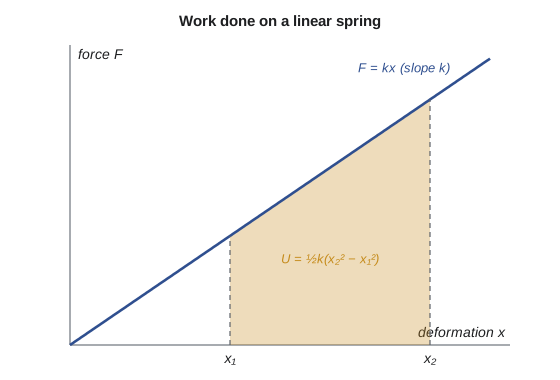
Spring force. A linear spring of stiffness \(k\), stretched or compressed by \(x\) from its free length, pushes back with force \(kx\). As the deformation changes from \(x_1\) to \(x_2\), the work done by the spring on the body is
It is negative when the spring is being deformed further, because the spring then resists the motion, and positive when it is relaxing. Note that the deformations are measured from the free length, not from wherever the spring happens to be at the start.
Kinetic friction. A friction force of constant magnitude \(\mu_k N\) acting opposite to the sliding does work \(-\mu_k N d\), where \(d\) is the distance slid. Unlike weight and spring forces, this work depends on the path: sliding the long way round dissipates more energy than sliding directly.
The principle of work and energy
Writing the tangential component of the second law as \(F_t = m\,dv/dt = m v\,dv/ds\) and integrating along the path gives
The kinetic energy \(T\) is always positive and depends only on speed, not on direction. The equation says that the kinetic energy at position 2 equals the kinetic energy at position 1 plus the total work done by all forces in between. It is a scalar equation, so it yields one unknown: a speed, a distance or a force. It cannot give directions, and it says nothing about time; for those you go back to the second law or forward to impulse and momentum in Lesson 6.
A practical procedure: draw a free-body diagram (yes, still), identify which forces do work and which do not, write the work of each over the path, and set up \(T_1 + \sum U = T_2\). The free-body diagram is what stops you forgetting a force, and also what tells you the normal force when friction depends on it.
Worked problem
Speed at the bottom of a gravity chute
A parcel enters the top of a straight gravity chute at 1.5 ft/s. The chute is 13 ft long and slopes at 30° to the horizontal, and the coefficient of kinetic friction between parcel and chute is 0.25. How fast is the parcel moving at the bottom?
Show solution
- Forces: weight, normal force \(N = W\cos 30^\circ\) (no acceleration perpendicular to the chute), and friction \(\mu_k N\) up the slope. The normal force does no work.
- Work of weight: \(W L\sin 30^\circ\). Work of friction: \(-\mu_k W\cos 30^\circ \, L\).
- \[\tfrac12 \frac{W}{g} v_1^2 + WL(\sin 30^\circ - \mu_k\cos 30^\circ) = \tfrac12 \frac{W}{g} v_2^2\]
- The weight cancels: \(v_2^2 = 1.5^2 + 2(32.2)(13)(0.500 - 0.217) = 2.25 + 237.3 = 239.6\).
- \(v_2 = 15.5 \text{ ft/s}\).
Answer: The parcel leaves the chute at 15.5 ft/s, which is fast enough to damage fragile contents or bounce off a takeaway belt. Chute designers add brake sections with higher-friction liners, or use spiral chutes, to keep exit speeds near 3 to 5 ft/s.
The answer is very sensitive to the friction coefficient, because the work of weight and the work of friction nearly cancel. If \(\mu_k\) were 0.40 instead of 0.25, the bracket would fall from 0.283 to 0.154 and the exit speed would drop to about 3.5 m/s; at 0.58 the parcel would barely move. Real parcels vary over a wider range than that. This is why gravity chutes are tuned on site with liners, and why they handle a mixed parcel stream less predictably than powered conveyors.
Conservative forces and potential energy
Weight and spring forces share a useful property: the work they do depends only on the start and end positions, not on the path between. Such forces are called conservative, and their work can be written as a decrease in a potential energy \(V\):
If only conservative forces do work, the principle of work and energy becomes the conservation of mechanical energy:
When non-conservative forces such as friction or an applied motor force also do work, they are kept as work terms: \(T_1 + V_1 + U^{nc}_{1 \to 2} = T_2 + V_2\). Friction's work is always negative and represents energy turned into heat in the contacting surfaces. Keeping track of which forces go into potential energy and which stay as work is a matter of bookkeeping; the only rule is that no force may be counted twice.
Worked problem
Sizing a spring buffer
A 250 kg shuttle reaches the end of its rail at 0.80 m/s when its brake fails and runs into a spring buffer of stiffness 20 kN/m. Find the maximum compression of the buffer and the peak deceleration of the shuttle. Neglect friction.
Show solution
- Take position 1 at first contact and position 2 at maximum compression, where the shuttle is momentarily at rest.
- \(T_1 = \tfrac12 (250)(0.80)^2 = 80.0 \text{ J}\), \(V_1 = 0\), \(T_2 = 0\), \(V_2 = \tfrac12 (20\,000) x^2\).
- \[80.0 = 10\,000\,x^2 \;\Rightarrow\; x = 0.0894 \text{ m}\]
- Peak spring force: \(kx = 20\,000(0.0894) = 1789 \text{ N}\). Peak deceleration: \(1789/250 = 7.16 \text{ m/s}^2\), about 0.73 g.
Answer: The buffer compresses about 89 mm and decelerates the shuttle at up to 0.73 g. A tote on the shuttle with a friction coefficient below about 0.73 would slide off the deck.
The last observation changes the design question. The buffer must not only stop the shuttle within its stroke but also limit the deceleration so the load stays put. A linear spring is a poor choice for that, because its force rises steadily and peaks at the end of the stroke. The program below compares three buffer types that all absorb the same 80 J: a linear spring, a progressive spring that stiffens as it compresses, and a hydraulic buffer that resists with a nearly constant force.
# A 250 kg shuttle at 0.8 m/s runs into an end-of-travel buffer.
# Work-energy: the buffer must absorb T = m v^2 / 2 over its stroke.
# Compare three buffer characteristics with the same allowed stroke.
m, v = 250.0, 0.8
T = 0.5 * m * v**2
print(f"kinetic energy to absorb: {T:.1f} J")

def stroke_for(force, xmax=1.0, n=20000):
    """March along x adding up work (trapezoid rule) until it equals T."""
    dx = xmax / n
    work, x = 0.0, 0.0
    while work < T:
        work += 0.5 * (force(x) + force(x + dx)) * dx
        x += dx
    return x, force(x)

buffers = {
    "linear spring  k = 20 kN/m": lambda x: 20000 * x,
    "progressive    k x + k3 x^3": lambda x: 8000 * x + 2.0e6 * x**3,
    "hydraulic      constant 900 N": lambda x: 900.0,
}
for name, F in buffers.items():
    x, Fpk = stroke_for(F)
print(f"{name:32s} stroke {x * 1000:6.1f} mm peak force {Fpk:7.0f} N peak decel {Fpk / m:5.2f} m/s^2")kinetic energy to absorb: 80.0 J linear spring k = 20 kN/m stroke 89.4 mm peak force 1789 N peak decel 7.16 m/s^2 progressive k x + k3 x^3 stroke 96.3 mm peak force 2557 N peak decel 10.23 m/s^2 hydraulic constant 900 N stroke 88.9 mm peak force 900 N peak decel 3.60 m/s^2
For about the same stroke, the constant-force hydraulic buffer halves the peak force, because a rectangle has twice the area of a triangle with the same height and base. That is why cranes, elevators and fast shuttles use hydraulic buffers. A second difference matters too: a spring returns its energy and throws the shuttle back off the buffer, while a hydraulic buffer turns the energy into heat in its oil, so the shuttle stays put. Work and energy tell you how much energy must go somewhere; good design decides where.
Power and efficiency
Power is the rate of doing work, \(P = dU/dt = \mathbf{F}\cdot\mathbf{v}\). In SI it is measured in watts (joules per second); in US customary units in foot-pounds per second or horsepower, where 1 hp = 550 ft·lb/s = 746 W. A force does work quickly when it is large and its point of application moves fast. This is why drives are sized at the speed where the load is greatest, not where it is heaviest.
No machine delivers all the power supplied to it. The mechanical efficiency is the ratio of output power to input power, \(\varepsilon = P_{out}/P_{in}\), always less than one, with the difference lost to friction in bearings, gears, belts and seals. A worm gear reducer may have an efficiency of 0.5 to 0.9 depending on its ratio; a good helical gearbox 0.95 to 0.98 per stage; a chain drive about 0.97. Efficiencies multiply through a drivetrain, so a motor feeding a gearbox, then a chain, then a conveyor with its own rolling losses may deliver only three-quarters of its electrical input as useful work on the load.
Worked problem
Motor power for a lift
A vertical tote lift raises a carriage and load weighing 880 lb at a steady 1.6 ft/s. The drive train, from motor shaft to carriage, has an overall efficiency of 0.80. What power must the motor deliver?
Show solution
- At steady speed the lifting force equals the weight, 880 lb.
- Output power: \(P_{out} = Fv = 880(1.6) = 1408 \text{ ft·lb/s}\), or \(1408/550 = 2.56 \text{ hp}\).
- Input power: \(P_{in} = 2.56/0.80 = 3.20 \text{ hp}\).
Answer: The motor must supply about 3.2 hp at steady speed. It must supply more while the carriage accelerates, and Kestrel would choose the next standard motor size above the peak, often 5 hp, after checking the acceleration phase.
Counterweighting, introduced in Lesson 4, cuts this power dramatically. If the carriage were balanced by a counterweight equal to its own mass plus half the average load, the motor would only have to lift the unbalanced part, and the energy stored in raising the counterweight is given back when the carriage descends. Elevators, stage machinery and many vertical conveyors use this principle, and an energy calculation shows the savings directly.
When to use energy methods
Work and energy is the method of choice when the question involves speeds at two positions and the forces depend on position, as with springs and gravity, or when the path is complicated but the forces doing work are simple. It is awkward when friction depends on a normal force that varies along the path, when you need a force perpendicular to the motion (such as the normal force at the bottom of a curve, which does no work), or when time is involved. In those cases, combine it with the second law: energy gives the speed at a point, and the normal-direction equation \(\sum F_n = m v^2/\rho\) then gives the force there.
Common mistakes
MistakeCounting the work of gravity and also including the gravitational potential energy.
InsteadUse either the work term or the potential energy for each force, never both.
MistakeMeasuring spring deformation from the starting position instead of the free length.
InsteadSpring energy is ½kx² with x measured from the unstretched length.
MistakeIncluding work done by normal forces on a body sliding over a fixed surface.
InsteadForces perpendicular to the motion do no work.
MistakeUsing energy methods to find the time of a motion.
InsteadEnergy has no time in it; use the second law or impulse-momentum.
MistakeForgetting that efficiencies multiply through a drive train.
InsteadOverall efficiency is the product of the stage efficiencies.
Summary and key terms
- Work is U = ∫F·dr; only force components along the motion do work.
- T₁ + ΣU₁→₂ = T₂ with T = ½mv².
- Weight and spring forces are conservative and can be handled as potential energy.
- Friction work depends on the path and is always negative.
- Buffers must limit peak deceleration as well as stroke; constant-force buffers do this best.
- Power is F·v; overall efficiency is the product of stage efficiencies.
- Combine energy with ΣF_n = m v²/ρ to find forces at points on a curved path.
- Work
- The integral of force along displacement; a scalar.
- Kinetic energy
- The energy of motion, ½mv².
- Potential energy
- Stored energy due to position in a conservative force field.
- Conservative force
- A force whose work depends only on the end positions.
- Mechanical energy
- The sum of kinetic and potential energy.
- Power
- The rate of doing work.
- Mechanical efficiency
- The ratio of output power to input power.
- Hydraulic buffer
- An end stop that absorbs energy by forcing oil through orifices, giving a nearly constant force.
Practice problems
Work each problem on paper first, then reveal the answer to check.
A 5 kg box slides 3 m down a frictionless 20° ramp from rest. What is its speed at the bottom?
Show answer
v = sqrt(2 x 9.81 x 3 sin 20°) = 4.49 m/s.
In the chute example, what friction coefficient would bring the exit speed down to the entry speed?
Show answer
When sin 30° = μ cos 30°, that is μ = 0.577.
How far would the buffer compress if the shuttle hit it at 1.6 m/s?
Show answer
Twice as far, 179 mm, since x is proportional to v.
A conveyor needs 1.2 kW at the belt. The gearbox is 0.95 efficient and the chain 0.97. What motor output is needed?
Show answer
1.2 / (0.95 x 0.97) = 1.30 kW.
In the program, what constant force would stop the shuttle in 60 mm?
Show answer
80 J / 0.060 m = 1,333 N.
Why does the normal force not appear in the energy equation for a block on a curved track?
Show answer
It is perpendicular to the motion, so it does no work.
Lesson quiz · 5 questions
Score 60% or more to complete this lesson.
Create a free account to save your progress, take quizzes and earn a certificate.