
MEC-210 · Lesson 12 of 12 · 26 min
Introduction to mechanical vibrations
Every machine in Kestrel's sorting hall vibrates. Motors hum at their running speed, conveyor rollers thump at a rate set by belt speed and roller pitch, the pusher's slider-crank shakes its frame twice per revolution, and a shuttle rocks on its wheels each time it brakes. Most of this vibration is harmless. Some of it loosens bolts, cracks welds, wears out bearings, makes a mezzanine floor feel unsafe or spoils a scanner's barcode reads. When a forcing frequency lands near a natural frequency of the structure, a small shake can grow into a large one. This lesson introduces the vibration of a single-degree-of-freedom system, the model behind nearly every first vibration calculation, and shows how the tools of the whole course combine in it: Newton's second law, energy, and the kinematics of oscillating motion.
A vibration is a motion that repeats about an equilibrium position. Two things are needed: something that pulls the system back toward equilibrium, such as a spring or gravity, and inertia that carries it past equilibrium. Damping, from friction, air, oil or the internal losses of rubber, removes energy and makes free vibration die out. The number of independent coordinates needed to describe the motion is the number of degrees of freedom. A machine on four rubber mounts has six in principle (three translations and three rotations), but very often one motion dominates, and a one-degree-of-freedom model of mass, spring and damper gives the answer that matters.
Free undamped vibration
Consider a mass \(m\) on a spring of stiffness \(k\). Measure the displacement \(x\) from the static equilibrium position, where the spring already carries the weight. Gravity and the static spring force then cancel and drop out of the equation of motion, a convenient result that holds for any linear spring. Newton's second law gives
The solution is a sine wave, \(x = A\sin(\omega_n t + \phi)\), where the amplitude \(A\) and phase \(\phi\) come from the initial displacement and velocity. The system oscillates at its natural circular frequency \(\omega_n\) in radians per second, which corresponds to a natural frequency \(f_n = \omega_n/2\pi\) in hertz (cycles per second) and a period \(\tau = 1/f_n\). The natural frequency depends only on the stiffness and the mass, not on how hard the system was disturbed.
A useful shortcut uses the static deflection \(\delta_{st} = mg/k\), the amount the spring compresses under the weight. Since \(k/m = g/\delta_{st}\),
So a machine that sinks 4 mm (about 0.16 in) into its mounts has a natural frequency of about 7.9 Hz, and one that sinks 1 in has about 3.1 Hz; the US customary form is \(f_n \approx 3.13/\sqrt{\delta_{st}\,[\text{in}]}\) Hz. Mount suppliers often state their products by static deflection for exactly this reason.
Worked problem
Natural frequency of the gearmotor on its mounts
The pusher's motor-gearbox unit weighs 265 lb and stands on four rubber mounts, each with a vertical stiffness of 420 lb/in. Find the static deflection and the natural frequency of vertical vibration.
Show solution
- The mounts act in parallel, so their stiffnesses add: \(k = 4(420) = 1680 \text{ lb/in} = 20{,}160 \text{ lb/ft}\).
- Mass: \(m = 265/32.2 = 8.23 \text{ slug}\). Static deflection: \(\delta_{st} = 265/1680 = 0.158 \text{ in}\).
- \[\omega_n = \sqrt{k/m} = \sqrt{20{,}160/8.23} = 49.5 \text{ rad/s} \qquad f_n = 49.5/2\pi = 7.88 \text{ Hz}\]
Answer: The unit bounces about 7.9 times a second if disturbed. The check with the shortcut, \(15.8/\sqrt{4.00} = 7.9\) Hz, agrees. Whether this is a good number depends on what is shaking the unit, which is the subject of forced vibration below.
The energy method
For an undamped system, energy is conserved, so \(T + V\) is constant. If the motion is harmonic, the maximum kinetic energy (at the equilibrium position, where the speed is greatest) equals the maximum potential energy (at the extreme position, where the system is momentarily at rest). With \(x_{max} = A\) and \(\dot{x}_{max} = \omega_n A\), this gives \(\tfrac12 m \omega_n^2 A^2 = \tfrac12 k A^2\), the same result as before. The method is powerful for systems that are awkward to draw free-body diagrams for, because it needs only the expressions for \(T\) and \(V\) from Lessons 5 and 11.
For a rotating or rolling body, the kinetic energy includes \(\tfrac12 I\dot{\theta}^2\). A simple pendulum of length \(L\) gives \(\omega_n = \sqrt{g/L}\) for small swings, and a compound pendulum, a rigid body swinging about a pivot a distance \(r_G\) from its center of mass, gives \(\omega_n = \sqrt{m g r_G/I_O}\). A hanging tote on an overhead conveyor hook swings this way, and the period of its swing decides how gently the conveyor must start and stop to avoid sending totes into each other.
Free damped vibration
Real systems lose energy. The simplest model, and the one that fits oil dampers and, approximately, many rubber mounts, is viscous damping, a force \(c\dot{x}\) opposing the velocity. The equation of motion becomes
The damping ratio \(\zeta\) compares the actual damping with the critical damping \(c_c = 2\sqrt{km}\). Three cases follow. An underdamped system (\(\zeta < 1\)) oscillates with an amplitude that decays exponentially, at a damped frequency \(\omega_d = \omega_n\sqrt{1 - \zeta^2}\) that is only slightly lower than \(\omega_n\) for light damping. A critically damped system (\(\zeta = 1\)) returns to rest as fast as possible without overshooting. An overdamped system (\(\zeta > 1\)) creeps back slowly. Door closers and the needle movements of old instruments are designed near critical damping; most machine structures are lightly damped, with \(\zeta\) of a few percent: welded steel frames perhaps 1 to 2 percent, rubber mounts around 5 to 10 percent.
The damping ratio is hard to calculate but easy to measure. Strike the structure, record the decaying vibration and compare successive peaks. Their ratio is constant, and its natural logarithm, the logarithmic decrement, is
The program below does exactly this numerically for the gearmotor on its mounts. It integrates the equation of motion step by step from a 10 mm initial displacement, picks out the peaks, and recovers the damping ratio from them. It then tabulates the forced response discussed in the next section for two damping ratios.
# Single-degree-of-freedom vibration: m x'' + c x' + k x = F(t)
import math

# 1. Free vibration of a motor-gearbox unit on rubber mounts
m, k, zeta = 120.0, 2.94e5, 0.05             # kg, N/m, damping ratio
wn = math.sqrt(k / m)
c = 2 * zeta * math.sqrt(k * m)
print(f"natural frequency {wn:.2f} rad/s = {wn / (2 * math.pi):.2f} Hz, c = {c:.0f} N s/m")

# Simulate a 10 mm initial displacement and measure two successive peaks
x, v, t, dt = 0.010, 0.0, 0.0, 1e-5
peaks, prev_v = [], v
while len(peaks) < 3:
    a = (-c * v - k * x) / m
    v += a * dt
    x += v * dt
    t += dt
    if prev_v > 0 and v <= 0:                # velocity changes sign at a positive peak
        peaks.append(x)
    prev_v = v
delta = math.log(peaks[0] / peaks[1])
print(f"successive peaks {peaks[0] * 1000:.3f} mm and {peaks[1] * 1000:.3f} mm")
print(f"log decrement {delta:.4f} -> zeta = {delta / math.sqrt(4 * math.pi**2 + delta**2):.4f}")

# 2. Forced response: magnification factor and transmissibility
print("\n   r     M (z=0.05)  TR (z=0.05)   M (z=0.20)  TR (z=0.20)")
for r in (0.5, 0.9, 1.0, 1.1, 1.41, 2.0, 3.0, 3.7):
    row = []
    for z in (0.05, 0.20):
        den = math.sqrt((1 - r * r)**2 + (2 * z * r)**2)
        row += [1 / den, math.sqrt(1 + (2 * z * r)**2) / den]
print(f"{r:5.2f} {row[0]:9.3f} {row[1]:9.3f} {row[2]:9.3f} {row[3]:9.3f}")natural frequency 49.50 rad/s = 7.88 Hz, c = 594 N s/m successive peaks 7.301 mm and 5.331 mm log decrement 0.3146 -> zeta = 0.0500 r M (z=0.05) TR (z=0.05) M (z=0.20) TR (z=0.20) 0.50 1.330 1.332 1.288 1.314 0.90 4.757 4.776 2.457 2.611 1.00 10.000 10.050 2.500 2.693 1.10 4.218 4.244 2.051 2.241 1.41 1.002 1.012 0.879 1.009 2.00 0.333 0.339 0.322 0.412 3.00 0.125 0.130 0.124 0.193 3.70 0.079 0.084 0.078 0.140
The program recovers \(\zeta = 0.050\) from peaks of 7.30 mm and 5.33 mm: each cycle loses about 27 percent of its amplitude, so the shaking dies away in a handful of cycles. A field engineer with an accelerometer and a rubber mallet does the same thing in a bump test.
Forced vibration and resonance
Most machine vibration is forced: something pushes the system periodically. Let the force be \(F_0\sin\omega t\). After the free vibration from the start-up has died away, the system settles into a steady-state vibration at the forcing frequency \(\omega\), not at its own natural frequency. Its amplitude is
The numerator \(F_0/k\) is the deflection the force would cause if applied slowly. The denominator turns it into the magnification factor \(M = X k/F_0\), which depends only on the frequency ratio \(r\) and the damping ratio. Well below resonance (\(r \ll 1\)), \(M \approx 1\): the spring dominates and the system simply follows the force. Near resonance (\(r \approx 1\)), \(M \approx 1/(2\zeta)\), which is 10 for \(\zeta = 0.05\) and 50 for a lightly damped steel frame with \(\zeta = 0.01\). Well above resonance (\(r \gg 1\)), \(M \approx 1/r^2\): the mass dominates, and its inertia keeps it almost still while the force shakes back and forth.
Resonance is the reason a vibration problem can appear suddenly. A conveyor runs smoothly at one belt speed and badly at a slightly higher one. A floor is fine until a new machine with the wrong running speed arrives. A fan runs quietly at full speed but rattles the duct as it passes through a certain speed on start-up. Each time, a forcing frequency has crossed a natural frequency. The standard design rule is to keep running speeds well away from natural frequencies, typically by at least 20 to 30 percent, and, where a machine must pass through resonance on start-up, to pass through quickly.
Rotating unbalance
The most common forcing in machinery comes from an unbalanced rotor. If a small mass \(m_u\) sits at radius \(e\) from the axis of a rotor spinning at \(\omega\), it needs a centripetal force \(m_u e\omega^2\) (Lesson 2's normal acceleration, \(r\omega^2\)), and the reaction shakes the machine with a force of that amplitude at the running frequency. Because the force grows with the square of speed, a rotor that is acceptable at low speed can be unacceptable at high speed. Rotors are therefore balanced, by adding or removing mass, to grades set out in balancing standards, with finer grades for faster and more precise machines.
Reciprocating machines, such as the pusher's slider-crank, add a shaking force from the acceleration of the slider. Lesson 9's acceleration analysis shows that it contains a component at the running speed and a smaller one at twice the running speed, which is why slider-crank machines often show vibration at both frequencies and why multi-cylinder engines arrange their cranks to cancel as much of it as possible.
Vibration isolation
A mount does two jobs: it supports the machine, and it controls how much of the machine's shaking reaches the floor. The ratio of the force transmitted to the floor to the force generated in the machine is the transmissibility,
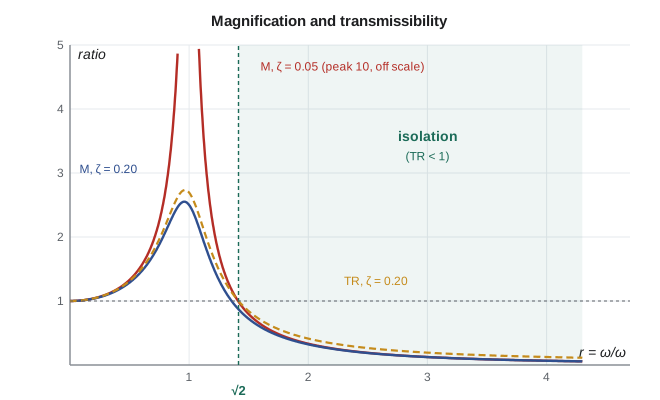
Transmissibility equals 1 at \(r = \sqrt{2}\) for every damping ratio, and below that value the mount actually amplifies the transmitted force. Isolation, \(TR < 1\), happens only when the machine runs at more than about 1.4 times the natural frequency of the machine on its mounts. To isolate well, therefore, mounts must be soft enough to make the natural frequency low compared with the running speed. Damping has a double edge: it limits the peak when the machine passes through resonance on start-up, but at high frequency ratios it slightly increases the force transmitted. That is why isolators are made of lightly damped rubber or steel springs, sometimes with a separate damper for start-up.
Worked problem
Is the gearmotor isolated?
The gearmotor of the first example runs at 1,750 rev/min, and its rotor has a small residual unbalance. Its mounts give \(\omega_n = 49.5\) rad/s with \(\zeta = 0.05\). What fraction of the unbalance force reaches the mezzanine floor? What would happen if the motor were replaced by a variable-speed drive that runs the pusher at only 470 rev/min during commissioning?
Show solution
- Running frequency: \(\omega = 1750(2\pi/60) = 183.3 \text{ rad/s}\). Frequency ratio: \(r = 183.3/49.5 = 3.70\).
- From the transmissibility formula (or the program's table): \(TR = 0.084\). Only about 8 percent of the unbalance force reaches the floor.
- At 470 rev/min: \(\omega = 49.2 \text{ rad/s}\), so \(r = 0.99\), almost exactly at resonance.
- \[TR \approx \frac{\sqrt{1 + (0.099)^2}}{\sqrt{(0.0199)^2 + (0.099)^2}} = 9.9\]
Answer: At full speed the mounts do their job, cutting the transmitted force by a factor of about 12. At 470 rev/min the same mounts would multiply it by about 10, and the unit would bounce visibly. Kestrel's commissioning instructions therefore skip the band of roughly 400 to 600 rev/min on the drive, a standard feature of variable-frequency drives called a skip or prohibited frequency band.
Vibration problems are usually diagnosed by measuring rather than calculating. A vibration analyzer records the motion at a bearing housing and shows its frequency spectrum; peaks at the running speed point to unbalance, peaks at twice the running speed to misalignment or looseness, and peaks at bearing defect frequencies to failing bearings. Severity is judged against charts in international machine-vibration standards, which classify vibration velocity levels as good, acceptable or in need of action for different classes of machine. Kestrel's maintenance contract for the sorting hall includes a monthly vibration route on every motor and gearbox, so that rising levels are caught months before a bearing fails.
Bringing the course together
The single-degree-of-freedom model uses nearly everything in this course. Its equation of motion is Newton's second law for a particle (Lesson 4), or the moment equation for a rotating body (Lesson 10). Its natural frequency comes as readily from energy conservation (Lessons 5 and 11) as from forces. The harmonic motion it produces is rectilinear kinematics with a sinusoidal acceleration (Lesson 1). Rotating unbalance is a normal acceleration (Lesson 2), and reciprocating shaking forces come from the acceleration analysis of mechanisms (Lesson 9). The shock of a sudden load is an impulse (Lesson 6). Further courses build on this foundation: multi-degree-of-freedom systems with several natural frequencies and mode shapes, the vibration of beams and shafts, and the control systems that keep machines like Kestrel's shuttles moving smoothly.
Common mistakes
MistakeMeasuring displacement from the unstretched spring and keeping the weight in the equation of motion.
InsteadMeasure from static equilibrium; the weight and the static spring force cancel.
MistakeUsing frequency in hertz where radians per second are needed.
Insteadω_n = √(k/m) is in rad/s; divide by 2π for hertz.
MistakeAdding stiffnesses of springs in series.
InsteadParallel springs add; for springs in series, the reciprocals add.
MistakeAssuming more damping always reduces transmitted force.
InsteadAbove r = √2, more damping slightly increases transmissibility.
MistakeChoosing stiff mounts to 'hold the machine still'.
InsteadIsolation needs soft mounts, with the running speed well above √2 times the natural frequency.
Summary and key terms
- A single-degree-of-freedom system obeys m x'' + c x' + k x = F(t), with x measured from static equilibrium.
- ω_n = √(k/m) = √(g/δ_st); f_n = ω_n/2π; f_n ≈ 15.8/√(δ_st in mm) Hz.
- The damping ratio is ζ = c/(2√(km)); most machine structures have ζ of a few percent.
- The logarithmic decrement δ = ln(x₁/x₂) measures damping from a decaying record.
- Steady forced response has magnification M = 1/√((1 − r²)² + (2ζr)²), peaking near 1/(2ζ) at resonance.
- Rotating unbalance gives a force m_u e ω² at the running frequency.
- Transmissibility falls below 1 only for r > √2: isolation needs soft mounts.
- Degree of freedom
- An independent coordinate needed to describe a system's motion.
- Natural frequency
- The frequency at which a system vibrates freely, ω_n = √(k/m) for a mass on a spring.
- Static deflection
- The deflection of a spring or mount under the weight it carries.
- Damping ratio
- The ratio of actual damping to critical damping, ζ = c/c_c.
- Critical damping
- The damping c_c = 2√(km) that returns a system to rest fastest without overshoot.
- Logarithmic decrement
- The natural logarithm of the ratio of successive peaks in free damped vibration.
- Resonance
- Large forced vibration when the forcing frequency is close to a natural frequency.
- Magnification factor
- The ratio of the dynamic amplitude to the static deflection under the same force.
- Transmissibility
- The ratio of the force transmitted to the support to the force applied to the machine.
- Rotating unbalance
- An off-center mass on a rotor that produces a shaking force at the running frequency.
Practice problems
Work each problem on paper first, then reveal the answer to check.
A 40 kg pump sits on springs of total stiffness 160 kN/m. Find its natural frequency in Hz.
Show answer
ω_n = 63.2 rad/s, f_n = 10.1 Hz.
A machine sinks 9 mm into its mounts. Estimate its natural frequency.
Show answer
f_n ≈ 15.8/3 = 5.3 Hz.
Successive peaks in a bump test are 2.0 mm and 1.6 mm. What is the damping ratio?
Show answer
δ = 0.223, ζ = 0.036.
For ζ = 0.02, what is the magnification factor at resonance?
Show answer
About 1/(2 × 0.02) = 25.
A fan runs at 1,200 rev/min. What is the highest mount natural frequency that still gives isolation?
Show answer
20 Hz / √2 ≈ 14 Hz; in practice aim much lower, around 5 Hz or less.
In the program, change ζ to 0.10. How do the peaks and the recovered damping ratio change?
Show answer
The peaks decay faster (about 47 percent lost per cycle) and the program recovers ζ = 0.10.
Lesson quiz · 5 questions
Score 60% or more to complete this lesson.
Create a free account to save your progress, take quizzes and earn a certificate.