
MBA-514 · Lesson 4 of 12 · 21 min
Resources, capabilities and the resource-based view
Leo Brandt has been asked the same question by every investor Kestrel Analytics has met this year: what stops a large software company from doing what you do? Kestrel sells inventory forecasting software to retailers, and its models are good. But the large enterprise software vendors that sell retailers their core systems have announced forecasting features of their own, built on the same open-source machine learning libraries Kestrel uses. Leo's usual answer, that Kestrel has better technology and a great team, has stopped convincing anyone, including Leo.
Dr. Ashford uses Leo's problem to introduce the other half of strategy. Lessons 2 and 3 looked outward, at industries and environments. This lesson looks inward, at the resources and capabilities a firm controls, and asks which of them can be the basis of an advantage that lasts. The view that sustained advantage comes from resources that are valuable, rare and hard to imitate is called the resource-based view of the firm.
Resources and capabilities
The idea has a long history. Edith Penrose, in her 1959 book The Theory of the Growth of the Firm, described firms as collections of productive resources whose services could be combined in different ways, and argued that firms grow by finding new uses for resources that are underused. Birger Wernerfelt's 1984 article A Resource-Based View of the Firm gave the approach its name, and Jay Barney's 1991 article Firm Resources and Sustained Competitive Advantage set out the conditions that later textbooks turned into a framework.
Resources are the assets a firm owns or controls. Tangible resources include plants, equipment, locations, inventory and cash; intangible resources include brands, patents, software, data, reputation, relationships and organizational culture; human resources include the skills, knowledge and motivation of employees. Capabilities are what a firm can do with its resources: the routines and processes, built up over time, through which resources are combined to perform activities such as designing products, managing suppliers, running stores or developing software. A capability is more than the sum of the people who perform it, because it lives in practices and relationships that persist when individuals leave.
Capabilities can be mapped onto the value chain, which Porter described in his 1985 book Competitive Advantage. Primary activities are inbound logistics, operations, outbound logistics, marketing and sales, and service; support activities are firm infrastructure, human resource management, technology development and procurement. Asking which activities the firm performs distinctively well, and which merely adequately, is a practical way to find its capabilities.
The VRIO framework
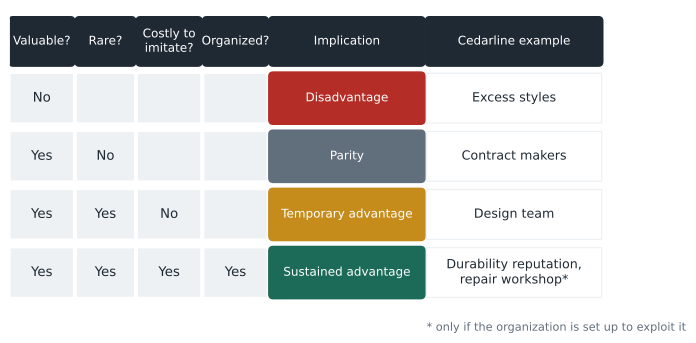
Barney's conditions are usually summarized as four questions, known as VRIO. Is the resource or capability valuable, meaning that it lets the firm exploit an opportunity or neutralize a threat, raising customers' willingness to pay or lowering costs? Is it rare, meaning that few competitors possess it? Is it costly to imitate, meaning that competitors without it face a cost disadvantage in obtaining or developing it, or in substituting for it? And is the firm organized to capture its value, with the structure, systems and incentives needed to exploit it?
The answers determine the competitive implication. A resource that is not valuable is a competitive disadvantage. A valuable resource that is common gives competitive parity, which is necessary to stay in the game but does not set the firm apart. A valuable and rare resource that is easy to imitate gives a temporary advantage that will erode as competitors copy it. Only a resource that is valuable, rare and costly to imitate can support a sustained advantage, and only if the firm is organized to exploit it.
Why some resources are hard to imitate
The costly-to-imitate test is the heart of the framework, and Barney and others identified several reasons imitation can be costly. The first is unique historical conditions. Some resources were acquired at a particular time and cannot be acquired again, such as a store location secured decades ago or a brand built through a long history. Ingemar Dierickx and Karel Cool, in a 1989 article, argued that many strategic assets are stocks accumulated over time through consistent flows of investment, and that they suffer from time compression diseconomies: spending twice as much for half as long does not produce the same stock, just as a crash course does not produce the same knowledge as years of study.
The second is causal ambiguity. If neither competitors nor the firm itself can say exactly which resources produce its advantage, competitors cannot know what to copy. The third is social complexity: resources such as culture, trust among managers, relationships with suppliers and a reputation among customers are hard to buy or engineer, even when they are well understood. The fourth is patents and other legal protection, which are important in some industries but often less durable than they appear, since patents expire and can be invented around.
Resources that can be bought in the market rarely support sustained advantage, because competitors can buy them too, and the price of a scarce resource tends to rise until it captures the value it creates. This is a sobering point for managers who believe they can buy their way to advantage by hiring star employees or acquiring technology. The star employee who creates great value may capture most of it in pay, and acquired technology is available to the next buyer as well.
Core competences and dynamic capabilities
C. K. Prahalad and Gary Hamel, in their 1990 article The Core Competence of the Corporation, argued that companies should think of themselves as portfolios of competences rather than of businesses. A core competence provides access to a variety of markets, makes a significant contribution to the benefits customers perceive in the end product, and is difficult for competitors to imitate. Their examples included Honda's competence in engines, which it applied to motorcycles, cars, lawn mowers and generators. The idea has been influential and also misused, as firms labeled almost anything they did as a core competence.
Resources that create advantage in one environment can become a burden when the environment changes. Dorothy Leonard-Barton, in a 1992 article, called this the problem of core rigidities: the same skills, systems and values that made a firm successful can blind it to new approaches. David Teece, Gary Pisano and Amy Shuen, in a 1997 article, proposed the concept of dynamic capabilities, the firm's ability to integrate, build and reconfigure its competences to address rapidly changing environments. Teece later described dynamic capabilities as sensing opportunities and threats, seizing them by mobilizing resources, and transforming the organization by continually renewing its assets and structures. In fast-moving industries, the ability to change may matter more than any specific resource.
A VRIO analysis for Kestrel
Leo works through Kestrel's resources with the cohort. Its forecasting algorithms are valuable but not rare: the techniques are published and the libraries are open source. Its engineering team is talented but, as the market for machine learning engineers shows, mobile and expensive. Its brand among mid-sized retailers is valuable and somewhat rare but young. Then Leo describes something he had not thought of as a resource. Kestrel's models have been trained on six years of daily sales, inventory and promotion data from more than 400 retailers, cleaned and matched to weather, holidays and local events, and every new customer's results feed improvements back into the models. The large vendors have more data in total but have never assembled it in this form for this purpose, and their customers' contracts often prevent them from pooling it.
# A VRIO classifier for Kestrel's resources and capabilities
def vrio(valuable, rare, costly_to_imitate, organized):
    if not valuable: return "competitive disadvantage"
    if not rare: return "competitive parity"
    if not costly_to_imitate: return "temporary advantage"
    return "sustained advantage" if organized else "unexploited advantage"

kestrel = [
    # name,                                        V     R      I      O
    ("Forecasting algorithms",                     True, False, False, True),
    ("Engineering team",                           True, True,  False, True),
    ("Brand with mid-sized retailers",             True, True,  False, True),
    ("Pooled six-year retail demand data set",     True, True,  True,  False),
    ("Onboarding and integration routines",        True, True,  True,  True),
    ("Office lease and hardware",                  True, False, False, True),
]
for name, *tests in kestrel:
    print(f"{name:42s} -> {vrio(*tests)}")

# Importance versus relative strength: where to invest
caps = {"Data pooling and governance": (5, 3), "Model accuracy": (4, 4),
        "Integration with store systems": (5, 4), "Sales coverage": (3, 2), "User interface": (2, 4)}
for name, (importance, strength) in sorted(caps.items(), key=lambda kv: kv[1][1] - kv[1][0]):
    gap = importance - strength
    action = "invest" if gap > 0 else ("maintain" if gap == 0 else "do not over-invest")
print(f"{name:32s} importance {importance} strength {strength}: {action}")Forecasting algorithms -> competitive parity Engineering team -> temporary advantage Brand with mid-sized retailers -> temporary advantage Pooled six-year retail demand data set -> unexploited advantage Onboarding and integration routines -> sustained advantage Office lease and hardware -> competitive parity Data pooling and governance importance 5 strength 3: invest Integration with store systems importance 5 strength 4: invest Sales coverage importance 3 strength 2: invest Model accuracy importance 4 strength 4: maintain User interface importance 2 strength 4: do not over-invest
The output separates the resources Leo had been emphasizing from the ones that matter. The algorithms and the office give only parity; the team and the brand give at best a temporary advantage. The pooled data set passes the first three tests, because it is valuable, rare and costly to imitate through a combination of history, since six years of data cannot be collected in less than six years, and social complexity, since it depends on trust and data-sharing agreements with hundreds of retailers. But it fails the fourth test: Kestrel is not yet organized to exploit it. Its contracts allow pooling but its pricing does not reflect the value of the pooled models, its product does not show customers what they gain from contributing data, and nobody owns data governance. The onboarding routines, which let Kestrel integrate with a retailer's systems in weeks rather than months, are a less obvious sustained advantage built from hundreds of past implementations.
The second part of the code compares each capability's importance to customers with Kestrel's relative strength. The largest gap, in data pooling and governance, is where investment pays most, followed by integration with store systems and sales coverage; the user interface, already stronger than it needs to be relative to its importance, is a candidate for less investment. Leo's new answer to investors is that Kestrel's advantage is a learning system: the more retailers it serves, the better its forecasts, and the better its forecasts, the more retailers it attracts. That argument depends on Kestrel organizing itself around the data, and Leo leaves with a list of changes to contracts, pricing and the product.
Cedarline's resources
The cohort then applies the framework to Cedarline. Its contract manufacturing relationships are valuable but common in the industry. Its store network is valuable, but stores in good malls can be leased by any well-funded rival, so they give parity or at best a temporary advantage. Its design team has produced several successful products, including the Ridgeline jacket, but designers are mobile. Two resources stand out. The first is its brand reputation for durability, built over three decades and reinforced by customers who have worn the same jacket for years, a stock accumulated over time and embedded in social memory. The second is the small repair workshop the company has run since its founding, which MBA-512 proposed turning into a lifetime repair service. The workshop's skills, records of how products fail and relationships with loyal customers would be hard for a fast-fashion competitor to copy quickly. Whether these resources become a sustained advantage depends on the organization test, and Cedarline's current organization, built around rapid growth in every channel, is not designed to exploit them.
Worked problem
Testing a hospital's capabilities
Hana Kowalski is preparing Lakeview Health's case for regional funding for a new cardiac program. Her team lists four resources: a new imaging suite, its relationships with family physicians across the region, a team of three experienced cardiac surgeons, and a culture of collaboration between nurses and physicians that has produced the region's lowest readmission rates for five years. Apply the VRIO framework.
Show solution
- Imaging suite: valuable but other hospitals have or can buy the same equipment; competitive parity.
- Surgeons: valuable and rare in the region but recruitable by competitors with higher pay; at best a temporary advantage, and much of the value may be captured in compensation.
- Referral relationships: valuable, rare and costly to imitate because they were built over years and depend on trust; a likely sustained advantage if Lakeview organizes to use them, for example through shared care pathways.
- Collaborative culture: valuable, as the readmission rates show, rare, and very costly to imitate because of social complexity and causal ambiguity; a sustained advantage that the new program should be designed to exploit.
Answer: Hana's case for the cardiac program should rest less on the equipment and the surgeons, which any funded rival could match, and more on the referral network and the culture that produce better outcomes.
Common mistakes
MistakeOur people are our competitive advantage.
InsteadSkilled people are valuable but often mobile; advantage lies in how the organization combines them, which is harder to copy.
MistakeAnything the firm does well is a core competence.
InsteadA core competence opens multiple markets, matters to customers and is hard to imitate.
MistakeBuying the best assets creates advantage.
InsteadResources bought in open markets are available to rivals, and their price tends to absorb their value.
MistakeA valuable, rare, inimitable resource guarantees success.
InsteadThe firm must also be organized to exploit it, and resources can become rigidities when conditions change.
Summary and key terms
- The resource-based view holds that lasting advantage comes from resources and capabilities that rivals cannot easily obtain or copy.
- Resources are assets a firm controls; capabilities are the routines through which it combines them to perform activities.
- VRIO asks whether a resource is valuable, rare, costly to imitate and supported by the organization.
- Imitation is costly when resources depend on history, causal ambiguity or social complexity, or are legally protected.
- Resources bought in open markets rarely give lasting advantage; accumulated stocks such as reputation and know-how often do.
- Dynamic capabilities, the ability to sense, seize and transform, matter most when environments change quickly; core rigidities are the risk.
- Resource-based view
- The theory that sustained advantage comes from firm-specific resources that are valuable, rare and hard to imitate.
- Capability
- A firm's ability to combine resources through routines to perform an activity.
- VRIO
- The tests of value, rarity, costly imitation and organization applied to a resource or capability.
- Causal ambiguity
- Uncertainty about which resources produce an advantage, which makes imitation difficult.
- Core competence
- A capability that opens access to many markets, matters to customers and is hard to imitate.
- Dynamic capability
- The ability to integrate, build and reconfigure competences as the environment changes.
Practice problems
Work each problem on paper first, then reveal the answer to check.
A resource is valuable and rare but easy to imitate. What advantage does it give?
Show answer
A temporary competitive advantage that will erode as rivals copy it.
Explain time compression diseconomies with an example.
Show answer
Building a reputation for reliability takes years of consistent performance; spending heavily on advertising for one year cannot produce the same reputation.
Why might a star employee not be a source of sustained advantage?
Show answer
The employee is mobile and can capture much of the value created through higher pay or move to a rival.
What is a core rigidity?
Show answer
A capability that once gave advantage but now hinders the firm from adapting to new conditions.
Lesson quiz · 5 questions
Score 60% or more to complete this lesson.
Create a free account to save your progress, take quizzes and earn a certificate.