
MATH-499 · Lesson 4 of 12 · 24 min
Searching the literature: MathSciNet, zbMATH and citation trails
Every project eventually asks the question: is this known? The answer shapes everything else. If your main result is in a paper from 1912, you need to know before you present it as new, and you probably want to read that paper. If it is not known, you need to be confident of that before you claim originality. Between these extremes lies the most common situation: related results exist, some of which you can use, extend or improve. Finding them is a skill with its own tools, and this lesson teaches it. We follow Amara's search for the consecutive-sums problem from a vague query to a reading list of verified references.
Why searching mathematics is hard
Mathematical results are notoriously hard to search for by keyword. The same object goes by different names in different decades and communities: the numbers Amara is studying are called polite numbers in some sources, trapezoidal numbers in others and staircase numbers in a third; the representation count is the politeness. A result may be stated in a general form whose relevance is not obvious, such as a theorem about partitions into distinct parts, of which consecutive sums are a special case. Notation varies too, and formulas cannot easily be typed into a search box. Effective searching therefore combines several strategies: keyword searches with many synonyms, subject classification, sequence lookup, and following citation trails from a few good starting points.
Mathematical Reviews and MathSciNet
Mathematical Reviews was founded by the American Mathematical Society in 1940, with Otto Neugebauer as its first editor. Its idea is simple and powerful: every significant mathematical publication is summarized, often critically, by an expert reviewer, and indexed by author, subject and citation. MathSciNet, the online version, covers literature back to the early nineteenth century and contains millions of items. It is available by institutional subscription, so you will usually access it through your university library. Its strengths are reliable author identification, which distinguishes different mathematicians with the same name, expert reviews that tell you what a paper actually proves, and citation links showing which later papers cite a given one.
zbMATH Open
The other major reviewing database is zbMATH, the successor of Zentralblatt für Mathematik, which Neugebauer had founded at Springer in 1931 before he left Germany. It is now operated by FIZ Karlsruhe with the European Mathematical Society and Heidelberg Academy of Sciences. Since January 2021 it has been freely available to everyone as zbMATH Open. Its coverage begins in the 1860s, and it also indexes mathematical software through swMATH and links to formalized mathematics. For a student without library access, or for quick searches, zbMATH Open is often the first stop; its author profiles, classification searches and citation data are excellent.
The Mathematics Subject Classification
Both databases classify every item by the Mathematics Subject Classification, currently MSC2020, maintained jointly by Mathematical Reviews and zbMATH. It has about 63 two-digit top-level areas, such as 05 for combinatorics, 11 for number theory, 53 for differential geometry and 90 for operations research, each subdivided by letters and further digits. For example, 11A63 covers radix representation and digital problems, 11P81 elementary theory of partitions and 11P83 partitions with congruences and congruential restrictions. Searching by classification code finds papers whose titles use vocabulary you had not thought of, and journals ask authors to choose MSC codes for their own papers, so you will eventually choose them for your thesis too.
The OEIS
For any project that produces integer sequences, the On-Line Encyclopedia of Integer Sequences is indispensable. Neil Sloane began collecting sequences as a graduate student in 1964, published A Handbook of Integer Sequences in 1973 and, with Simon Plouffe, The Encyclopedia of Integer Sequences in 1995. The online database opened in 1996 and since 2009 has been run by the OEIS Foundation, with entries edited by volunteers. By late 2026 it contained more than 390,000 sequences. Each entry gives terms, formulas, references, programs, cross-references and comments linking the sequence to apparently unrelated mathematics.
Amara's counts begin 1, 1, 2, 1, 2, 2, 2, 1, 3, 2, 2, 2, 2, 2, 4. Typing these terms into the OEIS search box returns sequence A001227, the number of odd divisors of \(n\), whose comments state that it also counts the ways to write \(n\) as a sum of consecutive positive integers, with references. In one search she confirmed that her conjecture was true and known, and acquired a trail of references. Before you can search, though, you need the terms; and it is worth being able to test candidate formulas against your data yourself, since the OEIS will not always have your sequence. The program below does a small offline version of this, matching Amara's data against several natural arithmetic functions.
def r(n):
    """number of representations of n as sums of consecutive positive integers"""
    count, k = 0, 1
    while k * (k + 1) // 2 <= n:
        if (n - k * (k - 1) // 2) % k == 0:
            count += 1
        k += 1
    return count

def divisors(n):
    return [d for d in range(1, n + 1) if n % d == 0]

candidates = {
    'number of divisors':          lambda n: len(divisors(n)),
    'number of odd divisors':      lambda n: sum(1 for d in divisors(n) if d % 2),
    'number of prime factors':     lambda n: sum(1 for p in divisors(n) if p > 1 and len(divisors(p)) == 2),
    'divisors of n not exceeding sqrt(n)': lambda n: sum(1 for d in divisors(n) if d * d <= n),
    'number of divisors of 2n, halved':     lambda n: len(divisors(2 * n)) // 2,
}

N = 200
data = [r(n) for n in range(1, N + 1)]
print("data:", data[:20], "...")
for name, f in candidates.items():
    values = [f(n) for n in range(1, N + 1)]
    bad = [n for n in range(1, N + 1) if values[n - 1] != data[n - 1]]
    verdict = "matches all" if not bad else f"first mismatch at n = {bad[0]} ({len(bad)} mismatches)"
print(f"{name:38s} {verdict}")data: [1, 1, 2, 1, 2, 2, 2, 1, 3, 2, 2, 2, 2, 2, 4, 1, 2, 3, 2, 2] ... number of divisors first mismatch at n = 2 (100 mismatches) number of odd divisors matches all number of prime factors first mismatch at n = 1 (140 mismatches) divisors of n not exceeding sqrt(n) first mismatch at n = 3 (149 mismatches) number of divisors of 2n, halved first mismatch at n = 4 (99 mismatches)
Only one candidate survives all 200 terms: the number of odd divisors. The others fail early, and the way they fail is instructive. The number of divisors fails at \(n = 2\), where 2 has two divisors but only one representation. Half the number of divisors of \(2n\) is the most tempting wrong answer, because it agrees for every odd \(n\) and for \(n = 2\): if \(n = 2^e m\) with \(m\) odd, then \(2n\) has \((e + 2)\tau(m)\) divisors, where \(\tau\) counts divisors, and half of this equals \(\tau(m)\) only when \(e = 0\), with integer rounding rescuing \(n = 2\) when \(\tau(m) = 1\). It first fails at \(n = 4\) and then fails for 99 of the 200 values. A candidate that fits the first few terms can still be wrong, which is why the program tests a long range and why, in the end, only a proof settles the matter.
Citation trails
Once you have one good paper, its references take you backward in time to the work it builds on, and citation databases take you forward to the work that builds on it. Backward searching from a reference list is easy but finds only older work, and only what the authors chose to cite. Forward searching, through MathSciNet's or zbMATH's citation links or through Google Scholar's cited-by feature, finds newer work, including papers that generalize, apply or correct the seed. Alternating backward and forward steps from two or three seeds quickly maps a small field.
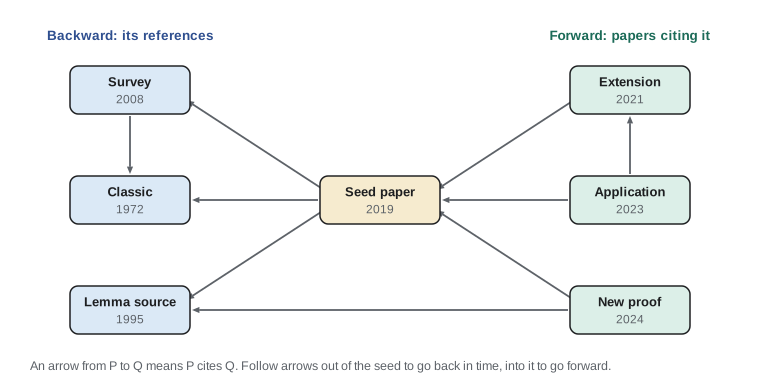
Forward searching is especially valuable for checking whether your idea has been done recently. If a 2007 expository paper presents the basic bijection, a search of papers citing it may reveal a 2015 paper on exactly the generalization you were planning, which you would want to know about now rather than at your oral examination.
The following program explores a small citation graph by breadth-first search in both directions, reporting how many steps each paper is from the seed. Real citation data can be exported from the databases in similar form; the graph here is a toy whose shape mirrors the figure.
from collections import deque

cites = {   # paper: list of papers it cites
    'seed2019': ['survey2008', 'classic1972', 'lemma1995'],
    'survey2008': ['classic1972'],
    'ext2021': ['seed2019'],
    'app2023': ['seed2019', 'ext2021'],
    'proof2024': ['seed2019', 'lemma1995'],
    'classic1972': [], 'lemma1995': [],
}
cited_by = {p: [] for p in cites}
for p, refs in cites.items():
    for q in refs:
        cited_by[q].append(p)

def trail(start, graph):
    dist, queue = {start: 0}, deque([start])
    while queue:
        p = queue.popleft()
        for q in graph[p]:
            if q not in dist:
                dist[q] = dist[p] + 1
                queue.append(q)
    return dist

back = trail('seed2019', cites)
fwd = trail('seed2019', cited_by)
print("backward:", {p: d for p, d in back.items() if d})
print("forward: ", {p: d for p, d in fwd.items() if d})
# papers that cite the seed AND share a reference with it are especially relevant
shared = [p for p in cited_by['seed2019'] if set(cites[p]) & set(cites['seed2019'])]
print("cite the seed and share a reference with it:", shared)backward: {'survey2008': 1, 'classic1972': 1, 'lemma1995': 1}
forward: {'ext2021': 1, 'app2023': 1, 'proof2024': 1}
cite the seed and share a reference with it: ['proof2024']Amara's search, step by step
Amara's search illustrates the strategies working together. The OEIS lookup gave the sequence A001227 and its comments. The Wikipedia article on polite numbers, found by searching the vocabulary in those comments, gave the alternative names and a list of references. Its references were a starting point, not an end point: she checked each one in zbMATH Open and the publisher's site. She found that J. J. Sylvester's long 1882 paper on partitions, written with contributions from his student Fabian Franklin and published in volume 5 of the American Journal of Mathematics, contains the fact that the number of representations of \(n\) with at least two terms is the number of odd divisors greater than 1. T. E. Mason published a note in the American Mathematical Monthly in 1912 relating the representations as sums of consecutive integers, allowing zero and negative terms, to odd divisors two-to-one. W. J. LeVeque's 1950 paper in the Canadian Journal of Mathematics studied the counting function more deeply, including its average order. Wai Yan Pong's 2007 article in the College Mathematics Journal gives a clear modern exposition with a bijective proof and introduces the set of possible lengths of representations, which he calls the length spectrum.
From these she drew three conclusions. The main conjecture is a classical theorem, so her thesis must present it as such, with citations. The bijective proof is standard, but she can still give her own careful version. And the length spectrum and the variations she had listed in her proposal are where she has room for her own work: Pong's paper, and searching for papers citing it, would show which variations are already settled.
| Source | What it gave Amara | How she found it |
|---|---|---|
| OEIS A001227 | Conjecture confirmed; comments and references | Searched the first 15 terms |
| Wikipedia: polite numbers | Synonyms, references to check | Searched names from the OEIS comments |
| Sylvester (1882) | Historical origin of the result | Reference trail; verified in zbMATH Open |
| Mason (1912) | The two-to-one count over all integers | Reference trail; verified on the journal site |
| LeVeque (1950) | Average size of the counting function | Reference trail and classification 11P83 |
| Pong (2007) | Modern bijective proof; length spectrum | Reference trail; also on the arXiv |
General search engines and AI tools
General search engines, Google Scholar and Semantic Scholar are useful for finding recent preprints, lecture notes and expository material that the reviewing databases may not cover, and for full-text searching of phrases that appear inside papers. AI assistants can suggest search terms, explain unfamiliar notation and sometimes point to relevant results. But both kinds of tool can mislead. Search engines rank by popularity rather than authority. AI assistants can produce references that look plausible but are wrong or entirely fictional, with real-sounding authors, journals and years. The rule is absolute: no reference enters your bibliography until you have seen the actual document, checked that it says what you claim, and recorded its bibliographic details from the source itself.
Recording what you find
As you search, record the search itself: which databases, which keywords and classification codes, which dates. This takes moments and pays off in two ways. If you later need to show that a result is new, a record of a careful search is your evidence. And when you search again months later, you will know what you have already covered. Combine this with the reading log of lesson 3 and a reference manager, and you will have the raw material for both the background chapter and the bibliography of the thesis.
Worked problem
Is the length spectrum question open?
Amara wants to know which sets of lengths can occur: for which \(n\) does a representation with exactly \(k\) terms exist? How should she decide whether this is known?
Show solution
- Work out the answer for small cases herself first, so that she can recognize it in the literature. From \(2n = k(2a + k - 1)\) with \(a \ge 1\): if \(k\) is odd, she needs \(k \mid n\) and \(n/k > (k - 1)/2\); if \(k\) is even, she needs \(n/(k/2)\) to be an odd integer greater than \(k\), that is \(k/2 \mid n\) with \(2n/k\) odd and \(2n/k > k\).
- Read Pong's paper in a second pass: it treats exactly these length conditions.
- Search forward from Pong (2007) and LeVeque (1950) in zbMATH Open and Google Scholar for later papers, and search the OEIS for sequences such as the numbers with a representation of each fixed length.
- Record the outcome: the basic length conditions are known, so she will present them with citation and look for less-studied refinements, such as which pairs of lengths can occur together.
Answer: A question is judged open only after a recorded search through the reviewing databases, sequence lookup and forward citation trails from the most relevant papers. Here the basic question is known, and the search itself points to refinements.
Common mistakes
MistakeSearching one database with one keyword and concluding a result is new.
InsteadUse several databases, synonyms, classification codes, sequence lookup and forward citation searches, and record what you did.
MistakeCiting references found in another bibliography or suggested by an AI tool without checking them.
InsteadSee every source yourself and take bibliographic details from the document.
MistakeIgnoring old papers because the notation is unfamiliar.
InsteadClassical sources often contain the result you need; modern surveys can translate the notation.
MistakeStopping the search once the main result is found to be known.
InsteadKnown results come with literature that reveals open variations and better proofs.
MistakeTrusting a match between data and formula without understanding it.
InsteadCheck that the formula provably equals your quantity; numerical agreement on small cases can be coincidental.
Summary and key terms
- Searching mathematics requires synonyms, classification codes, sequence lookup and citation trails, because terminology and notation vary.
- MathSciNet (Mathematical Reviews, founded 1940) and zbMATH Open (from Zentralblatt, founded 1931; free since January 2021) index and review the literature.
- MSC2020 classifies mathematics by codes such as 11P83, which find papers with unfamiliar vocabulary.
- The OEIS, begun by Neil Sloane in 1964 and online since 1996, holds over 390,000 sequences and quickly identifies known patterns.
- Backward trails follow references; forward trails find later papers citing a seed, including recent generalizations.
- Every reference must be checked against the actual document, and searches should be recorded.
- MathSciNet
- The online database of Mathematical Reviews, published by the American Mathematical Society.
- zbMATH Open
- The freely available successor of Zentralblatt für Mathematik.
- MSC2020
- The current Mathematics Subject Classification scheme.
- OEIS
- The On-Line Encyclopedia of Integer Sequences.
- forward citation search
- Finding later works that cite a given paper.
- polite number
- A positive integer that is a sum of two or more consecutive positive integers.
Practice problems
Work each problem on paper first, then reveal the answer to check.
Give three alternative names under which results on Amara's problem appear.
Show answer
Polite numbers (and politeness), trapezoidal numbers, staircase numbers; also partitions into consecutive parts.
Explain why forward citation searching can reveal that your planned generalization has already been done.
Show answer
Papers that generalize a result usually cite it, so searching for works citing the seed finds them, including recent ones not in any older reference list.
Run the candidate-matching program. At which \(n\) does the halved-divisors-of-\(2n\) candidate first fail, and why?
Show answer
At \(n = 4\): \(2n = 8\) has 4 divisors, half is 2, but \(r(4) = 1\). In general it gives \((e + 2)\tau(m)/2\) with integer halving, which equals \(\tau(m)\) only for \(e = 0\).
Using the length conditions, decide whether 30 has a representation with exactly 4 terms.
Show answer
\(k = 4\) needs \(2 \mid 30\) and \(2n/k = 15\) odd and greater than 4: yes, \(a = (15 - 4 + 1)/2 = 6\), giving \(6 + 7 + 8 + 9 = 30\).
Why might zbMATH Open be preferred to a general web search for checking a reference?
Show answer
It records verified bibliographic data, author identities and reviews from the literature itself, while web results may be inaccurate copies.
An AI assistant gives you a reference: Smith, J., On polite numbers, Annals of Mathematics 104 (1976). What should you do before citing it?
Show answer
Look it up in MathSciNet or zbMATH and on the journal site, and read it. If it cannot be found, it must not be cited; plausible-looking invented references are a known failure of such tools.
Lesson quiz · 5 questions
Score 60% or more to complete this lesson.
Create a free account to save your progress, take quizzes and earn a certificate.