
MATH-499 · Lesson 2 of 12 · 25 min
Choosing a topic and a supervisor
The two decisions that most affect an honors project are made in its first few weeks: what to work on, and with whom. Students tend to agonize over the first and neglect the second, but experienced supervisors will tell you that the match between student and supervisor predicts the outcome at least as well as the topic does. This lesson treats both decisions systematically. It describes where good questions come from, how to test whether a question is the right size, how to approach potential supervisors, and how to turn a choice into a plan with milestones. It ends with Amara's own decision and a timeline for her year.
Where good topics come from
Most honors topics arrive by one of four routes.
From a supervisor's list. Many departments publish lists of projects offered by faculty members. These have the great advantage of being pre-sized by someone who knows the area: a supervisor who offers a project usually has a reasonable idea of where it can go and what a student might achieve. The disadvantage is that you are working on someone else's question and must take the time to make it your own.
From a course that excited you. A theorem from MATH-351 or MATH-460 that you found beautiful, a proof you did not fully understand, or a remark in a lecture that the general case is still open can all seed a project. Take the idea to the lecturer of that course: they are the natural supervisor and will know whether it leads anywhere.
From your own curiosity, as with Amara's consecutive sums. Self-generated questions are motivating and often surprisingly good, but they need a reality check. The question may be trivial, impossibly hard, or completely solved in a paper from 1925. A potential supervisor can usually tell within a short conversation, which is why you should talk to one early.
From an application. Questions from physics, biology, economics, computer science or industry often contain mathematical problems suitable for a project, especially in modeling, optimization, statistics and numerical analysis. The challenge is to isolate a mathematical question from the applied context and to make sure the project is assessed as mathematics, with theorems and proofs or rigorous analysis, rather than as a report on the application.
Sizing a question
A good honors question has a ladder of versions: a version you are confident you can finish, a version you hope to finish and a version you would be delighted to finish. If the only version of the question is the hardest one, the project is a gamble. If even the hardest version is easy, the project will be thin. Here is the ladder for the model project.
| Level | Question | Expected outcome |
|---|---|---|
| Floor | Which n are sums of two or more consecutive positive integers? | Exactly the non-powers of two; short proof |
| Target | How many representations does n have? | The number of odd divisors; bijective proof |
| Stretch | How many representations with exactly k terms, or with consecutive odd numbers, squares, or terms of an arithmetic progression? | Several partial results, some computational |
| Moonshot | Asymptotic distribution of the counts; analogues for consecutive primes | Experiments, heuristics, possibly open problems |
Several tests help to size a question. Can you compute examples within the first week? If not, you will have nothing to look at while you think. Do you understand what an answer would look like: a formula, a classification, an inequality, an algorithm, a counterexample? Does a natural special case exist that you are confident you can do? Is there literature, and if so is the question already completely answered? Does the question connect to mathematics you know, so that you are not learning three new fields before you can start? A question that passes all five tests is probably well sized.
Choosing a supervisor
A supervisor is chosen for expertise, availability and fit. Expertise matters because a supervisor in the right area can point you to the key paper in an afternoon, recognize when a result is known and spot the standard trick you are missing. Availability matters because a brilliant supervisor who meets you twice a term will be less useful than a competent one who meets you every week. Fit concerns working styles: some students want detailed guidance and frequent deadlines, others want freedom and occasional advice, and supervisors vary in the same way.
Before approaching someone, read a little of their work: their course notes, the abstracts of a few recent papers, their list of past honors projects if the department publishes one. Then write a short, specific email. Say who you are and which courses you have taken, say what interests you and why you are writing to them in particular, mention any idea you already have in a sentence or two, and ask whether they would be willing to meet to discuss possible projects. A message of this kind takes ten minutes to write and is far more likely to get a positive response than a generic request for any project.
At the first meeting, ask questions as well as answering them. How often do they usually meet honors students? What do they expect to see at meetings? How do they prefer to receive drafts? Are they on leave or traveling for part of the year? What happened in projects they supervised before? These questions are entirely normal and help both of you decide whether the arrangement will work.
A decision matrix
When choosing between several candidate topics, it can help to make your criteria explicit. Write down the criteria that matter to you, give each a weight, score each candidate from 1 to 5 on each criterion and compute weighted totals. The numbers will not make the decision for you, and should not, but the exercise forces you to state what matters and frequently reveals that you were overweighting something, such as how impressive a topic sounds, relative to things that predict success, such as your background and the supervisor's fit.
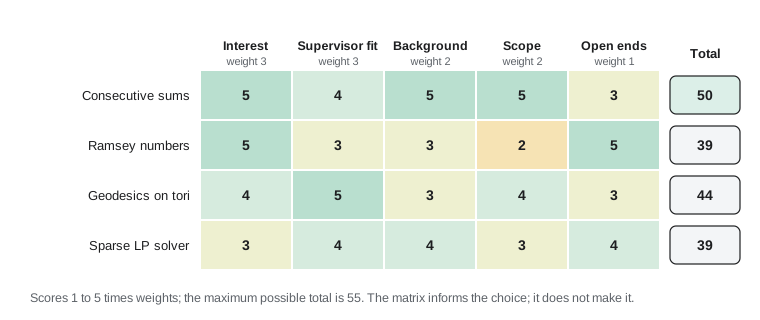
The matrix above is Amara's. She was genuinely interested in Ramsey numbers after MATH-460, and the topic scores highly on interest and on open ends, but she lacked the background in probabilistic methods that a serious attack requires and the scope was hard to control: the smallest unknown classical Ramsey number, \(R(5,5)\), has resisted decades of work. The geodesics project scored well on supervisor fit, and the optimization project was solid but less interesting to her. The weighted totals confirmed what she suspected, and she also noticed that the consecutive-sums project had the best floor: she was confident of a result within weeks.
The program below computes such a matrix and also tests its sensitivity. A decision that flips when one weight changes by one is a close call that deserves more thought; a decision that survives all such changes is robust.
criteria = ['interest', 'supervisor fit', 'background', 'scope', 'open ends']
weights  = [3, 3, 2, 2, 1]
scores = {
    'consecutive sums':  [5, 4, 5, 5, 3],
    'Ramsey numbers':    [5, 3, 3, 2, 5],
    'geodesics on tori': [4, 5, 3, 4, 3],
    'sparse LP solver':  [3, 4, 4, 3, 4],
}

def totals(w):
    return {t: sum(a * b for a, b in zip(w, s)) for t, s in scores.items()}

base = totals(weights)
best = max(base, key=base.get)
for t, v in sorted(base.items(), key=lambda kv: -kv[1]):
    print(f"{t:18s} {v:3d}")
print("best:", best)

# sensitivity: change each weight by -1 or +1 and see whether the winner changes
flips = []
for i in range(len(weights)):
    for d in (-1, 1):
        w = weights[:]
        w[i] = max(0, w[i] + d)
        t = totals(w)
        winner = max(t, key=t.get)
        if winner != best:
            flips.append((criteria[i], d, winner))
print("winner changes under single-weight changes:", flips if flips else "none")
margin = base[best] - sorted(base.values())[-2]
print("margin over runner-up:", margin)consecutive sums 50 geodesics on tori 44 Ramsey numbers 39 sparse LP solver 39 best: consecutive sums winner changes under single-weight changes: none margin over runner-up: 6
The project proposal
Many departments ask for a short proposal within the first month. Even when they do not, writing one is valuable. A proposal of one or two pages should state the question in its floor, target and stretch versions; summarize what is known, with two or three key references; describe the planned approach, including any computations; list milestones; and identify risks. Writing it forces you to discover whether you can state the question precisely, and gives your supervisor something concrete to respond to.
Worked problem
Amara's proposal, in brief
Write the core of a one-page proposal for the consecutive-sums project.
Show solution
- Question. For a positive integer \(n\), let \(r(n)\) be the number of ways of writing \(n\) as a sum of one or more consecutive positive integers. Determine \(r(n)\), characterize the \(n\) with \(r(n) = 1\), and study variations: a fixed number of terms, sums of consecutive odd integers, and sums of consecutive squares.
- Known results. Computations for \(n \le 40\) suggest \(r(n)\) equals the number of odd divisors of \(n\). The literature search in month one will determine whether this is known and where.
- Approach. Reduce to the equation \(2n = k(2a + k - 1)\) and analyze the parity of the factors; seek a bijection between representations and odd divisors; use computation to explore the variations and to test every conjecture beyond \(n = 10^5\).
- Milestones. Literature search and floor result by the end of October; target result with full proof by mid-December; variations and interim talk in January and February; full draft by mid-March.
- Risks. The main question may be well known, in which case the originality must come from the variations; sums of consecutive squares may lead to hard Diophantine problems, so they are a stretch goal only.
Answer: The proposal states the question at three levels, plans the literature search, names concrete methods and dates, and identifies risks with fallback plans. This is what supervisors look for.
A timeline
A plan with dates turns good intentions into a schedule. The chart below is a typical eight-month plan. Observe that reading, experimenting and writing overlap rather than following one another, and that there is a deadline for a full draft well before the final deadline. Students consistently underestimate how long writing and revision take; a common rule is that writing takes at least twice as long as you expect, even after you have applied this rule.
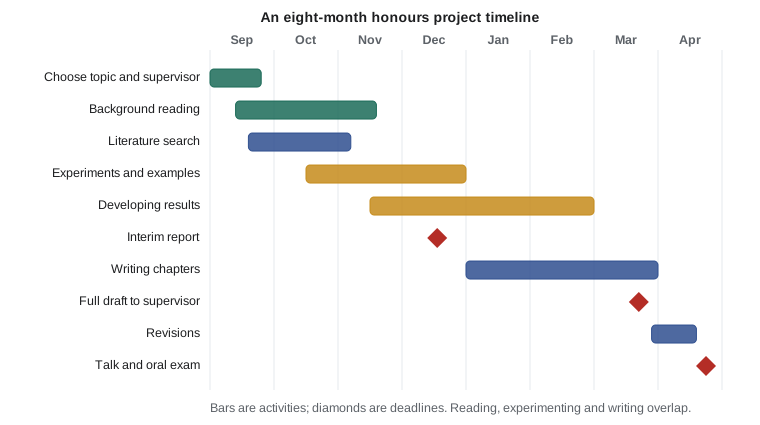
Build in slack. Illness, other courses, a proof that collapses in February: something will go wrong, and a plan with no slack will fail the first time it does. Two weeks of unallocated time before the final deadline is a sensible minimum. The program below takes a list of tasks with estimated durations and dependencies and computes the earliest finish date, which is the simplest version of the critical path method used in project management.
from datetime import date, timedelta

# task: (weeks, prerequisites)
tasks = {
    'choose topic':      (2, []),
    'reading':           (8, ['choose topic']),
    'literature search': (5, ['choose topic']),
    'experiments':       (8, ['choose topic']),
    'main results':      (12, ['reading', 'experiments']),
    'interim talk':      (1, ['experiments', 'literature search']),
    'draft chapters':    (10, ['main results']),
    'revisions':         (3, ['draft chapters']),
    'final talk':        (1, ['revisions']),
}

finish = {}
def earliest_finish(t):
    if t not in finish:
        weeks, pre = tasks[t]
        start = max((earliest_finish(p) for p in pre), default=0)
        finish[t] = start + weeks
    return finish[t]

for t in tasks:
    earliest_finish(t)

start_day = date(2026, 9, 8)
for t, f in sorted(finish.items(), key=lambda kv: kv[1]):
    print(f"{t:18s} finishes end of week {f:2d}  ({start_day + timedelta(weeks=f)})")

# the critical path: walk back from the last task through the latest-finishing prerequisite
path, t = [], max(finish, key=finish.get)
while True:
    path.append(t)
    pre = tasks[t][1]
    if not pre:
        break
    t = max(pre, key=lambda p: finish[p])
print("critical path:", ' -> '.join(reversed(path)))
print("total weeks:", max(finish.values()), "of about 32 available")choose topic finishes end of week 2 (2026-09-22) literature search finishes end of week 7 (2026-10-27) reading finishes end of week 10 (2026-11-17) experiments finishes end of week 10 (2026-11-17) interim talk finishes end of week 11 (2026-11-24) main results finishes end of week 22 (2027-02-09) draft chapters finishes end of week 32 (2027-04-20) revisions finishes end of week 35 (2027-05-11) final talk finishes end of week 36 (2027-05-18) critical path: choose topic -> reading -> main results -> draft chapters -> revisions -> final talk total weeks: 36 of about 32 available
The plan fits in about 32 teaching weeks only if the main results take no more than twelve weeks and the drafting starts as soon as they are done. In reality the main results will not finish on a fixed date, which is why lesson 9 recommends drafting chapters in parallel with the research rather than afterwards. The critical path tells you which tasks have no slack: a delay in reading or in the main results delays everything, while a delay in the literature search does not.
Working with your supervisor through the year
Agree on a meeting rhythm at the start, and keep a project notebook, physical or electronic, in which you record what you tried, what worked, what failed and what you plan to do next. Before each meeting, send a short note listing what you have done and what you want to discuss. After each meeting, write down the advice you received and the actions agreed. This habit costs a few minutes and saves hours of repeated discussion; it also produces a record you will be glad of when writing the thesis, because many of the examples and remarks in a good thesis originate in exactly these notes.
If the relationship is not working, because meetings keep being canceled, advice is unclear or you feel unable to ask questions, raise it early, first with the supervisor and then, if necessary, with the honors coordinator. Problems discovered in March are much harder to fix than problems discovered in October.
Common mistakes
MistakeChoosing a topic solely because it sounds impressive.
InsteadWeigh interest against background, scope and supervisor fit; a modest topic done well beats an ambitious one abandoned.
MistakeSending a generic email asking any professor for any project.
InsteadWrite a specific message showing you know their area and suggesting an idea or interest.
MistakeHaving a question with only one, hard version.
InsteadBuild a ladder of floor, target and stretch versions so that progress is guaranteed at some level.
MistakePlanning writing as a single block at the end.
InsteadDraft in parallel with the research and schedule a full draft weeks before the deadline.
MistakeKeeping no record of meetings and failed attempts.
InsteadKeep a project notebook; failed attempts often become remarks or counterexamples in the thesis.
Summary and key terms
- Topics come from supervisors' lists, courses, your own curiosity or applications; each route has strengths and risks.
- A good question has floor, target and stretch versions, examples you can compute early and a recognizable form of answer.
- Choose a supervisor for expertise, availability and fit; approach with a short, specific message and ask about working practices.
- A weighted decision matrix makes criteria explicit, and a sensitivity check shows how robust the choice is.
- A one-page proposal states the question at several levels, the known results, the approach, milestones and risks.
- A timeline with overlapping activities, a critical path and slack keeps the project on schedule.
- floor result
- The version of the project question you are confident of completing.
- stretch goal
- A harder version of the question pursued if time allows.
- decision matrix
- A table of options scored against weighted criteria.
- project proposal
- A short document stating the question, background, approach, milestones and risks.
- critical path
- The chain of dependent tasks that determines the earliest possible finish date.
- slack
- Unallocated time in a schedule that absorbs delays.
Practice problems
Work each problem on paper first, then reveal the answer to check.
Write a floor, target and stretch version of the question: which graphs have a Hamiltonian cycle?
Show answer
Floor: prove and illustrate Dirac's and Ore's sufficient conditions with examples. Target: study Hamiltonicity in a specific family, such as generalized Petersen graphs, by proof and computer search. Stretch: find new sufficient conditions for that family or count Hamiltonian cycles.
In the decision matrix, by how much would the weight on open ends have to rise, all else fixed, for Ramsey numbers to overtake consecutive sums?
Show answer
The totals are 50 and 39 with open-ends scores 3 and 5. Raising the weight by \(w\) adds \(3w\) and \(5w\), so we need \(39 + 5w > 50 + 3w\), that is \(w > 5.5\): the weight would have to reach 7. The choice is robust.
List three questions to ask a potential supervisor at a first meeting.
Show answer
For example: how often they meet honors students; how they prefer to receive drafts and how quickly they usually respond; whether they will be away during the year; what past students in their projects produced.
In the critical-path program, which tasks have slack, and how much?
Show answer
The literature search finishes in week 7 but is needed only by the interim talk, which also waits for experiments (week 10), so it has 3 weeks of slack; the interim talk itself has a great deal of slack since nothing depends on it.
Name two risks for a project on sums of consecutive squares and a fallback for each.
Show answer
The Diophantine equations may be intractable in general: fall back to small numbers of terms or computation. The problem may be fully solved in the literature: shift to an expository account plus a new variation.
Why should a proposal identify risks rather than present an optimistic plan?
Show answer
Naming risks shows the supervisor you understand the problem, and planning fallbacks in advance protects the project when something fails, as something always does.
Lesson quiz · 5 questions
Score 60% or more to complete this lesson.
Create a free account to save your progress, take quizzes and earn a certificate.