
MATH-445 · Lesson 8 of 12 · 23 min
Baire category, the uniform boundedness principle and the open mapping theorem
The Hahn–Banach theorem works in any normed space. The theorems of this lesson need completeness, and they get their power from a single topological fact about complete metric spaces, the Baire category theorem: such a space cannot be a countable union of thin sets. From it we deduce the uniform boundedness principle, which turns pointwise bounds on a family of operators into a uniform bound; the open mapping theorem, which says that a bounded surjection between Banach spaces has a bounded right inverse in a quantitative sense and that a bounded bijection has a bounded inverse; and the closed graph theorem, which gives a practical test for boundedness. Along the way we prove that there are continuous functions whose Fourier series diverge, that infinite-dimensional Banach spaces have no countable algebraic basis, and that a symmetric operator defined on a whole Hilbert space must be bounded.
The Baire category theorem
A subset \(E\) of a metric space is nowhere dense if its closure has empty interior, that is, if every open ball contains a smaller open ball disjoint from \(E\). A countable union of nowhere dense sets is called meager, or of first category; a set that is not meager is of second category, and the complement of a meager set is called comeager or residual.
Theorem 8.1 (Baire category theorem). Let \((X, d)\) be a nonempty complete metric space. (a) If \(U_1, U_2, \ldots\) are dense open subsets, then \(\bigcap_n U_n\) is dense. (b) Equivalently, \(X\) is not meager: if \(X = \bigcup_n F_n\) with each \(F_n\) closed, then some \(F_n\) contains an open ball.
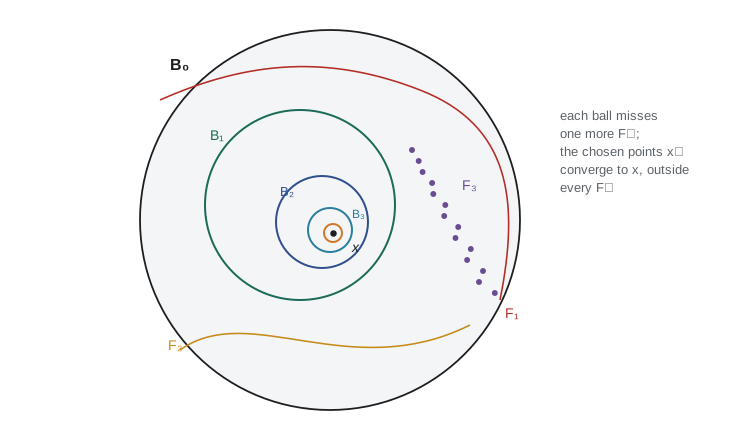
Proof. (a) Let \(B_0\) be any open ball; we find a point of \(\bigcap U_n\) in it. Since \(U_1\) is dense and open, \(B_0 \cap U_1\) is a nonempty open set, so it contains a closed ball \(\overline{B}(x_1, r_1)\) with \(r_1 < 1\). Inductively, \(B(x_{n-1}, r_{n-1}) \cap U_n\) is nonempty and open, so it contains a closed ball \(\overline{B}(x_n, r_n)\) with \(r_n < \frac{1}{n}\). The centers satisfy \(x_m \in \overline{B}(x_n, r_n)\) for \(m \ge n\), so \(d(x_m, x_n) < \frac{1}{n}\) and \((x_n)\) is Cauchy. Its limit \(x\) lies in every closed ball \(\overline{B}(x_n, r_n)\), hence in \(B_0\) and in every \(U_n\). (b) If \(X = \bigcup F_n\) with closed \(F_n\) having empty interior, then \(U_n = X \setminus F_n\) are dense open sets with empty intersection, contradicting (a). \(\blacksquare\)
René Baire proved the theorem for \(\mathbb{R}^n\) in his thesis of 1899; the version for complete metric spaces is due to Hausdorff in 1914 and was put to work in functional analysis by Banach and Steinhaus. The proof is a nested balls argument, the same one that shows the real line is uncountable. Its conclusion is a statement of size: comeager sets are large in the sense of category, even though they may have measure zero (the dense \(G_\delta\) set of Liouville numbers in \(\mathbb{R}\) is comeager and null).
Corollary 8.2. A Hamel basis of an infinite-dimensional Banach space is uncountable. Proof: suppose \(\{b_1, b_2, \ldots\}\) were a countable Hamel basis. Then \(X = \bigcup_n F_n\) with \(F_n = \operatorname{span}\{b_1, \ldots, b_n\}\). Each \(F_n\) is finite dimensional, hence closed (Theorem 1.3), and it has empty interior because a subspace containing a ball contains every vector. This contradicts Baire's theorem. \(\blacksquare\) So the space of polynomials, and the space \(c_{00}\), which have countable Hamel bases, admit no complete norm at all.
A famous application is to continuous functions. Banach and Mazurkiewicz showed in 1931 that the set of functions in \(C[0, 1]\) that have a finite derivative at some point is meager. Hence a typical continuous function in the sense of category is nowhere differentiable, although writing one down explicitly, as Weierstrass did in 1872 with \(\sum a^n \cos(b^n \pi x)\), takes real work.
The uniform boundedness principle
Theorem 8.3 (uniform boundedness principle; Banach and Steinhaus, 1927). Let \(X\) be a Banach space, \(Y\) a normed space and \(\mathcal{T} \subseteq B(X, Y)\) a family of operators with \(\sup_{T \in \mathcal{T}} \|Tx\| < \infty\) for every \(x \in X\). Then \(\sup_{T \in \mathcal{T}} \|T\| < \infty\).
Proof. For each \(n\) let \(F_n = \{x \in X : \|Tx\| \le n \text{ for all } T \in \mathcal{T}\}\). Each \(F_n\) is closed, as an intersection of the closed sets \(\{x : \|Tx\| \le n\}\), and the hypothesis says \(X = \bigcup_n F_n\). By Baire, some \(F_N\) contains a ball \(\overline{B}(x_0, r)\). For \(\|z\| \le r\) and \(T \in \mathcal{T}\), \(\|Tz\| \le \|T(x_0 + z)\| + \|Tx_0\| \le 2N\). Hence \(\|T\| \le 2N / r\) for every \(T \in \mathcal{T}\). \(\blacksquare\)
The contrapositive is often more useful. If \(\sup \|T\| = \infty\), then the set of \(x\) with \(\sup_T \|Tx\| = \infty\) is not just nonempty but comeager: its complement \(\bigcup F_n\) is a countable union of closed sets, each with empty interior by the argument just given. Completeness of \(X\) is essential. On \(c_{00}\) with the supremum norm, the functionals \(f_n(x) = n x_n\) are pointwise bounded, since each \(x\) has only finitely many nonzero terms, but \(\|f_n\| = n\).
Corollary 8.4 (Banach–Steinhaus). If \(X\) is a Banach space and \(T_n \in B(X, Y)\) converge pointwise to a limit \(Tx = \lim T_n x\), then \(T\) is bounded and \(\|T\| \le \liminf \|T_n\|\). Proof: convergent sequences are bounded, so the principle gives \(\sup \|T_n\| < \infty\), and \(\|Tx\| = \lim \|T_n x\| \le \liminf \|T_n\| \, \|x\|\). \(\blacksquare\) Note that pointwise convergence does not imply \(\|T_n - T\| \to 0\): the coordinate projections \(P_n\) onto the first \(n\) entries of \(\ell^2\) converge pointwise to \(I\) while \(\|I - P_n\| = 1\).
Continuous functions with divergent Fourier series
For a continuous \(2\pi\)-periodic function \(f\), the partial sum of its Fourier series at \(0\) is \(S_N f(0) = \frac{1}{2\pi} \int_{-\pi}^{\pi} f(t) D_N(t) \, dt\), with the Dirichlet kernel \(D_N(t) = \sum_{|n| \le N} e^{int} = \frac{\sin((N + \frac{1}{2})t)}{\sin(t/2)}\). Each \(\phi_N(f) = S_N f(0)\) is a bounded functional on the Banach space \(C(\mathbb{T})\) of continuous periodic functions with the supremum norm, and by the computation of lesson 3 its norm is the Lebesgue constant \[L_N = \frac{1}{2\pi} \int_{-\pi}^{\pi} |D_N(t)| \, dt.\]
Lemma 8.5. \(L_N \ge \frac{4}{\pi^2} \sum_{k=1}^{N} \frac{1}{k}\), so \(L_N \to \infty\) like \(\frac{4}{\pi^2} \ln N\). Proof: since \(|\sin(t/2)| \le |t|/2\), \(L_N \ge \frac{2}{\pi} \int_0^\pi \frac{|\sin((N + \frac{1}{2})t)|}{t} \, dt = \frac{2}{\pi} \int_0^{(N + 1/2)\pi} \frac{|\sin s|}{s} \, ds\). Split the last integral over the intervals \([(k - 1)\pi, k\pi]\) for \(k = 1, \ldots, N\): on each, \(\frac{1}{s} \ge \frac{1}{k\pi}\) and \(\int |\sin s| = 2\), giving \(\frac{2}{\pi} \sum_{k=1}^{N} \frac{2}{k\pi}\). \(\blacksquare\)
Theorem 8.6 (du Bois-Reymond, 1873). There is a continuous periodic function whose Fourier series diverges at \(0\); in fact the set of such functions is comeager in \(C(\mathbb{T})\). Proof: the functionals \(\phi_N\) have norms \(L_N \to \infty\), so by the contrapositive of the uniform boundedness principle the set of \(f\) with \(\sup_N |S_N f(0)| = \infty\) is comeager. \(\blacksquare\) Du Bois-Reymond's original construction was explicit and intricate; the Baire argument, due to Banach and Steinhaus, takes two lines once the Lebesgue constants are known. Applying it to a countable dense set of points shows that a comeager set of continuous functions has Fourier series diverging on a dense \(G_\delta\) set of points. Carleson's theorem guarantees that this divergence set still has measure zero.
# Lebesgue constants L_N = (1/2 pi) * integral of |D_N|, and continuous f with |f| <= 1 making S_N f(0) large.
import math

def D(N, t):
    return (2 * N + 1) if abs(t) < 1e-12 else math.sin((N + 0.5) * t) / math.sin(t / 2)

def lebesgue_constant(N, M=200000):
    h = math.pi / M                          # D_N is even: integrate over (0, pi) and double
    return 2 * h * sum(abs(D(N, (k + 0.5) * h)) for k in range(M)) / (2 * math.pi)

for N in (1, 4, 16, 64, 256, 1024):
    LN = lebesgue_constant(N)
    lower = 4 / math.pi ** 2 * sum(1 / k for k in range(1, N + 1))
    print(f"N = {N:5d}: L_N = {LN:.4f}  lower bound = {lower:.4f}  L_N - (4/pi^2) ln N = {LN - 4 / math.pi ** 2 * math.log(N):.4f}")

# a continuous f with |f| <= 1 that nearly attains the norm: smooth out the sign of D_N
N, M = 64, 200000
h = math.pi / M
f = lambda t: math.tanh(50 * D(N, t))      # continuous, values in (-1, 1)
val = 2 * h * sum(f((k + 0.5) * h) * D(N, (k + 0.5) * h) for k in range(M)) / (2 * math.pi)
print(f"S_64 f(0) for f = tanh(50 D_64): {val:.4f} versus L_64 = {lebesgue_constant(64):.4f}")N = 1: L_N = 1.4360 lower bound = 0.4053 L_N - (4/pi^2) ln N = 1.4360 N = 4: L_N = 1.8801 lower bound = 0.8443 L_N - (4/pi^2) ln N = 1.3182 N = 16: L_N = 2.4065 lower bound = 1.3702 L_N - (4/pi^2) ln N = 1.2828 N = 64: L_N = 2.9590 lower bound = 1.9226 L_N - (4/pi^2) ln N = 1.2735 N = 256: L_N = 3.5185 lower bound = 2.4821 L_N - (4/pi^2) ln N = 1.2711 N = 1024: L_N = 4.0798 lower bound = 3.0434 L_N - (4/pi^2) ln N = 1.2706 S_64 f(0) for f = tanh(50 D_64): 2.9590 versus L_64 = 2.9590
The differences \(L_N - \frac{4}{\pi^2} \ln N\) settle down to a constant near \(1.27\), confirming the logarithmic growth. The function \(\tanh(50 D_N)\) is a continuous approximation to the sign of \(D_N\), and \(S_N f(0)\) for it is close to \(L_N\). The uniform boundedness principle glues infinitely many such near-extremal functions, for a sparse sequence of values of \(N\), into a single continuous function whose partial sums at \(0\) are unbounded.
The open mapping theorem
Theorem 8.7 (open mapping theorem; Banach 1929, Schauder 1930). Let \(X, Y\) be Banach spaces and \(T \in B(X, Y)\) surjective. Then \(T\) is an open map: it sends open sets to open sets. Equivalently, there is \(\delta > 0\) with \(T(B_X) \supseteq \delta B_Y\), where \(B\) denotes an open unit ball.
Proof. Step 1: \(\overline{T(B_X)}\) contains a ball around \(0\). Since \(T\) is onto, \(Y = \bigcup_n \overline{T(nB_X)}\). By Baire, some \(\overline{T(nB_X)} = n \overline{T(B_X)}\) contains a ball, so \(\overline{T(B_X)}\) contains a ball \(B(y_0, \eta)\). This set is convex and symmetric, so it also contains \(B(-y_0, \eta)\), and by convexity \(\frac{1}{2}(B(y_0, \eta) + B(-y_0, \eta)) \supseteq B(0, \eta)\). So \(\overline{T(B_X)} \supseteq \eta B_Y\), and by scaling \(\overline{T(rB_X)} \supseteq r\eta B_Y\) for all \(r > 0\).
Step 2: removing the closure. Let \(\|y\| < \eta / 2\). By step 1 with \(r = \frac{1}{2}\), there is \(x_1\) with \(\|x_1\| < \frac{1}{2}\) and \(\|y - Tx_1\| < \frac{\eta}{4}\). Applying step 1 with \(r = \frac{1}{4}\) to \(y - Tx_1\), there is \(x_2\) with \(\|x_2\| < \frac{1}{4}\) and \(\|y - Tx_1 - Tx_2\| < \frac{\eta}{8}\). Continuing, we get \(x_k\) with \(\|x_k\| < 2^{-k}\) and \(\|y - T(x_1 + \cdots + x_k)\| < \eta 2^{-k-1}\). The series \(x = \sum x_k\) converges absolutely in the Banach space \(X\), with \(\|x\| < 1\), and continuity of \(T\) gives \(Tx = y\). So \(T(B_X) \supseteq \frac{\eta}{2} B_Y\). Finally, if \(U\) is open and \(x \in U\) with \(x + \varepsilon B_X \subseteq U\), then \(T(U) \supseteq Tx + \varepsilon\frac{\eta}{2} B_Y\), so \(T(U)\) is open. \(\blacksquare\)
Completeness of \(Y\) was used in step 1 (Baire) and completeness of \(X\) in step 2 (summing the series). The quantitative form says: every \(y\) has a preimage \(x\) with \(\|x\| \le C\|y\|\), where \(C = 2/\eta\). This is an a priori estimate in disguise: if an equation \(Tx = y\) is solvable for every \(y\), then it is solvable with control of the solution by the data.
Corollary 8.8 (inverse mapping theorem). A bounded linear bijection between Banach spaces has a bounded inverse. Proof: \(T^{-1}\) is continuous because \(T\) maps open sets to open sets. \(\blacksquare\) Corollary 8.9. If a vector space is complete under two norms with \(\|x\|_a \le C \|x\|_b\), then the norms are equivalent. Proof: the identity from \((X, \|\cdot\|_b)\) to \((X, \|\cdot\|_a)\) is a bounded bijection. \(\blacksquare\) For instance, no norm on \(C[0, 1]\) dominated by the supremum norm, such as the integral norm, can make the space complete, unless it is equivalent to the supremum norm.
The closed graph theorem
The graph of a linear map \(T : X \to Y\) is \(G(T) = \{(x, Tx) : x \in X\}\), a subspace of \(X \times Y\) with the norm \(\|(x, y)\| = \|x\| + \|y\|\). The graph is closed when: if \(x_n \to x\) and \(Tx_n \to y\), then \(y = Tx\). Every bounded operator has a closed graph. The point of the next theorem is that closedness is easier to check than boundedness, because one may assume both that \(x_n\) and that \(Tx_n\) converge.
Theorem 8.10 (closed graph theorem). A linear map between Banach spaces with closed graph is bounded. Proof: \(G(T)\) is a closed subspace of the Banach space \(X \times Y\), hence a Banach space. The projection \(\pi_1(x, Tx) = x\) is a bounded linear bijection from \(G(T)\) onto \(X\), so by Corollary 8.8 its inverse \(x \mapsto (x, Tx)\) is bounded. Therefore \(\|Tx\| \le \|x\| + \|Tx\| \le C\|x\|\). \(\blacksquare\)
Corollary 8.11 (Hellinger and Toeplitz, 1910). If \(T\) is a linear map defined on all of a Hilbert space \(H\) with \(\langle Tx, y \rangle = \langle x, Ty \rangle\) for all \(x, y\), then \(T\) is bounded. Proof: if \(x_n \to x\) and \(Tx_n \to z\), then for all \(y\), \(\langle z, y \rangle = \lim \langle Tx_n, y \rangle = \lim \langle x_n, Ty \rangle = \langle x, Ty \rangle = \langle Tx, y \rangle\), so \(z = Tx\). \(\blacksquare\) The corollary explains why the important symmetric operators of physics, such as position, momentum and energy in quantum mechanics, which are unbounded, cannot be defined on the whole Hilbert space. Lesson 12 deals with operators defined on dense subspaces.
Worked problem
A pointwise bound that is not uniform without completeness
On \(c_{00}\) with the supremum norm, let \(T_n x = n x_n\). Show the hypothesis of Theorem 8.3 holds but the conclusion fails, and explain what goes wrong for \(c_0\).
Show solution
- For fixed \(x \in c_{00}\), \(x_n = 0\) for \(n > N(x)\), so \(\sup_n |T_n x| = \max_{n \le N(x)} n|x_n| < \infty\).
- \(\|T_n\| = n\), attained at \(e_n\), so the norms are unbounded. The principle fails because \(c_{00}\) is not complete.
- On \(c_0\), the sequence \(x_n = n^{-1/2}\) has \(T_n x = \sqrt{n} \to \infty\), and the theorem predicts that the set of such \(x\) is comeager in \(c_0\).
Answer: Completeness is essential: the meager subspace \(c_{00}\) can carry pointwise bounded families that are not uniformly bounded.
Common mistakes
MistakeReading meager as having measure zero.
InsteadCategory and measure are different notions of size; the Liouville numbers are comeager and null.
MistakeApplying the uniform boundedness principle on an incomplete space.
InsteadOn \(c_{00}\) the functionals \(n x_n\) are pointwise bounded with unbounded norms.
MistakeConcluding norm convergence from pointwise convergence of operators.
InsteadProjections \(P_n\) on \(\ell^2\) converge pointwise to \(I\) with \(\|I - P_n\| = 1\).
MistakeProving boundedness from a closed graph without completeness of both spaces.
InsteadThe closed graph theorem uses the open mapping theorem, which needs both spaces complete.
Summary and key terms
- In a complete metric space, countable intersections of dense open sets are dense; the space is not a countable union of nowhere dense sets.
- Infinite-dimensional Banach spaces have uncountable Hamel bases; polynomials admit no complete norm.
- Pointwise bounded families of bounded operators on a Banach space are uniformly bounded; pointwise limits are bounded.
- Lebesgue constants grow like (4/π²) ln N, so some continuous functions have Fourier series diverging at a point.
- Bounded surjections between Banach spaces are open, bounded bijections have bounded inverses, and closed graphs imply boundedness.
- Nowhere dense
- A set whose closure has empty interior.
- First category
- The property of being a countable union of nowhere dense sets; such sets are called meager.
- Uniform boundedness principle
- Pointwise boundedness of operators on a Banach space implies a uniform bound on their norms.
- Open mapping theorem
- A bounded linear surjection between Banach spaces maps open sets to open sets.
- Closed graph
- The property that \(x_n \to x\) and \(Tx_n \to y\) imply \(y = Tx\).
Practice problems
Work each problem on paper first, then reveal the answer to check.
Show that \(\mathbb{Q}\) is meager in \(\mathbb{R}\). Is it meager in itself, and does that contradict Baire’s theorem?
Show answer
\(\mathbb{Q}\) is a countable union of points, which are nowhere dense in \(\mathbb{R}\). In \(\mathbb{Q}\) itself each point is still nowhere dense, so \(\mathbb{Q}\) is meager in itself; there is no contradiction because \(\mathbb{Q}\) is not complete.
Let \(y_n\) be scalars with \(\sum x_n y_n\) convergent for every \(x \in c_0\). Show \(y \in \ell^1\).
Show answer
The functionals \(f_N(x) = \sum_{n \le N} x_n y_n\) have norms \(\sum_{n \le N} |y_n|\) and are pointwise bounded, so these sums are bounded.
Use the inverse mapping theorem to show that \(T(x_n) = (x_n / n)\) on \(\ell^2\) has non-closed range.
Show answer
\(T\) is a bounded injection; if its range were closed it would be a Banach space and \(T^{-1}\) would be bounded, but \(\|T^{-1}e_n\| = n\).
Is the differentiation map from \((C^1[0,1], \|\cdot\|_\infty)\) to \((C[0,1], \|\cdot\|_\infty)\) closed?
Show answer
Yes: if \(f_n \to f\) and \(f_n^{\prime} \to g\) uniformly then \(f^{\prime} = g\). It is unbounded, which is consistent because the domain is not complete.
Explain why \(\ell^1\) with the \(\ell^2\) norm is not a Banach space.
Show answer
The norms satisfy \(\|x\|_2 \le \|x\|_1\); if both were complete they would be equivalent, but \(\|\sum_{k \le n} e_k\|_1 = n\) while the \(\ell^2\) norm is \(\sqrt{n}\).
Lesson quiz · 5 questions
Score 60% or more to complete this lesson.
Create a free account to save your progress, take quizzes and earn a certificate.