
MATH-445 · Lesson 10 of 12 · 25 min
Compact operators and Fredholm theory
Fredholm's discovery, described in lesson 1, was that integral equations \(u - \lambda K u = f\) behave like finite systems of linear equations. The reason is that integral operators with reasonable kernels are compact: they map bounded sets to sets with compact closure, so they are uniformly approximable by operators of finite rank, at least in Hilbert space. This lesson develops compact operators, proves that they form a closed ideal, shows that integral operators with square-integrable kernels are compact, and proves the Fredholm alternative for \(I - K\), the precise sense in which a compact perturbation of the identity behaves like a square matrix. We end with Fredholm operators and their index, illustrated by the shift operators.
Compact operators
Definition 10.1. A linear map \(T : X \to Y\) between normed spaces is compact if the image \(T(B_X)\) of the unit ball has compact closure in \(Y\); equivalently, if for every bounded sequence \((x_n)\), the sequence \((Tx_n)\) has a convergent subsequence. Compact operators are bounded, since relatively compact sets are bounded. The set of compact operators is written \(K(X, Y)\).
Examples. (a) Every bounded operator of finite rank is compact, since bounded sets in a finite-dimensional space are relatively compact. (b) The identity of an infinite-dimensional space is not compact, by Theorem 2.6. (c) The diagonal operator \(D_\lambda\) on \(\ell^2\) with \(\lambda_n \to 0\) is compact, as Theorem 10.2 shows, being the norm limit of its finite-rank truncations: \(\|D_\lambda - D_{\lambda}^{(N)}\| = \sup_{n > N} |\lambda_n| \to 0\). If \(\lambda_n\) does not tend to \(0\), \(D_\lambda\) is not compact: some \(|\lambda_{n_k}| \ge \delta > 0\), and the images \(\lambda_{n_k} e_{n_k}\) of the unit vectors are at distance at least \(\delta\sqrt{2}\) from each other. (d) The shifts on \(\ell^2\) are not compact, since they map \((e_n)\) to an orthonormal sequence.
Theorem 10.2. Let \(X\) be a normed space and \(Y\) a Banach space. Then \(K(X, Y)\) is a closed subspace of \(B(X, Y)\). Moreover, if \(T\) is compact and \(A, B\) are bounded, then \(AT\) and \(TB\) are compact whenever the products are defined.
Proof. Sums and multiples of compact operators are compact, by extracting subsequences twice. For closedness, recall that a subset of a complete metric space has compact closure if and only if it is totally bounded: for every \(\varepsilon > 0\) it is covered by finitely many balls of radius \(\varepsilon\). Let \(T_n\) be compact with \(\|T_n - T\| \to 0\), and fix \(\varepsilon > 0\). Choose \(n\) with \(\|T_n - T\| < \varepsilon / 3\), and cover \(T_n(B_X)\) by balls \(B(y_i, \varepsilon / 3)\), \(i = 1, \ldots, m\). For \(\|x\| \le 1\) there is \(i\) with \(\|T_n x - y_i\| < \varepsilon / 3\), so \(\|Tx - y_i\| < 2\varepsilon / 3\). Hence the balls \(B(y_i, \varepsilon)\) cover \(T(B_X)\), which is therefore totally bounded. The ideal property: \(B\) maps bounded sequences to bounded sequences, so \(TB\) is compact; \(A\) is continuous, so it maps convergent subsequences of \((Tx_n)\) to convergent sequences. \(\blacksquare\)
Theorem 10.3. On a Hilbert space \(H\), an operator \(T \in B(H)\) is compact if and only if it is a norm limit of finite-rank operators.
Proof. One direction is Theorem 10.2. Conversely, let \(T\) be compact. The closure of \(T(B_H)\) is compact, hence separable, so the closure of the range of \(T\) is a separable subspace with an orthonormal basis \((e_k)\). Let \(P_n\) be the projection onto \(\operatorname{span}\{e_1, \ldots, e_n\}\); then \(P_n T\) has finite rank. Suppose \(\|T - P_nT\| \not\to 0\). Then for some \(\delta > 0\) and infinitely many \(n\) there are unit vectors \(x_n\) with \(\|(I - P_n) T x_n\| \ge \delta\). Passing to a subsequence, \(Tx_n \to y\) in norm. Then \(\|(I - P_n) Tx_n\| \le \|Tx_n - y\| + \|(I - P_n) y\|\), and both terms tend to zero, the second because \(y\) lies in the closed span of the \(e_k\). This contradiction proves \(\|T - P_n T\| \to 0\). \(\blacksquare\)
Whether every compact operator on every Banach space is a limit of finite-rank operators was a famous open problem, equivalent to the approximation problem posed by Banach and Grothendieck. Per Enflo solved it negatively in 1972, constructing a separable Banach space without the approximation property, and therefore without a Schauder basis, published in Acta Mathematica in 1973. Stanisław Mazur had promised a live goose for the solution of the basis problem in the Scottish Book, and in 1972 he handed it over to Enflo in Warsaw.
Hilbert–Schmidt integral operators
Theorem 10.4. Let \(k \in L^2([0, 1]^2)\) and \(Ku(x) = \int_0^1 k(x, y) u(y) \, dy\). Then \(K\) is a compact operator on \(L^2[0, 1]\) with \(\|K\| \le \|k\|_{L^2}\).
Proof. By Cauchy–Schwarz in \(y\), \(|Ku(x)|^2 \le \int |k(x, y)|^2 \, dy \cdot \|u\|^2\) for almost every \(x\), and integrating in \(x\) (Tonelli) gives \(\|Ku\|^2 \le \|k\|^2 \|u\|^2\). So the map \(k \mapsto K\) is linear with \(\|K\| \le \|k\|_2\). If \((e_i)\) is an orthonormal basis of \(L^2[0, 1]\), the products \(e_i(x)\overline{e_j(y)}\) form an orthonormal basis of \(L^2([0, 1]^2)\) (a consequence of Fubini's theorem), so \(k\) is the \(L^2\) limit of finite sums \(k_N = \sum_{i, j \le N} c_{ij} e_i(x)\overline{e_j(y)}\). The corresponding operators have finite rank, since their range lies in \(\operatorname{span}\{e_1, \ldots, e_N\}\), and \(\|K - K_N\| \le \|k - k_N\|_2 \to 0\). By Theorem 10.2, \(K\) is compact. \(\blacksquare\)
Integral operators with continuous kernels, the Volterra operator with kernel \(\mathbf{1}_{y < x}\), and the Green's operator of lesson 11 with kernel \(\min(x, y) - xy\) are all Hilbert–Schmidt, hence compact. The quantity \(\|k\|_2\) is the Hilbert–Schmidt norm of \(K\), and for a matrix it is the Frobenius norm \((\sum |a_{ij}|^2)^{1/2}\). It dominates the operator norm and is usually larger.
Proposition 10.5. A compact operator on a Hilbert space maps weakly convergent sequences to norm convergent ones, and the adjoint of a compact operator is compact. Proof. Let \(x_n \overset{w}{\longrightarrow} x\). Then \(Tx_n \overset{w}{\longrightarrow} Tx\), because \(\langle Tx_n, y \rangle = \langle x_n, T^*y \rangle\). If \(Tx_n \not\to Tx\), some subsequence stays at distance \(\delta > 0\) from \(Tx\); since weakly convergent sequences are bounded, compactness gives a further subsequence with \(Tx_{n_k} \to z\) in norm, and then \(z = Tx\) by uniqueness of weak limits, a contradiction. For the adjoint, if \(T_n\) has finite rank and \(\|T_n - T\| \to 0\), then \(T_n^*\) has finite rank and \(\|T_n^* - T^*\| = \|T_n - T\| \to 0\). \(\blacksquare\) Juliusz Schauder proved in 1930 that \(T\) is compact if and only if \(T^*\) is, for operators between arbitrary Banach spaces.
The Fredholm alternative
Theorem 10.6 (Riesz 1918; Fredholm alternative). Let \(K\) be a compact operator on a Hilbert space \(H\) and \(A = I - K\). Then: (a) \(\ker A\) is finite dimensional; (b) the range of \(A\) is closed, and equals \((\ker A^*)^\perp\); (c) if \(A\) is injective, it is surjective, and conversely; (d) \(\dim \ker A = \dim \ker A^*\).
Proof of (a). On \(N = \ker A\) we have \(Kx = x\), so the closed unit ball of \(N\) equals its image under \(K\), which is relatively compact. By Theorem 2.6, \(N\) is finite dimensional.
Proof of (b). Let \(Ax_n \to y\). Replacing \(x_n\) by its component orthogonal to the finite-dimensional, hence closed, subspace \(N\), we may assume \(x_n \perp N\). We claim \((x_n)\) is bounded. If not, pass to a subsequence with \(\|x_n\| \to \infty\) and set \(z_n = x_n / \|x_n\|\). Then \(Az_n \to 0\), and by compactness a further subsequence has \(Kz_n \to w\). So \(z_n = Az_n + Kz_n \to w\), with \(\|w\| = 1\), \(w \perp N\) and \(Aw = \lim Az_n = 0\), so \(w \in N\), which is impossible. With \((x_n)\) bounded, a subsequence has \(Kx_n \to v\), and then \(x_n = Ax_n + Kx_n \to y + v\), so \(y = A(y + v)\) lies in the range. The range is closed, and by Theorem 6.3 it equals \(\overline{\operatorname{ran} A} = (\ker A^*)^\perp\).
Proof of (c). Suppose \(A\) is injective but \(H_1 = A(H) \ne H\). Let \(H_n = A^n(H)\). Since \(A^n = I - K_n\) with \(K_n\) compact (expand the power), each \(H_n\) is closed by (b). The \(H_n\) decrease, and strictly: if \(H_{n+1} = H_n\) for some first \(n \ge 1\), then for \(x \in H\), \(A^n x = A^{n+1} y\) for some \(y\), and injectivity of \(A^n\) gives \(x = Ay\), so \(H_1 = H\). Choose unit vectors \(u_n \in H_n\) orthogonal to \(H_{n+1}\). For \(m > n\), \[Ku_n - Ku_m = u_n - (Au_n + u_m - Au_m),\] and the bracket lies in \(H_{n+1}\). So \(\|Ku_n - Ku_m\| \ge \|u_n\| = 1\) by Pythagoras, and \((Ku_n)\) has no convergent subsequence, contradicting compactness. The converse follows by applying this to \(A^* = I - K^*\): if \(A\) is surjective then \(\ker A^* = (\operatorname{ran} A)^\perp = \{0\}\), so \(A^*\) is surjective, and \(\ker A = (\operatorname{ran} A^*)^\perp = \{0\}\).
Proof of (d). Let \(N = \ker A\) and \(N_* = \ker A^*\), both finite dimensional. Suppose \(\dim N < \dim N_*\). Choose an injective linear map \(V : N \to N_*\) that is not onto, and let \(P\) be the orthogonal projection onto \(N\). The operator \(B = A + VP = I - (K - VP)\) is a compact perturbation of the identity. It is injective: if \(Bx = 0\) then \(Ax = -VPx\), where \(Ax \in \operatorname{ran} A = N_*^\perp\) and \(VPx \in N_*\), so both vanish; then \(x \in N\), so \(Px = x\) and \(Vx = 0\), giving \(x = 0\). By (c), \(B\) is onto. Take \(y \in N_*\) outside the range of \(V\) and write \(y = Bx = Ax + VPx\). Then \(y - VPx = Ax\) lies in both \(N_*\) and \(N_*^\perp\), so \(y = VPx\), a contradiction. Hence \(\dim N \ge \dim N_*\), and the same argument with \(K^*\) gives the reverse inequality. \(\blacksquare\)
Stated as Fredholm stated it: for the equation \(u - Ku = f\) with \(K\) compact, exactly one of two things happens. Either it has a unique solution for every \(f\), and then the solution depends continuously on \(f\) by the inverse mapping theorem; or the homogeneous equation \(u - Ku = 0\) has \(d \ge 1\) independent solutions, the adjoint homogeneous equation also has \(d\) independent solutions \(v_1, \ldots, v_d\), and the equation is solvable precisely when \(\langle f, v_i \rangle = 0\) for \(i = 1, \ldots, d\), with solutions unique up to adding elements of \(\ker(I - K)\). Riesz's 1918 paper proved these results for compact operators on spaces of continuous functions by the method we used; Schauder extended them to Banach spaces in 1930.
# Fredholm alternative for u - lam K u = f with kernel cos(2 pi (x - y)) on [0, 1] (Nystrom method).
import math

N = 200
h = 1 / N
xs = [(i + 0.5) * h for i in range(N)]
K = [[math.cos(2 * math.pi * (a - b)) * h for b in xs] for a in xs]

def solve(A, b):
    n = len(b); M = [row[:] + [b[i]] for i, row in enumerate(A)]
    for c in range(n):
        p = max(range(c, n), key=lambda r: abs(M[r][c])); M[c], M[p] = M[p], M[c]
        for r in range(c + 1, n):
            f = M[r][c] / M[c][c]
            if f:
                M[r] = [a - f * b for a, b in zip(M[r], M[c])]
    x = [0.0] * n
    for i in range(n - 1, -1, -1):
        x[i] = (M[i][n] - sum(M[i][j] * x[j] for j in range(i + 1, n))) / M[i][i]
    return x

# K has eigenvalue 1/2 on span{cos 2 pi x, sin 2 pi x}; lam = 2 is the exceptional value.
for name, f in (("f = 1", [1.0] * N), ("f = x", xs[:])):
    for lam in (1.9, 1.99, 1.999):
        A = [[(1.0 if i == j else 0.0) - lam * K[i][j] for j in range(N)] for i in range(N)]
        u = solve(A, f)
        norm = math.sqrt(h * sum(t * t for t in u))
        print(f"{name}, lam = {lam}: L2 norm of solution = {norm:10.3f}")
c = h * sum(x * math.cos(2 * math.pi * x) for x in xs)
s = h * sum(x * math.sin(2 * math.pi * x) for x in xs)
print(f"<x, cos 2 pi x> = {c:.5f}, <x, sin 2 pi x> = {s:.5f} (exact 0 and -1/(2 pi) = {-1 / (2 * math.pi):.5f})")f = 1, lam = 1.9: L2 norm of solution = 1.000 f = 1, lam = 1.99: L2 norm of solution = 1.000 f = 1, lam = 1.999: L2 norm of solution = 1.000 f = x, lam = 1.9: L2 norm of solution = 4.533 f = x, lam = 1.99: L2 norm of solution = 45.021 f = x, lam = 1.999: L2 norm of solution = 450.177 <x, cos 2 pi x> = -0.00000, <x, sin 2 pi x> = -0.15916 (exact 0 and -1/(2 pi) = -0.15915)
Here \(K\) has rank two: \(\cos(2\pi(x - y)) = \cos 2\pi x \cos 2\pi y + \sin 2\pi x \sin 2\pi y\), and both functions are eigenvectors with eigenvalue \(\frac{1}{2}\). At \(\lambda = 2\), \(I - 2K\) has a two-dimensional kernel, and \(K\) is self-adjoint, so the adjoint kernel is the same. The equation is solvable for \(f = 1\), which is orthogonal to both, and the solution \(u = 1\) for every \(\lambda\) does not feel the exceptional value at all. For \(f = x\), which has a nonzero component along \(\sin 2\pi x\), the solution has a term \(\frac{\lambda}{2 - \lambda}\) times that component, which blows up as \(\lambda \to 2\).
Fredholm operators and the index
An operator \(T \in B(X, Y)\) between Banach spaces is Fredholm if its kernel is finite dimensional and its range has finite codimension; the range is then automatically closed. Its index is \(\operatorname{ind} T = \dim \ker T - \operatorname{codim} \operatorname{ran} T\). Theorem 10.6 says that \(I - K\) is Fredholm of index \(0\) for compact \(K\). The index is a remarkably robust invariant. Frederick Atkinson proved in 1951 that \(T\) is Fredholm exactly when it is invertible modulo compact operators, that the index is unchanged by compact perturbations and by sufficiently small perturbations, and that \(\operatorname{ind}(ST) = \operatorname{ind} S + \operatorname{ind} T\).
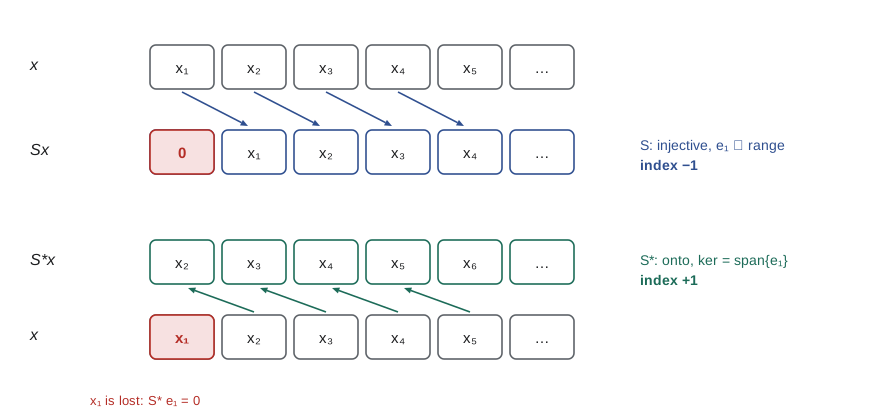
The shifts give the simplest operators with nonzero index. The right shift \(S\) on \(\ell^2\) is injective and its range, the sequences with first entry zero, has codimension \(1\): \(\operatorname{ind} S = -1\). The left shift \(S^*\) has \(\ker S^* = \operatorname{span}\{e_1\}\) and is onto: \(\operatorname{ind} S^* = 1\). Then \(S^n\) has index \(-n\), and no compact perturbation of \(S\) is invertible, since invertible operators have index \(0\). The index can only be seen in infinite dimensions: for a square matrix, rank–nullity forces index \(0\). In the 1960s Michael Atiyah and Isadore Singer showed that the index of an elliptic differential operator on a compact manifold equals a topological invariant, and their index theorem of 1963 became one of the central results of twentieth-century mathematics.
Compact operators also bear on one of the oldest open problems of operator theory, the invariant subspace problem: does every bounded operator on a separable infinite-dimensional Hilbert space have a closed invariant subspace other than \(\{0\}\) and \(H\)? Victor Lomonosov proved in 1973 that every operator commuting with a nonzero compact operator has one. On Banach spaces the answer is negative: Enflo constructed a counterexample, circulated in the mid-1970s and published in 1987, and Charles Read constructed one on \(\ell^1\) in the 1980s. For Hilbert spaces the problem is open; Enflo posted a preprint in 2023 claiming a positive solution, and its verification by the community had not been completed at last report.
Worked problem
A Fredholm integral equation with one exceptional value
Solve \(u(x) - \lambda \int_0^1 (x + y) u(y) \, dy = 1\) on \([0, 1]\), and find the values of \(\lambda\) where the alternative fails.
Show solution
- Write \(a = \int_0^1 u\) and \(b = \int_0^1 y u(y) \, dy\). The equation says \(u(x) = 1 + \lambda(a x + b)\), so \(u\) is linear.
- Integrate against \(1\) and \(x\): \(a = 1 + \lambda(\frac{a}{2} + b)\) and \(b = \frac{1}{2} + \lambda(\frac{a}{3} + \frac{b}{2})\). The determinant of this system is \(\Delta(\lambda) = (1 - \frac{\lambda}{2})^2 - \frac{\lambda^2}{3} = 1 - \lambda - \frac{\lambda^2}{12}\).
- \(\Delta(\lambda) = 0\) when \(\lambda^2 + 12\lambda - 12 = 0\), that is \(\lambda = -6 \pm 4\sqrt{3}\). For other \(\lambda\), Cramer’s rule gives \(a = \frac{1}{\Delta}\) and \(b = \frac{1/2 + \lambda/12}{\Delta}\).
Answer: For \(\lambda \ne -6 \pm 4\sqrt{3}\) the unique solution is \(u(x) = 1 + \frac{\lambda}{\Delta(\lambda)}\big(x + \frac{1}{2} + \frac{\lambda}{12}\big)\) with \(\Delta = 1 - \lambda - \frac{\lambda^2}{12}\). At the two exceptional values the homogeneous equation has a solution, and the alternative applies; the reciprocals \(\frac{1}{\lambda}\) are the nonzero eigenvalues \(\frac{1}{2} \pm \frac{1}{\sqrt{3}}\) of the rank-two kernel \(x + y\).
Common mistakes
MistakeTreating every bounded operator of norm less than one as compact.
InsteadCompactness is about the image of the unit ball being relatively compact; ½I on ℓ² has norm ½ and is not compact.
MistakeApproximating compact operators on a general Banach space by finite-rank operators.
InsteadThis works in Hilbert spaces but fails on spaces without the approximation property (Enflo, 1973).
MistakeConcluding solvability of u − Ku = f from uniqueness alone in a non-compact setting.
InsteadThe injective-implies-surjective step uses compactness; the right shift is injective and not onto.
MistakeForgetting the adjoint equation in the Fredholm alternative.
InsteadThe solvability conditions are orthogonality to the solutions of the adjoint homogeneous equation, not of the original one.
Summary and key terms
- Compact operators map bounded sets to relatively compact sets; they form a closed two-sided ideal in the bounded operators.
- On Hilbert space, compact operators are exactly the norm limits of finite-rank operators, and they turn weak convergence into norm convergence.
- Integral operators with square-integrable kernels are compact, with operator norm at most the Hilbert–Schmidt norm.
- For compact K, I − K has finite-dimensional kernel, closed range, and is injective exactly when surjective; dim ker(I − K) = dim ker(I − K*).
- Fredholm operators have finite-dimensional kernel and cokernel; the index is stable under compact perturbation, and the shift has index −1.
- Compact operator
- An operator under which the image of the unit ball has compact closure.
- Hilbert–Schmidt operator
- An integral operator with square-integrable kernel; more generally an operator with Σ‖Teₖ‖² finite.
- Fredholm alternative
- Either u − Ku = f is uniquely solvable for all f, or the homogeneous equation has solutions and f must satisfy finitely many orthogonality conditions.
- Fredholm index
- dim ker T − codim ran T for an operator with finite-dimensional kernel and cokernel.
- Approximation property
- The property that compact operators into the space are limits of finite-rank operators.
Practice problems
Work each problem on paper first, then reveal the answer to check.
Is the operator \(Tx = (x_1, \frac{x_2}{2}, \frac{x_3}{3}, \ldots)\) on \(\ell^2\) compact? Is it Hilbert–Schmidt?
Show answer
Yes: the diagonal tends to \(0\). It is Hilbert–Schmidt since \(\sum \|Te_n\|^2 = \sum \frac{1}{n^2} < \infty\).
Show that a compact operator on an infinite-dimensional space cannot be invertible.
Show answer
If \(K\) were invertible, \(I = K^{-1}K\) would be compact by the ideal property.
Compute the Hilbert–Schmidt norm of the Volterra operator on \(L^2[0, 1]\).
Show answer
\(\iint_{y < x} 1 = \frac{1}{2}\), so the norm is \(\frac{1}{\sqrt{2}}\); the operator norm is \(\frac{2}{\pi}\), which is smaller.
For \(K\) compact, why is \(\ker(I - K)^n\) finite dimensional for every \(n\)?
Show answer
\((I - K)^n = I - K_n\) with \(K_n\) compact, so part (a) applies.
What is the index of \(S^2 + K\) for compact \(K\), where \(S\) is the right shift?
Show answer
\(\operatorname{ind}(S^2) = -2\), and compact perturbations do not change the index, so the answer is \(-2\).
Lesson quiz · 5 questions
Score 60% or more to complete this lesson.
Create a free account to save your progress, take quizzes and earn a certificate.